
1. Background
Reading comprehension is a multifaceted skill deeply rooted in language (1). Accordingly, a great deal of research has focused on uncovering the metalinguistic skills predictive of children's reading comprehension abilities. One such skill is morphological awareness, which refers to the awareness and ability to manipulate the smallest meaningful units in the language (2). Substantial evidence indicates a significant relationship between morphological awareness and reading comprehension, even after accounting for factors such as phonological awareness, nonverbal skills, vocabulary, and word reading (1, 3, 4). The question arises: How does morphological awareness contribute to reading comprehension? A research process similar to previous investigations into the relationship between phonological awareness and word reading in each language needs to be conducted to answer this question, as the underlying mechanisms of this relationship remain unclear (2).
In a theoretical framework of reading comprehension, Perfetti et al. (2005) postulated that morphology plays a dual role in the text. In the first role, morphology is considered a part of the vocabulary system, indirectly influencing text comprehension by facilitating the reading of words with complex structures. To fulfill this role, individuals need morphological decoding, which involves breaking words into their constituent morphemes. This decomposition leads to accurate pronunciation and reading, especially for compound and complex words that are lengthy and low in frequency and can pose challenges for novice readers. In the second role, morphology is viewed as a component of the linguistic system that directly influences reading comprehension by affecting general and overall comprehension processes. In other words, the linguistic system impacts the extensive and shared semantic network between the spoken and written language (5, 6).
Within the linguistic system, morphology serves as a pattern and structural guide, determining how meaning is established in morphemes. The realization of this second role requires morphological analysis by the reader. Morphological analysis entails comprehending the meanings of complex and unfamiliar words by utilizing the comprehension of constituent morphemes. Morphological awareness provides individuals with two distinct abilities: (1) decomposition (identification of morphemes): Through this, an individual divides complex words into meaningful and smaller units; (2) production (morphological structure awareness): With the help of this ability, people utilize their linguistic knowledge to connect smaller units and construct new words. In short, it can be said that morphological awareness facilitates reading comprehension in two ways: (1) reading words with complex morphological structures and improving reading accuracy; (2) understanding the meaning of words with a complex morphological structure (6). For example, a differentiation of sound(s) associated with the letter combination "sh" can be found when decoding the -sh in the base words shoe and bush versus the /s/ and /h/ pronounced separately at the juncture of an affix and base word, as in the word misheard. Moreover, adding a suffix or prefix can "make a change." Thus, we can change the word fear to fearful, and adding the suffix -ful means we are "full of" the base word. We can also change the word friend to friendly, in which the suffix -ly means "like the base word," or change it to unfriendly, in which the prefix un- means "the opposite of friendly."
For students of elementary school up to the first year of high school, morphological analysis is a crucial and necessary skill for reading comprehension. This is because a significant portion of the words found in their grade-level texts are unfamiliar and unusual, and understanding their meaning becomes possible through comprehending the meanings of smaller units and their constituent parts. Morphological awareness constitutes a significant part of the information processing from higher to lower levels and is beneficial for readers as they are already aware of the pronunciation, spelling, meaning, and usage of word roots (7). Morphological awareness, especially in elementary education, indirectly impacts reading comprehension through vocabulary knowledge (7). Understanding morphological relationships among words facilitates the organization of information within the mental lexicon, aiding in vocabulary learning. Given that understanding the meanings of individual words is a key component of text comprehension, vocabulary knowledge is inherently linked to reading comprehension. In other words, the greater the children's morphological awareness, the more extensive their vocabulary knowledge becomes, leading to stronger reading comprehension (6, 8). The relationship between vocabulary knowledge and reading comprehension varies across stages (9). In the fourth grade, morphological awareness acts as the only mediating factor in the reading comprehension process due to its influence on vocabulary knowledge and word identification skills. However, in the fifth grade, it assumes this mediating role solely through vocabulary knowledge (not word identification) (10). According to Goodwin and Ahn, English-speaking third-grade students demonstrated that morphological awareness indirectly influences reading comprehension through its impact on vocabulary reading ability. In other words, in this age group, morphological awareness leads to fluent and accurate word reading, which in turn affects reading comprehension. In a longitudinal study of 2143 Dutch students from first to sixth grades, Verhoeven and VanLeewe (2008) cited in Goodwin and Ahn showed that the level of vocabulary knowledge of this group was a predictor of their reading comprehension ability in the following years (10). In 2008, Kiefer investigated the relationship between the extent of vocabulary knowledge and morphological awareness using the production subtest (morphological awareness subtest) in 87 Spanish-speaking fourth and fifth-grade students. The relationship between the two variables in the first group (fourth grade) was r = 0.53, and in the second group (fifth grade), r = 0.46 (7). The level of morphological awareness skills in elementary school children is a suitable predictor for vocabulary skills, nonword reading, reading speed, and reading comprehension in this group of children (7). Morphological awareness grows over time, beginning in early childhood and continuing until the end of elementary school (11, 12). Levesque et al. evaluated the performance of 90 Spanish students longitudinally from the fourth grade of elementary school to the seventh grade of secondary school. In this research, both standard tests and researcher-made tests were used to measure the level of vocabulary knowledge and morphological awareness. The data analysis showed the relationship between the growth of vocabulary knowledge and the growth of morphological awareness (13). Guimaraes (2014) as cited in James et al. evaluated the performance of 72 Portuguese-speaking students in the third, fourth, and fifth grades and concluded that morphological awareness affects the ability to read and spell. In all three levels of education, students who obtained a higher score on the morphological awareness test performed better. They showed themselves in reading and writing assignments (14). Jing Shou as cited in Zhang et al. (2021) investigated the role of morphological awareness and vocabulary knowledge in the reading comprehension of elementary school students who were learning Chinese as a second language. The results indicated that morphological awareness affects the improvement of vocabulary knowledge, and vocabulary knowledge affects reading comprehension. In other words, physical awareness affects reading comprehension indirectly through vocabulary knowledge (15).
Considering the roles that each of these language components and subcomponents, particularly vocabulary knowledge and morphological awareness, play in students' academic success, it is essential to evaluate the interaction of these variables in different age groups of Persian-speaking individuals. Additionally, given the numerous studies conducted on the relationship between vocabulary knowledge, morphological awareness, and reading comprehension in foreign languages, it is necessary to investigate the possibility of the existence of this relationship in Persian as well. Therefore, this study sought to address these questions:
(1) Is there a positive relationship between vocabulary knowledge and morphological awareness of Persian-speaking students in the third, fourth, and fifth grades?
(2) Is there a positive relationship between vocabulary knowledge and reading comprehension of Persian students in the third, fourth, and fifth grades?
(3) Is there a positive relationship between morphological awareness and reading comprehension of Persian-speaking students in the third, fourth, and fifth grades?
(4) Is there a significant difference in the relationship between vocabulary knowledge and morphological awareness and the reading comprehension of Persian-speaking students in the third, fourth, and fifth grades?
2. Objectives
Our goal was to examine the role of vocabulary knowledge and evaluate 2 potential pathways through which morphological awareness affected reading comprehension using the theoretical foundations mentioned earlier. These 2 pathways included reading morphologically complex words (morphological decoding) and understanding the meanings of morphologically complex words (morphological analysis). The research questions focused on the contribution of these two pathways to reading comprehension in Persian-speaking students and compared it with the situation in other languages. As far as the writer's search indicated, there was no comprehensive research in Iran that investigated the relationship between vocabulary knowledge, morphological awareness, and reading comprehension in Persian speakers. Limited studies have been conducted on the relationship between morphological awareness and reading, as well as the relationship between vocabulary knowledge and reading comprehension, using researcher-designed tasks. Therefore, any scientific endeavor in this direction can potentially yield fruitful results toward achieving educational and learning goals. Like many languages, if the relationship between vocabulary knowledge, morphological awareness, and reading comprehension in Persian is confirmed, the results of this study could be used to develop and adjust the content of Persian language teaching resources, oral examinations, and speech and language therapy packages. For this purpose, the current study evaluated 3 variables and the relationships between them through researcher-made tests.
3. Methods
3.1. Study Design
The current study was of a quantitative nature and conducted through a cross-sectional approach. The independent variables were the grade levels. The dependent variables were the students' scores on 3 tests: vocabulary knowledge, morphological awareness, and reading comprehension. The moderator variables were being monolingual (Persian-speaking), academic performance status, and the physical and mental well-being of the participants. The participants included 180 Persian-speaking students from the third, fourth, and fifth grades of elementary school. They were selected equally among boys and girls from schools in District 3 of the Tehran Municipality using purposive sampling. In total, the research assessments were conducted in 8 public and private schools located in District 3 of the Tehran Municipality. The participants were in the final 3 months of the academic year 2021 - 2022 during the administration of the tests.
The data were collected through a questionnaire that included personal information about the students (age, grade level, physical and mental condition, academic performance status in the first term of the academic year 2021 - 2022, and school name), as well as scores obtained from the administration of vocabulary knowledge, morphological awareness (subtests of decomposition and generation), and reading comprehension tests (8, 16, 17).
With the decomposition subtest, participants' morphological decoding ability was assessed, and with the generation subtest, their morphological analysis ability was examined (13).
3.2. Inclusion Criteria
According to similar studies and factors affecting reading comprehension (positive and negative), the following inclusion criteria were determined:
- Chronological age of the students: The participants were between 9 and 11 years old.
- Being monolingual (Persian language): All the participants were Persian-speaking based on the information recorded in their files.
- Above-average academic status: The participants were selected from students whose academic status was categorized as "good" in the first term of the academic year 2021-2022, according to descriptive indicators on their report cards. The "good" rank indicates that the student has achieved 70% of the goals and expectations of the relevant grade-level courses. Quantitatively, this indicator is equivalent to a grade of 15 to 17 (Supreme Council of Education, 2005).
- Physical and mental well-being: Participants whose physical and mental condition was normal (based on student health files) were selected.
3.3. Procedures
After the approval of the proposal at the Department of Linguistics and Postgraduate Education of the Allameh Tabatabaei University and the approval of the Ethics Committee, the necessary permits to conduct the study were obtained. Before administering the tests, the purpose of the research and the types of tests used were explained to the school principal and the students. The participants were assured that their participation in this study was voluntary and that they could withdraw at any time if they wished. Written informed consent was obtained from the school principals who were interested in having their students participate in the research. They were informed that during the administration of the reading comprehension test, the participants' voices would be recorded (to accurately measure reading speed and the number of reading errors), and after the data were recorded, the audio files would be deleted. The researcher assured both the school principal and the participants that the test results and the students' identities would remain confidential (Each student was assigned a unique code to ensure anonymity). The participants were also assured that the test results would be published accurately, comprehensively, and honestly and that the results would not affect their academic matters or the quality/quantity of educational resources provided by the school. During the implementation phase, the researcher played the role of the test administrator. The administration of each test took 15 to 20 minutes. The tests were then administered to each participant in a fixed order (1- vocabulary, 2- morphological awareness, and 3- reading comprehension).
3.4. Research Tools
Three tests of vocabulary, morphological awareness, and reading comprehension were developed and administered. All 3 tests were adapted from foreign sources and designed to suit the nature of the Persian language. Since these tests were researcher-created, the contents of each test were reviewed by 3 experts with PhDs in linguistics to establish content validity. Necessary revisions were made based on their feedback and the result of piloting all 3 tests on 5 female and 5 male students from each grade (These individuals were different from the main participants).
For reliability assessment, the tests were administered to a separate group of participants at a 15-day interval (These individuals were different from the main study participants), and the Cronbach's alpha coefficients were calculated for each test and subtest (the vocabulary test, 0.87; the production subtest, 0.83; the decomposition subtest, 0.8; the reading comprehension test, 0.81).
Before starting each test, the examiner provided 1 to 3 examples of the subject. Fifteen to 20 minutes was needed for all the tests.
3.4.1. The Vocabulary Test
The vocabulary test was designed based on the Vocabulary Levels Test (VLT) in English by Webb, Sasao, and Ballance (2017), adapted to Persian by the researcher (8). The vocabulary selection criteria were based on word frequency. Accordingly, the vocabulary test used in this research consisted of 4 levels: the simplest level (1000-word level) comprising the first 1000 most frequent words, the second level (2000-word level) comprising words 1001 to 2000, the third level (3000-word level) comprising words 2001 to 3000, and the most complex level (4000-word level) consisting of words 3001 to 4000 in Persian language. For the selection of test materials, the priority was to translate the words in the main test (Webb et al.'s test) directly into Persian. If the word was equivalent in terms of frequency index to the level of the Persian researcher-made test, it would be used in the test; otherwise, the closest word to the main test word would be replaced.
The Frequency Dictionary of Persian by Bijan Khan and Mohseni (2011) (18) and Miller and Aghajanian-Stewart (2018) (19) was used to develop the test in the Persian language. The examiner asked the subject to choose the appropriate word with the same meaning as the word or phrase in question. The criterion for stopping the evaluation at each level of 1000, 2000, and 3000 words is to provide more than 2 incorrect answers by the subject and, at the level of 4000 words, to provide more than 6 incorrect answers. Each level has 10 questions, and each question has 3 marks. The acceptable score at the level of 1000, 2000, and 3000 words is a minimum of 28 and a maximum of 30, and at the level of 3000 to 4000 words, a minimum of 24 and a maximum of 30.
3.4.2. The Morphological Awareness Test
The morphological awareness test comprised 2 subtests: Production and decomposition. The production subtest was designed based on the Appel and Lawrence (2011) test, and the decomposition subtest was designed using the Castles (2004) and Lester (2002) tests as cited in Apel, adapted to Persian (16). The words used were chosen according to the materials of the main tests (inflectional or derivational morphemes) from the textbooks of each grade. For the production subtest, the most common method is to fill in the blanks in the sentence. In this subtest, the basic morpheme is presented to the individual, and he/she must make the correct word by adding the appropriate verb and then complete the sentence. This subtest is administered in written form.
In the segmentation subtest, the subject is asked orally to segment 2-syllable or more than 2-syllable words that have prefixes or suffixes (inflectional and derivational) into their components (minimum 2 and maximum 3 parts), and he/she must also verbally answer. In these subtests, there is no stop criterion, and all the questions are asked. Each subtest has 10 questions. In the production subtest, each question has 1 mark, but in the segmentation subtest, some questions (2 questions in the third grade, 3 questions in the fourth grade, and 4 questions in the fifth grade) contain words that can be divided into 3 parts. If the subject divides the word into 2 parts, he/she will get 1 mark, and if the subject divides it into 3 parts, he/she will receive 2 marks for those questions. In other words, the maximum total score of the morphological awareness test is 22 in the third grade, 23 in the fourth grade, and 24 in the fifth grade.
3.4.3. The Reading Comprehension Test
The final test (reading comprehension) evaluated the participants' reading speed and accuracy and their ability to extract explicit information, make inferences, and integrate and interpret text information. It was constructed using the Oral Reading Fluency test by Bryant and Wiederholt (2012) as cited in Crosson et al. (7). For each grade, 4 texts were designed, ranging from simple to complex. Initial text drafts were taken from comprehension books (published by Kheli Sabz) for grades 3, 4, and 5 and were adapted based on the Pirls test. However, certain words within each story were changed and selected according to frequency criteria, using the Persian Core Vocabulary based on Iranian Children by Nematzadeh et al. (20) for selecting high-frequency words and the Frequency Dictionary of Persian by Bijan Khan and Mohseni (2011) (18) and Miller and Aghajanian-Stewart (2018) (19) for both high- and low-frequency words to ensure the readability of the texts. Considering the nature of the foreign tests used as models for the reading comprehension test, the first text (the simplest one) contained 80 words, with 70% of its words being high-frequency words. The second text consisted of 100 words, with 70% being high-frequency words. The third text contained 120 words, 60% of which were high-frequency words. The fourth text, the most complex one, comprised 150 words, 60% of which were high-frequency words. Each text was followed by 5 comprehension questions assessing explicit information retrieval, inference-making, information integration, and text interpretation. As mentioned, Pirl's test books in the Persian language were used in the construction of the reading comprehension test (text and questions). In the reading comprehension test, 1 point is given to the subject for each correct answer to the comprehension questions. This score is added to the score obtained from reading speed and reading accuracy, which is the result of the fraction below:
3.5. Data Analysis
During the data collection process, the scores of each participant's tests were calculated and entered into Microsoft Excel and SPSS v. 26 (IBM Corp., Armonk, NY, USA). A zero-order correlation matrix, which is based on the relationship between the variables, was calculated to verify the study questions.
Additionally, the variance–covariance matrix and the Shapiro-Wilk test were used to assess the normality of the data. In checking the normality of the data, the null hypothesis is that the distribution of the data is normal. If the test statistic is greater than or equal to 0.05, then the null hypothesis is rejected.
We used the chi-square test of model fit, the comparative fit index (CFI), the Tucker-Lewis index (TLI), the root mean square error of approximation (RMSEA), and the standardized root mean square residual (SRMR) to evaluate the model fit. We used percentile bootstrap 95% confidence intervals (CIs) to test the significance of direct and indirect effects and to examine the significance of group differences in these effects. This approach is suitable for the current study because it does not require the data to follow a normal distribution.
4. Results
The statistical method employed in this study was correlation matrix analysis, which is used to simultaneously represent the relationship between pairs of variables. The inferential analysis findings for the data from the 3 tests of vocabulary, morphological awareness, and reading comprehension are presented in Tables 1-3.
Table 1.
Correlation Matrix Between Vocabulary Knowledge and Morphological Awareness by Grade a
| Variables | Vocabulary Knowledge | Production | Decomposition |
|---|---|---|---|
| Third grade | |||
| Vocabulary knowledge | |||
| Production | 0.497** | ||
| Decomposition | 0.471** | 0.454** | |
| Morphological awareness | 0.589** | 0.759** | 0.830** |
| Fourth grade | |||
| Vocabulary knowledge | |||
| Production | 0.679** | ||
| Decomposition | 0.775** | 0.589** | |
| Morphological awareness | 0.809** | 0.896** | 0.838** |
| Fifth grade | |||
| Vocabulary knowledge | |||
| Production | 0.573** | ||
| Decomposition | 0.809** | 0.448** | |
| Morphological awareness | 0.813** | 0.764** | 0.877** |
a **P < 0.01 *P < 0.05
Table 2.
Correlation Matrix Between Vocabulary Knowledge and Reading Comprehension, Separated by Grade a
| Variables | Vocabulary Knowledge | Comprehension | Speed and Accuracy |
|---|---|---|---|
| Third grade | |||
| Vocabulary knowledge | |||
| Comprehension | 0.735** | ||
| Speed and accuracy | 0.718** | 0.880** | |
| Reading comprehension | 0.751** | 0.992** | 0.933** |
| Fourth grade | |||
| Vocabulary knowledge | |||
| Comprehension | 0.776** | ||
| Speed and accuracy | 0.769** | 0.806** | |
| Reading comprehension | 0.801** | 0.992** | 0.876** |
| Fifth grade | |||
| Vocabulary knowledge | |||
| Comprehension | 0.837** | ||
| Speed and accuracy | 0.785** | 0.858** | |
| Reading comprehension | 0.847** | 0.988** | 0.927** |
a **P < 0.01 *P < 0.05
Table 3.
Correlation Matrix Between Morphological Awareness and Reading Comprehension by Grade a
| Variables | Production | Decomposition | Morphological Awareness | Comprehension | Speed and Accuracy |
|---|---|---|---|---|---|
| Third grade | |||||
| Production | |||||
| Decomposition | 0.454** | ||||
| Morphological awareness | 0.759** | 0.830** | |||
| Comprehension | 0.600** | 0.473** | 0.575** | ||
| Speed and accuracy | 0.703** | 0.553** | 0.691** | 0.880** | |
| Reading comprehension | 0.641** | 0.502** | 0.619** | 0.992** | 0.933** |
| Fourth grade | |||||
| Production | |||||
| Decomposition | 0.589** | ||||
| Morphological awareness | 0.896** | 0.838** | |||
| Comprehension | 0.749** | 0.688** | 0.812** | ||
| Speed and accuracy | 0.627** | 0.650** | 0.732** | 0.806** | |
| Reading comprehension | 0.748** | 0.680** | 0.822** | 0.992** | 0.876** |
| Fifth grade | |||||
| Production | |||||
| Decomposition | 0.448** | ||||
| Morphological awareness | 0.764** | 0.877** | |||
| Comprehension | 0.573** | 0.780** | 0.783** | ||
| Speed and accuracy | 0.444** | 0.770** | 0.692** | 0.858** | |
| Reading comprehension | 0.552** | 0.800** | 0.780** | 0.988** | 0.927** |
a **P < 0.01 *P < 0.05
4.1. The Relationship Between Vocabulary Knowledge and Morphological Awareness
The data in Table 1 reveal that in third grade, the strongest relationship existed between vocabulary knowledge and production (0.497). However, in the fourth and fifth grades, the strongest relationship existed between vocabulary knowledge and decomposition (0.775 and 0.809, respectively).
4.2. The Relationship Between Vocabulary Knowledge and Reading Comprehension
The findings (Table 2) indicate that in the third, fourth, and fifth grades, the relationship between vocabulary knowledge and comprehension was stronger than the relationship between vocabulary knowledge, reading speed, and accuracy (in third grade, 0.735; in fourth grade, 0.776; and in fifth grade, 0.837).
4.3. The Relation between Morphological and Reading Comprehension
Based on the correlation matrix calculations between variables (Table 3), in the third grade, the relationship of reading speed and accuracy with morphological awareness, decomposition, and production (0.691, 0.703. 0.553) was stronger than the relationship with comprehension and morphological awareness, decomposition, and production (0.575, 0.473, 0.600, respectively). Unlike the third-grade students, in the fourth and fifth grades, the relationship of morphological awareness, decomposition, and production with comprehension was stronger compared to their relationship with reading speed and accuracy.
4.4. Modeling the Results
The structural equation modeling of Levesque et al. (13) based on the Perfetti and Landi framework was utilized to illustrate the relationship between morphological awareness and reading comprehension in all three grades.
4.4.1. Third-grade
The presentation of data related to calculating the correlation of vocabulary knowledge and morphological awareness with reading comprehension, based on the assumed premise of Levesque et al. (13) (Figure 1), indicates that the direct relationship between morphological awareness and word reading (r = 0.69) was stronger than the indirect relationship between these two variables through morphological decoding (r = 0.45 × 0.55 × 0.83). Moreover, the direct relationship between morphological awareness and vocabulary knowledge (r = 0.58) was stronger than their indirect relationship through morphological analysis (r = 0.36 × 0.49 × 0.75). Consequently, the indirect relationships between morphological awareness and vocabulary knowledge and the indirect relationships between morphological awareness and word reading were weaker compared to the direct relationships.
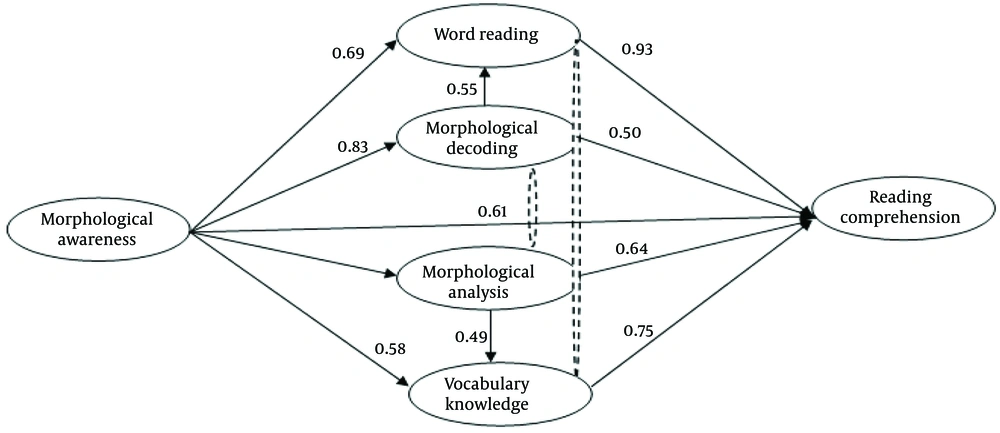
Figure 1.
Representation of the correlation matrix of the research variables for third-grade students under the assumed premise of Levesque et al. (2017)(13).
On the other hand, the indirect relationship between morphological decoding and reading comprehension through word reading (r = 0.51 × 0.93 × 0.55) was stronger than the direct relationship between these two variables (r = 0.50). In contrast, the direct relationship between morphological analysis and reading comprehension (r = 0.64) was stronger than their indirect relationship through vocabulary knowledge (r = 0.36 × 0.75 × 0.49). Additionally, comparing the direct relationship between morphological awareness and reading comprehension (r = 0.61) with the 2 indirect relationships through morphological decoding (r = 0.41 × 0.50 × 0.83) and morphological analysis (r = 0.48 × 0.64 × 0.75) supports the notion that the direct relationship between morphological awareness and reading comprehension was stronger than the 2 indirect relationships.
4.4.2. Fourth-grade
The presentation of the data concerning the calculation of the correlation of vocabulary knowledge and morphological awareness with reading comprehension, based on the assumed premise of Levesque et al. (2017) (Figure 2), indicates that the direct relationship between morphological awareness and word reading (r = 0.73) was stronger than the indirect relationship between these variables through morphological decoding (r = 0.53 = 0.65 × 0.83). Furthermore, the direct relationship between morphological awareness and vocabulary knowledge (r = 0.80) was stronger than the indirect relationship between morphological awareness and vocabulary knowledge (r = 0.59 = 0.67 × 0.89). On the other hand, the direct relationship between morphological decoding and reading comprehension (r = 0.68) was stronger than the indirect relationship between these variables through word reading (r = 0.56 = 0.87 × 0.65). Additionally, the direct relationship between morphological analysis and reading comprehension (r = 0.74) was stronger than their indirect relationship (r = 0.53 = 0.80 × 0.67). The comparison of the direct relationship of morphological awareness and reading comprehension (r= 0.82) and its 2 indirect relationships through morphological decoding (r = 0.56 = 0.68 × 0.83) and morphological analysis (r = 0.65 = 0.74 × 0.89) with reading comprehension also indicated that the direct relationship was stronger in fourth-grade students than the 2 indirect paths.
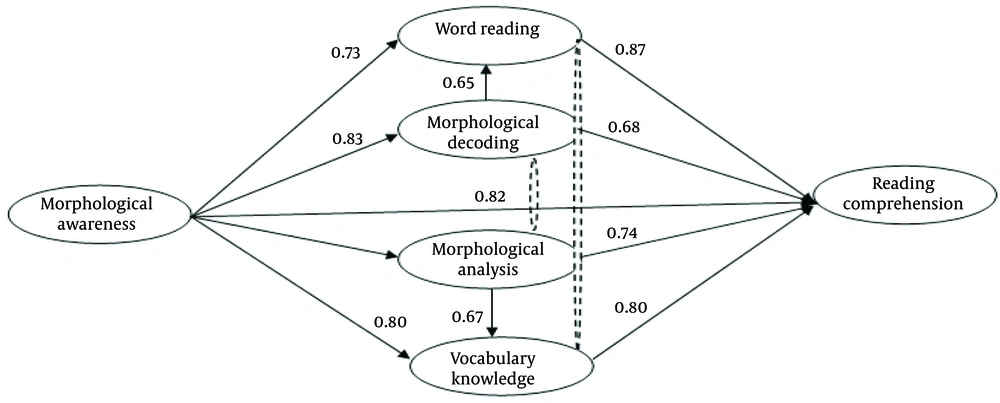
Figure 2.
Representation of the correlation matrix of research variables for fourth-grade students based on the assumed premise of Levesque et al. (2017) (13).
4.4.3. Fifth-grade
The presentation of the data related to calculating the correlation of vocabulary knowledge and morphological awareness with reading comprehension, based on the assumed premise of Levesque et al. (Figure 3), shows that the direct relationship between morphological awareness and word reading (r = 0.69) was stronger than the indirect relationship between these variables through morphological decoding (r = 0.66, path coefficient = 0.77 × 0.87). Furthermore, the direct relationship between morphological awareness and vocabulary knowledge (r = 0.81) was stronger than the indirect relationship between morphological awareness and vocabulary knowledge through morphological decoding (r = 0.43, path coefficient = 0.57 × 0.76). On the other hand, the direct relationship between morphological decoding and word reading (r = 0.80) was stronger than the indirect relationship between these two variables through word reading (r = 0.70, path coefficient = 0.92 × 0.77). Similarly, the direct relationship between morphological analysis and word reading (r = 0.55) was stronger than the indirect relationship between them (r = 0.47, path coefficient = 0.84 × 0.57). Therefore, in fifth grade, the indirect relationships of morphological analysis and morphological decoding with reading comprehension were weaker. Comparing the direct relationship of morphological awareness and word reading (r = 0.78) with the 2 indirect relationships between morphological awareness and word reading through morphological decoding (r = 0.69, path coefficient = 0.80 × 0.87) and morphological analysis (r = 0.41, path coefficient = 0.55 × 0.76) also confirmed that in fifth grade, the direct relationship between morphological awareness and word reading was stronger than the 2 indirect paths between these variables.
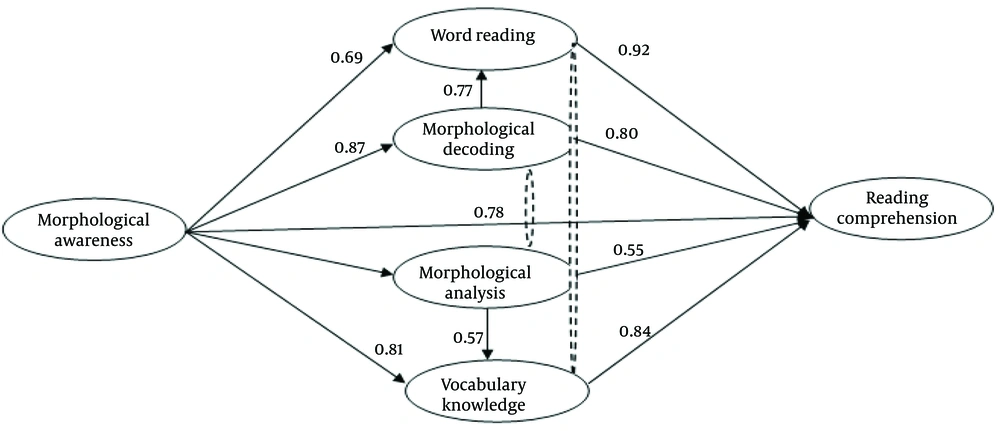
Figure 3.
The representation of the correlation matrix of research variables for fifth grade in the assumed framework of Levesque et al. (2017) (13).
5. Discussion
According to what has been said so far, the research question about the relationships between morphological awareness, vocabulary knowledge, and reading comprehension among elementary students can be answered.
Question 1: Is there a positive relationship between vocabulary knowledge and morphological awareness of Persian-speaking students in the third, fourth, and fifth grades?
Examining the performance of students in all three grades indicates that in third-grade students, there is a positive and significant relationship between vocabulary test scores and morphological awareness subtests (production and decomposition). The data in Table 1 also reveal a positive and significant relationship between vocabulary test scores and morphological awareness subtests (production and decomposition) in fourth- and fifth-grade students. Furthermore, there is a positive and significant relationship between vocabulary test scores and overall morphological awareness scores in third-, fourth-, and fifth-grade students. Since the strongest morphological awareness skill in the third grade is the production skill and, in the fourth and fifth grades, is decomposition, the vocabulary knowledge in each grade has the strongest relationship with the most dominant skill.
This suggests that higher vocabulary test scores are associated with higher levels of morphological awareness in the participants and vice versa. Therefore, it can be claimed that a positive and bilateral relationship exists between vocabulary knowledge and morphological awareness among Persian-speaking students in all three grades. This implies that children's knowledge of morphemes contributes to vocabulary growth, and having a rich vocabulary also leads to the development of morphological awareness skills.
This result is consistent with the findings of Kieffer et al., Vartharaju (2015), and Al-Saeedi (2017) as cited in Kazazoğlu (11, 21). Moreover, the studies by Kieffer et al., Eri (2000), Kieffer and Lesaux (2012) as cited in kieffer et al. were conducted in similar age groups (11). McBride–Chang et al. (22) and Wagner, Muse, Chow, & Shu (2008) as cited in McBride–Chang et al. also obtained similar results in first- and second-grade students. Kieffer (2008 and 2012), Harraqi (2017), and Rabadi (2019) as cited in Kazazoğlualso reached similar conclusions using tests similar to the ones used in this research, confirming the relationship between vocabulary growth and morphological awareness development (21).
However, the results of the study by Al-Farsi (2008) contradict the findings of this research, indicating that there is no relationship between vocabulary knowledge and morphological awareness among high school students. The reason for this inconsistency could be attributed to the grades and the proficiency level of the participants. As Al-Farsi mentioned, the proficiency of their participants was weak in both vocabulary knowledge and morphological awareness (23).
Question 2: Is there a positive relationship between vocabulary knowledge and reading comprehension of Persian students in the third, fourth, and fifth grades?
The analysis of the data revealed a positive and significant relationship between vocabulary knowledge and reading comprehension components (comprehension, speed, and accuracy) in the third, fourth, and fifth grades. This suggests that as the level of vocabulary knowledge increases, so does the level of reading comprehension, and vice versa. This finding is consistent with the results of Kieffer et al. and Martin-Chang and Gould (2008), Storch and Whitehurst (2002) as cited in kieffer et al. (11), Garcia and Cain (2014), and Torppa (2016) as cited in Moody et al., all of which highlight the role of vocabulary knowledge in the decoding and language comprehension process (24). The reason for the strong relationship between vocabulary knowledge and reading speed and accuracy is that vocabulary knowledge is inherently linked to reading comprehension. This finding aligns with the results of Milton's (2009) study, which examined the effect of word frequency on reading methods (25).
It can be concluded that the relationship between vocabulary test scores and total reading comprehension test scores in all three grades is statistically significant. This conclusion is in line with the results of studies by Garcia (1991), Laufer (1996), Schan (2008), Kieffer (2013) as cited in Deacon et al. (26), Garcia and Cain (2014), Jiang (2008), and Yin (2020) as cited in Webb (8). These researchers conducted studies on students in similar age groups and, using similar tests, confirmed the positive and bilateral relationship between reading comprehension and vocabulary knowledge. This means that by increasing vocabulary, reading comprehension improves, and more reading experience leads to learning new words.
Question 3: Is there a positive relationship between morphological awareness and reading comprehension of Persian-speaking students in third, fourth, and fifth grades?
The results of this study confirmed the positive and bilateral relationship between morphological awareness and reading components (comprehension, speed, and accuracy) in all three educational levels. This suggests that a higher score in morphological awareness is associated with a higher level of reading comprehension and vice versa. According to the theoretical framework of Perfetti and Landi, the reason for this relationship is that morphological decoding ability influences reading speed and accuracy, while morphological analysis skill affects word meaning comprehension. In other words, morphological awareness exercises can be used both to increase the speed and accuracy of reading and to increase the understanding of the reading material. This unique role of morphological awareness in reading comprehension is also supported by Bauman (2003), Jarmulowicz (2008), Carlisle and Bowers (2010), Pearson and Hibbert (2012), Kieffer and Box (2013), Dickinson, Kieffer, and Laroche (2014), Deacon, Tang, and Francis (2015), and Carlisle and Kieffer (2017) as cited in Levesque et al. (13). Consistent with the research results and based on the correlation matrix calculations between variables, in the third grade, the relationship between reading speed, accuracy, and morphological awareness, decomposition, and production was stronger than the relationship between comprehension and morphological awareness, decomposition, and production. Unlike the third-grade students, in the fourth and fifth grades, the relationship between morphological awareness, decomposition, and production is stronger with comprehension compared to their relationship with reading speed and accuracy because the process of reading up to the third grade is in the stage of learning to read and use the bottom-up path, that is, it is done more to decode than to understand. However, after the third grade, because the student has mastered decoding, she/he enters the stage of reading to learn, the purpose of which is to understand the content and learn new material. Therefore, morphological awareness is coordinated with the development stages of reading at every educational level and affects it. Jarmulowicz (2008) and Goodwin (2003) also arrived at this conclusion in their studies, explaining that morphological awareness boosts reading speed and accuracy through word identification until the fourth grade and from the fourth grade onwards, especially in the fifth grade and beyond, it plays a role solely in reading comprehension (10). Similar findings were reported by Carlisle (2), Dickinson and Kirby (2004) as cited in Nagy et al. (4), Goodwin and Ahn (10), Kieffer and Lesaux (2012) as cited in Kieffer et al. (11), Kirby et al. (3), Perfetti and Stafura (2012) (6), Bishop, Petscher, and Foreman (2012), Tang (2015), Jiang (2016) as cited in Levesque et al. (13), Memiş (2019) as cited in James et al. (14), and Bishara (27), indicating that morphological awareness influences both decoding and analyzing skills, making it a primary factor in the comprehension process (2-4, 6, 14, 27). While the relationship between morphological awareness and reading comprehension has been confirmed in most languages, either directly or indirectly (via vocabulary knowledge), the study by Coronel et al. (2019) as cited in Zhang et al. in Spanish did not confirm this finding. Jing Shuo (2021) as cited in Zhang et al. also demonstrated that in Chinese, morphological awareness only affects reading comprehension indirectly through vocabulary knowledge (15). It seems that the reason for this violation is the nature of Chinese (a monomorphic and prosodic language) and Spanish (a synthetic language).
Question 4: Is there a significant difference between the relationship between vocabulary knowledge and morphological awareness and the reading comprehension of Persian-speaking students in the third, fourth, and fifth grades?
For representing the relationship between the variables of the current research (vocabulary knowledge, morphological awareness, and reading comprehension) based on the results of calculating the correlation matrix (referred to in the findings section) and using the model by Levesque et al. (13), which is designed based on the Perfetti framework, it is possible to create Figure 4 by omitting the weaker relationships to illustrate the relationship between morphological awareness, vocabulary knowledge, and reading comprehension in Persian-speaking third-grade students. Similarly, Figure 5 can be constructed to depict the mentioned relationships for fourth- and fifth-grade students.
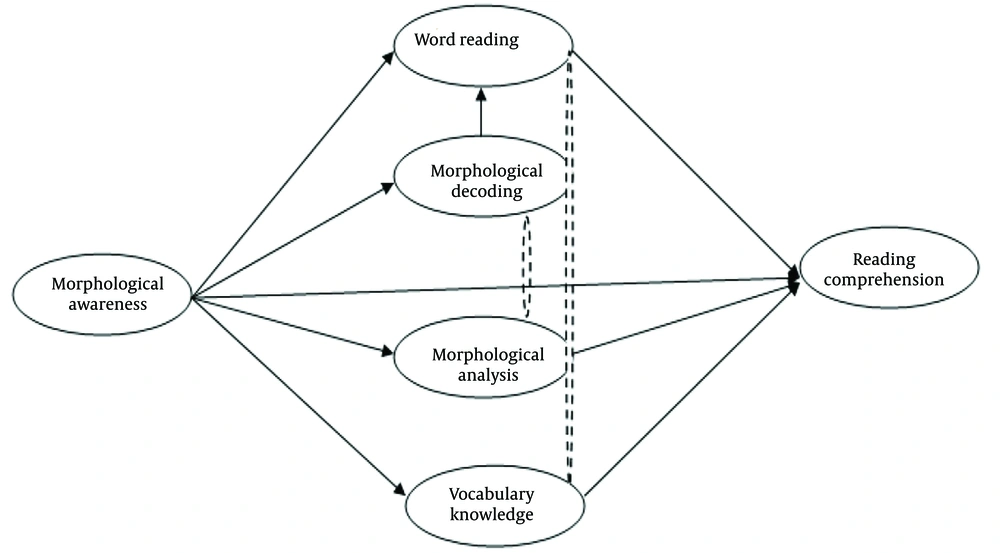
Figure 4.
The relationship between vocabulary knowledge, morphological awareness and reading comprehension of third grade Persian students
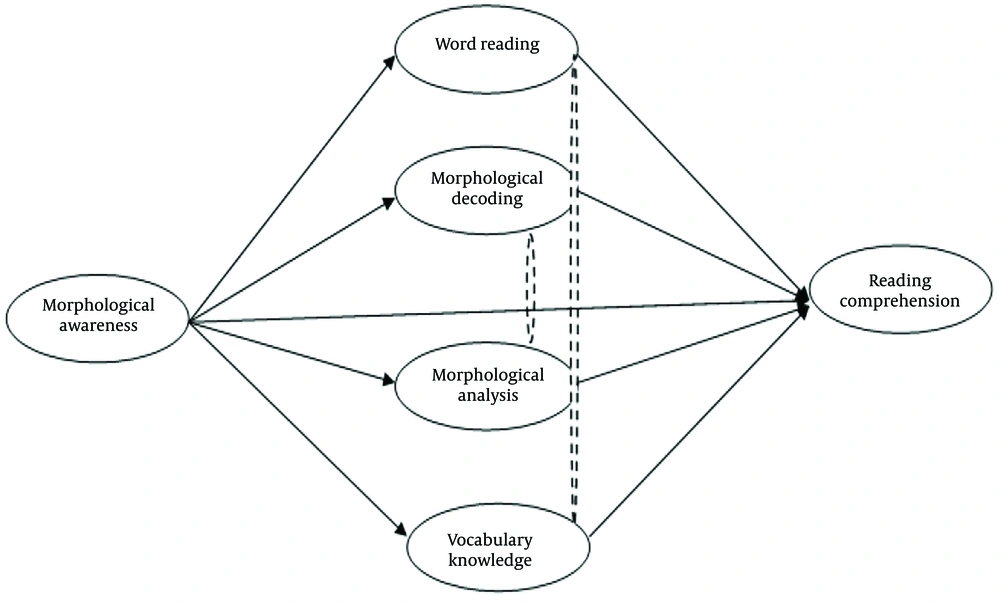
Figure 5.
The relationship between lexical knowledge, morphological awareness and reading comprehension of fourth and fifth grade Persian students
In the third grade, the direct impact of morphological awareness on reading speed, accuracy, and comprehension is stronger than the indirect pathway. Additionally, the role of morphological analysis concerning vocabulary knowledge is more noticeable in reading comprehension. Meanwhile, the effect of morphological decoding at this stage is weaker on reading proficiency.
In the fourth grade, the direct impact of morphological awareness on reading speed, accuracy, and comprehension is stronger than the indirect pathway. In this age group, morphological decoding has a greater impact on reading compared to word identification in comparison to the third grade.
In the fifth grade (similar to the fourth grade and unlike the third grade), morphological decoding also has a greater impact on reading compared to word identification. In this age group, morphological awareness skills directly influence reading comprehension, and the role of mediators (word identification and vocabulary knowledge) diminishes.
5.1. Conclusions
According to the results and based on the calculation of the correlation matrix between variables, in the third grade, the relationship between reading speed and accuracy with morphological awareness and its subcomponents (production and decomposition) was stronger than the relationship between reading comprehension and morphological awareness and its subcomponents. However, in the fourth and fifth grades, the relationship between morphological awareness and its subcomponents (production and decomposition) was stronger with reading comprehension. In other words, in the third grade, morphological awareness influences fluent reading, while in the fourth and fifth grades, it impacts the ability to comprehend the read text. It is essential to integrate morphological awareness instruction, including decomposition and production, into Persian language textbooks, particularly from the third to sixth grades, to enhance reading speed, accuracy, and comprehension. It is necessary that in the third grade, reading exercises include phoneme-grapheme matching, increase the vocabulary, and teach the meaning of Persian derivational affixes. However, in the fourth and fifth grades, phoneme-grapheme exercises are removed, and instead, the teaching of all kinds of Persian affixes, especially dependent affixes, is included. Similar to the third grade, it is very effective to increase the vocabulary.
5.2. Limitations
Since the subjects were Persian-speaking third to fifth-graders, the results cannot be generalized to all levels of education. Besides, the selection of subjects from a specific area (District 3) of Tehran should cause caution in the generalization of the research results.
In this research, three tests were used to collect data. Due to the nature of vocabulary knowledge test stimuli and choosing an available option as the correct answer, some of the subjects' answers may have been guessed and do not reflect the person's real knowledge.
5.3. Suggestions for Future Studies
- Since most of the internal studies have investigated the extent of vocabulary knowledge and morphological awareness and their effect on reading comprehension in second language learning, it is suggested that studies evaluate vocabulary knowledge, morphological awareness, and how these factors influence each other. The ability of children and adults to read in their first language should be studied in a larger sample size and diverse economic and cultural conditions.
- Examining the relationship between morphological awareness, lexical knowledge, and reading comprehension in Persian-language dyslexic students to compare the relationship between these three variables in normal and dyslexic students will undoubtedly bring new findings.
- Conducting similar research on groups of bilingual/multilingual students to investigate the effect of bilingualism on the relationship of vocabulary knowledge and morphological awareness with reading comprehension can lead to significant and important results.