
1. Background
Specific Learning Disorder (SLD) presents a significant global challenge. It is characterized by persistent difficulties in reading, writing, or mathematics skills, with onset during the school-age years (1, 2). The SLD affects 5 - 15% of school-aged children and manifests as a profound impediment to their academic, social, and emotional development (2). The neurological differences associated with SLD hinder the ability to process, retain, and communicate information, leading to enduring developmental obstacles throughout childhood and adolescence (3). In Iran, the prevalence of SLD is estimated to be between 4.58% and 7%, highlighting the importance of addressing its wide-ranging impacts (4).
One critical domain often impaired in individuals with SLD is executive function (EF) (3), which refers to higher-order cognitive processes enabling goal-directed behavior — including working memory, cognitive flexibility, inhibitory control, managing daily tasks, problem-solving, and social interactions (5-7). These processes help adolescents regulate emotions, inhibit impulsive reactions, and shift strategies during social play (8, 9). These challenges include difficulties in decoding words, organizing written tasks, and regulating attention (3, 10). Among these EF sub-components, working memory and inhibitory control have been identified as especially crucial for functional outcomes, particularly in adolescents with SLD (3, 11). Deficits in these functions significantly hinder adolescents’ participation in both academic and non-academic activities (10), including leisure, which is crucial for their social and emotional development (12, 13).
Leisure activities encompass both formal (organized) and informal (spontaneous) pursuits, providing enjoyment, social interaction, and personal growth (14). They play a pivotal role in the overall well-being of adolescents, offering essential opportunities for social interaction, emotional regulation, and skill development (15). For adolescents with SLD, who frequently encounter cognitive and academic challenges that contribute to frustration and stress, these activities serve as a vital refuge from academic pressures (7, 16). Moreover, they allow adolescents to develop social skills in a non-competitive, informal setting, fostering positive peer interactions and a sense of emotional well-being (11). Participating in leisure activities can also enhance emotional regulation, reducing the anxiety associated with academic challenges. These activities support the development of a sense of achievement and personal independence (6). Additionally, relaxed settings enable adolescents to practice problem-solving and decision-making, which can positively influence their cognitive development (17).
The EF fuels these benefits by enabling adolescents to regulate emotions and negotiate social situations during play. For instance, inhibiting an impulsive reaction when a teammate makes a mistake or flexibly shifting to a new strategy when the original game plan fails are EF-driven abilities that keep leisure encounters enjoyable and inclusive (8, 18). When such skills are weak — common in SLD — frustration can escalate quickly, subtle social cues may be missed, and participation may taper off (9, 19). In this context, during adolescence, the demand for EF skills increases significantly as individuals enter Piaget’s formal operational stage, requiring abstract thinking and logical reasoning (9, 12). Adolescents with SLD often struggle to meet these advanced cognitive demands, which affects their academic performance, emotional regulation, and social functioning (2). Increased cognitive demands in adolescence, including abstract reasoning and complex decision-making, specifically impact participation in leisure activities that require social skills, planning, and problem-solving (3, 9, 20).
Given these cognitive challenges, understanding the role of EF beyond academic settings becomes essential. However, studies investigating the role of EF in broader, non-academic settings — particularly in leisure activities — are extremely limited. While extensive research has examined EF in academic contexts, no major studies have comprehensively explored how EF impacts leisure engagement in adolescents with SLD. This represents a critical gap in the literature that requires further investigation (9, 12).
In addition to cognitive challenges, cultural and systemic factors affect leisure participation in adolescents with SLD. Academic pressure, limited inclusive programs, and financial constraints restrict engagement, especially in Middle Eastern societies (3, 4). The EF impairments — such as poor planning, limited working memory capacity, and inflexible problem-solving — can intensify these barriers by making it harder for adolescents to search for affordable venues, organize transport, or adapt to last-minute schedule changes (9, 11). The lack of disability-aware policies further limits access to recreational activities, highlighting the need for broader systemic interventions (1, 10). In Iran specifically, social expectations for academic achievement, limited inclusive programs for adolescents with SLD, and inadequate community-based support may further restrict leisure participation for this population (21-23).
While some studies emphasize EF as crucial for structured activities, others report minimal correlation with leisure participation, suggesting that additional factors might influence such engagement (24, 25). This study uniquely examines whether EF deficits extend beyond academics to impact leisure engagement, addressing a critical gap in SLD research. Specifically, it investigates the relationship between EF and leisure activities among adolescents aged 12 - 17 diagnosed with SLD, exploring whether EF serves as a predictor or correlates with levels of leisure participation in this population. By probing the potential link between cognitive deficits and non-academic engagement, the study seeks to contribute to the development of more holistic interventions designed to enhance well-being and social integration in adolescents with SLD.
2. Objectives
The present study aimed to examine whether EF deficits in adolescents with SLD are associated with reduced participation in leisure activities. It was hypothesized that lower levels of EF would predict lower frequency, variety, and enjoyment of leisure participation.
3. Methods
3.1. Study Design and Setting
We conducted a cross-sectional descriptive-analytical study between 2020 and 2021 in Tehran, Iran, aiming to investigate the relationship between EF and participation in leisure activities among adolescents aged 12 to 17 diagnosed with SLDs. Data collection overlapped with the COVID-19 pandemic, potentially limiting in-person recreational options. This context was documented as a possible external factor influencing the type and extent of leisure activities.
3.2. Participants
Eighty-five adolescents (12 - 17 years) with clinically confirmed SLD were recruited via convenience sampling from five specialized learning-disorder centers across multiple districts in Tehran. Inclusion criteria required: (1) Adolescents aged 12 to 17 years with a confirmed diagnosis of SLD (formal SLD diagnosis); (2) participants were required to have a minimum reading ability equivalent to understanding short, simple written sentences (approximately second-to-third-grade level); (3) absence of any additional disabilities (e.g., moderate-to-severe intellectual disability, uncorrected visual/hearing impairments, or major psychiatric disorders) preventing participation; (4) informed consent provided by parents or guardians.
Exclusion criteria were: (1) Incomplete (> 5% missing data) or invalid responses, and (2) major psychiatric diagnoses [e.g., attention-deficit/hyperactivity disorder (ADHD) of any severity, major depression, or moderate-to-severe intellectual disability].
3.3. Specific Learning Disorder Diagnosis Criteria
All participants had an official SLD diagnosis confirmed through standard educational and psychological assessments within the Iranian school system and specialized learning disorder centers.
3.4. Data Collection Tools
1. Demographic questionnaire: Collected essential demographics, including age, gender, family size, socioeconomic status (SES), and the highest educational level of both parents.
2. Behavior Rating Inventory of EF-Self-Report Version (SR-BRIEF) (5): This 80-item questionnaire was used to assess EF across two domains: (1) Metacognition: Includes working memory, planning/organizing, task monitoring, and organization of materials (Cronbach’s alpha = 0.89) (5); (2) behavioral regulation: Covers inhibition, shifting, emotional control, and self-monitoring (Cronbach’s alpha = 0.87) (5).
The Persian version of SR-BRIEF (26), which has demonstrated strong reliability (Cronbach's alpha ranging from 0.68 to 0.93), was used for this study. SR-BRIEF total scores range from 81 to 219 (26).
3. Children’s assessment of participation and enjoyment (CAPE) (27): This tool assesses participation in 55 recreational activities over the past four months, measuring: (1) Diversity of activities; (2) frequency of participation; (3) enjoyment experienced during activities.
The CAPE also tracks the setting (e.g., home vs. community) and the involvement of others during the activities. The CAPE total scores range from 0 to 180 (27). The Persian version of CAPE (28), which has demonstrated strong reliability (Cronbach's alpha = 0.86 and ICC > 0.75), was validated in a study involving children aged 7 - 17 years with disabilities (28).
The BRIEF-SR and CAPE were self-reported by adolescents to maintain the reliability of standardized assessments. If a participant struggled with comprehension, parents or the researcher provided neutral verbal clarifications without influencing responses. The demographic questionnaire was completed by parents online (via the Porsline platform), after which the data were downloaded and prepared for analysis using SPSS version 22. To ensure consistency and reliability in data collection, questions were not read aloud to participants. Instead, participants completed the assessments independently, with minimal neutral clarification provided only when strictly necessary. Approximately 12% (n = 10) of participants requested verbal explanations one or two times, primarily for definitions of specific items. The majority (88%) completed the questionnaires without requiring additional verbal clarifications. Specific EF domains (metacognition and behavior regulation) and leisure dimensions (variety, frequency, enjoyment) measured by BRIEF-SR and CAPE respectively, directly addressed our hypothesis about the relationship between EF and leisure participation.
3.5. Data Analysis
Data were analyzed in SPSS v.22. Descriptive statistics (mean and standard deviation) were calculated to summarize the demographic information and participation levels. The Kolmogorov-Smirnov test was employed to test the normality of data distribution. Pearson correlation was used to explore relationships between EF and participation in leisure activities. Multiple linear regression was conducted to determine the predictive power of EF on various dimensions of leisure participation, including physical, social, and skill-based subscales. Potential confounders (age, gender, SES) were tested via bivariate correlations; none showed a statistically significant correlation with the dependent variable, so they were removed from the final regression model. A P-value of less than 0.05 was considered statistically significant for all analyses. Cases with ≤ 5% missing items were retained; missing values were replaced with that participant’s mean for the remaining items in the same BRIEF-SR or CAPE subscale (person-mean imputation) (29).
3.6. Sample Size Calculation
Using a correlation-based formula (30) with α = 0.05, β = 0.2 (80% power), and an anticipated correlation coefficient of 0.3, the required sample size was determined to be 85 participants, as calculated by the following formula.
4. Results
4.1. Participant Characteristics
A total of 85 adolescents with a confirmed SLD diagnosis (mean age 14.01 ± 1.20 years; 52.9% male, 47.1% female) participated. The average family size was 4.06 ± 0.83, with 2.02 ± 0.59 children per family. About 24.7% reported low SES, 54.1% moderate, and 21.2% high. Data collection took place under COVID restrictions, potentially reducing standard leisure routines. A detailed summary of demographic characteristics is provided in Table 1.
Table 1.
Participant Demographics
| Variables | No. (%) |
|---|---|
| Gender | |
| Male | 45 (52.9) |
| Female | 40 (47.1) |
| Age | |
| 12 | 20 (23.5) |
| 13 | 21 (24.7) |
| 14 | 24 (28.2) |
| 15 | 20 (23.5) |
| Living with both parents | |
| Yes | 70 (82.4) |
| No | 15 (17.6) |
| Number of siblings | |
| 1 | 25 (29.4) |
| 2 | 30 (35.3) |
| 3 + | 30 (35.3) |
| Mother's education | |
| Below diploma | 10 (11.8) |
| Diploma | 20 (23.5) |
| Associate | 15 (17.6) |
| Bachelor’s | 25 (29.4) |
| Master’s | 15 (17.6) |
| Father's education | |
| Below diploma | 12 (14.1) |
| Diploma | 18 (21.2) |
| Associate | 22 (25.9) |
| Bachelor’s | 20 (23.5) |
| Master’s | 15 (17.6) |
| SES | |
| Low | 21 (24.7) |
| Moderate | 46 (54.1) |
| High | 18 (21.2) |
Abbreviation: SES, socioeconomic status.
4.2. Descriptive Statistics for Executive Function and Leisure Participation
1. The EF Scores: The mean total EF score was 144.71 ± 33.92.
2. Leisure Activity Participation: (1) Diversity of participation: Mean score of 28.68 ± 10.56, (2) frequency of activity: Mean score of 2.13 ± 0.82, (3) enjoyment: Mean score of 3.55 ± 0.54 (Table 2).
Table 2.
Descriptive Indices for the Total Score of Executive Function and Participation in Leisure Activities and Its Subscales
| Variables | No. | The Least | The Most | Mean ± SD |
|---|---|---|---|---|
| EF | 85 | 81 | 219 | 144.71 ± 33.92 |
| Diversity of participation | 85 | 6 | 55 | 28.68 ± 10.56 |
| Frequency of participation | 85 | 0.4 | 5.9 | 2.13 ± 0.82 |
| The amount of enjoyment | 85 | 2.1 | 5 | 3.55 ± 0.54 |
| General participation | 85 | 51 | 651 | 248.68 ± 95.42 |
| Participation in official activities | 85 | 0 | 180 | 44.15 ± 32.98 |
| Participation in informal activities | 85 | 51 | 471 | 204.53 ± 69.31 |
| Participation in recreational activities | 85 | 25 | 145 | 69.68 ± 26.25 |
| Participation in physical activities | 85 | 0 | 156 | 44.28 ± 32.04 |
| Participation in social activities | 85 | 10 | 115 | 59.81 ± 18.89 |
| Participation in skill-based activities | 85 | 0 | 116 | 27.78 ± 23.77 |
| Participation in self-improvement activities | 85 | 0 | 120 | 47.13 ± 21.52 |
Abbreviation: EF, executive function.
4.3. Correlation and Regression Analyses
Pearson’s correlation analysis revealed no significant relationship between EF and overall leisure participation (R = -0.024, P = 0.826). Similarly, no significant correlations were found for subscales, including physical (R = -0.085, P = 0.439; Figure 1), social (R = 0.096, P = 0.383), and skill-based (R = -0.064, P = 0.561) (Table 3). Furthermore, multiple regression analysis [F (3, 81) = 1.75, P = 0.16, R2 = 0.05] confirmed that EF did not predict participation in these subscales. Although none of the regression coefficients were statistically significant (P > 0.05), a small positive trend was observed between EF and participation in physical activities (β = 0.235, P = 0.141). Other leisure subscales showed either negligible or negative trends. In this model, metacognition and behavioral regulation domains from BRIEF-SR were included in the regression model. Interaction terms (e.g., age, gender) were tested but showed no significant moderation effects.
Table 3.
Correlation Coefficient Between Participation in Leisure Activities and Its Subscales with Executive Function in Adolescents
| Leisure Subscale | R (P-Value) |
|---|---|
| Physical activities | -0.085 (0.439) |
| Social activities | 0.096 (0.383) |
| Skill-based activities | -0.064 (0.561) |
| Overall leisure | -0.024 (0.826) |
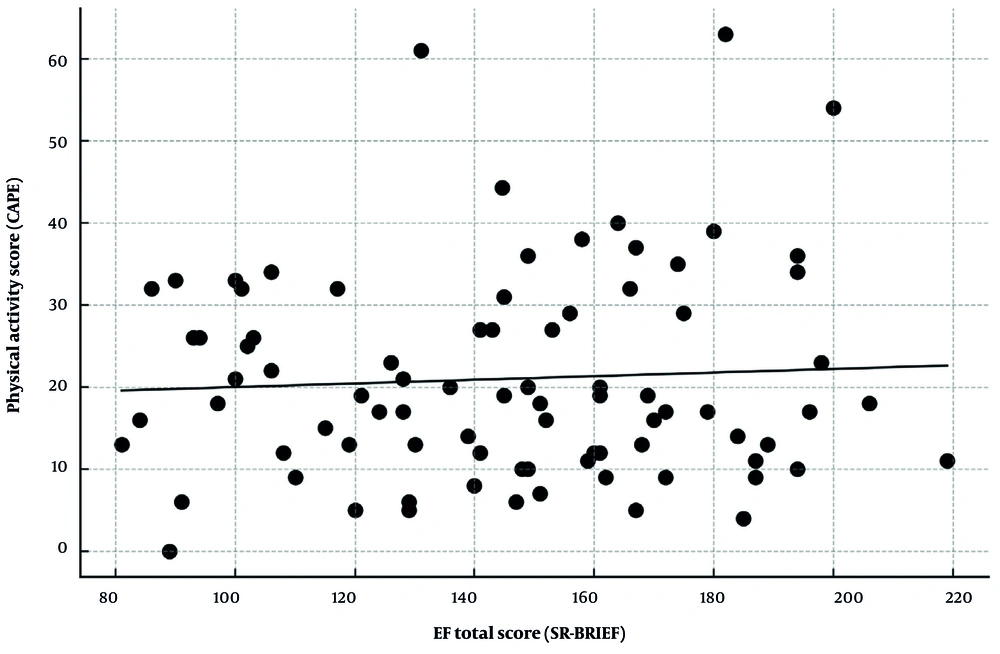
Figure 1.
Behavior Rating Inventory of EF-Self-Report Version (SR BRIEF) versus Children’s Assessment of Participation and Enjoyment (CAPE) in 85 adolescents with specific learning disorder (SLD). The solid regression line illustrates the non-significant association (R = 0.059, P = 0.590).
5. Discussion
We aimed to determine if EF deficits constrain leisure participation in adolescents with SLD. Consistent with some prior findings (24), no significant correlation was observed. A small positive trend between EF and physical-activity participation (β = 0.235, P = 0.141) suggests a subtle relationship that did not reach significance. A similar positive but non-significant trend was reported by Yang et al. in a large pediatric cohort, implying a possible threshold effect whereby only higher levels of EF translate into increased engagement in structured physical activity; this hypothesis merits evaluation in larger post-pandemic samples (31). The non-significant findings may reflect limitations in sample size, measurement precision of self-report tools, or the overshadowing influence of external social and environmental factors. Instead, leisure activities may be flexible, unstructured, or socially scaffolded (25). Adolescents can compensate for EF deficits through peer relationships or family involvement. For example, several participants mentioned peer mentoring in cooperative online games — such as an experienced teammate guiding them through quest planning — which kept them engaged despite weak planning skills.
COVID-19 restrictions likely altered the nature and frequency of leisure activities, reducing physical and group activities, potentially explaining the lack of significant associations. Lockdowns shifted many participants toward screen-based, solitary leisure (e.g., mobile gaming, social-media scrolling). This migration from in-person, group activities to digitally mediated hobbies likely diluted the expected relationship between executive-function skills — especially planning and inhibitory control — and leisure participation that has been reported in pre-pandemic cohorts (24, 32). Consequently, EF may have played a smaller role in determining participation because solitary, screen-based activities demand less planning and social coordination.
Leisure activities are generally more flexible and less dependent on planning, organizing, and cognitive regulation, which are crucial in structured tasks. Instead, they may rely more on social skills, emotional well-being, and external support systems such as family involvement and peer relationships. Adolescents with SLD may compensate for EF deficits in leisure contexts by leveraging these supports, which could explain why EF was not a significant predictor of leisure participation in this study. Moreover, previous studies, such as those by Sharfi and Rosenblum (19), suggest that emotional regulation and social integration play a crucial role in leisure participation, particularly for individuals with learning disabilities. These factors may help mitigate the impact of EF deficits, allowing adolescents to engage more freely in social and recreational activities. Additionally, emotional resilience and self-regulation strategies serve as compensatory mechanisms, enabling adolescents to navigate stress and uncertainty in leisure contexts while reducing reliance on EF (33).
There is a lack of research on whether adolescents with SLD in Iran exhibit distinct patterns of leisure participation compared to their peers. While Esmaili et al. (4) noted differences in extracurricular involvement, their study did not specifically address leisure activities. Our findings indicate that future research should explore whether these differences extend to leisure engagement. This finding aligns with research on other populations with developmental disorders, such as autism spectrum disorder (ASD) and ADHD, where social and emotional factors play a more significant role in leisure participation than cognitive abilities alone (25). While EF deficits affect daily functioning, particularly in structured environments, studies on ASD (25) emphasize the role of EF in such settings. However, our results suggest that in unstructured leisure activities, social and environmental factors may compensate for EF deficits, leading to different patterns of engagement.
Further, studies such as that conducted by Sharfi and Rosenblum (3) highlight the critical role of time management and quality of life in individuals with learning disabilities, emphasizing that these factors, along with social integration, significantly impact leisure participation. Time management, which involves planning, prioritizing, and scheduling activities, is often impaired in adolescents with SLD due to EF deficits, affecting their ability to structure daily routines, complete schoolwork on time, and engage in leisure activities effectively (3). However, despite these challenges, they may still participate in leisure activities through social interactions and environmental support.
5.1. Future Research Directions
Given the non-significant EF–leisure link, investigating other predictors (e.g., social skills, emotional regulation, family support) is warranted. Longitudinal studies may clarify how EF deficits change over adolescence, affecting leisure at different stages. Qualitative methods (interviews, observations) could uncover motivational or infrastructural barriers. Interventions that combine EF training with family-based or peer-supported programs may prove most effective. Individual differences in specific EF impairments (e.g., working memory vs. inhibitory control) and their interaction with social support levels warrant further investigation. Qualitative studies focusing on the lived experiences of adolescents with SLD could also help uncover the social and emotional barriers to leisure participation, providing a deeper understanding of their unique challenges.
Future studies should consider integrating objective behavioral measures — such as wearable activity monitors, ecological momentary assessment (EMA), and multi-informant reports — to validate self-reported data and minimize potential bias. Additionally, interventions designed to enhance leisure participation should integrate strategies that address social and emotional development alongside cognitive training for EF, acknowledging the broader context in which leisure activities take place. In sum, future work should explicitly model the interaction between EF deficits and the availability of social support to clarify how these factors jointly shape leisure engagement.
5.2. Limitations
This study faced several limitations. First, reliance on self-reported measures (SR-BRIEF, CAPE) may have introduced biases such as social desirability and recall errors. Although the study was powered to detect moderate effect sizes (R = 0.3), it may not have been sufficient to identify smaller effects. Person-mean imputation may slightly attenuate within-subscale variance; however, a sensitivity check using available-case data yielded the same non-significant EF-leisure pattern. To mitigate these biases, neutral clarifications were provided to ensure comprehension while avoiding any suggestive guidance.
Additionally, the use of convenience sampling may limit the generalizability of the findings to the broader population of individuals with SLD. The cross-sectional design further prevents the establishment of causal relationships. While SES data were collected, the sample size may have been insufficient to detect its confounding effects, potentially limiting the identification of weaker influences.
Data collection took place during the COVID-19 pandemic, which likely influenced the availability and frequency of leisure activities. While pandemic-related variables were not directly included in the analysis, external restrictions may have disproportionately impacted structured and group-based activities compared to unstructured, solitary ones. Social distancing measures may have further reduced peer participation opportunities, potentially limiting the role of social support as a compensatory mechanism for EF deficits. These factors represent potential confounders, as changes in accessibility could have influenced the observed associations between EF and leisure participation. Moreover, the study did not account for other influential factors, such as social skills, emotional regulation, or family support, which might also contribute to EF-related outcomes.
The online data collection method may have introduced selection bias, as participation was limited to families with internet access and a willingness to complete online surveys. Self-report measures, particularly online data collection during COVID-19, may introduce biases due to limited internet access or participant motivation. This could have led to an underrepresentation of lower-income households or those less familiar with digital tools. Lastly, variations in parental involvement may have influenced adolescents’ responses, despite efforts to ensure independent self-reporting.
5.3. Conclusions
Our findings suggest that EF may not be the primary driver of leisure participation in adolescents with SLD. Therefore, interventions should prioritize social and emotional support, rather than solely focusing on EF training. This highlights the need for a comprehensive examination of how EF interacts with these broader factors, such as social skills and time management, to shape leisure engagement. Clinicians should consider integrating social and emotional supports alongside EF training to develop more effective interventions.
Further studies, particularly beyond pandemic constraints, can clarify how adolescents with SLD engage in leisure and which interventions best support them. In this regard, practical interventions may include community-based activities where EF strategies are paired with social support, parental guidance, or group-based coaching.