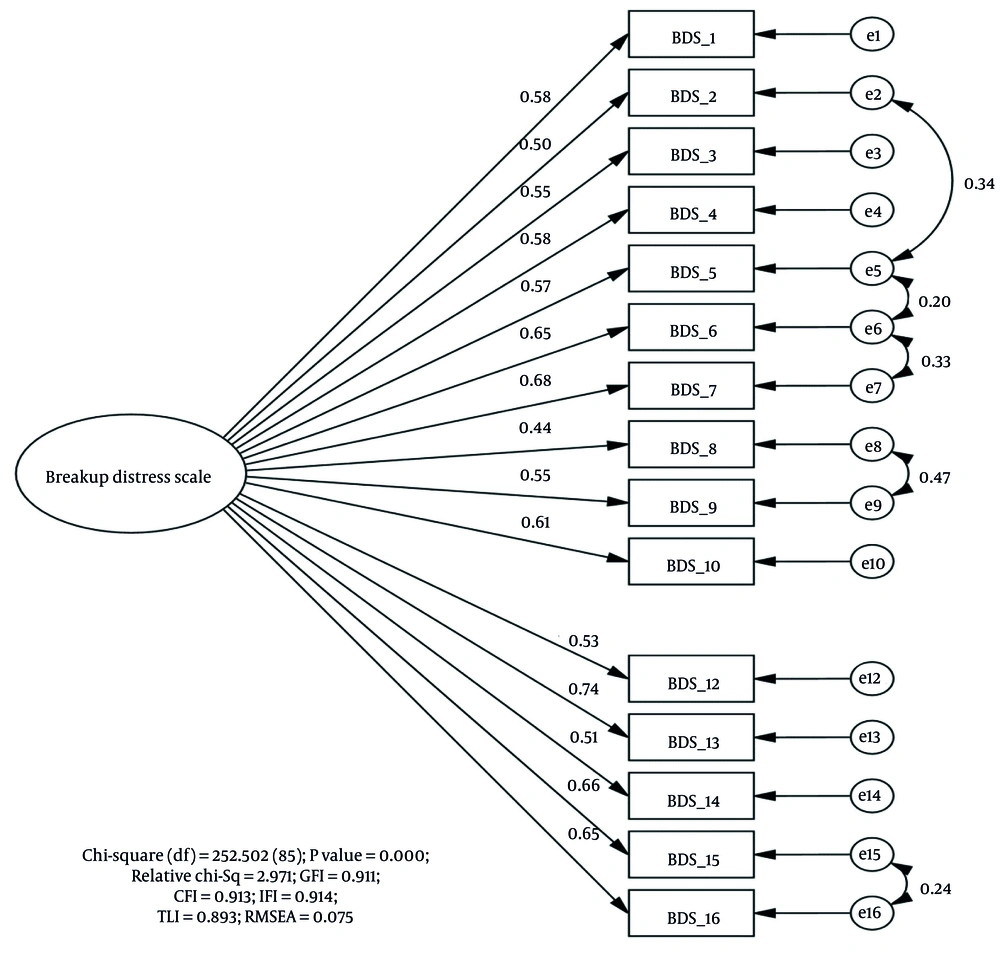
This study involved 350 Iranian university students aged 18 to 30 and aimed to achieve two primary objectives: First, to translate and adapt the 16-item BDS into Persian, assessing its psychometric properties (validity and reliability) among students who have experienced breakup distress within the past six months; second, to examine the relationship between breakup distress and resilience, considering demographic factors such as gender, age, birth order, education level, duration since separation, and the intensity of prior relationships.
Initial findings suggest that the Persian Breakup Distress Scale (P-BDS) exhibits adequate construct and content validity for assessing the experiences of separation among students. However, to strengthen these findings, further investigation into its cross-cultural validity and potential biases associated with self-reported data is crucial. The CFA indicated that the original model of the P-BDS did not fit well, leading to necessary modifications. Specifically, Item 11 was eliminated due to a low factor loading of 0.21, which improved the model's fit but raises questions about its conceptual relevance. This suggests that the item might reflect cultural differences in how breakup distress is conceptualized and expressed. Additionally, covariance errors between five item pairs were addressed, resulting in a revised model that demonstrated acceptable fit.
Reliability assessments indicated high internal consistency for both the original 16-item version (Cronbach's alpha = 0.88) and the modified 15-item version (Cronbach's alpha = 0.89), consistent with earlier findings that reported a Cronbach's alpha of 0.91 for the original scale (
3). Moreover, scores on the BDS were positively correlated with feelings of rejection, betrayal, intrusive thoughts, sleep disturbances, anxiety, and depression (
20). This supports the notion that the Persian version effectively captures the construct of breakup distress, in line with other cultural adaptations of the scale.
Recent literature highlights the significance of age demographics in studies of breakup distress, arguing that it is a culturally relevant phenomenon linked to the normative development of intimacy in young adults rather than merely reflecting relationship failure (
21). The BDS is based on the complicated Grief Inventory (
18) and illustrates how the end of romantic relationships can trigger elevated physical and emotional distress, marked by feelings of rejection and a desire for intimacy (
12).
The P-BDS's reliability among Iranian students, assessed through the split-half method, revealed coefficients of R = 0.81 for the first half, R = 0.82 for the second half, and R = 0.85 overall. These findings closely mirror those from the original version and its Spanish adaptation, which also report high internal consistency. Additionally, structural equation modeling showed that individuals who initiate breakups tend to experience lower distress levels than those who are on the receiving end (
3).
Further analysis indicated that students’ breakup distress scores varied according to birth order and the time since the breakup. Specifically, students with lower birth order rankings reported reduced breakup distress, aligning with research suggesting that strong sibling attachments can alleviate anxiety and distress (
22,
23). Healthy sibling relationships appear to enhance self-esteem and positively impact psychosocial development, helping individuals cope better during stressful situations. A supportive family environment is vital for mitigating breakup distress and facilitating adjustment post-separation (
24).
The study also found that as the time since a breakup increases, students report lower distress levels, which supports existing research identifying time as a key predictor of emotional recovery (
7). Notably, the most severe mental health issues are typically associated with relationships lasting less than one year (
25). Individuals often employ cognitive and behavioral coping strategies to manage separation stress, with adaptive strategies — such as self-help practices and building new relationships — correlating negatively with symptoms of depression and anxiety. Over time, individuals become more skilled at using these coping mechanisms after experiencing a breakup.
Interestingly, no significant differences in breakup distress scores were observed between male and female students, contrasting with prior research indicating that females generally report higher distress levels (
17). This discrepancy may arise from the study's specific sample composition, as women typically experience more intense feelings of depression and hopelessness post-breakup. Overall, this highlights the importance of considering the sample's characteristics when interpreting gender differences in breakup distress.
The analysis also identified significant differences in resilience and its components — such as personal competence, tolerance of negative affect, positive acceptance of change, and control — between students with high and low breakup distress scores, except for the spiritual aspect. A notable negative correlation was found between breakup distress and overall resilience, particularly regarding control, a trend that was especially evident among female students. Resilience is increasingly recognized as a crucial trait that helps young adults navigate challenges in romantic relationships (
26-
28). Family resilience theory posits that the quality of interpersonal relationships significantly affects one’s capacity to cope with crises like breakups (
27).
This research indicates that individuals grappling with breakup distress can benefit from enhanced resilience, which boosts their coping abilities. Resilience facilitates personal competence during pivotal events, such as relational endings, leading to better emotional acceptance. Consequently, resilience serves as a psychological buffer, helping to mitigate the adverse effects of breakup distress and allowing for smoother adjustments following relationship terminations (
28). Increased resilience correlates with higher self-esteem and more adaptive coping strategies, enabling individuals to navigate the challenges associated with breakups effectively.
Furthermore, the notion of sudden loss closely aligns with levels of depression, as supported by existing grief literature. While prior studies indicate that women typically experience higher depression following breakups (
29), this study found no significant gender differences in depression scores. Additionally, men did not demonstrate a correlation between the loss of positive affect and the severity of depressive symptoms, suggesting they may underreport their emotional struggles during stressful situations. Longitudinal research is essential to further explore the unique coping mechanisms and vulnerabilities tied to depressive symptoms under stress (
30).
The analysis revealed a connection between students' resilience levels and the time elapsed since their breakup, with those who had broken up within the last 12 to 24 months reporting higher resilience than those who had experienced a breakup recently or over two years prior, which aligns with earlier findings (
31,
32). However, no significant resilience differences were discovered based on demographic factors such as gender, age, birth order, educational background, or relationship intensity. Notably, commitment to a past relationship negatively correlated with the willingness to engage in new relationships, while negative memories of former partners were associated with increased depression and distress (
32).
A comparative analysis of resilience by gender showed that male and female students significantly differed only in personal competence and tolerance of negative affect, with males scoring higher in both areas, a finding consistent with Behl and Jain (
32). Furthermore, three resilience components — control, commitment, and purpose — serve as indicators of "hardiness" (
33). Individuals who perceived less control over breakup decisions experienced greater distress, suggesting that emphasizing social connections and pursuing new romantic relationships could aid recovery by decreasing post-breakup distress. Additionally, men often exhibited a more optimistic outlook on post-breakup challenges compared to women (
32).
Lastly, the study assessed the combined effects of control, time since the breakup, and acceptance in predicting breakup distress, explaining 18.9% of variance in distress levels, consistent with Rosenfeld’s findings (
26). Individuals in high-quality romantic relationships typically display greater resilience, derive meaning from their breakup experiences, and manage external stressors effectively. Conversely, seeking new romantic partnerships was negatively correlated with breakup distress. Higher commitment, intimacy, and longer relationship durations emerged as strong predictors of breakup distress. Resilience significantly shapes psychological outcomes after a breakup, with numerous studies affirming its positive impact on helping young adults navigate emotional distress (
7). Resilience is also associated with cognitive styles and coping strategies, suggesting it fosters positive thinking and adaptive strategies among students dealing with recent breakups (
31). Exploring resilience interventions more thoroughly could provide insights into effective methods for reducing breakup distress.
The concept of sudden loss is intricately linked to depression scores, aligning with existing literature on grief, particularly regarding unexpected losses and associated psychiatric challenges like clinical depression. Despite findings indicating that women often experience higher depression levels linked to breakup distress than men (
29), this study found no significant gender differences in depression scores. Men exhibited no correlation between the loss of positive affect and depressive symptoms, while women reported more significant declines in positive affect. These results suggest that men may underreport their emotional difficulties during stressful periods, influencing perceived gender disparities in depression rates. The aftermath of breakups relates to both sudden loss and the loss of positive affect, emphasizing the necessity for longitudinal studies to explore coping mechanisms and vulnerabilities among individuals experiencing depressive symptoms during stress (
30).
5.1. Conclusions
This study significantly contributes to the research literature by being the first to assess the validity and reliability of the Persian version of the BDS among Iranian students. The results indicate that the Persian translation exhibits suitable psychometric properties for individuals who have experienced breakup distress at least six months prior. Distinctions between high and low distress levels were associated with birth order, time since the breakup, and certain resilience components, such as personal competence and tolerance for negative affect. The study highlights a multidimensional approach to romantic separations, demonstrating that the 15-item version of the scale is as reliable as the 16-item version and is recommended for screening emotional distress in this population. Future research should focus on reliability assessments, cross-cultural validity, and the relationship between emotional distress and adjustment post-breakup, emphasizing the need for longitudinal studies to explore these dynamics over time.
5.2. Limitations
This study has made valuable contributions, but it also presents several limitations. Participants were not assessed for psychological disorders through clinical interviews, and the reliance on self-reported data may impact the findings' validity. To enhance future research, it would be beneficial to include individuals who have experienced traumatic breakups to validate Item 11 of the BDS, which demonstrated low factor loading. Other limitations include the absence of established cutoff points for the BDS, lack of inter-rater agreement coefficients, and reliance on convenience sampling instead of random sampling. The findings may not be widely applicable due to the focus on a specific student population. This sampling method may not reflect the broader public's experiences, potentially limiting the study's relevance. Relying solely on self-reports introduces bias, highlighting the need for future studies to include more diverse samples. Exploring various age groups and backgrounds will help deepen the understanding of breakup distress and resilience, making the research more applicable across different populations.