
1. Background
Much evidence indicates that parenting interventions can significantly reduce children’s emotional and behavioral problems (1-4). Therefore, it is important to understand related protective and risk factors and create interventions based on cultural differences (5, 6). In addition to these interventions, it is essential to have an appropriate instrument that can measure the outcome of therapies provided by specialists to families (7). Hence, because one of the major features of family- and parenting-based interventions is the systematic assessment of clients’ outcomes, we need valid and reliable instruments to measure their improvements during and after the provision of mental health services (7, 8).
Currently, in English-speaking, high-income countries, there is a tendency toward increasing the use of evidence-based parenting interventions (9, 10). The main goals of these interventions are improving parenting skills, family relationships, and family emotional adjustment (10-12). However, there is still no appropriate instrument that is sensitive to change, has satisfactory psychometrics, provides a parent-based report, and can measure the mentioned constructs (7). On the contrary, a study of evidence-based parenting in countries with moderate and low income has shown that similar instruments used in these countries most of the time were not valid and reliable (13).
The instruments currently used for assessing parenting styles in Iran are often used with other measures, such as the parenting scale (14), the Alabama Parenting Questionnaire (15), and the Parenting To-Do List (16), so the completion of them takes a long time. One of the main reasons for not studying the risk and protective factors of parenting and not performing parenting-based interventions is the lack of a valid and reliable instrument designed or standardized specifically for Iranian culture (17). There are questionnaires assessing parenting in Iran, such as the Parenting Style Questionnaire. However, these tools have major weaknesses, such as weak psychometric properties, measurement of only one dimension, and lack of necessary comprehensiveness (18).
The more important thing is that therapy protocols like the Sadra protocol are among the most reliable for addressing parenting and emotional problems in families. This treatment targets various areas such as parents’ relationships with children, emotional problems, perception of family support, and the quality of parents’ relationships with each other. However, the questionnaires that exist to measure the effectiveness of this treatment do not have sufficient psychometrics and comprehensiveness. One of the few tools that has this comprehensiveness is PAFAS, which evaluates all these areas (7).
On the other hand, parent management training packages are currently used worldwide to prevent problems, provide early interventions, reduce abuse, and improve children’s behavioral and emotional states. Sander’s parenting package is one of the most commonly used in Iran, but there is no appropriate instrument to assess its outcomes. Most of the tools that exist in Iran do not have the adequacy of measurement in various fields of parenting and children’s emotional problems. Failure to recognize these problems has unfortunate consequences, including physical threats, rejection by peers, social exclusion, and limited future job opportunities (19). Timely diagnosis of risk factors in parenting and children’s emotional problems can prevent the escalation of these problems or allow for necessary psychological interventions for them and their families.
The 30-item parent-report Parenting and Family Adjustment Scales (PAFAS) measure significant risk factors for family functioning, parenting, and children’s emotional and behavioral problems (20-23). It assesses five domains: (1) Parenting styles, which indicate the approach or style used to reinforce children’s positive behaviors; (2) quality of the child-parent relationship, measured by parental satisfaction; (3) emotional adjustment of parenting, measured by stress, depression, and anxiety levels; (4) positive family relationships, defined by a conflict-free and positive environment; and (5) parenting team, defined by the social support received from a partner (7). The original questionnaire is in English and standardized in the Australian population, showing satisfactory construct and predictive validity (0.70 to 0.96) (7). This questionnaire has also been standardized in various other countries. For example, in Spain, this scale showed good construct validity, concurrent validity, and good internal consistency (more than 0.60 for all subscales) with satisfactory test-retest reliability (ICC above 0.60 for all subscales) (24). Although this instrument has been used and standardized in many different countries, it has not yet been standardized and translated in Iran. This study investigates the psychometric properties of the Persian version of the PAFAS in the Iranian population.
2. Objectives
The present study aimed to investigate the psychometric properties of the Persian version of the PAFAS within the Iranian population.
3. Methods
This cross-sectional study was conducted on 1,053 parents during 2020 - 2021. Using a convenience sampling method, 1,053 parents residing in Tehran, Iran, with children aged 2 to 12 years, were recruited. The sample included parents of typically developing children. Participants completed a questionnaire assessing parenting and family adjustment. The minimum recommended sample size for structural equation modeling studies is 200. Recent simulation studies suggest that the sample size needed for confirmatory factor analysis (CFA) is 200 ≤ n for theoretical models and 300 ≤ n for population models. The sample size was calculated using the SOPER formula, considering the number of latent and observed variables (7 and 30, respectively) (25). Based on an anticipated effect size of 0.19, a desired statistical power level of 0.80, a probability level of 0.05, and the number of latent and observable variables, the sample size was calculated to be 683. However, accounting for an attrition rate, this number was increased to 1,161. Participants (n = 30) completed the questionnaires again after two weeks to determine test-retest reliability. The questionnaire was distributed online, and the link was sent to participants with information about the research purpose.
Inclusion criteria for parents were: (1) Being the parent of a typically developing child; (2) having a child aged 2 to 12 years; (3) satisfaction and willingness to participate in the study; and (4) being the parent of a typically developing child. Exclusion criteria were: (1) Failure to complete the questionnaires fully; (2) reluctance to continue participating in the study; and (3) if the child was under welfare care or did not live with their parents. Several criteria were used to assess the normal development of children: Prior consultations with psychologists or psychiatrists, history of taking psychiatric medications, and referrals (if the child was school-aged) from school to a psychologist or psychiatrist.
The age range of the 1,053 participants was 20 to 50 years, with most in the 30 to 40-year range (61.03%). For children, the age range was 2 to 12 years, with most in the 11 to 12-year range (33.4%). Most participants were mothers (n = 880), held a bachelor’s degree (n = 347), and were married (n = 1,001). Most of the children were girls (n = 564).
3.1. Data Collection Tool and Technique
Initially, we contacted the primary author of the questionnaire via email to request permission to adapt the questionnaire, which was granted. The translation of the scale was completed in three steps. Five clinical psychologists from the university faculty (three assistant professors and two associate professors), fluent in English, independently translated the questionnaire. These translations were then consolidated into a single document. We provided this version to 15 parents to assess its fluency and comprehensibility. After completing the translation process, the Persian version was back-translated into English and sent to the original developers for approval. With their consent and permission for its use in Persian, the final version was prepared by the first author.
Due to the COVID-19 outbreak and adherence to health protocols, data collection was conducted online. After preparing the questionnaire link and including a description of the research objectives at the beginning, the link was shared on various social media platforms (Instagram, WhatsApp, and Telegram). It was also distributed in various online groups, allowing members to read the description and access and complete the questionnaire. At the end of the form, the researcher’s contact information was provided for participants to ask questions if they encountered any issues.
Potential sources of bias were addressed by including both genders, children aged 2 - 12 years, and typically developing children. Before each questionnaire, instructions on how to answer the questions were provided. Thirty participants were randomly selected for re-evaluation two weeks after the initial assessment to assess test-retest reliability. The researcher contacted and reminded them two days before the second assessment date.
A total of 1,161 participants completed the questionnaires. However, 61 individuals reported that their children had a history of psychological disorders and had taken psychiatric medications; these responses were excluded from the analysis. Additionally, 47 participants failed to answer more than half of the questions and had extensive missing data, leading to their exclusion. Consequently, the analysis was conducted on 1,053 participants. To detect any abnormalities, a question was included regarding the history of the children’s visits to mental health centers; if the response was positive, they were excluded from the research.
3.2. Tools
3.2.1. Parenting and Family Adjustment Scales
The scale was developed by Sanders et al. in 2014 (7). It consists of 30 questions that measure family adjustment and parenting over the past four weeks. Each question is scored on a 4-point scale ranging from "not true of me at all" (0) to "true of me very much or most of the time" (3). The questionnaire includes two dimensions: Parenting and family adjustment. Parenting comprises four factors: Parental consistency, coercive parenting, positive encouragement, and parent-child relationship. Family adjustment includes three factors: Parental adjustment, family relationship, and parental teamwork. The items are summed to yield a separate score for each domain, where higher scores indicate higher levels of dysfunction. Sanders et al. reported that the PAFAS had satisfactory construct and predictive validity, as well as good internal consistencies among Australian parents (α = 0.70 - 0.85) (7). Convergent validity in this study ranged from 0.26 to 0.57 (7). In our study, Cronbach’s alpha for parenting and family adjustment was 0.95 and 0.94, respectively. Construct validity showed a significant correlation between factors. The results indicated that, like the original scale, parenting consists of four factors: Parental consistency, coercive parenting, positive encouragement, and parent-child relationship. Family adjustment includes three factors: Parental adjustment, family relationship, and parental teamwork.
3.3. Ethical Consideration
The present study was approved by the Ethics Committee of the University of Social Welfare and Rehabilitation Sciences (IR.USWR.REC.1399.219). Before completing the questionnaire, participants completed an informed consent form.
3.4. Data Analysis
Confirmatory factor analysis was conducted for data analysis using AMOS. In this study, CFA was prioritized over exploratory factor analysis (EFA) because the factor structure of the original instrument had already been established and validated in multiple previous studies (7, 24, 26). According to Kline (27), when adapting a psychometric instrument with an existing theoretical model, CFA is the appropriate initial step, especially when the purpose is to confirm the applicability of the model in a new context. Moreover, several cross-cultural adaptation studies of PAFAS and other standardized instruments (17, 26) also used CFA without EFA, based on the assumption that the underlying structure is stable across populations. Therefore, consistent with these guidelines and practices, we conducted CFA to validate the structure of the Persian version of PAFAS. Exploratory factor analysis is generally recommended only when no theoretical framework exists or CFA results are unsatisfactory (27).
4. Results
4.1. Factor Structure
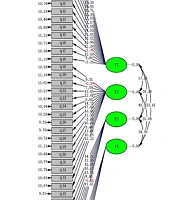
Before analyzing the data, the assumption of normality was tested. For this purpose, skewness and kurtosis values were checked. If a value is between +2 and -2, it indicates that the data is normal. For this study and all the tested variables, the skewness and kurtosis values were between +2 and -2. Next, to confirm the factors extracted from the questionnaire, the PAFAS was used using AMOS. A PAFAS was performed for the parenting questionnaire, which included four factors (Figure 1).
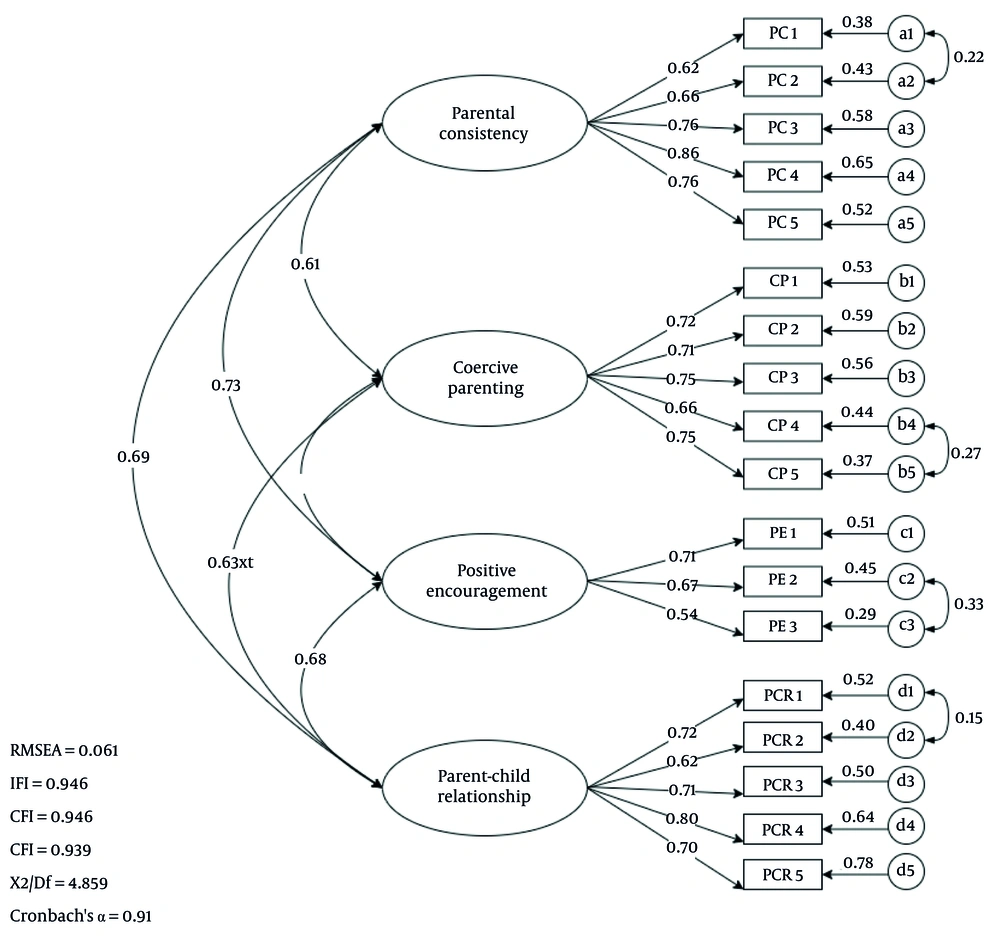
Figure 1.
Standardized coefficients for the confirmatory factor analysis (CFA) of the parenting scale
Also, the values of the model fit indices indicated a good model fit, and the results are presented in Table 1. In this table, the indices obtained from the model were compared with the fit indices (27).
Table 1.
Fit Indices of Confirmatory Factor Analysis for Parenting Questionnaire
| Indices | Standard Range | Values |
|---|---|---|
| X2/df | < 5 | 4.859 |
| RMSEA | < 0.08 | 0.061 |
| CFI | > 0.9 | 0.946 |
| IFI | > 0.9 | 0.946 |
| GFI | > 0.8 | 0.939 |
| α | > 0.7 | 0.914 |
Abbreviations: X2/df, chi-square/degree of freedom; RMSEA, root mean square error of approximation; CFI, Comparative Fit Index; IFI, Incremental Fit Index; GFI, Goodness-of-Fit Index; α, Cronbach’s alpha.
In the next step, CFA was used for the adjustment questionnaire, and the results are shown in Figure 2. All the model fit indices were acceptable and satisfactory, indicating that the collected data could cover and fit the CFA well.
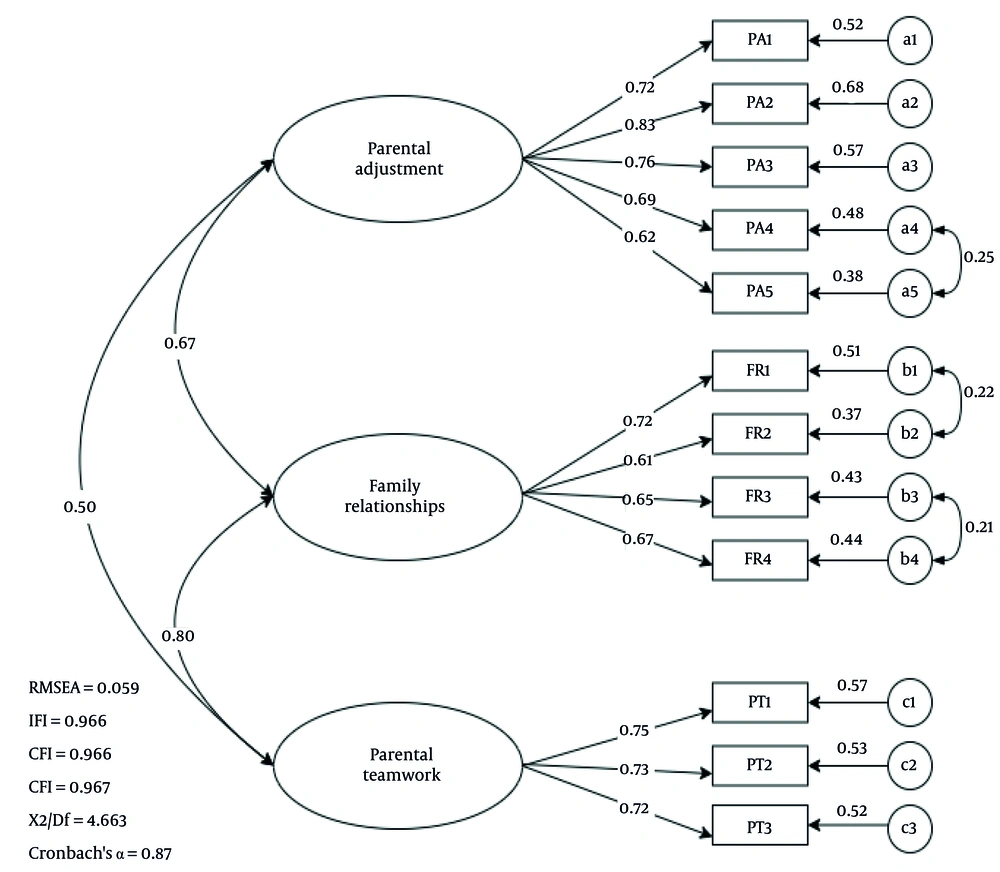
Figure 2.
Standardized coefficients for the confirmatory factor analysis (CFA) of the family adjustment scale
4.2. Reliability
The most acceptable test for reliability is calculating and interpreting the intraclass correlation coefficient (ICC). The intraclass correlations, Spearman correlations, and Cronbach’s alpha of the questionnaire’s subscales are presented in Table 2.
Table 2.
The Results of Cronbach’s Alpha, Intraclass Correlation Coefficients, and Spearman Correlations
| Subscales (Number of Items) | Cronbach’s Alpha | ICC | Spearman Correlations | ||||
|---|---|---|---|---|---|---|---|
| Mean | Correlation Coefficient | CI | P- Value | Correlation Coefficient | P-Value | ||
| Parenting Scale | |||||||
| Parental consistency (5) | 0.86 | 7.27 | 0.76 | 0.54 - 0.87 | 0.001 | 0.67 | 0.001 |
| Coercive parenting (5) | 0.88 | 6.47 | 0.79 | 0.61 - 0.89 | 0.001 | 0.78 | 0.001 |
| Positive encouragement (3) | 0.92 | 2.06 | 0.86 | 0.73 - 0.93 | 0.001 | 0.86 | 0.001 |
| Parent-child relationship (5) | 0.93 | 1.86 | 0.87 | 0.74 - 0.93 | 0.001 | 0.85 | 0.001 |
| Total score (18) | 0.95 | 17.66 | 0.91 | 0.82 - 0.95 | 0.001 | 0.90 | 0.001 |
| Family Adjustment Scale | |||||||
| Parental adjustment (5) | 0.86 | 6.10 | 0.76 | 0.56 - 0.88 | 0.001 | 0.77 | 0.001 |
| Family relationship (4) | 0.93 | 2.80 | 0.87 | 0.74 - 0.93 | 0.001 | 0.91 | 0.001 |
| Parental teamwork (3) | 0.90 | 2.60 | 0.82 | 0.67 - 0.91 | 0.001 | 0.86 | 0.001 |
| Total score (12) | 0.94 | 11.50 | 0.89 | 0.79 - 0.95 | 0.001 | 0.92 | 0.001 |
Abbreviation: ICC, intraclass correlation coefficients.
Regarding the test-retest reliability results for two assessments conducted at two-week intervals (n = 30), the intraclass correlation coefficients for the parenting scale, the family adjustment scale, and their subscales were all above 0.75, which is the acceptable level for good reliability. This indicates that the scales and their subscales have satisfactory reliability over time. The Spearman correlations for the Persian version of the scales ranged from 0.67 to 0.92. These correlations were different but significant, indicating that the scales have good to excellent reliability. The Cronbach’s alpha values reported for the scales ranged from 0.67 to 0.92, demonstrating that the internal consistencies of the scales are significant (P < 0.001) and at reasonable levels. Moreover, Table 3 shows the correlations between the subscales of the questionnaire.
Table 3.
Correlations Between Subscales
| Constructs | 1 | 2 | 3 | 4 | 5 | 6 | 7 |
|---|---|---|---|---|---|---|---|
| 1. Parental consistency | - | - | - | - | - | - | - |
| 2. Coercive parenting | 0.507 a | - | - | - | - | - | - |
| 3. Positive encouragement | 0.537 a | 0.427 a | - | - | - | - | - |
| 4. Parent-child relationship | 0.609 a | 0.529 a | 0.549 a | - | - | - | - |
| 5. Parental adjustment | 0.025 | 0.082 a | -0.006 | 0.013 | - | - | - |
| 6. Family relationship | 0.055 | 0.082 a | 0.055 | 0.068 b | 0.536 a | - | - |
| 7. Parental teamwork | 0.063 b | 0.111 a | 0.046 | 0.067 b | 0.430 a | 0.597 a | - |
| Mean ± SD | 5.4292 ± 3.18325 | 5.4834 ± 3.10295 | 2.6923 ± 1.88155 | 2.4834 ± 2.87227 | 5.1595 ± 3.38544 | 3.3713 ± 2.42841 | 2.8139 ± 2.49286 |
| Alpha | 0.844 | 0.832 | 0.722 | 0.865 | 0.850 | 0.782 | 0.775 |
a P < 0.01.
b P < 0.05.
The results of the correlation matrix indicated significant relationships between consistency in parenting and authoritarian parenting, positive reinforcement, parent-child relationship, and parenting teamwork. Additionally, authoritarian parenting showed significant positive correlations with positive parenting, parent-child relationship, parenting adaptability, family relationships, and parenting teamwork. A significant correlation was also found between positive reinforcement and the parent-child relationship. Furthermore, positive and significant correlations were observed between parenting adaptability and the parent-child relationship, family relationships, and parenting teamwork. The parent-child relationship subscale showed a significant correlation with positive reinforcement. Additionally, family relationships demonstrated a significant positive correlation with parenting teamwork. Other correlation results are presented in Table 3.
5. Discussion
This study aimed to standardize a short but comprehensive questionnaire on parenting and family adjustment within the Iranian population. Confirmatory factor analysis was performed to validate the structure of the scales, and test-retest and Cronbach’s alpha methods were used to assess reliability. Initially, CFA was conducted to analyze the factor structure of the scale. The results confirmed that the parenting scale comprises four factors and the family adjustment scale comprises three factors. These results are consistent with those of the original scale and other studies standardizing these scales in different countries (7, 17, 28).
A study by Guo et al. (28) showed that two items of the parental consistency subscale, items 3 and 11, had low factor loading values, leading to their deletion (26). Fortunately, we did not encounter any low factor loadings in our study, and all items were retained. This may be due to cultural differences between Chinese and Iranian populations, as Chinese participants had negative and different understandings of the items’ meanings. China, a country with a communist ideology, is culturally diverse from Iran, an Islamic and religious country. In collectivistic countries, consistent communication is of great importance, and interpersonal conflicts should be resolved quickly (29, 30). Iran is considered a collectivistic country but has recently undergone social changes, tending more towards Western individualism in some aspects, though differences remain considerable. These changes are observable in large cities like Tehran, the capital, and, as a result, our findings are more similar to Western cultures (31).
This finding is also consistent with research conducted on the original version (7) and the Brazilian adaptation (26). One reason for this consistency may be that studies suggest parenting processes and family regulation practices operate globally based on broadly similar cultural characteristics, even if there are minor cultural differences. In other words, the core values and needs of families — such as emotional support, family structures, and parenting styles — are often similar across different societies. These similarities may arise from common global social and psychological processes that affect individuals across most societies. For instance, in most cultures, the role of parents in providing emotional support, creating structure and order, and managing family challenges is viewed similarly (32).
Moreover, many of the psychological constructs measured by the PAFAS, such as parenting styles, emotional regulation, and family adaptability, may be shaped by universal principles of human interaction. These constructs, influenced by similar psychological and biological factors in many societies, may result in aligned findings across different cultures. On the other hand, globalization and the international exchange of information in today’s world have led to mutual cultural influences. Despite their differences, cultures may converge by adopting similar concepts and family lifestyle practices. This trend may contribute to the similarity of findings in research on family structure and parent-child interactions across various societies.
The internal consistency of the parenting scale and family adjustment, assessed by Cronbach’s coefficient, was found to be good. These results are consistent with the original scale, which reported high internal consistency (7). Test-retest reliability was also assessed, showing good reliability. In conclusion, the results indicate that this scale is reliable over time, and therapists can use this instrument to assess the outcomes of their interventions.
Construct validity was used to assess validity, and the results showed a significant correlation between the variables of the parenting scale and family adjustment, indicating good validity. This suggests that consistency in the parents’ relationship leads to consistency and agreement in parenting. Furthermore, a healthy relationship between parents is associated with a healthy and efficient relationship between parents and children. However, in the Australian version, the correlation results showed significant correlations between the subscales of the PAFAS, but these correlations were not significant for all subscales. There were significant correlations between family relationships, coercive parenting, and parent-child relationships, indicating that consistency in family members’ relationships is associated with consistent parenting. The results also showed a significant correlation between the parenting adjustment subscale of the family adjustment scale and the coercive parenting subscale of the parenting scale. The content of the parenting adjustment scale includes the emotional characteristics of parents, which can assess their mental health by addressing emotional problems (7). Emotional problems in parents are associated with poor emotional and behavioral adjustment in children and negative consequences of parenting (33). Therefore, clinicians should assess parents’ emotional problems and offer appropriate psychological interventions to reduce emotional and behavioral problems in struggling children.
The findings of our study show that the Persian version of the PAFAS has excellent and acceptable psychometric properties. One common issue in parenting-focused treatment protocols is the lack of an effective and comprehensive tool for researchers to assess the efficacy of their interventions in the domain of parenting. Therefore, this instrument could serve as an appropriate tool for both clinical and research purposes. Moreover, given that mental health in childhood is significantly influenced by parenting, the use of this tool can assist in the detection and prevention of unhealthy parenting practices.
Despite achieving its goals, the present study encountered some limitations. These limitations should be considered when interpreting the results and conducting future studies. First, because there were no questionnaires similar to the current one in Iran, this study’s convergence and divergence validity were not examined. Future studies should address and investigate this. This study was conducted on a normative population, and caution should be exercised when generalizing the findings to clinical populations. Additionally, approximately one-third of the participants were within the 11 - 12 age range. Finally, many participants were residents of Tehran, which may culturally differ from other Iranian cities. Due to the prevalence of COVID-19, the questionnaires were completed virtually by parents in Tehran, so further studies in other cities are recommended.