
1. Introduction
Dental fear and anxiety persist despite modern advancements in dental procedures and instruments. This continues to be a major concern for both patients and dental professionals. Dental fear makes patients postpone appointments, compromises cooperation during treatment, and impacts care quality and patient-dentist relationships (1, 2).
Studies show that high anxiety before treatment is associated with more anesthesia injections, increased pain perception, and more analgesics consumed after surgeries (3, 4). Root canal treatment is common, and many people experience pain and discomfort before visiting the dentist. Root canal therapy (RCT) is associated with significant anxiety for patients. Therefore, reducing pain and anxiety is crucial (5).
Different methods have been introduced to measure dental anxiety. Objective approaches include measuring biological parameters like blood pressure, pulse rate, and respiratory rate. Subjective methods involve using questionnaires and figure scales recorded by the patient or observer (6).
One tool used to measure anxiety is the self-report State-Trait Anxiety Inventory (STAI) (7), which assesses trait and state anxiety. Trait anxiety refers to a general tendency to perceive situations as threatening, while state anxiety is temporary and situation-specific. This questionnaire has been used in studies assessing dental anxiety (8-10).
Dental anxiety can be managed by pharmacological, equipment-based, and non-pharmacological approaches. Medications like benzodiazepines and N2O gas help control anxiety. Improved anesthetic injection tools reduce pain and anxiety. Non-pharmacological methods, such as hypnosis, soothing music, audiovisuals, and virtual reality, have been adopted (11).
One reason for patients’ fear of dental treatments is pain induced by anesthesia injections. Pain control is a basic principle of dental treatment, and a pain-free experience ensures better patient cooperation. Efforts to reduce injection pain include changes in anesthetic solutions, adding buffer substances, and improving needle designs (12). However, few studies have investigated the effect of music on pain perception from dental anesthetic injections in adults.
Using music to alleviate dental anxiety offers advantages. It is accepted by everyone and, compared to pharmaceutical methods, has no medication side effects (13). It has also been reported that music improves treatment team efficiency and cooperation (14).
Unpleasant auditory stimuli, like the sound of dental burs, suction, and equipment, contribute to patient discomfort. Music helps distract patients from these stimuli (3). European classical music has been used in studies to investigate music's effect on patient anxiety in therapy (2, 3, 6). However, the impact of Iranian classical music, which aligns with patient culture, has rarely been studied. Investigating the effect of different music genres on pain from dental anesthesia is a neglected area. This study aims to investigate the effect of European and Iranian classical music on physiological anxiety parameters (pulse and respiratory rate), anxiety, and pain levels due to inferior alveolar nerve block (IANB) anesthesia during root canal treatment.
2. Methods
2.1. Study Design
This randomized controlled trial study was conducted using a prospective, parallel design and followed CONSORT guidelines. This research was approved by the Ethics Committee of Mashhad University of Medical Sciences (IR.MUMS.DENTISTRY.REC.1402.025) and was registered in the Iranian Registry of Clinical Trials (IRCT20230819059182N1). Informed consent was obtained from all patients.
2.2. Determining the Sample Size
To determine the sample size in each group, considering the quantitative nature of the dependent variables and the existence of three independent groups, one-way analysis of variance (ANOVA) was used in PASS 21 software. The sample size was estimated at 30 cases in each group (total n = 90) considering mean values of 9.9, 9.2, and 8.4 with a common standard deviation of 1.8 and an effect size of 0.34 for the variable 'anxiety' obtained from the study conducted by Kupeli and Gulnahar (6), as well as based on a Type I error rate of α = 0.05 and a Type II error rate of β = 0.2 (i.e., a test power of 80%).
2.3. Eligibility Criteria
The eligible participants were those aged between 18 and 65 years old, had American Society of Anesthesiologists (ASA) 1 and 2 systemic conditions, consented to participate in the study, and had referred for root canal treatment of mandibular molar teeth. On the other hand, individuals with cognitive problems, hearing impairment, psychiatric disorders affecting the autonomic system (e.g., schizophrenia and depression), and those taking anxiolytic or sedative drugs were excluded from the study.
After the initial examination, all patients were informed about the treatment process, including the number of treatment sessions, the duration of the treatment, and possible side effects during and after the treatment. All the participants were aware of the purpose of the study. The study was finally conducted on 90 patients.
2.4. Randomization, Allocation, and Blinding
All eligible individuals were randomly assigned to one of the study groups. The stratified permuted block method was used for randomization. Blocks of three were employed, and a random number table was utilized to select these blocks. Considering that the difference between the groups was in the genre of music played by the loudspeaker in the treatment environment, blinding was impossible for either the patient or the healthcare provider.
Patients were divided into three groups of 30 individuals: Group 1 (European classical music), group 2 (Iranian classical music), and group 3 (without music).
The Iranian classical music playlist was the “ba yadash” album, consisting of solo piano pieces composed by Javad Maroufi. The European classical music was the same number of piano solo pieces composed by Chopin and Mozart. The number and total duration of both playlists were the same, and the pieces of the two playlists were matched based on their tempo and rhythm two by two with the guidance of a musician. Both playlists were completely played based on related study groups.
2.5. Study Implementation
Before entering the treatment room, the patients filled out the STAI Questionnaire in the waiting room (before treatment examination). This 40-item questionnaire measures the levels of state anxiety (20 items) and trait anxiety (20 items) in order, and the replies are scored on a 4-point Likert scale. The patients had to circle the option that best reflected their emotional state. The overall score in each section is obtained between 20 and 80, with higher scores indicating higher levels of anxiety. Demographic information, including age, gender, and education level, was also recorded in the questionnaire. The participants were assured of the confidentiality of their personal information. Pulse rate and respiratory rate were measured by a trained dental assistant and registered in the relevant forms.
After entering the treatment room, European and Iranian classical music was played for groups 1 and 2 with the same volume, whereas no music was played for group 3.
Examinations and treatment were initiated approximately 5 min after the patients entered and were exposed to the music. All root canal treatment procedures were performed by an endodontist with 10 years of clinical expertise together with an experienced dental assistant. IANB anesthesia was administered with 2% lidocaine and 1:100000 epinephrine using a 30-gauge needle and following the same technique. The level of pain due to the injection was assessed by the Visual Analogue Scale (VAS) just after administration of the anesthesia, for which the patients were already trained. In this scale, patients recorded the level of their pain on a 100 mm line. The VAS was anchored on the left with “No pain” and on the right with “The most imaginable pain”.
Endodontic treatment was administered to all participants in a designated treatment room using a uniform standard procedure and equipment. All individuals received treatment between 3:00 PM and 6:00 PM, and the treatment lasted 40 - 60 min.
To check the level of anxiety during the treatment, the patients filled out the STAI Questionnaire in the middle of the treatment (after access cavity preparation while the cavity was filled with temporary filling in order to prevent canal contamination), and their pulse rate and respiratory rate were also measured and recorded. Music was played for the first and second groups continually until the end of the treatment process. Finally, the questionnaire was completed once more by the patients at the end of the treatment (after dismissing the patient from the treatment room) and their pulse rate and respiratory rate were evaluated and recorded (after treatment examination).
2.6. Statistical Analysis
Statistical indices, including measures of central tendency and dispersion, were utilized for descriptive statistics. Pearson's chi-squared test was used to compare gender distribution among the three groups, while Fisher's exact test was employed to compare the educational level. One-way ANOVA was used to compare age in the three groups, and Tukey's honestly significant difference (HSD) test was utilized for pairwise group comparisons. A comparison of group variances was performed using Levene's test, and the normal distribution of data was assessed using the Shapiro-Wilk test. Repeated measures two-way ANOVA was utilized to compare the trend of changes in dependent variables at three measurement times among the three groups. The assumption of sphericity or circularity was tested using Mauchly's test. The pairwise comparison of time points was done using the Bonferroni method, and the changes in the dependent variables in the three groups were compared with one-way ANOVA. Effect size was calculated using partial Eta squared. The significance level was considered at 0.05. The analyses were performed in SPSS software (version 26).
3. Results
3.1. Description of Subjects
A total of 90 subjects with an average age of 34.90 ± 9.65 years and an age range of 18 - 67 years completed the study. Gender distribution frequency consisted of 46 (51.1%) male and 44 (48.9%) female patients. Considering educational level, 5 individuals (5.5%) held a high-school diploma, 16 (17.8%) a diploma, 7 (7.8%) an associate degree, 36 (40%) a bachelor's degree, 17 (18.9%) a master's degree, and 9 (10%) a doctorate degree. The results of Pearson’s chi-squared test, Fisher's exact test, and one-way ANOVA showed that there was no statistically significant difference between the groups in terms of gender (P = 0.157), education (P = 0.874), or age (P = 0.114) distribution.
3.2. Physiological Parameters
The analysis of physiological parameters (pulse rate and respiratory rate) based on the Bonferroni method showed that both of these factors had statistically significant differences at the three investigated time points. The pulse rate and respiratory rate had the highest values before the treatment, while they reached the lowest points after the treatment; however, this change was not significantly different between the three study groups (pulse rate, P = 0.28; respiratory rate, P = 0.371; Table 1).
Table 1.
Descriptive Statistics for Physiological Parameters Before, During and After Root Canal Treatment (N = 30)
| Groups | Heart Rate | Breath Rate | ||||
|---|---|---|---|---|---|---|
| Before | During | After | Before | During | After | |
| European music | ||||||
| Mean | 86.83 a | 85.73 | 84.30 | 19.03* | 18.43 | 18.00 |
| Std. error of mean | 1.61 | 1.74 | 1.65 | 0.70 | 0.73 | 0.56 |
| Iranian music | ||||||
| Mean | 85.83 | 83.00 | 81.87 | 18.30 | 17.47 | 16.97 |
| Std. error of mean | 2.37 | 2.23 | 2.17 | 0.72 | 0.66 | 0.66 |
| Silent | ||||||
| Mean | 82.83 | 82.13 | 80.23 | 18.73 | 18.13 | 17.80 |
| Std. error of mean | 1.99 | 2.07 | 1.91 | 0.76 | 0.78 | 0.77 |
a Per minute.
3.3. Pain Perception on Anesthesia Injection
The reported average pain following anesthesia injection on the VAS was 1.96 for the European classical music group, 2.25 for the Iranian music group, and 3.45 for the control group. According to the one-way ANOVA analysis, the pain level in the three groups had a statistically significant difference (P = 0.006). The results of Tukey's HSD test indicated that there was no statistically significant difference between the two groups of European music and Iranian music (P = 0.822); however, the average was lower in the European music group (Table 2).
Table 2.
Descriptive Statistics for Pain Perception on Anesthesia Injection (Visual Analog Scale; N = 30)
| Groups | Mean | Std. Error of Mean |
|---|---|---|
| European music | 1.96 | 0.3313 |
| Iranian music | 2.25 | 0.2803 |
| Silent | 3.45 | 0.3861 |
3.4. Anxiety
Examining the level of state anxiety at three time points (i.e., before, during, and after the intervention) revealed a statistically significant difference [F (2, 174) = 8.561, P ˂ 0.001, effect size = 0.111]. Accordingly, the level of anxiety increased during the treatment, while it decreased post-treatment (Figure 1). Nevertheless, there was no statistically significant difference between the three groups in the state anxiety levels, and all groups exhibited a similar trend [F (2, 87) = 0.542, P = 0.584, Effect size = 0.025] (Table 3).
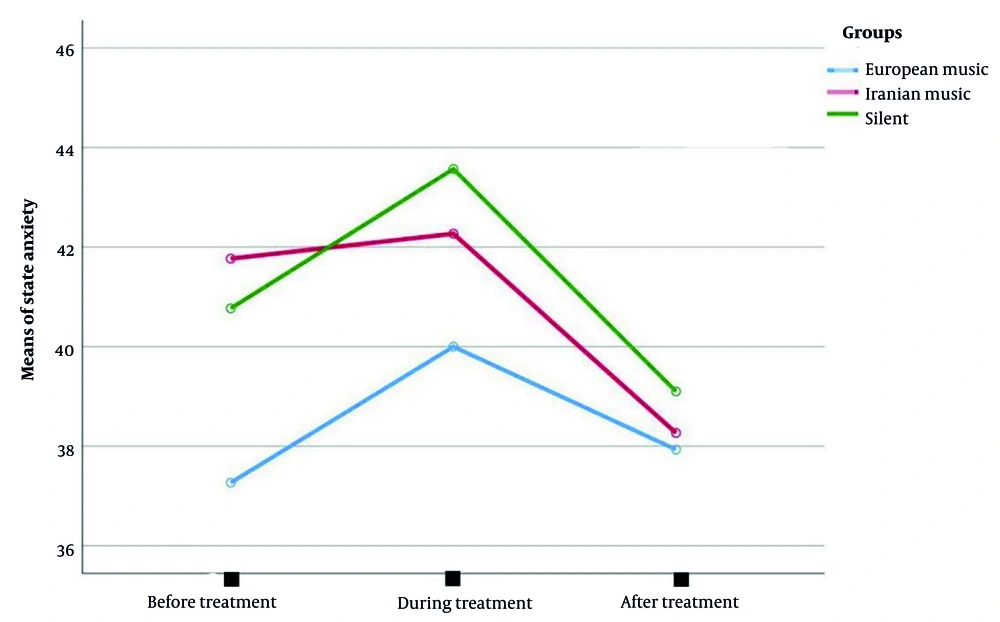
Figure 1.
State anxiety in three study groups, before, during, and after root canal treatment
Table 3.
Descriptive Statistics for State and Trait Anxiety Before, During and After Root Canal Treatment (N = 30)
| Groups | Trait Anxiety | State Anxiety | ||||
|---|---|---|---|---|---|---|
| Before | During | After | Before | During | After | |
| European music | ||||||
| Mean | 41.13 | 38.80 | 39.47 | 37.27 | 40.00 | 37.93 |
| Std. error of mean | 1.52 | 1.68 | 1.41 | 1.49 | 1.43 | 1.72 |
| Iranian music | ||||||
| Mean | 41.13 | 38.77 | 40.70 | 41.77 | 42.27 | 38.27 |
| Std. error of mean | 1.17 | 1.54 | 1.30 | 1.51 | 1.33 | 1.63 |
| Silent | ||||||
| Mean | 44.07 | 37.43 | 41.73 | 40.77 | 43.57 | 39.10 |
| Std. error of mean | 1.90 | 1.31 | 1.85 | 1.76 | 1.65 | 1.77 |
4. Discussion
Dental procedures are often perceived as stressful by many individuals, with pain from injections being one of the primary factors contributing to this anxiety (13). The present study investigated the effect of listening to classical European and classical Iranian music on physiological parameters related to anxiety, anxiety level, and pain associated with IANB anesthesia in patients prior to undergoing root canal treatment.
Psychophysiological theories propose that certain kinds of music can evoke relaxation and positive reactions, leading to a reduction in the activity of the sympathetic and neuroendocrine systems, which consequently helps regulate physiological parameters linked to the autonomic system (15). Nonetheless, the results of studies in this field have been contradictory (3, 10, 16, 17). The general findings of a previous study indicate that background music has no significant effect on the physiological parameters of anxiety (16), which is in line with the results of the present study.
In this study, no statistically significant differences were observed in terms of changes in pulse rate and respiratory rate at three-time intervals (i.e., before, during, and after treatment) among the three study groups, and these parameters were always within the normal range. However, the levels of these parameters were significantly different at the three time points. To elaborate, the highest levels of respiratory rate and pulse rate were recorded before the treatment, while a decrease was observed during the treatment, and they reached the lowest levels after the treatment. This finding revealed that the dental treatment phase was the factor that had a decreasing effect on the physiological parameters, with the minimum levels after the treatment was over.
The lack of difference between the experimental groups may be attributed to individual variations in the parasympathetic nervous system response during sympathetic system stimulation. This is due to the fact that pulse rate and respiratory rate are controlled by the balance between the activities of the sympathetic and parasympathetic systems, which may account for the lack of significant differences between the groups (6).
Pain is a complex and subjective experience influenced by various factors, including environmental, genetic, pathological, cognitive, and emotional elements (18). The literature provides robust evidence indicating that listening to music can diminish pain perception and regulate emotions, a phenomenon known as "music-induced analgesia" (19, 20). However, the underlying mechanisms of this phenomenon are not fully understood. Listening to music, as a meaningful auditory stimulus, can divert people's attention away from the painful stimulus, potentially reducing their pain perception. It is worth mentioning that this positive effect of distraction is accompanied by the regulatory effect of music on emotional arousal. Neurobiological studies have shown that descending pain inhibition mechanisms play a role in regulating emotions and decreasing pain perception through music (19).
In the present study, the perceived pain level following the injection of IANB anesthesia was measured by the VAS, the results of which showed a significantly lower level in the two music groups than in the control group. The pain level was lower in the European classical music group than in the Iranian classical group; nevertheless, the difference between these two groups was not statistically significant. The effect of music on reducing pain was in line with the findings of several previous studies (21-23). However, few studies have been dedicated to comparing the impact of music and its different genres on the pain from dental anesthetic injection, and no findings were found in this field.
Based on the results of the present study, music can be used as an adjunct tool for pain control in patients during dental treatments. One of the advantages of this method is that it does not impose any additional cost on the patient and, unlike many other distraction methods, it allows patient passive engagement in various clinical conditions. Moreover, similar to pharmacological interventions, this method is free of unwanted side effects. However, it should be noted that music should be used as an adjunct tool alongside primary pain relief or anesthesia methods.
Overall, there is a notion that listening to music makes one feel more comfortable and relaxed and also reduces anxiety levels (6). The findings of various studies in diverse treatment conditions have shown that listening to music leads to a reduction in anxiety-related factors. Nevertheless, the results of studies in this area have been controversial (2, 3, 6, 10, 18).
The findings of our study indicated that the state anxiety levels assessed using the STAI Questionnaire showed a relatively similar pattern among participants in all three groups. It was observed that the anxiety level significantly increased with the initiation of and during dental treatment, whereas it decreased at the end of the treatment. However, the three groups did not exhibit significant differences in terms of changes in anxiety levels. Therefore, under the conditions of the current study, the patients experienced the highest level of anxiety at the stage of dental treatment, and with the completion of the root canal treatment, which was the main source of anxiety, this anxiety decreased. Other factors, including the presence or absence of music or its genre, could not have a significant effect on the anxiety level.
This discrepancy in the findings can be attributed to various factors. Various methods and questionnaires have been adopted in studies to measure anxiety levels; this diversity in measurement tools can lead to varying findings. Additionally, the stressful nature of the treatment process under study could also have an impact on the results. When the treatment is psychologically stressful for patients, there is little chance that other background factors, such as playing music, can reduce treatment-induced anxiety levels. For instance, in the present study, patients were under root canal treatment, which is one of the most stressful dental procedures. Therefore, under the conditions of this study, only the stage of dental treatment was able to significantly affect state anxiety levels and related physiological parameters. Additionally, most patients who refer to a dentist for root canal treatment have usually experienced pain or infection symptoms in the previous days (5), which can also affect individuals mentally and influence study results.
Another factor is the administration method of music. In the current study, music was played through loudspeakers (16), while in some studies, it was played through headphones for patients (10). Each of these methods has advantages and disadvantages. Some patients may feel uncomfortable using headphones due to the masking of ambient sounds and the sense of detachment from the environment, leading them to refuse to use them. Furthermore, it has been reported that patients prefer listening to music through speakers rather than headphones as the latter decreases the chance of following the dentist’s instructions, such as adjusting head position or opening and closing the mouth, which resulted in using loudspeakers in the current study (24).
The use of headphones would lead to listening to the music with fewer distortions and a higher likelihood of being influenced by the music. When music is played through loudspeakers, the medical staff also enjoy the music, the treatment environment becomes more pleasant, and the patient is more prepared to follow medical instructions (14). However, the noises from the clinic equipment may negatively impact the patient's focus on the music. In addition, playing music through loudspeakers prevents blinding, so it can increase the risk of bias.
In our study, the VAS was adopted to assess the pain level resulting from IANB injection. This tool is commonly employed in research to assess pain levels and other subjective factors due to its simplicity and versatility across various populations and settings (25, 26). This tool does not require patient training and can be completed in under a minute. It has also been reported to be sensitive to minor changes in pain levels, and numerous studies have used this scale to assess dental pain (27).
In the current study, two different music genres were used to investigate the effect of music on pain and anxiety levels among patients. Some music genres, such as European classical music, have been extensively studied. However, Iranian classical music was chosen for examination and comparison because of its greater alignment with the cultural and auditory backgrounds of the participants. Considering that previous studies have indicated that the tempo and rhythm of music can influence the emotions evoked in individuals, the pieces selected for these two music genres were matched in this regard. Furthermore, instrumental piano music was adopted to prevent lyrics from affecting individuals' emotions. Instrumental music has also been recommended in relevant studies (28, 29).
One of the limitations of this study was related to its single-center nature, which might have restricted the diversity of the participants as individuals attending a specific treatment center may not represent a broad demographic range. Despite this, efforts were made to include individuals from various age groups and educational levels, ranging from illiterate to doctoral degrees. Additionally, individuals’ diverse previous dental experiences might have affected their emotions. Since participants were randomly assigned to experimental groups, they lacked the choice to decide whether to listen or not listen to music or even choose the genre of music. If participants had been able to choose the genre of music, different results might have been obtained.
Another limitation of this study is that the results may not be generalizable to populations with different cultural and linguistic backgrounds, and therefore can only be considered reliable for the population studied. Moreover, if individuals’ preferences in selecting the type of music are taken into account, the outcomes may differ, which is an issue that future studies could examine and compare.
4.1. Conclusions
The results of this study indicated that playing background music, regardless of its genre, could significantly reduce the perceived pain resulting from dental anesthesia injections. However, playing or not playing music did not seem to significantly impact the patient’s anxiety level or physiological parameters. Nevertheless, these findings did not rule out the positive effects of music on subsiding dental anxiety in patients.