
1. Background
Cardiovascular diseases are one of the leading causes of death in Iran and many other countries around the world (1, 2). In Iran, from 1990 to 2021, the prevalence of cardiovascular disease among all ages increased by 182.6 (2.6 to 3.8 million people). The age at death from this disease also decreased to 42.6, which is a significant concern (3). Unfortunately, despite medical advances, the mortality rate from cardiovascular diseases has continued to grow, rising from around 10% in 1990 to 39.9% in 2019 in Europe and Asia , which is a concerning trend (4). Despite numerous advances in non-invasive treatments for cardiac patients, surgery remains the preferred treatment option in many cases (5). However, many individuals find it stressful to undergo surgery, attend the hospital for treatment, and follow medical instructions. The surgery itself is associated with significant anxiety and stress; research has shown that about half of patients who have undergone cardiovascular surgery experience anxiety, stress, and fear, and exhibit behaviors such as isolation and even resistance to adherence (6). In more severe cases, this stress can lead to posttraumatic stress disorder (PTSD) (7, 8). On the other hand, various psychological factors influence how people experience and perceive stressful situations, such as cardiac surgery. One of the most significant of the characteristics is the presence of maladaptive schema (9). Maladaptive schemas are defined as pervasive, dogmatic themes that an individual holds about themselves and their relationships with others (10). This is because when confronted with challenging situations, these early maladaptive schemas are triggered, influencing how an individual interprets the events. Early maladaptive schemas are usually self-perpetuating and are usually activated by childhood experiences, where the individual resorts to maladaptive coping strategies such as avoidance, hyperactivity, and obsessions to satisfy these unmet emotional needs (11). On the other hand, these strategies are associated with increased psychological distress, which plays an important role in the development of complex conditions such as digestive disorders (12), migraines (13), phlebological conditions, and other physical illnesses (14). In patients with somatization disorders and other physical illnesses, schema creates a cognitive bias in the interpretation of physical events and symptoms (15). These people experience physical symptoms that normal people would consider normal physical symptoms. Due to the activation of over-vigilance schemas, they perceive symptoms as a sign of serious danger, to which they respond by excessive associations with physical symptoms or excessive seeking of treatment. Therefore, early maladaptive schemas can be associated with an exacerbation of physical symptoms in the long term (16). People with an excessive focus on physical symptoms usually also show high maladjustment in the Other-directedness dimension, which is basically rooted in a lack of internal encouragement and insufficient encouragement in childhood (17). Therefore, according to the schema therapy perspective, excessive focus on physical symptoms can be a way to get attention from others (16, 18). Research has shown that these schemas play an important role in the perception of stress, psychological trauma, psychological distress, and personality disorders (17).On the other hand, interventions based on schema therapy have shown that this type of therapy has a significant role in improving psychological problems, both in psychiatric patients (19, 20) and in medical patients, including cardiovascular patients (21).
Essentially, early maladaptive schemas are related with dogmatic attitudes and cognitive rigidity, thus the individual believes their schemas are entirely true and correct. Cognitive flexibility is defined as an individual’s ability to investigate and interpret various aspects of an object or event, assess the controllability of events, and adjust to changing stimuli (22, 23). Research has shown that poor cognitive flexibility is associated with increased stress and anxiety, while adaptive cognitive flexibility can moderate symptoms of anxiety and stress (24, 25). People with cognitive flexibility tend to have higher self-confidence, are aware of different options, are resilient to conflict, ambiguity, and challenges, and have a higher tolerance threshold. In addition, cognitive flexibility is associated with improved ability to cope with internal and external stressors (26).
Because early maladaptive schemas are enduring and primarily developed in early childhood, they have a considerable impact on pathological dimensions of personality, known as dark personality traits (27). These dark personality traits include the three dimensions of narcissism, machiavellianism, and psychopathy (28). According to research findings, these factors have a significant impact in the development of psychological distress and other psychological disorders; Such that the prevalence of these aspects is associated with psychological difficulties and health issues (29, 30). Given the increasing prevalence of cardiovascular diseases, evidence indicates that these conditions are associated with the highest mortality rates among physical illness (3). Moreover, clinical findings emphasize the importance of schema therapy in improving psychological problems, while empirical evidence demonstrates the role of early maladaptive schemas in emotional difficulties and, subsequently, in the development of physical diseases (12, 14). Therefore, developing a causal model for the etiology of stress perception in patients with cardiovascular diseases with a history of surgery is essential. Furthermore, since some personalities are more prone to cardiovascular conditions, it is of importance to examine constructs such as early maladaptive schemas, which have a deep cognitive nature and impact on psychological problems.
2. Objectives
The current study sought to evaluate the role of early maladaptive schemas in relation to perceived stress, as well as the mediating role of cognitive flexibility and dark personality traits.
3. Methods
3.1. Participants
The sample size was calculated using G*POWER, considering the number of predictors variables (10 variables). Based on an effect size of 0.10, a statistical power of 0.95 a probability level of 0.05, and the number of manifest predictor variables, the sample size was calculated to be 254 people. However, accounting for an attrition rate, this number was increased to 300 people. This study was a correlational research using SEM. The population included all people with a history of cardiovascular surgery in Kermanshah in 2024 - 2025. After obtaining relevant consents and signing an ethical commitment, the researcher used the inclusion criteria to choose 300 participants. After giving information online and referring patients to Imam Ali Hospital-Cardiovascular Clinic, Kermanshah, Iran, 300 participants completed the surveys, with 13 being eliminated from the study due to incomplete data. Inclusion criteria included a history of cardiovascular disease and related surgery, no psychiatric disorder that impaired reality perception (such as schizophrenia, bipolar spectrum disorders, and substance abuse) based on medical record information and interviews with patients, informed consent to participate in the study, and no other acute or chronic illnesses. Exclusion criteria included having acute medical disorders or serious physical illnesses other than cardiovascular disease and incomplete data. After visiting the hospital and receiving an initial explanation regarding the goal of the study, the patients filled an informed consent form. In order to preserve confidentiality, the obtained information was recorded without the subjects’ names and other personal information. This research was approved by the Research Ethics Committee of Islamic Azad University (IR.IAU.KSH.REC.1404.059).
3.2. Tools
3.2.1. Demographic Information
The demographic information collected in this study includes age, marital status, employment status, and education status.
3.2.2. Cognitive Flexibility Inventory (CFI)
CFI was designed by Dennis and Vander Wal (31) to assess psychological flexibility. The questionnaire consists of 19 items and three subscales: Alternatives, Control, and Perceived Behavioral Justification. Responses are based on a 7-point Likert scale. The divergent validity of this Scale with the Beck Depression Scale was reported to be -0.39, and the Cronbach’s alpha was 0.91 (31). In Iran, Kahandani and Abolmaali Hosseini (32) standardized this tool; its reliability was 0.90 using the Cronbach’s alpha method and its convergent validity was 0.47 (32). Cronbach’s alpha in this study was 0.81.
3.2.3. Young Schema Questionnaire - Short Form (YSQ-SF)
This scale is a self-report questionnaire consisting of 75 items designed in the form of 5 primary maladaptive schema domains and developed by Young (11). Each item is scored on a 6-point Likert scale (1=absolutely false to 6= absolutely true), and the total score is obtained by summing the scores of the items on each subscale. Cronbach’s alpha of this scale was reported to be 0.83 and its convergent validity with the Beck Anxiety Inventory (BAI) was 0.42 (11). This questionnaire has been evaluated in Iran; the Cronbach’s alpha for the overall scale was 0.94, and its convergent validity with the Depression Anxiety Stress Scales (DASS) was 0.34, which was considered to be satisfactory (33). Cronbach’s alpha in this study was 0.79.
3.2.4. Dark Triad Scale (DTS)
This scale was designed by Jonason and Webster (34) and consists of 27 items and three dimensions of Machiavellianism, Narcissism, and Psychopathy. Each item is scored on a 5-point Likert from 1 (completely disagree) to 5 (completely agree). In early investigations, the reliability of this questionnaire was between 0.70 and 0.80, with an internal correlation of 0.22 to 0.40 (34). Attari and Chegeni (35) standardized this tool in Iran, with Cronbach’s alpha reliability ranging from 0.65 to 0.82 and convergent validity ranging from 0.31 to 0.52 (35). Cronbach’s alpha in this study was 0.83.
3.2.5. Perceived Stress Scale (PSS)
This questionnaire was designed by Cohen et al. (36) and consists of 14 items. Each item is scored on a 5-point Likert scale from 0 (never) to 4 (very often). The lowest score in this questionnaire is 0 and the highest is 56, with higher scores indicating greater stress perception. The reliability of this instrument using Cronbach’s alpha was reported to be 0.81 and its convergent validity was reported to be 0.47 (36). In Iran, Maroofizadeh et al. (37) standardized this questionnaire and its reliability and convergent validity were found to be 0.79 and 0.39, respectively (37). Cronbach’s alpha in this study was 0.78.
3.2.6. Statistical Analysis
The Pearson correlation coefficient was used to assess the relationships between variables, and Structural Equation Modeling (SEM) was employed to test the direct and indirect effects among the variables. Following completion of the surveys, data analysis was carried out using SEM and SPSS-25 and R software.
4. Results
In this study, 287 patients with a history of cardiovascular surgery participated as study samples. Demographic characteristics are presented in Table 1.
Table 1.
Demographic Characteristics of Participants
| Variables | Mean (SD) | F | Percent |
|---|---|---|---|
| Age | 52.03 ± 6.15 | ||
| Education | |||
| Diploma or less | 121 | 0.42 | |
| Bachelor’s degree | 91 | 0.32 | |
| MSC | 47 | 0.14 | |
| PhD or higher | 28 | 0.22 | |
| Marital status | |||
| Married | 234 | 0.82 | |
| Single | 53 | 0.18 |
The Mean (M) and Standard Deviation (SD) of the research variables are presented in Table 2.
Table 2.
Mean and Standard Deviation of Study Variables
| Variables | Mean ± SD |
|---|---|
| Early Maladaptive Schemas | 125.62 ± 9.73 |
| Disconnection/ Rejection | 20.06 ± 2.85 |
| Autonomy/Performance | 30.84 ± 2.68 |
| Vigilance/Inhibition | 21.79 ± 3.31 |
| Impaired Limits | 33.95 ± 2.08 |
| Other-Direction | 18.96 ± 2.03 |
| Dark Personality Traits | 75.57 ± 13.19 |
| Machiavellianism | 22.91 ± 5.47 |
| Narcissism | 25.42 ± 5.62 |
| Psychopathy | 27.23 ± 5.53 |
| Cognitive Flexibility | 78.35 ± 17.19 |
| Problem Solving Processing | 52.44 ± 13.16 |
| Perception of Controllability | 25.91 ± 5.99 |
| Perceived Stress | 30.85 ± 6.61 |
| Negative perception stress | 12.07 ± 3.60 |
| Positive perception stress | 18.77 ± 3.89 |
Also, the correlation matrix of the study variables is presented in Table 2. It is obvious that there was a positive relationship between early maladaptive schemas and perceived stress (r = 0.50). Also, a negative relationship was observed between cognitive flexibility and perceived stress (r = -0.49). Other results can also be seen in Table 3.
Table 3.
Correlation of Study Variables
| Variables | 1 | 2 | 3 | 4 | 5 | 6 | 7 | 8 | 9 | 10 | 11 | 12 | 13 | 14 | 15 |
|---|---|---|---|---|---|---|---|---|---|---|---|---|---|---|---|
| Early Maladaptive Schemas | |||||||||||||||
| Disconnection/ Rejection | 0.76 a | ||||||||||||||
| Autonomy/Performance | 0.77 a | 0.47 a | |||||||||||||
| Vigilance/Inhibition | 0.75 a | 0.42 a | 0.44 a | ||||||||||||
| Impaired Limits | 0.67 a | 0.39 a | 0.45 a | 0.35 a | |||||||||||
| Other-Direction | 0.76 a | 0.51 a | 0.53 a | 0.44 a | 0.47 a | ||||||||||
| Dark Personality Traits | 0.35 a | 0.25 a | 0.24 a | 0.26 a | 0.25 a | 0.29 a | |||||||||
| Machiavellianism | 0.24 a | 0.20 a | 0.13 b | 0.20 b | 0.16 a | 0.19 a | 0.80 a | ||||||||
| Narcissism | 0.23 a | 0.14 b | 0.15 b | 0.19 b | 0.17 b | 0.19 b | 0.77 a | 0.43 a | |||||||
| Psychopathy | 0.36 a | 0.26 a | 0.29 a | 0.24 a | 0.25 a | 0.31 a | 0.79 a | 0.48 a | 0.41 a | ||||||
| Cognitive Flexibility | -0.40 a | -0.33 a | -0.30 a | -0.27 a | -0.26 a | -0.31 a | -0.44 a | -0.35 a | -0.34 a | -0.35 a | |||||
| Problem Solving Processing | -0.35 a | -0.30 a | -0.27 a | -0.23 a | -0.20 a | -0.28 a | -0.42 a | -0.35 a | -0.32 a | -0.32 a | 0.95 a | ||||
| Perception of Controllability | -0.38 a | -0.28 a | -0.28 a | -0.27 a | -0.31 a | -0.26 a | -0.34 a | -0.25 a | -0.26 a | -0.29 a | 0.76 a | 0.54 a | |||
| Perceived Stress | 0.50 a | 0.37 a | 0.38 a | 0.39 a | 0.32 a | 0.39 a | 0.55 a | 0.43 a | 0.39 a | 0.49 a | -0.49 a | -0.43 a | -0.46 a | ||
| Negative perception stress | 0.39 a | 0.31 a | 0.28 a | 0.30 a | 0.24 a | 0.29 a | 0.50 a | 0.40 a | 0.34 a | 0.45 a | -0.37 a | -0.33 a | -0.33 a | 0.87 a | |
| Positive perception stress | 0.49 a | 0.33 a | 0.39 a | 0.38 a | 0.33 a | 0.40 a | 0.47 a | 0.36 a | 0.34 a | 0.41 a | -0.48 a | -0.41 a | -0.48 a | 0.89 a | 0.55 a |
a P < 0.05.
b P < 0.01.
Following the analysis of descriptive data, structural equation modeling (SEM) was used to investigate the correlations between variables. The type of estimator used in this study was Maximum Likelihood (ML). Before presenting the results, the assumptions of SEM were examined and confirmed. The multiple collinearity of the variables was examined using tolerance statistics and variance inflation factor (VIF), and the results showed that there was no multiple collinearity between the variables. Given the non-significance of the Mardia test, it means that the variables follow a multivariate normal distribution (Table 4).
Table 4.
Model Assumptions a
| Variables | Skewness | Kurtosis | Tolerance | Variance Inflation Factor (VIF) | AVE | CR |
|---|---|---|---|---|---|---|
| Early Maladaptive Schemas | -0.137 | 0.505 | 0.802 | 1.247 | 0.56 | 0.80 |
| Dark Personality Traits | 0.013 | -0.009 | 0.769 | 1.301 | 0.53 | 0.72 |
| Cognitive Flexibility | -0.100 | -0.131 | 0.736 | 1.358 | 0.61 | 0.76 |
| Perceived Stress | 0.193 | -0.001 | 0.56 | 0.72 |
a Mardia’s skewness = 7.66, P-value = 0.44; Mardia’s kurtosis = 164.22, P-value = 0.08.
The results of confirmatory factor analysis are presented in the Table 5. As the results show, the factor loadings of the subscales are of a good level.
Table 5.
Results of Confirmatory Factor Analysis (Standardized Factor Loadings)
| Variables | Standardized Factor Loading | Z-value | P-value |
|---|---|---|---|
| Early Maladaptive Schemas | |||
| Disconnection/ Rejection | 0.67 | 10.29 | 0.001 |
| Autonomy/Performance | 0.71 | 10.81 | 0.001 |
| Vigilance/Inhibition | 0.61 | 9.45 | 0.001 |
| Impaired Limits | 0.74 | 11.26 | 0.001 |
| Other-Direction | 0.61 | 8.45 | 0.001 |
| Dark Personality Traits | |||
| Machiavellianism | 0.67 | 9.57 | 0.001 |
| Narcissism | 0.59 | 7.74 | 0.001 |
| Psychopathy | 0.73 | 10.95 | 0.001 |
| Cognitive Flexibility | |||
| Problem Solving Processing | 0.70 | 9.78 | 0.001 |
| Perception of Controllability | 0.79 | 11.98 | 0.001 |
| Perceived Stress | |||
| Negative perception stress | 0.69 | 9.47 | 0.001 |
| Positive perception stress | 0.79 | 10.25 | 0.001 |
To examine the divergent validity of the latent constructs, the Fornell-Larcker criterion was used, and as Table 6 shows, all latent variables have acceptable divergent validity.
Table 6.
Examining Divergent Validity Using the Fornell-Larcker Criterion
| Variables | 1 | 2 | 3 | 4 | 5 | 6 | 7 | 8 | 9 | 10 | 11 | 12 | 13 | 14 | 15 |
|---|---|---|---|---|---|---|---|---|---|---|---|---|---|---|---|
| Early Maladaptive Schemas | |||||||||||||||
| Disconnection/ Rejection | 0.75 | ||||||||||||||
| Autonomy/Performance | 0.51 | 0.72 | |||||||||||||
| Vigilance/Inhibition | 0.58 | 0.59 | 0.80 | ||||||||||||
| Impaired Limits | 0.65 | 0.61 | 0.65 | 0.75 | |||||||||||
| Other-Direction | 0.61 | 0.56 | 0.58 | 0.63 | 0.79 | ||||||||||
| Dark Personality Traits | 0.57 | 0.50 | 0.48 | 0.56 | 0.51 | 0.51 | |||||||||
| Machiavellianism | 0.51 | 0.49 | 0.41 | 0.6 | 0.55 | 0.52 | 0.77 | ||||||||
| Narcissism | 0.49 | 0.51 | 0.44 | 0.49 | 0.50 | 0.49 | 0.69 | 0.74 | |||||||
| Psychopathy | 0.50 | 0.48 | 0.41 | 0.58 | 0.59 | 0.48 | 0.50 | 0.58 | 0.72 | ||||||
| Cognitive Flexibility | 0.48 | 0.47 | 0.43 | 0.49 | 0.61 | 0.50 | 0.39 | 0.52 | 0.52 | 0.52 | |||||
| Problem Solving Processing | 0.47 | 0.48 | 0.40 | 0.55 | 0.52 | 0.53 | 0.44 | 0.62 | 0.60 | 0.49 | 0.80 | ||||
| Perception of Controllability | 0.52 | 0.47 | 0.44 | 0.52 | 0.53 | 0.52 | 0.52 | 0.46 | 0.59 | 0.50 | 0.66 | 0.75 | |||
| Perceived Stress | 0.54 | 0.50 | 0.39 | 0.52 | 0.54 | 0.51 | 0.51 | 0.55 | 0.47 | 0.39 | 0.52 | 0.58 | 0.46 | ||
| Negative perception stress | 0.53 | 0.43 | 0.42 | 0.51 | 0.55 | 0.49 | 0.47 | 0.51 | 0.54 | 0.47 | 0.53 | 0.64 | 0.51 | 0.74 | |
| Positive perception stress | 0.49 | 0.45 | 0.50 | 0.50 | 0.60 | 0.39 | 0.50 | 0.44 | 0.51 | 0.55 | 0.54 | 0.51 | 0.45 | 0.71 | 0.69 |
SEM was used to examine the relationship between early maladaptive schemas, dark personality traits, cognitive flexibility, and stress perception. Figure 1 shows the structural model diagram and Table 4 shows the fit indices of the final model of the study sample.
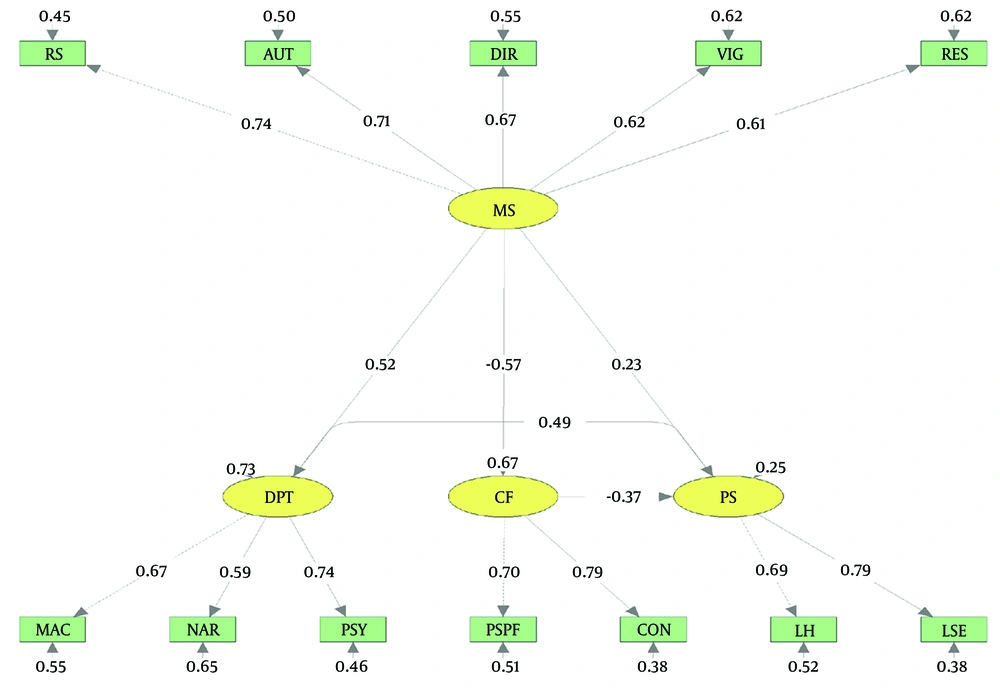
Figure 1.
Structural Equation Modeling Diagram Showing the Mediating Role of Dark Personality Traits and Cognitive Flexibility in the Relationship Between Early Maladaptive Schemas and Perceived Stress. MS: Maladaptive Schema; DPT: Dark Personality Traits; CF: Cognitive Flexibility; PS: Perceived Stress.
As can be seen in Table 7, the fit indices of the final model include the comparative fit index (0.96), the incremental fit index (0.97), the Tucker Lewis fit index (0.97), and the root mean square error of approximation (0.04), which indicate the optimal fit of the final model. So, the model presented in Figure 1 has a good fit.
Table 7.
Fit Indices
| Index | Obtained Value | Acceptable Level | Interpretation |
|---|---|---|---|
| χ² | 71/43 | Weak | |
| Df | 49 | + | Good |
| χ²/df | 1.44 | < 3 | Good |
| RMSEA | 0.04 | < 08 | Good |
| SRMR | 0.046 | < 08 | Good |
| CFI | 0.95 | >0.90 | Good |
| GFI | 0.96 | >0.90 | Good |
| AGFI | 0.93 | >0.90 | Acceptable |
| IFI | 0.97 | >0.90 | Good |
| TLI | 0.97 | >0.90 | Good |
| RFI | 0.91 | >0.90 | Acceptable |
| NFI | 0.97 | >0.90 | Good |
| PNFI | 0.69 | >0.50 | Acceptable |
| AIC | 18427.57 | Good | |
| BIC | 18533.69 | Good | |
| PCLOSE | 0.08 | >0.05 | Good |
Figure 1 shows the standard regression coefficients of the direct paths in the present study. As can be seen, the path of early maladaptive schemas to stress perception was significant with a coefficient of β = 0.23 and P = 0.016 (CI. Lower Estimate: 0.07, CI. Upper Estimate: 0.67). Also, the path of cognitive flexibility (β = -0.37, P = 0.01, CI. Lower Estimate: -0.19, CI. Upper Estimate: -0.47) and dark personality traits (β = 0.49, P = 0.01, CI. Lower Estimate: 0.24, CI. Upper Estimate: 0.64) to stress perception was also reported to be significant.
The mediating role of dark personality traits was found to be 0.22 and was statistically significant. Also, the indirect standardized coefficient of the path of early maladaptive schemas on stress perception through the mediator of cognitive flexibility was reported to be 0.21. The complete findings are presented in Table 8.
Table 8.
Standardized Regression Coefficients of Indirect Paths
| Path | Standardized Beta | Z | Significance Level | CI. Lower Estimate | , CI. Upper Estimate |
|---|---|---|---|---|---|
| Early maladaptive schemas → Dark personality traits → Perceived stress | 0.22 | 4.43 | 0.01 | 0.17 | 0.58 |
| Early maladaptive schemas → Cognitive flexibility → Perceived stress | 0.21 | 3.67 | 0.01 | 0.15 | 0.51 |
5. Discussion
The current study sought to evaluate the association between early maladaptive schemas and perceived stress, as well as the mediating role of psychological flexibility and dark personality dimensions in patients undergoing cardiac surgery. The findings of the study revealed that maladaptive schemas have a direct and significant effect on perceived stress. This finding is consistent with previous research indicating a relationship between early maladaptive schemas, stress, and anxiety (38, 39). The results of Babajani et al. (38) study showed that early maladaptive schemas were associated with emotion-focused and avoidance coping strategies. The results of a review study by Nicole et al. (39) showed that early maladaptive schemas are related to depression, anxiety, stress, and problematic behaviors. In explaining this finding, it can be said that schemas are basically associated with exaggeration and catastrophizing about events and, as a result, affect the individual’s ability to cope with the disease. As a result, the individual is always in a state of expectation and sensitivity to physical symptoms followed by anxiety and stress (40). Maladaptive schemas can affect regular life activities including interactions with friends and family. As a result, interpersonal conflicts worsen, causing greater tension and stress (41). Maladaptive schemas, on the other hand, including vulnerability to medical conditions, are related with catastrophizing about the disease. This catastrophizing has been associated with more stress and anxiety throughout one’s life (17).
Also, the findings showed that early maladaptive schemas are related to stress perception in patients undergoing cardiovascular surgery through the mediating role of psychological flexibility. This finding is consistent with studies that show a relationship between stress perception and early maladaptive schemas (40, 42), as well as the relationship between cognitive flexibility and stress perception. The results of Cámara et al.'s research (40) showed that abandonment, emotional deprivation, defectiveness, and failure schemas would interact with stressful events to predict depressive symptoms, whereas abandonment, vulnerability to harm, and dependence schemas were expected to moderate anxiety symptoms. Cudo et al. (42) showed in their research that early maladaptive schemas are related to the perception of emotional tension, interpersonal stress, and external stress. Early maladaptive schemas guide behavioral responses and distort information processing in such a way that it aligns with their content, which makes them rigid (43). According to the schema-based perspective, which takes a “bottom-up” approach, schemas serve as the foundation for cognitive functions such as cognitive flexibility. Schemas are basically long-lasting and resistant to change; therefore, when confronted with life’s challenges, such as illness, creative cognitive functions are weakened and despairing dogmatic attitudes are strengthened (44). Early maladaptive schemas impair memory and cognition, preventing the individual from properly processing information. This misleading analysis and inflexibility increase the likelihood of developing a variety of psychological issues, including stress and anxiety. In contrast, cognitive flexibility, as an effective response to medical conditions, makes it less challenging for individuals to accept the situation and, more importantly, facilitates the chosen coping style in individuals while reducing anxiety-induced coping responses (45). Cognitive flexibility is not a type of coping style, however, it does help individuals develop coping strategies for challenging and stressful situations, such as illness. As a result, cognitive flexibility leads to individuals making more beneficial decisions that do not jeopardize their mental and physical health, and having optimistic expectations in different circumstances that makes individuals less influenced by stress or stressors (46).
Another finding of this study was that early maladaptive schemas have been related to stress perception through the mediating role of dark personality characteristics. This conclusion is also consistent with earlier research (27, 47). According to the schema therapy perspective, primary maladaptive schemas are the core of psychological problems and personality disorders (17). Early maladaptive temperaments are important risk factors for psychopathology, especially personality disorders (48). For example, one of the most important problems in people with personality problems is ineffectiveness in managing emotions, which is based on two schemas: inadequate self-control and inability to inhibit emotions (49). Also, one of the important characteristics of people with dark personality dimensions is the existence of a kind of unpleasant expectations from the surrounding environment, which are essentially present in the nature of schemas such as Pessimism/Negativism and Disconnection/Rejection (49). Early maladaptive schemas emerge during development as a result of interactions with parents and unmet needs. These unmet demands can lead to the development of many personality traits and difficulties in adulthood. All schemas have cognitive origins, are formed in childhood, and persist throughout life, implying that they have an impact on how people interpret and respond to stressful events (17). Schemas typically work at an unconscious level, making people more susceptible to various psychological issues and influencing the dark traits of personality (50, 51). On the other hand, these dark aspects of personality are associated with stress and anxiety-related cognitive-behavioral patterns, which can exacerbate psychological problems and even lead to the emergence of physical health issues (27). Also, early maladaptive schemas are emotional and arousing in nature. For example, people with a distrust schema have a pessimistic attitude towards others and, for this reason, always perceive their surroundings as threatening. These characteristics are also prominently seen in people with dark personality traits. On the other hand, these dark personality traits are usually accompanied by a kind of constant alertness; a state that can lead to an increase in feelings of anxiety and stress (52). In fact, early maladaptive schemas are known as the main basis for personality pathology and affect the way an individual copes with life events. Unpleasant childhood experiences are the basis for the formation of these maladaptive personality schemas and attitudes in various dimensions. These schemes can change the way an individual interprets and reacts to different situations; in such a way that instead of perceiving situations as challenges, the individual perceives them as threats, and this is accompanied by the emergence of emotions such as anxiety and stress.
5.1. Conclusion
Maladaptive schemas act as a risk factor of stress in patients with cardiovascular surgery. According to the results of this study, it is suggested that in the treatment programs of cardiovascular patients with a history of surgery, attention should be paid to strengthening cognitive flexibility and modifying early maladaptive schemas as strategies to reduce dark personality traits and, consequently, reduce perceived stress. In addition to usual medical treatments for patients undergoing cardiovascular surgery, the conceptual model of schema therapy can be used to explain patients how stress and its physical and psychological mechanisms exacerbates the process of cardiovascular disease. Then, using the theoretical foundations of this approach and how schemas such as alertness and uncertainty exacerbate the experience of stress, the role of schemas in the formation of stress is explained. Also, it explains the logic of the schema and how childhood experiences and early environment contribute to the formation of these schemas. To access repressed emotions and experience emotions that schemas direct in a maladaptive way. Using important techniques such as the "child pose," individuals confront their schemas and repair them within the context of the relationship with the therapist. In this situation, the patient comes to the realization that expressing emotions as he or she expected as a child will not lead to disaster. Also, in a therapy session, schemas such as "worrying prevents unpleasant events" that play an important role in feelings of stress are empathetically challenged using cognitive techniques. As a result, the individual comes to understand that these types of schemas are not representations of reality, but rather have their roots in their early relationships in the family environment. However, the current environment and adulthood are different, so it is not necessary for these maladaptive schemas to continue. Also, it is important to consider problematic personality dimensions in the formation of tension and anxiety, which exacerbate cardiovascular problems. On the other hand, since the theoretical perspective of schema therapy is an approach that has a comprehensive application for patients with personality problems, using the schema therapy approach can be an effective approach for improving personality problems and subsequently improving stress-related problems.
5.2. Limitations
Despite the study’s interesting findings, there are some limitations that should be noted before generalizing the results. First, this study was conducted cross-sectionally; therefore, precise causal inferences cannot be drawn from its results. Second, the study’s statistical population consisted of patients undergoing cardiovascular surgery, and the special characteristics of this group may restrict the generalizability of the findings to other groups. In addition, the data collection instrument was a questionnaire, and the participants’ responses may have been influenced by factors such as fatigue or their physical condition. Another limitation of this study was the lack of control over demographic variables. As a result, it is recommended that future studies include a variety of population groups as well as more unbiased and reliable measurement instruments. Also, it is suggested that alternative models be examined in future research.