
1. Background
School avoidance is an increasing concern among adolescents (1) and represents an interdisciplinary public health issue with potentially adverse effects on individuals, families, and society (2). The term school avoidance refers to adolescents who intentionally refrain from attending classes or school (3). School avoidance is a serious problem that, if persistent, is associated with a range of adverse individual outcomes, including poor academic performance, increased psychological problems (4), substance use (5), bullying behaviors, victimization, self-harming tendencies (6), and suicidal behaviors (7).
Moreover, the prevalence of school avoidance is increasing in many countries. This is a particularly serious educational issue in Iran, especially among adolescents, because the highest rates of school dropout have been observed among adolescents and high school students, with an increase of approximately 17% between 2013 and 2023 (8). In fact, the transition to high school is one of the most critical educational periods (9), during which rates of school avoidance are highest (10). Therefore, understanding the etiology of these behaviors is essential. Because completing education is a cornerstone of successful employment and a healthy transition into adulthood, addressing school avoidance and its underlying causes is particularly important (4).
Research has shown that school avoidance and declines in academic performance are fundamentally influenced by the quality of an individual’s psychological adjustment (11). Psychological adjustment refers to an individual’s ability to adapt to the environment and can be expressed in various domains, including social, occupational, family, and personal dimensions (12). In fact, school avoidance can represent a coping strategy for psychological problems and stress experienced by the individual (13). Individuals with poor psychological adjustment generally encounter challenges in peer relationships at school and in academic performance. Furthermore, poor psychological adjustment may contribute to various psychological disorders, such as anxiety, depression, and severe stress, all of which contribute to poor school adaptation and dropout (14).
The quality of psychological adjustment is strongly influenced by individuals’ social networks, particularly their relationships with family members (15-17). Individuals who lack family support or experience dysfunctional family relationships are more likely to experience various psychological issues, including anxiety, stress, and depression (15, 18, 19), substance abuse (20), and poor academic performance (21). This association is particularly evident during adolescence, a developmental stage in which family-related issues and a lack of family support are closely linked to psychological maladjustment (15). In contrast, family support and healthy family functioning are associated with improved psychological well-being and, consequently, enhanced academic achievement in adolescents (22).
The family serves as a secure protective base for adolescents and helps them cope with the tensions they face. Thus, family support can effectively mitigate the effects of life stressors. Adolescent psychological problems may indicate poor family functioning or inadequate family support (15). A lack of family support may lead to the formation of rejected peer groups (23) and, consequently, a tendency toward avoidant behavior and school avoidance (24, 25).
In addition to family-related factors, another major factor associated with academic enthusiasm in students, particularly adolescents, is the quality of the teacher-student relationship and students’ evaluation of this relationship (26). Previous findings have shown that appropriate teacher-student relationships, along with parental support, can improve students’ psychological functioning, commitment to school, enthusiasm for learning, and school adjustment (26, 27). Students with lower grades tend to perceive their teachers as unsupportive and the school itself as an unpleasant, meaningless, and even hostile environment (28).
Although previous research has examined psychological adjustment, the quality of teacher-student communication, and family support in relation to academic problems and avoidance, these factors have not yet been investigated using a comprehensive structural equation modeling approach. Furthermore, because educational issues have become a major concern in Iran, examining the causes of school avoidance and dropout among adolescents is of high importance. Therefore, the present study aimed to evaluate the effect of perceived family support and the quality of teacher-student communication on school avoidance, as well as the mediating role of psychological adjustment.
2. Objectives
This study aimed to predict students' school avoidance based on perceived family support and the teacher–student relationship, with psychological adjustment as the mediating variable.
3. Methods
3.1. Participants
Sampling was conducted using a convenience sampling method. The sample size was determined using relevant procedures, including Soper's formula, which considered the latent and observed variables, a probability level of 0.05, a test power of 0.80, an expected effect size of 0.20, and a sample size of 296 (29). In addition, according to Bentler's formula, which recommends 10 to 20 participants per indicator, the sample size for this study with 9 indicators was 180 participants (30). However, the sample size was increased to 351 participants to compensate for possible attrition and to obtain more accurate results.
A total of 351 participants took part in the study; 32 were excluded from the analysis because of incomplete questionnaires. Therefore, the analysis was conducted on 319 participants. The statistical population included all high school adolescents in Tehran. The participants were selected from four schools: Shahid Mofatteh Boys' School, Seyyed Razi Boys' School, Iran Girls' School, and Zohreh Bonyan Girls' School.
3.2. Tools
Demographic Information Form. The demographic variables in this study included age, gender, educational level, father's education, mother's occupation, and field of study.
3.2.1. School Avoidance Questionnaire (SAQ)
Khormaei and Saleh Ardestani (31) developed this 20-item scale. The items were based on interviews with students and subsequent content analysis. Factor analysis indicated that the scale comprised two subscales: school aversion and school avoidance. Items 2, 4, 6, 7, 9, 16, 17, 18, 19, and 20 measure school aversion, and items 1, 3, 5, 8, 10, 11, 12, 13, 14, and 15 measure school avoidance. Each item is rated on a 5-point Likert scale, ranging from 1 (completely disagree) to 5 (completely agree). Total scores range from 20 to 100, with higher scores indicating greater school avoidance. In the initial study, Khormaei and Saleh Ardestani (31) conducted exploratory factor analysis on a sample of 237 students and identified two factors, which they named school aversion and school avoidance. They reported Cronbach's alpha values of 0.93, 0.92, and 0.83 for the overall scale, the school aversion subscale, and the school avoidance subscale, respectively. In the present study, the Cronbach's alpha for this questionnaire was 0.83.
3.2.2. Inventory of Teacher-Student Relationships (IT-SR)
This scale was developed by Murray and Zvoch in 2011. It comprises 17 items and three subscales: relationship, trust, and alienation. Items are scored on a 4-point scale (1 = never, 2 = sometimes, 3 = most of the time, and 4 = always). To obtain each subscale score, the relevant item scores are summed. To calculate the overall questionnaire score, all item scores are summed. In the study by Murray and Zvoch (32), Cronbach's alpha coefficients for the relationship, trust, and alienation subscales were 0.89, 0.84, and 0.72, respectively. The convergent validity of this questionnaire was 0.41. In Iran, the questionnaire was standardized by Mansouri Nejad et al. (33). Reliability was examined using Cronbach's alpha, and the Cronbach's alpha coefficient for the entire scale was 0.83. The convergent validity of this scale was 0.37. In the present study, the Cronbach's alpha for this questionnaire was 0.81.
3.2.3. Parental Support Scale (PSS)
This scale was developed by Fall and Roberts (34) and consists of 6 items. Items are rated on a 3-point Likert scale, with higher scores indicating greater parental support. The Cronbach's alpha reliability of this scale was 0.83, and its convergent validity was 0.40. This questionnaire was standardized by Ardestan in Iran, and its Cronbach's alpha reliability and convergent validity were 0.78 and 0.31, respectively (31). In the present study, the Cronbach's alpha for this questionnaire was 0.76.
3.2.4. Adjustment Inventory for School Students (AISS)
Sinha and Singh developed the Adjustment Inventory for School Students (AISS) in 1993 to evaluate student adjustment. This questionnaire includes 60 questions and three subscales: emotional, social, and educational adjustment. Questions are answered with yes (1) or no (0). The total questionnaire score indicates the individual's adjustment status, with higher scores indicating greater psychological adjustment problems. The reliability coefficients, assessed using the test-retest and Richardson coder methods, were 0.93 and 0.94, respectively (35). Navidi examined the psychometric properties of this questionnaire in Iranian society and reported a reliability coefficient of 0.82 for the total scale and a convergent validity of 0.45.
3.3. Procedure
After obtaining the ethics code from Garmsar Azad University, participants were selected from four schools. Male volunteers were recruited from Shahid Mofatteh Boys' School and Seyyed Razi Boys' School, whereas female participants were recruited from Iran Girls' School and Zohreh Bonyan Girls' School. After coordination with the school principals and obtaining informed consent from the students and their parents, the questionnaires were distributed to the volunteers.
The inclusion criteria were being a student, no substance abuse, and no psychiatric disorders that interfered with the individual's perception of reality, including bipolar disorder and schizophrenia. These criteria were assessed using parental reports, students' school files, and self-report sources. Exclusion criteria included substance misuse, incomplete questionnaires, and the use of psychiatric drugs.
3.4. Ethical Considerations
The research ethics committee of the Islamic Azad University, Garmsar Branch, approved this study under the ethical code IR.IAU.SEMNAN.REC.1404.081. Participants were provided with information regarding the confidentiality of their personal data.
3.5. Data Analysis
The collected data were analyzed using R and SPSS version 26. Pearson correlation coefficients were used to evaluate correlations among the study variables, and structural equation modeling (SEM) was used to examine the direct and indirect effects of the variables.
4. Results
The study included 319 participants, with a mean age of 16.45 years. Additional demographic characteristics are presented in Table 1.
Table 1.
Frequency Distribution of Participants' Gender, Parents' Education, and Parents' Occupation
| Variables | No. (%) |
|---|---|
| Gender | |
| Female | 179 (56) |
| Male | 140 (44) |
| Total | 319 (100) |
| Father’s education | |
| Diploma or below | 98 (30) |
| Bachelor | 114 (35) |
| Master | 91 (28) |
| PhD | 10 (7) |
| Total | 319 (100) |
| Father’s occupation | |
| Employed | 298 (93) |
| Unemployed | 21 (7) |
| Mother’s occupation | |
| Housewife | 203 (63) |
| Employed | 116 (37) |
The correlation results are presented in Table 2. As shown, perceived family support and the teacher-student relationship were significantly correlated with school avoidance (criterion variable) and psychological adjustment (mediating variable). In addition, psychological adjustment, as the mediating variable, was significantly correlated with school avoidance.
Table 2.
Correlations Between Research Variables
| Variables | 1 | 2 | 3 | 4 | 5 | 6 | 7 | 8 | 9 | 10 | 11 |
|---|---|---|---|---|---|---|---|---|---|---|---|
| Teacher-student relationship | |||||||||||
| Trust | 0.70 a | ||||||||||
| Confidence | 0.82 a | 0.33 a | |||||||||
| Alienation | 0.71 a | 0.35 a | 0.38 a | ||||||||
| Parental support | 0.02 | 0.03 | 0.03 | 0.07 | |||||||
| Psychological adjustment | -0.30 a | -0.22 a | -0.23 a | -0.26 a | -0.32 a | ||||||
| Affective | -0.23 a | -0.18 a | -0.14 b | -0.24 a | -0.32 a | 0.76 a | |||||
| Educational | -0.21 a | -0.11 b | -0.16 a | -0.20 a | -0.20 a | 0.77 a | 0.37 a | ||||
| Social | -0.24 a | -0.21 a | -0.19 a | -0.14 a | -0.19 a | 0.72 a | 0.33 a | 0.34 a | |||
| School avoidance | -0.32 a | -0.24 a | -0.24 a | -0.25 a | -0.32 a | 0.41 a | 0.32 a | 0.26 a | 0.34 a | ||
| Escape | -0.21 a | -0.12 b | -0.16 a | -0.20 a | -0.30 a | 0.33 a | 0.28 a | 0.22 a | 0.25 a | 0.83 a | |
| Aversive | -0.34 a | -0.28 a | -0.26 a | -0.23 a | -0.28 a | 0.39 a | 0.29 a | 0.25 a | 0.34 a | 0.93 a | 0.57 a |
a P < 0.01.
b P < 0.05.
Before performing structural equation modeling, the assumptions for this analysis were examined. Skewness and kurtosis tests were used to assess normality. Table 3 shows that the skewness and kurtosis values for the study variables ranged from -2 to +2, indicating a normal distribution. To assess non-collinearity, tolerance coefficients and variance inflation factors were analyzed. The findings indicated no collinearity among the predictor variables.
Table 3.
Skewness, Kurtosis, Tolerance, and Variance Inflation Factor
| Variables | Skewness | Kurtosis | Tolerance | VIF |
|---|---|---|---|---|
| Teacher-student relationship | -0.13 | -0.20 | 0.78 | 1.27 |
| Trust | -0.14 | -0.03 | 0.80 | 1.23 |
| Confidence | -0.26 | -0.36 | 0.76 | 1.31 |
| Alienation | 0.17 | 0.03 | 0.75 | 1.32 |
| Parental support | 0.005 | -0.22 | 0.86 | 1.15 |
| Psychological adjustment | -0.05 | 0.06 | 0.89 | 1.12 |
| Social | -0.08 | 0.006 | 0.79 | 1.25 |
| Affective | 0.14 | 0.037 | 0.73 | 1.35 |
| Educational | -0.30 | -0.02 | 0.78 | 1.27 |
| School avoidance | -0.02 | 0.282 | 0.79 | 1.25 |
| Aversive | 0.05 | 0.26 | 0.67 | 1.49 |
| Escape | -0.15 | -0.36 | 0.67 | 1.49 |
The results of the confirmatory factor analysis (CFA), average variance extracted (AVE), composite reliability (CR), and standardized factor loadings for the components of each questionnaire are presented in Table 4.
Table 4.
Results of Confirmatory Factor Analysis
| Variables and Subscale | Standardized Factor Loading | Z-Value | P-Value | AVE | CR |
|---|---|---|---|---|---|
| Teacher-student relationship | 0.60 | 0.81 | |||
| Confidence | 0.61 | 6.28 | 0.001 | 0.59 | 0.74 |
| Trust | 0.56 | 5.54 | 0.009 | 0.54 | 0.72 |
| Alienation | 0.62 | 6.67 | 0.001 | 0.60 | 0.78 |
| Psychological adjustment | 0.59 | 0.79 | |||
| Social | 0.57 | 5.81 | 0.008 | 0.55 | 0.75 |
| Affective | 0.56 | 5.61 | 0.009 | 0.53 | 0.82 |
| Educational | 0.64 | 6.89 | 0.001 | 0.60 | 0.71 |
| School avoidance | 0.76 | 0.83 | |||
| Escape | 0.82 | 9.05 | 0.001 | 0.81 | 0.81 |
| Aversive | 0.70 | 7.65 | 0.001 | 0.67 | 0.74 |
Structural equation modeling was used to examine the relationships among perceived family support, the teacher-student relationship, psychological adjustment, and school avoidance. Figure 1 shows the results of this model.
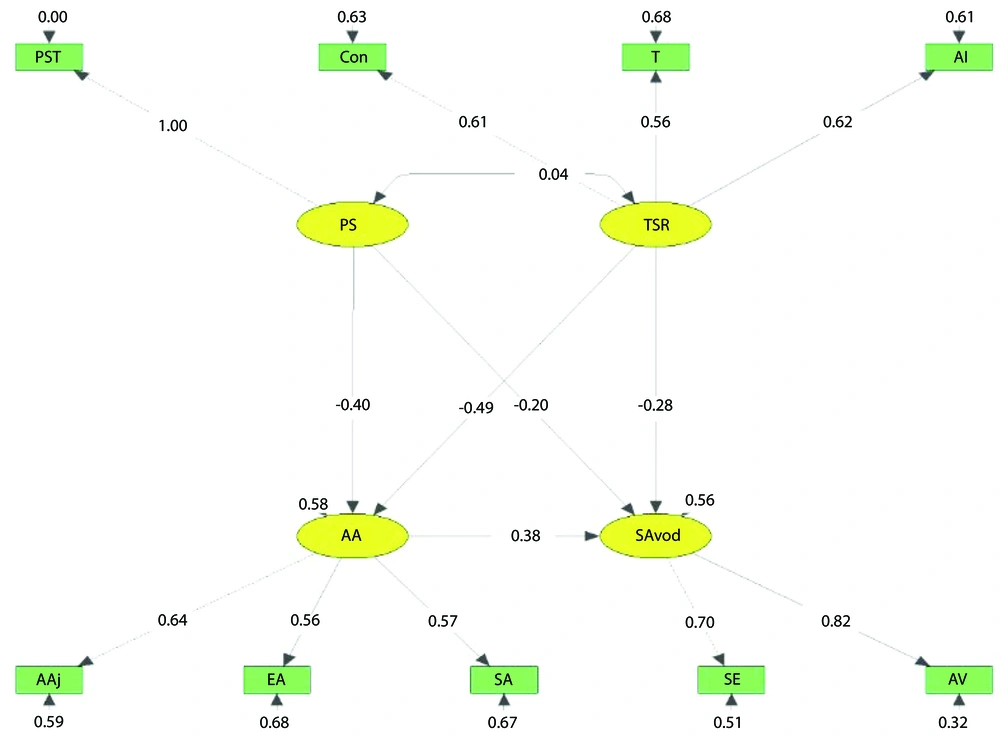
Figure 1.
Conceptual model of the study and standardized regression coefficients of the model.
The fit indices indicated that the research model had a good fit (Table 5).
Table 5.
Fit Indices of the Conceptual Model
| Index | Obtained Value | Acceptable Level | Status |
|---|---|---|---|
| CFI | 0.98 | > 0.90 | Good |
| GFI | 0.98 | > 0.95 | Good |
| AGFI | 0.95 | > 0.90 | Good |
| RMSEA | 0.03 | < 0.08 | Good |
| RFI | 0.91 | > 0.90 | Acceptable |
| IFI | 0.98 | > 0.90 | Good |
| NFI | 0.94 | > 0.90 | Good |
| χ²/DF | 2.45 | < 3 | Acceptable |
| SRMR | 0.047 | < 0.05 | Acceptable |
The standardized beta coefficients indicated that the effects of perceived family support, the teacher-student relationship, and psychological adjustment on school avoidance were -0.28, -0.20, and 0.38, respectively, and were statistically significant (Table 6).
Table 6.
Results of Direct Relationships
| Path | Standardized Coefficients | CI Lower | CI Upper | Z | P-value |
|---|---|---|---|---|---|
| Teacher-student relationship → school avoidance | -0.28 | -0.56 | -0.08 | -2.68 | 0.007 |
| Family support → school avoidance | -0.20 | -0.31 | -0.02 | -2.62 | 0.009 |
| Psychological adjustment → school avoidance | 0.38 | 0.21 | 0.67 | 3.14 | 0.002 |
| Teacher-student relationship → psychological adjustment | -0.49 | -0.61 | -0.21 | -5.64 | 0.001 |
| Family support → psychological adjustment | -0.40 | -0.71 | -0.19 | -4.32 | 0.001 |
In addition, the indirect standardized coefficients indicated that the effects of perceived family support and the teacher-student relationship on school avoidance through the mediating role of psychological adjustment were -0.15 and -0.18, respectively, and were statistically significant (Table 7).
Table 7.
Results of Indirect Relationships
| Path Direction | Standardized Coefficients | CI Lower | CI Upper | Z | P-value |
|---|---|---|---|---|---|
| Perceived parental support → psychological adjustment → school avoidance | -0.15 | -0.39 | -0.09 | -2.03 | 0.01 |
| Teacher-Student Relationship → Psychological Adjustment → School Avoidance | -0.18 | -0.36 | -0.06 | -2.84 | 0.01 |
5. Discussion
The present study aimed to examine the prediction of school avoidance based on high school students' perceptions of family support and the quality of teacher-student relationships. The results indicated that psychological adjustment plays a significant role in predicting school avoidance. This finding is consistent with those of previous similar studies (24, 36). Psychosocial adjustment is a multidimensional construct encompassing emotional, social, and educational dimensions (35). Students with poor adjustment not only experience greater emotional difficulties but also struggle to communicate and cooperate with peers in school and classroom environments and lack sufficient motivation to learn (13, 37, 38). Therefore, poor psychological adjustment exacerbates the tendency toward school avoidance.
Adequate psychological adjustment is also usually accompanied by a sense of self-efficacy, which enables individuals to act effectively when facing academic and life challenges and to resolve these challenges (39). This factor may reduce the likelihood of school avoidance-related behaviors. Conversely, poor academic achievement and school avoidance are often associated with various psychological problems, such as morning anxiety (4, 40), fear of separation from parents (41), perceiving the school environment as threatening, low motivation for learning, and poor communication with peers (42). These issues are more common among individuals with poor psychological adjustment.
Another finding of this study showed that perceptions of family support, through the mediating role of psychological adjustment, significantly predicted school avoidance among high school students. This finding is consistent with studies demonstrating a significant role of family functioning and family support in predicting school avoidance or dropout (15, 43). Poor and unsupportive family functioning is generally associated with various psychological problems (44), and this co-occurrence significantly reduces the likelihood of academic adjustment and academic achievement (45, 46).
Chaotic and unsupportive families appear to influence adolescent adjustment and, consequently, problematic academic behaviors in two main ways. First, the family, as a source of stress, negatively affects the adolescent's emotional life, thereby increasing the likelihood of emotional difficulties. Second, such families influence the adolescent's motivation and desire for socialization, which in turn affects social life, an important dimension of psychological adjustment. Weakening these two dimensions of adjustment increases the likelihood of school-related problem behaviors (15). In addition, families with a positive and supportive psychological atmosphere usually have children with more secure and adaptive attachment styles (47). This secure attachment style is associated with more adaptive social relationships with peers and teachers in the school environment and, consequently, reduces the likelihood of maladaptive behaviors such as bullying or school avoidance (48, 49).
Another finding of this study indicated that the quality of the teacher-student relationship, through the mediating role of psychological adjustment, plays a significant role in predicting school avoidance. This finding is consistent with previous studies (26, 50). Classrooms are not only environments for learning but also appropriate settings for developing interpersonal relationships. In this context, teachers and the quality of their relationships with students play a fundamental role and have a significant impact on many aspects of students' academic and personal lives. Students who experience positive and constructive relationships with their teachers typically show greater interest in school activities and higher motivation to learn (27, 51).
Furthermore, optimal teacher-student communication, particularly in terms of emotional support, is associated with the development of adaptive social and communication skills and psychological well-being among students, which are important constructs contributing to psychological adjustment (52). Improved social relationships and psychological well-being, in turn, are associated with greater interest in learning and greater involvement in school activities. When the teacher acts as a "secure base" for students by being accessible, responsive, and receptive to their needs in a timely manner (53), students tend to feel more competent (54), show greater interest in learning, establish better relationships with peers, and experience better mental health. All these factors are associated with improved school behaviors (53).
Given the significant predictive roles of family support and the teacher-student relationship, as well as their significant associations with the criterion variable, school avoidance, these two constructs appear to represent independent yet influential sources affecting school avoidance. The bases and sources of school avoidance can be divided into two distinct factors: factors outside school, the most important of which is the family (44), and factors inside school, namely the quality of the relationship with the teacher (52). Therefore, it is logical that these two factors, despite being distinct, are related to school avoidance. A student may experience an unpleasant family relationship and may not receive the necessary emotional support from the family. However, a positive relationship with the teacher, as an important figure in the student's communication network, and appropriate social support from school may serve as social reinforcement and reduce school avoidance behavior. In this regard, the school environment and the teacher-student relationship can function as reliable sources of emotional and psychological support for the student.
6.1. Conclusion
In light of these findings, family support and effective teacher-student communication play important and beneficial roles in psychological adjustment and in improving students' behaviors in the school environment. Therefore, psychological interventions addressing academic problems and school avoidance behaviors can focus on two main bases: families, through psychotherapists, and teachers, through school counselors. These factors are important for addressing students' psychological challenges. The family, as individuals' first social base, can pave the way for students' academic progress. Therefore, efforts to improve the family's relationship with students may facilitate students' interest in education.
6.2. Limitations
Despite these findings, the present study has limitations that should be considered when generalizing the results. First, the sample was selected conveniently; therefore, because of the non-random sampling method, it may not be representative of the adolescent population in other cities and provinces of the country. Second, this study was conducted cross-sectionally, and the sample included high school students from the general population. Therefore, future longitudinal studies are recommended, focusing on other populations, such as exceptional students, other provinces and cultures, and other age groups.