1. Background
In recent years, the concept of engagement in educational environments has been the focus of many researchers. Engaging students and focusing their attention on subjects has always been one of the most important challenges of teaching. The poor engagement of students in academic activities in the classroom and school can most likely lead to academic failure and negatively affect their academic and career future (1).
Academic engagement is a multidimensional construct that different theorists have conceptualized in different ways and considered different dimensions for it (2). The concept of academic engagement refers to the quality of effort that students make in order to achieve predetermined academic goals in order to reach acceptable results in a direct way, and in general, this concept focuses on the role of self-awareness in studying, designing Metacognitive beliefs and self-regulation are emphasized (3). Academic engagement includes emotional components (enjoying and being interested in the upcoming challenges in academic situations), cognitive (mental readiness to learn different subjects) and behavioral components (attending school and complying with the regulations of the educational environment) (4).
Students who have high academic engagement show positive characteristics. They go to school regularly and have good academic progress. Low academic engagement causes a lack of creativity and initiative, and when faced with academic problems, it causes not trying and abandoning assignments (5).
Various researches have investigated the influencing variables on academic engagement. Among the researches of Lam et al. (6) and Moltafet et al. (7) who came to the conclusion that academic engagement is directly, positively and significantly affected by the perception of classroom structure.
The classroom environment is one of the important areas of students' lives; Because they spend most of their time in school. The classroom environment refers to the psychological climate and the physical form of the school (8). The classroom environment reflects how a teacher's method is to liberate students, prepare them for learning, change students' attitudes towards school and society, the accuracy and sensitivity of teaching classroomes and their effective learning conditions (9).
It is the students' perception of the target structure of the school or classroom that affects their behaviors and responses. In other words, these perceptions are different according to students' experiences in school (teachers' evaluation) or outside of it (parents' opinion). This is the reason why sometimes students will have different experiences in the same educational environment (10). The classroom environment is a space or situation where learners or teachers interact with each other and benefit from various tools and information sources to pursue learning activities. When students get a positive perception of their classroom environment, they will perform better and have more positive attitudes towards their learning (11). Also, the results of the conducted research show a positive and significant relationship between the perception of the class structure and the experience of different emotions (12).
Emotional self-regulation is a skill that gives students the ability to regulate emotions and express the experience of emotions and helps them to regulate emotional arousal and negative emotions, understand the emotions of others and deal with it effectively, which will lead to success and efficiency in different areas of life (13). Emotional self-regulation happens when people monitor the emotions they experience and try to modify or manipulate them. This process can be automatic or effortful, as well as conscious or unconscious (14).
Hofmann and Kashdan (15) introduced three emotion self-regulation styles, which are concealing style, adjusting style, and tolerating style. The results of some researches, including the research of Mesan Esfangareh and Hosseinzadeh (16), indicate a positive and significant relationship between emotional self-regulation and academic self-efficacy. Beliefs related to self-efficacy (educational, social and emotional) play an important role in the development of emotion management and regulation and are of great importance (17).
Self-efficacy expresses expectations and judgments about a person's personal competence and is one of the most important control mechanisms of self-regulatory behavior (Bandura, 2015). The concept of self-efficacy refers to people's beliefs about their capabilities and abilities to organize and perform a specific action (18). Self-efficacy in the educational framework, that is, academic self-efficacy, is defined as students' belief and self-confidence in their ability to succeed in academic tasks, and it is considered one of the reliable predictors of positive academic results (19).
The results of Mikaeeli et al.'s research (20) showed that the perception of classroom structure has a direct and significant effect on academic self-efficacy, which is in line with the results of Singley et al.'s research (21). Also, the research findings of Sharifzadeh et al. (22) indicated the effectiveness of emotional regulation on academic self-efficacy. On the other hand, the results of Azfandak and Azad Abdolahur's research (23) indicated that academic self-efficacy is a predictor of academic engagement, which was in line with the findings of Lavasani et al. (24). On the other hand, the results of Dincer et al.'s research (25) showed that the classroom atmosphere has an effect on the academic engagement of students, which was in line with the findings of Moltafet et al.'s research (7).
According to the study of recent researches in the field of academic engagement, the researchers of the current research reached a proposed conceptual model which can be seen in the Figure 1.
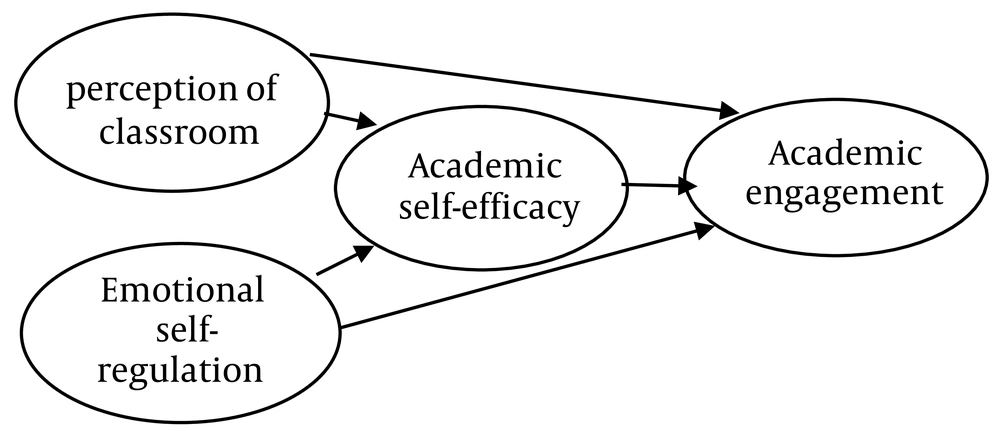
Figure 1.
Hypothetical model of the researcher regarding the relationship between variables
2. Objectives
Developing a causal model of academic engagement based on the perception of classroom structure and emotional self-regulation with the mediating role of academic self-efficacy.
3. Methods
Considering its purpose, the method of the present research is fundamental and considering that there was no intervention in the creation of data, it is descriptive of the correlation type. Also, this research is a type of structural equation modeling, and its purpose is to investigate the relationship between exogenous and endogenous hidden structures in the model. The statistical population of the research was all the female students of the second year of high school in the 1st and 2nd districts of Sanandaj city in the academic year of 2021 - 2022. Some experts have suggested that the required sample size should be at least three times the number of items in the questionnaires (26).
The four questionnaires used in this research had a total of 98 questions. However, the size of the statistical sample in this research was 5 times the total number of items in the questionnaires, which was 500 people. Considering the spread of people in the statistical population in different schools and fields of study using the cluster sampling method, respecting the ratio of branches and fields of study and paying attention to the dispersion of schools in different privileged and deprived urban areas, the samples were selected from girls' schools. SPSS-19 and Smart-PLS-3 software were used for data analysis. The tools used in this research are introduced below.
3.1. Academic Engagement Questionnaire (AEQ)
This questionnaire, which was prepared and edited by Reeve & Tseng (27), has 22 items and four subscales of active involvement (5 items), behavioral (5 items), cognitive (8 items) and emotional (4 items). be Subjects answer each item with a 5-point Likert scale (from completely disagree to completely agree). Reeve & Tseng (27) calculated the validity of this questionnaire through construct validity and using confirmatory factor analysis and reported it as favorable. Also, Naghsh and Ramezani Khamsi (12) in their research on the Iranian sample calculated the construct validity of this questionnaire using confirmatory factor analysis and reported that all the items have significant factor loadings and were loaded on their respective factors. In addition, Cronbach's alpha coefficient was used to calculate reliability, and its value was reported as 0.92 for the entire questionnaire. The value of this coefficient was calculated as 0.91 in Reeve & Tseng's research (27). In this study, the total Cronbach's alpha was 0.89.
3.2. Classroom Environment Scale (ES-RS)
This scale was prepared by Hoffman and Kashdan (15), which has 20 items and 3 subscales (concealing: 8 items, adjusting: 7 items and tolerating: 5 items). Each item is graded on a 5-point spectrum (from: Not at all true for me = 1 to infinitely true for me = 5). The range of scores is between 20 and 100. Hoffman and Kashdan (15) reported the reliability of this questionnaire based on Cronbach's alpha coefficient equal to 0.81 and for the subscales of concealing: 0.70, adjusting: 0.75 and tolerating: 0.50. After translation and re-translation, the said questionnaire was given to the relevant psychology experts in terms of content validity, and its validity was confirmed. In Narimani et al.'s research (28), after collecting the data, factor analysis method was used to verify the validity of the construct, and the reliability of the subscales of concealing, adjusting, and tolerating were based on Cronbach's alpha coefficient was 0.75, 0.8 and 0.55, respectively, and the total reliability was 0.85. In the present study, Cronbach's alpha was calculated as 0.84.
3.3. Classroom Environment Scale
The classroom perception scale was created by Blackburn (29), which has 26 items and three subscales of motivational tasks (11 items), autonomous support (5 items) and skill evaluation (10 items). Each item is graded on a 5-point spectrum (Completely disagree = 1 to Completely agree = 5). The range of scores is between 26 and 130. Hejazi et al. (30) used confirmatory factor analysis for construct validity and reported goodness of fit index GFI = 0.92, AGFI = 0.89 and SRMR = 0.06. These goodness of fit indices confirmed the perfect fit of the model with the observed data. Also, they (2008) showed Cronbach's alpha of these three scales as 0.71, 0.86 and 0.68 respectively. In the present study, the value of this coefficient was calculated as 0.78.
3.4. Academic Self-efficacy Scale (ASS)
This scale was developed by Jinks and Morgan (31). This 30-item scale is scored based on a 4-point Likert scale (Completely agree, somewhat agree, somewhat disagree, and completely disagree). The range of scores is between 30 and 120. This questionnaire includes three components: Talent, Effort and Context. The creators of this questionnaire have reported the overall reliability coefficient as 0.82 and the alpha coefficient for the subscales of talent, texture and effort as 0.78, 0.70 and 0.66 respectively. Karimzadeh and Mohseni (32) in their research entitled “Evaluation of the relationship between academic self-efficacy and academic achievement” found a reliability coefficient of 0.76 for overall academic self-efficacy and 0.66 for talent structure, 0.65 for effort structure and 0.60 for texture structure. In the present study, Cronbach's alpha coefficient was calculated as 0.73.
4. Results
The statistical sample of the present study included 500 female students of the second period of high school in District 1 and District 2 of Sanandaj city, who were studying in the academic year of 2021 - 2022. The mean and standard deviation of the total age of the students were 17.54 and 0.637, respectively.
Table 1 presents the frequency distribution of demographic information. According to Table 1, of the total statistical sample of the present study, 82.2% were studying in governmental schools and 17.8% were studying in non-governmental schools. Also, the highest frequency of GPA of students was in the 14 - 16 class and the lowest frequency was related to the 18 - 20 class. In addition, the frequency of age and educational level is almost equally distributed in the classes.
Table 1.
Frequency Distribution of Demographic Information
| Class | Year | Grade | GPA | Type of School | ||||||||
|---|---|---|---|---|---|---|---|---|---|---|---|---|
| 16 - 17 | 17 - 18 | 18 - 19 | First | Second | Third | -14 | 14 - 16 | 16 - 18 | 18 - 20 | Governmental | Non-governmental | |
| Frequency | 167 | 164 | 169 | 163 | 170 | 167 | 129 | 147 | 138 | 86 | 411 | 89 |
| Percentage | 33.4 | 32.8 | 33.8 | 32.6 | 34 | 33.4 | 25.4 | 29.4 | 27.6 | 17.2 | 82.2 | 17.8 |
Descriptive information related to the measured variables is given in Table 2. According to Table 2, the mean and standard deviation for the variables of academic engagement are 87.37 (21.27), perception of classroom structure 94.61 (24.57), emotional self-regulation 73.87 (18.31) and for academic self-efficacy 87.45 (18.60), respectively. It is also seen in this table that there is a positive and significant correlation between academic engagement and the perception of class structure (0.794), academic engagement and emotional self-regulation (0.774), academic engagement and academic self-efficacy (0.732), perception of classroom structure and emotional self-regulation (0.853), perception of classroom structure and academic self-efficacy (0.811) and between emotional self-regulation and academic self-efficacy (0.778).
Table 2.
Mean ± Standard Deviation and Correlation of the Examined Variables
| Variables | Mean ± SD | 1 | 2 | 3 | 4 |
|---|---|---|---|---|---|
| Academic engagement | 87.37 ± 21.27 | 1 | |||
| Perception of classroom structure | 94.61 ± 24.57 | 0.794 a | 1 | ||
| Emotional self-regulation | 73.87 ± 18.31 | 0.774 a | 0.853 a | 1 | |
| Academic self-efficacy | 87.45 ± 18.60 | 0.732 a | 0.811 a | 0.778 | 1 |
a P < 0.01
Considering that the required sample size for modeling is at least 5 and maximum 15 samples for each observation or question (26) and there were 98 questions in the questionnaires of this research, so the minimum sample size required there were about 500 people and finally the same number was studied.
In the process of analyzing the compiled model, first, all 98 items of the questionnaires used in the research were entered into the model. Also, perception of classroom structure, emotional self-regulation and academic self-efficacy were considered as three components and academic engagement as four components, all of which are reflective variables. Figure 2 shows the path diagram along with the standard coefficients in the initial model. As seen in Figure 2, the path of academic self-efficacy to academic engagement shows a value of 0.095, which is a weak coefficient and is not reliable. Therefore, in the following, by examining the T score, we will be aware of the significance of the paths.
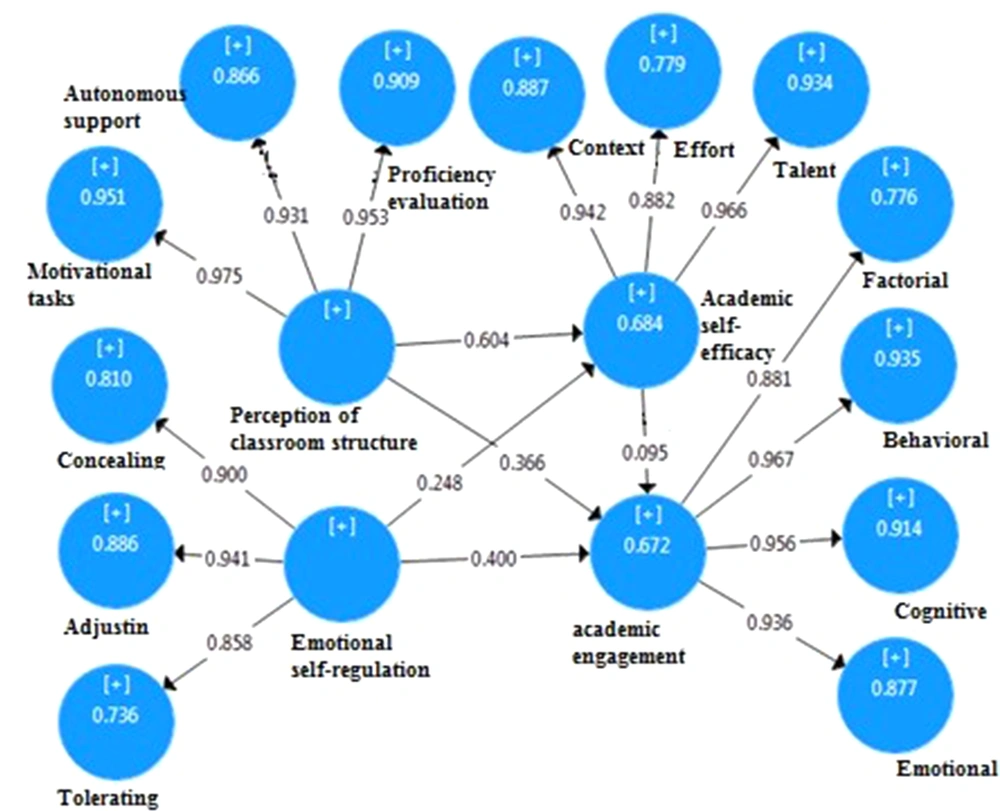
Figure 2.
Path diagram along with standard coefficients in the initial model
Figure 3 shows the path diagram along with T coefficients in the initial model. According to the T coefficients in Figure 3, the path of academic self-efficacy to academic engagement, whose T score is 1.799 and less than 1.96, was not significant. Therefore, to reach the appropriate model, 18 items with weak factor load were removed and the model was analyzed again. The deleted items include item 11 compromise component, 2, 3 and 4 concealings, 18 and 23 motivational tasks, 13 autonomous support, 1 and 3 Proficiency evaluation, 18, 19, 24 and 25 contexts, 15 efforts, 2, 5 and 6 were talents and 18 were cognitive occupations.
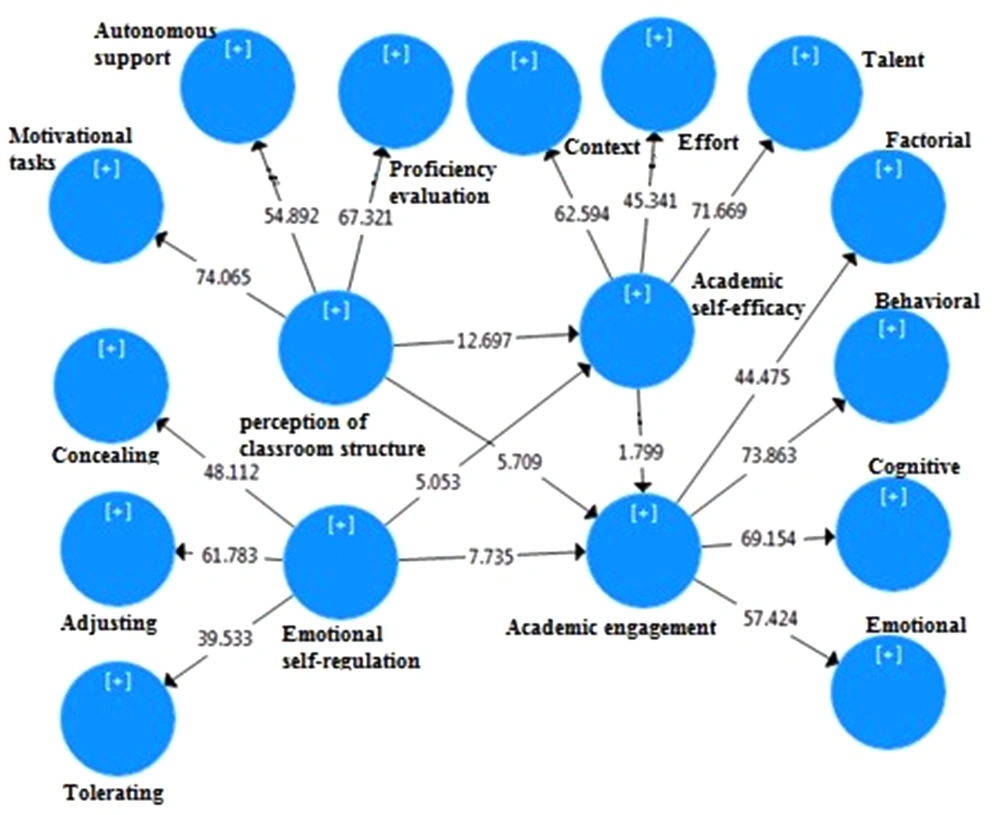
Figure 3.
Path diagram along with T coefficients in the initial model
Figure 4 shows the path diagram along with the standard coefficients in the final model. Figure 4 shows that students' perception of classroom structure and emotional self-regulation affects their academic engagement through the mediation of academic self-efficacy. In other words, these variables have the ability to predict students' academic engagement. According to the diagram above, the perception of classroom structure on academic self-efficacy (0.425) and on academic engagement (0.334); and academic self-efficacy has a direct effect on academic engagement (0.176) and emotional self-regulation on academic self-efficacy (0.424) and academic engagement (0.357) in students. Also, in the diagram, the determination coefficient or detection coefficient (R2) has been determined, which is one of the criteria for checking the fit of the structural model and shows how much of the changes in the dependent variable are explained by the independent variables. According to Figure 4, in all the endogenous variables of the model, the coefficient of determination is greater than the criterion of 0.33, which is the average quorum. Of course, its lowest value is related to the tolerating component (0.412) and the highest value is related to the behavioral engagement component (0.673).
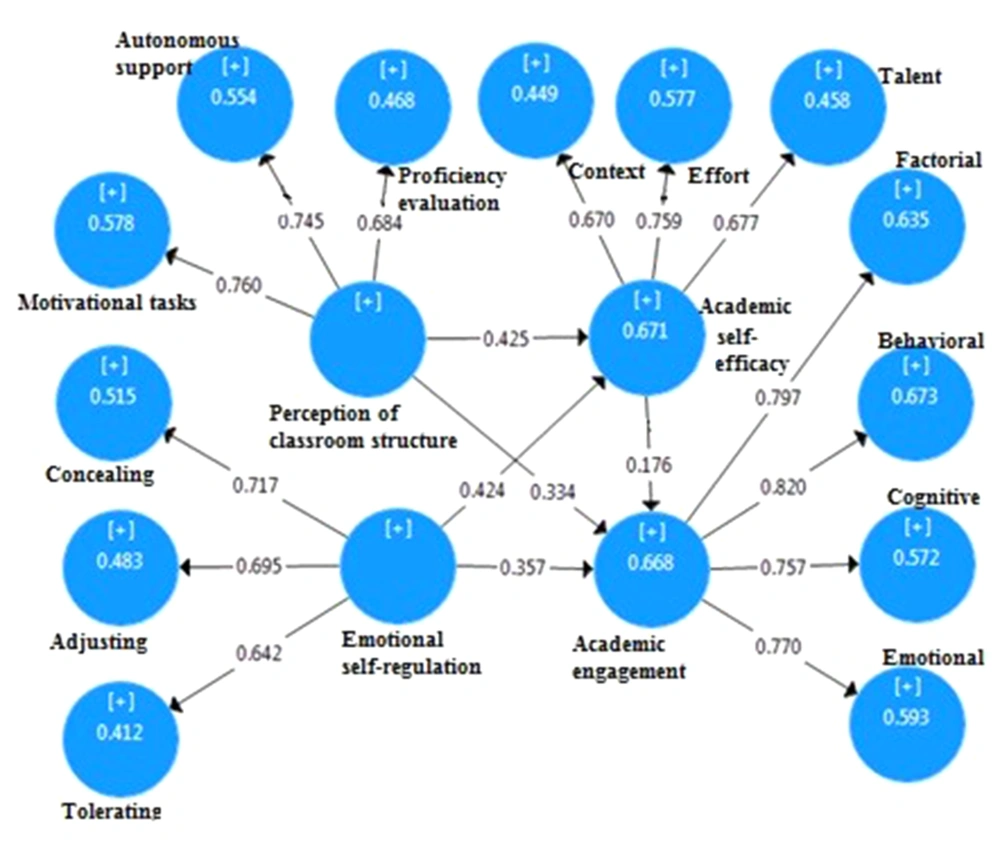
Figure 4.
Path diagram along with standard coefficients in the final model
Figure 5 shows the path diagram along with T coefficients in the final model. According to the T coefficients in Figure 5, all the obtained values are greater than 2.58. Therefore, the coefficients of all investigated pathes are significant with 99% confidence.
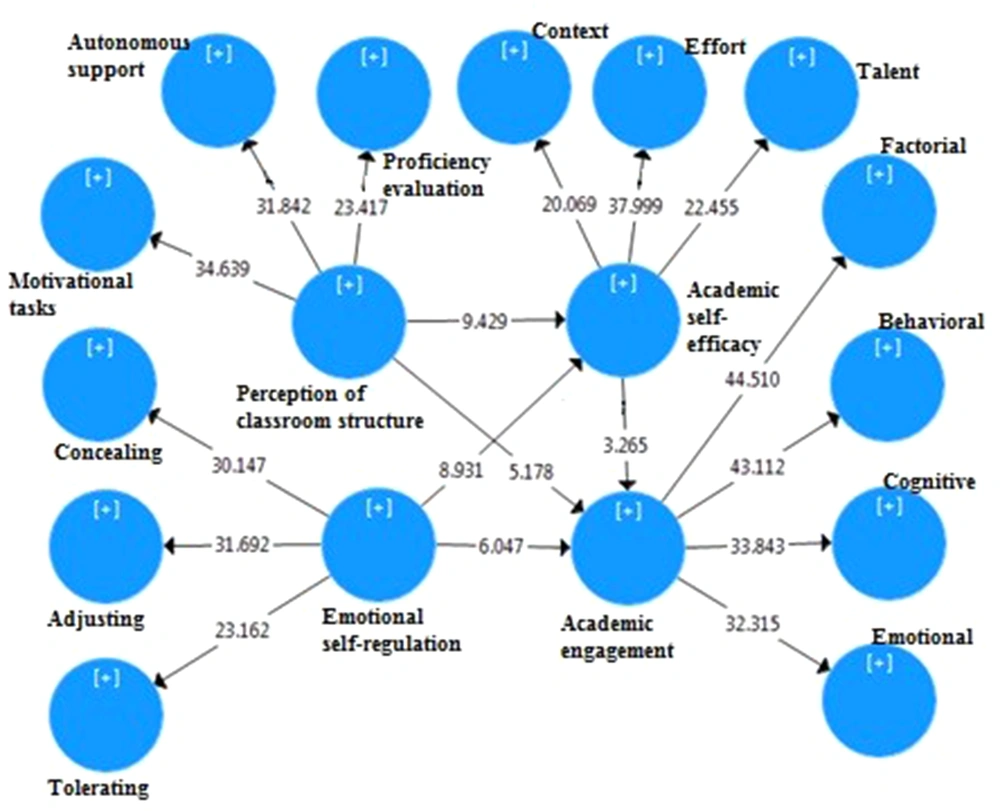
Figure 5.
Path diagram along with t coefficients in the final model
In Table 3, the effect size or factor load of each item in three questionnaires of academic engagement, perception of classroom structure and academic self-efficacy on its component is given in the form of measurement model or external model. According to the results of Table 3, all factor loads of the items of the three mentioned questionnaires are statistically significant.
Table 3.
Effect Size or Factor Load of the Items
| Items | Factor Load | t | P-Value | Items | Factor Load | t | P-Value | Items | Factor Load | t | P-Value |
|---|---|---|---|---|---|---|---|---|---|---|---|
| Questionnaire of Academic Engagement | Questionnaire of Perception of Classroom Structure | Questionnaire of Academic Self-efficacy | |||||||||
| 1 | 0.861 | 58.769 | 0.001 | 2 | 0.782 | 44.769 | 0.001 | 1 | 0.664 | 18.517 | 0.001 |
| 2 | 0.884 | 78.052 | 0.001 | 4 | 0.752 | 30.010 | 0.001 | 3 | 0.706 | 34.074 | 0.001 |
| 3 | 0.766 | 31.659 | 0.001 | 5 | 0.858 | 57.147 | 0.001 | 4 | 0.691 | 26.093 | 0.001 |
| 4 | 0.816 | 46.130 | 0.001 | 6 | 0.862 | 59.756 | 0.001 | 7 | 0.781 | 40.981 | 0.001 |
| 5 | 0.782 | 28.910 | 0.001 | 7 | 0.807 | 38.373 | 0.001 | 8 | 0.768 | 40.400 | 0.001 |
| 6 | 0.946 | 68.312 | 0.001 | 8 | 0.850 | 46.402 | 0.001 | 9 | 0.736 | 40.958 | 0.001 |
| 7 | 0.911 | 67.740 | 0.001 | 9 | 0.729 | 29.823 | 0.001 | 10 | 0.768 | 34.145 | 0.001 |
| 8 | 0.889 | 66.222 | 0.001 | 10 | 0.828 | 40.873 | 0.001 | 11 | 0.786 | 36.123 | 0.001 |
| 9 | 0.858 | 59.346 | 0.001 | 11 | 0.866 | 56.609 | 0.001 | 12 | 0.789 | 35.065 | 0.001 |
| 10 | 0.873 | 65.335 | 0.001 | 12 | 0.801 | 49.487 | 0.001 | 13 | 0.683 | 24.978 | 0.001 |
| 11 | 0.876 | 70.186 | 0.001 | 14 | 0.790 | 34.887 | 0.001 | 14 | 0.820 | 26.410 | 0.001 |
| 12 | 0.847 | 59.746 | 0.001 | 15 | 0.833 | 48.348 | 0.001 | 16 | 0.824 | 30.426 | 0.001 |
| 13 | 0.838 | 55.769 | 0.001 | 16 | 0.778 | 34.461 | 0.001 | 17 | 0.831 | 32.927 | 0.001 |
| 14 | 0.849 | 42.101 | 0.001 | 17 | 0.824 | 45.735 | 0.001 | 20 | 0.748 | 40.531 | 0.001 |
| 15 | 0.905 | 65.887 | 0.001 | 19 | 0.841 | 53.512 | 0.001 | 21 | 0.781 | 39.072 | 0.001 |
| 16 | 0.793 | 40.462 | 0.001 | 20 | 0.880 | 68.762 | 0.001 | 22 | 0.742 | 36.331 | 0.001 |
| 17 | 0.838 | 53.816 | 0.001 | 21 | 0.833 | 46.490 | 0.001 | 23 | 0.788 | 39.147 | 0.001 |
| 19 | 0.906 | 75.573 | 0.001 | 22 | 0.869 | 64.389 | 0.001 | 26 | 0.763 | 31.189 | 0.001 |
| 20 | 0.866 | 60.613 | 0.001 | 24 | 0.849 | 48.874 | 0.001 | 27 | 0.748 | 30.652 | 0.001 |
| 21 | 0.847 | 45.758 | 0.001 | 25 | 0.837 | 47.391 | 0.001 | 28 | 0.765 | 31.942 | 0.001 |
| 22 | 0.843 | 49.590 | 0.001 | 26 | 0.826 | 49.549 | 0.001 | 29 | 0.681 | 19.725 | 0.001 |
| - | - | - | - | - | - | - | - | 30 | 0.758 | 29.284 | 0.001 |
In Table 4, the factor load of each item in the emotional self-regulation questionnaire is presented on its component in the form of an external model. According to the results of Table 4, all factor loadings of the emotional self-regulation questionnaire items are statistically significant.
Table 4.
Effect Size or Factor Load of the Items
| Items | Factor Load | t | P-Value | Items | Factor Load | t | P-Value | Items | Factor Load | t | P-Value |
|---|---|---|---|---|---|---|---|---|---|---|---|
| Emotional Self-regulation Questionnaire | |||||||||||
| 1 | 0.852 | 64.503 | 0.001 | 10 | 0.892 | 72.996 | 0.001 | 17 | 0.887 | 69.603 | 0.001 |
| 5 | 0.806 | 39.987 | 0.001 | 12 | 0.736 | 30.973 | 0.001 | 18 | 0.886 | 68.173 | 0.001 |
| 6 | 0.873 | 44.557 | 0.001 | 13 | 0.732 | 33.717 | 0.001 | 19 | 0.800 | 39.752 | 0.001 |
| 7 | 0.750 | 30.445 | 0.001 | 14 | 0.841 | 46.311 | 0.001 | 20 | 0.840 | 47.648 | 0.001 |
| 8 | 0.739 | 29.046 | 0.001 | 15 | 0.868 | 50.271 | 0.001 | --- | 0.001 | ||
| 9 | 0.768 | 32.811 | 0.001 | 16 | 0.832 | 45.400 | 0.001 | --- | 0.001 | ||
Table 5 shows the reliability and validity of the measurement and structural model. According to the results of Table 5, Cronbach's alpha coefficient in all variables is at an excellent level. Also, composite reliability values were excellent in all variables. On the other hand, the convergent validity of the model has been confirmed using the average variance extracted, which is more than 0.5. In addition, the Q2 criterion, which determines the predictive power of the model in the dependent variables, is (close to or) greater than 0.35, which indicates the strong fit of the model predictor.
Table 5.
Results of Fitting the Measurement Model (Composite Reliability (CR), Average Variance Extracted (AVE) and Cronbach's Alpha) and Structural Model (Q2)
| Latent Variable | Average Variance Extracted (AVE) | Weighted Average | Composite Reliability (CR) | Weighted Average | Cronbach's Alpha Coefficients | Weighted Average | Predictive Fit of the Model (Q2) | Weighted Average |
|---|---|---|---|---|---|---|---|---|
| Perception of classroom structure | --- | |||||||
| Proficiency evaluation | 0.655 | 0.661 | 0.938 | 0.969 | 0.924 | 0.966 | 0.924 | |
| Autonomous support | 0.720 | 0.911 | 0.869 | 0.619 | ||||
| Motivational tasks | 0.699 | 0.942 | 0.928 | 0.648 | ||||
| Emotional self-regulation | --- | |||||||
| Concealing | 0.649 | 0.648 | 0.902 | 0.950 | 0.863 | 0.947 | 0.511 | |
| Adjusting | 0.681 | 0.927 | 0.905 | 0.602 | ||||
| Tolerating | 0.722 | 0.928 | 0.904 | 0.545 | ||||
| Academic self-efficacy | 0.374 | |||||||
| Talent | 0.599 | 0.675 | 0.913 | 0.938 | 0.893 | 0.930 | 0.503 | |
| Effort | 0.751 | 0.919 | 0.824 | 0.578 | ||||
| Context | 0.639 | 0.824 | 0.714 | 0.407 | ||||
| Academic engagement | 0428 | |||||||
| Factorial engagement | 0.677 | 0.706 | 0.913 | 0.974 | 0.881 | 0.971 | 0.510 | |
| Behavioural engagement | 0.703 | 0.953 | 0.938 | 0.747 | ||||
| Cognitive engagement | 0.722 | 0.948 | 0.936 | 0.648 | ||||
| Emotional engagement | 0.746 | 0.923 | 0.889 | 0.649 |
Table 6 presents the Fornell-Larcker matrix to check divergent validity. As indicated in Table 6, the values on the main diameter of the matrix are greater than all the values in the corresponding column and it indicates that the fitted model has a good diagnostic validity.
Table 6.
The Fornell-Larcker Matrix
| Components and Variables | 1 | 2 | 3 | 4 | 5 | 6 | 7 | 8 | 9 | 10 | 11 | 12 | 13 | 14 | 15 | 16 | 17 |
|---|---|---|---|---|---|---|---|---|---|---|---|---|---|---|---|---|---|
| 1. Proficiency evaluation | 0.809 | ||||||||||||||||
| 2. Autonomous support | 0.454 | 0.848 | |||||||||||||||
| 3. Motivational tasks | 0.571 | 0.388 | 0.836 | ||||||||||||||
| 4. Perception of classroom structure | 0.684 | 0.745 | 0.760 | 0.813 | |||||||||||||
| 5. Concealing | 0.339 | 0.421 | 0.533 | 0.677 | 0.806 | ||||||||||||
| 6. Adjusting | 0.357 | 0.478 | 0.574 | 0.678 | 0.465 | 0.825 | |||||||||||
| 7. Tolerating | 0.362 | 0.451 | 0.297 | 0.601 | 0.357 | 0.408 | 0.850 | ||||||||||
| 8. Emotional self-regulation | 0.540 | 0.611 | 0.725 | 0.765 | 0.717 | 0.695 | 0.642 | 0.804 | |||||||||
| 9. Talent | 0.483 | 0.328 | 0.566 | 0.538 | 0.284 | 0.292 | 0.342 | 0.555 | 0.773 | ||||||||
| 10. Effort | 0.423 | 0.326 | 0.676 | 0.661 | 0.571 | 0.376 | 0.387 | 0.656 | 0.441 | 0.866 | |||||||
| 11. Context | 0.377 | 0.377 | 0.588 | 0.542 | 0.262 | 0.529 | 0.194 | 0.525 | 0.511 | 0.437 | 0.799 | ||||||
| 12. Academic self-efficacy | 0.600 | 0.482 | 0.694 | 0.791 | 0.557 | 0.494 | 0.537 | 0.791 | 0.677 | 0.759 | 0.670 | 0.821 | |||||
| 13. Factorial engagement | 0.518 | 0.489 | 0.511 | 0.703 | 0.612 | 0.377 | 0.456 | 0.657 | 0.412 | 0.553 | 0.442 | 0.650 | 0.823 | ||||
| 14.Behavioural engagement | 0.507 | 0.317 | 0.539 | 0.635 | 0.576 | 0.327 | 0.434 | 0.627 | 0.355 | 0.580 | 0.247 | 0.527 | 0.556 | 0.838 | |||
| 15. Cognitive engagement | 0.519 | 0.354 | 0.526 | 0.626 | 0.561 | 0.274 | 0.334 | 0.588 | 0.392 | 0.573 | 0.186 | 0.583 | 0.492 | 0.671 | 0.850 | ||
| 16. Emotional engagement | 0.422 | 0.343 | 0.429 | 0.564 | 0.538 | 0.290 | 0.401 | 0.571 | 0.394 | 0.554 | 0.284 | 0.517 | 0.594 | 0.702 | 0.586 | 0.863 | |
| 17. Academic engagement | 0.840 | 0.610 | 0.521 | 0.628 | 0.782 | 0.656 | 0.425 | 0.474 | 0.785 | 0.571 | 0.664 | 0.442 | 0.722 | 0.797 | 0.820 | 0.757 | 0.770 |
In Table 7, the co-linearity index, direct, indirect and total effects as well as the effect size of the research model are presented. According to the results of Table 7, the tolerance level and the variance inflation factor (VIF) are between 0.2 and 5, which means that the non-collinearity condition is met. All T coefficients are also significant and the effect size values show an average and acceptable level.
Table 7.
The Co-linearity Index, Direct, Indirect and Total Effects
| Paths | Co-linearity (VIF) | Direct Effects | Effect Size (f2) | ||
|---|---|---|---|---|---|
| B | T | P-Value | |||
| Perception of classroom structure → Academic self-efficacy | 3.867 | 0.425 | 9.429 | 0.001 | 0.141 |
| Perception of classroom structure → Academic engagement | 4.412 | 0.334 | 5.178 | 0.001 | 0.067 |
| Emotional self-regulation → Academic self-efficacy | 3.861 | 0.424 | 8.931 | 0.001 | 0.139 |
| Emotional self-regulation → Academic engagement | 4.303 | 0.357 | 6.047 | 0.001 | 0.103 |
| Academic self-efficacy → Academic engagement | 3.011 | 0.176 | 3.265 | 0.001 | 0.033 |
| Indirect Effects | |||||
| Perception of classroom structure → Academic self-efficacy → Academic engagement | 0.092 | 3.355 | 0.001 | - | |
| Emotional self-regulation → Academic self-efficacy → Academic engagement | 0.071 | 3.454 | 0.001 | - | |
| Total Effects | |||||
| Perception of classroom structure → Academic self-efficacy → Academic engagement | 0.426 | 7.073 | 0.001 | - | |
| Emotional self-regulation → Academic self-efficacy →Academic engagement | 0.428 | 8.856 | 0.001 | - | |
In the modeling of structural equations using the partial least squares method, unlike the covariance-based method, there is no index to measure the entire model, but an index called the goodness of fit (GOF) index is used to measure the overall performance of the model, which is the fit of the structural part, and calculates the measurement simultaneously. To calculate this criterion, Wetzels et al. (33) have provided the following formula:
According to the obtained value (GOF = 0.616), the overall fit of the final model in the current research is at a strong level.
5. Discussion
The hypothesis of the current research is that the perception of classroom structure and emotional self-regulation with the mediating role of academic self-efficacy has a significant effect on academic engagement. According to the results of fitting the model in Table 5 and the path diagram in Figure 5, it can be said that the general hypothesis of the research has been confirmed and academic engagement with the variable of perception of the classroom structure and emotional self-regulation and with the mediation of academic self-efficacy can be predicted.
The analysis of structural relationships showed that students' perception of classroom structure has a direct and significant effect on their academic self-efficacy. In the re-examination of the findings of other studies conducted in this field, it was found that this finding is in line with the results of Mikaeeli et al. (20), Hajitabarfirozjaee (34) and Singley et al. (21). The results of the model analysis also showed that emotional self-regulation can directly and significantly affect the academic self-efficacy of students, which is in line with the research of Sharifzadeh et al. (22) and Mesen Esfangareh and Hosseinzadeh (16).
In addition, the findings indicated a direct and significant effect of academic self-efficacy on academic engagement, which is consistent with the research results of Azfandak and Azad Abdolahur (23) and Zhen et al. (35). Also, the findings showed that, on the one hand, the perception of the classroom structure has a direct and significant effect on academic engagement, which is similar to the results of the study by Moltafet et al. (7), Woolley & Bowen (36) and Dincer et al. (25).
On the other hand, emotional self-regulation has a direct and significant effect on academic engagement, which is in line with the research results of Mohanna and Talepasand (37). Finally, the main finding of the research is the significant and indirect effect of the perception of classroom structure and emotional self-regulation through academic self-efficacy on academic engagement, which is in line with the results of Babajani Gorji et al. et al. (38), Imamgholivand et al. (39), Askari et al. (40), Karimi and Sotoudeh (41), Patrick et al. (42) and Cheon and Reeve (43).
As stated earlier, the perception of the classroom structure has an effect on academic self-efficacy. In the explanation of this result, it can be said that to the extent that students find the classroom assignments meaningful for them, related to their educational goals and previous learning, attractive and interesting, to the same extent, they spend more energy to face academic obstacles, until the assignments are done. In addition, to the extent that the students consider the exams, evaluation and cognitive functions of the classroom to be good and appropriate, as well as how much emphasis is placed on learning, social comparisons and healthy competition in the classroom, they strive to the same extent to strengthen their skills to achieve academic goals and academic progress.
Another finding of this research was the direct and significant effect of emotional self-regulation on students' academic self-efficacy. When a student experiences a special emotion such as anxiety during an important exam, the intensity of anxiety gradually causes a decrease in concentration and a feeling of disappointment in succeeding in the exam. If the self-regulation of emotion is high in this student, he monitors his emotion and accepts it, but does not act according to it, but uses the strategy of evaluation and problem solving. Therefore, by reducing negative emotions and creating hope, the student's concentration increases and by judging himself as a capable student, he continues his efforts and feels more self-efficacy. Finally, by organizing the situation, he completes his academic duties in the best possible way.
Another finding of this research was the direct and significant effect of academic self-efficacy on academic engagement. According to Walker et al. (44), the more effort of a student has in performing academic tasks, it indicates high self-efficacy and he/she is more engaged in academic activities and when faced with assignments, he/she challenges herself. It can be said that self-efficacy beliefs have an essential role in determining students' behavior by influencing individual choices, the amount of effort and perseverance in facing problems, thinking patterns and emotional reactions. In other words, a strong sense of self-efficacy leads to the improvement of individual positive views and better participation of the individual in carrying out activities, setting goals and making commitments (45).
Another finding of the current research was the significant and direct effect of the perception of the classroom structure on academic engagement. When the teacher supports the autonomy of the students in the classroom and prepares the classroom environment in such a way that it accepts the active role of the student in learning, the is the opportunity to enjoy doing homework and create positive emotions. In this way, the field of more participation and even conscious planning is provided in order to get the opportunity of more activity and engagement in the student's academic duties. Therefore, the results have similarities with the study of Allahyari et al. (46). The findings of their study indicate that the objective structure has a significant effect on academic engagement and social adjustment. And also, the objective structure has an indirect effect on academic engagement and social adjustment through social development goals.
Another finding of this research was the direct and significant effect of emotional self-regulation on academic engagement. Considering that the method of expressing emotions in students is different, each type of emotional expression has different results. The development of emotional self-regulation leads to tolerance of disappointment and negative emotions, control of aggressive impulses and avoidance of hasty actions and attempts to express emotions in socially acceptable ways. A student with emotion self-regulation skill overcomes challenges, creates attachment, and with a sense of belonging to the teacher, peers, learning and school, becomes more interested in attending the classroom. Emotionally, he engages himself in studies and adjusts his behavior with more enthusiasm and vitality to achieve academic goals, and cognitively, by increasing concentration, evaluation and problem solving, he removes academic obstacles and plans for academic success and progress and a better future. Therefore, the results have similarities with the study of Gholamali Lavasani et al. (47). The findings of their study indicate that the academic resilience improvement with emotional self-regulation mediation will result in more academic engagement in students.
5.1. Conclusions
Overall, the general finding of the present study was the significant and indirect effect of perception of classroom structure and emotional self-regulation through academic self-efficacy on academic engagement. According to the review of the past researches and the findings obtained and the confirmation of the hypothetical model of the researchers in this research, it can be suggested from a practical point of view that educational planners and educational specialists in cooperation with teachers and school administrators by setting the program educational activities situations, by increasing the positive perception of the classroom structure and emotional self-regulation skills of the students, first increase their academic self-efficacy and then increase their academic engagement.
It should be noted that the subjects of this research were female students of the second period of high school in district 1 and 2 of Sanandaj city, so this issue limits the generalization of the results to other communities. Another limitation of this research was that the questionnaires used were self-reported, so some students may not have been accurate enough in answering the questionnaires. As a result, caution should be taken in generalizing the findings of this research. Therefore, it is suggested that this research be repeated in other societies and in the next researches by adding other factors to the model, the quality of the research will be increased and other variables affecting the academic engagement of the students will also be investigated. It is also suggested to use the model approved in this research to predict and intervene in students' academic engagement.