1. Background
Diabetes is one of the main serious problems of human health. Around 240 million people have diabetes all around the word. It is estimated that in 2025 it will be 380 million (7.1% of the world population adults (1). Statistics for diabetes in Iran is also remarkable. Around 7.7% of people between 25 and 65 have diabetes and this range is growing significantly (2). Different studies show that reduced physical activity and daily movements cause gaining weight and other metabolic disorders which are accelerating factor in the incidence or exacerbation of diabetes (specially diabetes type 2) (3). On the other hand, along with the progression of medical sciences and employment of effective therapeutic measures, longevity of patients with diabetes has increased. Also, decreased physical strength and muscle mass impose the feeling of aging and disability, and lack of movement and high dependency on these patients which finally results in their mental and physical disorders (4). While the main and recognized effects of exercise therapy such as increased power, endurance, muscle mass, and recovering ability in people have been studied extensively; studies conducted on exercise therapy in patients with diabetes showed different results such as high motivation and power increase, improvement of the quality of life, increase of movement and function in daily life, performance of job duties, and desirable leisure time. It is an outstanding point to control and delay disease progression and reduce diabetes complications (5). Studies on the effects of eccentric and concentric exercises on muscle and its metabolism revealed that eccentric exercises increase muscle mass and cause better functional activity in comparison with concentric exercises (6). Besides, intensive eccentric exercises are associated with higher risk of weakness, being hurt, feeling pain, and delay onset muscle soreness (DOMS) in comparison with concentric exercises, and cause lower muscle mass increase and muscle strength than concentric exercises (7). Evaluation of biomechanical features in patients with diabetes showed that joint stiffness, muscle weakness, deviation of central pressure sway, local obesity in distal lower extremity are associated with various stages of walking. These factors, which cause impair in the pattern and different stages of walking, finally result in lack of movement and severe functional disorders in patients with diabetes (8, 9).
It should be considered that aerobic and resistance exercises include two eccentric and concentric parts, and the parts have different structural and physiological effects, properties, and functions in comparison with each other. Hence, previous results and contradictions in aerobic and resistance exercises in patients with diabetes cannot be specifically and separately related to the eccentric or concentric exercises. Therefore, to understand the effect of these exercises on these patients more specific and separate studies are required. Considering the significant growth of diabetes and the need for modern and more effective therapeutic methods, it is hoped that the results of the current study are used to introduce specific and useful exercises, increase abilities and life expectancy, and decrease direct and indirect costs of patients with diabetes. Diabetes is a pathologic disorder diagnosed by absolute or relative insulin deficiency. This disorder is also associated with absolute and relative increase of glucagon (10). Running on treadmill engages many lower extremity and trunk muscles along with regular activity of upper extremity, head and neck. Walking and running on treadmill is very useful and stimulates all walking properties in such a way that in the case of regular use controls glycaemia, weight loss, low risk for cardio-vascular diseases, mental situation improvement, depression and anxiety reduction, and also encourages more social and physical activities (11).
Lindstedt et al. evaluated the effect of eccentric exercises on healthy people, and reported that regular and long-term eccentric exercises create more energy than concentric exercises. Also, more muscular power significantly improves movement, ability and agility of the patients and also increases their 6MWT eccentric exercise scores more than those of the concentric ones (12). Asimakopoulou et al. reported that fear of falling and low self-confidence of patients with diabetes type 2 is another reason for their low scores in Time up and Go test which play an important role in the reduction of their functional activity and stability (13). Study of Farthing et al. on the effect of eccentric exercises on muscular hypertrophy compared to concentric exercises showed that eccentric exercises significantly increase muscular hypertrophy due to muscular built stimulation and increase the size of muscular fibers (14). Cuff et al. evaluated the effect of therapeutic exercises on women patients with diabetes type 2 and reported that eccentric and concentric exercises increase oxidation of lipids and decrease insulin resistance in these patients which may control metabolic flexibility disorder and improve their health status, in the case of regular and long-term exercises (15). Beltman et al. evaluated the effect of eccentric and concentric exercises on the level of quadriceps muscle activity, and the results showed that although voluntary activation level of this muscle in eccentric exercises is significantly lower than those of concentric activities, there is no significant difference between these exercises in voluntary activation level (16). The study by Symons et al. on the effects of isometric, concentric and eccentric exercises on the motor function and walking features on healthy people showed that concentric exercises leave more effects on the pattern modification and motor factors in comparison with other exercises (17).
Studies conducted by Remaud and Coury on the effects of eccentric exercises on muscular-neurological system revealed that eccentric exercises improve muscular-neurological system, and also increase the activity and neurological adaptation better in comparison with concentric exercises. Therefore, functional activities will be associated with lower tiredness and better metabolic situation (18, 19). Snowling et al. evaluated the effect of aerobic exercises on glycosylated hemoglobin level in patients with diabetes type 2 and reported that the efficiency of these exercises is the same as medication, nutrition and insulin therapy (20). Petrofsky et al. reported that patients with diabetes suffer from slow walk and also unstable walk due to balance reduction. These features result from factors improving functional activity, especially in Time up and Go test. Hence, eccentric and concentric exercises improve muscular power and ability, and the balance in these patients may improve functional activity and the result of this functional test (21).
Pull et al. evaluated the effects of eccentric exercises on human muscles and reported that these exercises increase energy and oxygen absorption and storing, and also decrease ammonia and lactate production in tissues during exercises. Therefore, considering high metabolic advantage of eccentric exercises, low tiredness occurs with more delay in the patient and the duration of physical activity increases. They also believed that eccentric exercises significantly reduce the level of glycosylated hemoglobin in the patients (22). In a study the aerobic exercises and aerobic-eccentric exercises in patients with diabetes type 2 are compared. It's reported that aerobic and eccentric exercises significantly improve thigh muscle volume and protein storage and functional activities in comparison with aerobic exercises (21). Roig et al. compared the effects of eccentric and concentric exercises on the volume and power of muscles of healthy matured people. Results revealed that in eccentric exercises muscles were more energetic and bulky rather than the concentric ones (23).
2. Objectives
Considering functional problems of patients with diabetes and lack of specific studies regarding the effects of eccentric exercises in these patients, is seems that studying the effects of these exercises on the parameters of functional activities in patients with diabetes type 2 can play a significant role in the identification of their efficiency.
3. Patients and Methods
The current study was a quasi-experimental survey and 28 patients with diabetes type 2 participated in it. The subjects participated in the study voluntarily and were randomly divided into two 14-subject groups of eccentric and concentric exercises. All volunteers after signing the consent letter were approved by the Medical Ethics Committee of Semnan University of Medical Sciences. The study inclusion criterion was age range 40 to 60 years. People with orthopedic, neuromuscular, and retinopathy problems, foot ulcer, neuropathic independent diabetic ulcers, renal and liver failure, cardio-vascular diseases, or people who regularly did exercises were excluded. General and background information including age, gender, height, weight, blood pressure, heartbeat, time of diabetes diagnosis, prescribed drugs, level and type of physical action, and other associated diseases were collected from all patients by a questionnaire.
First, functional activities of the subjects were evaluated using 6 MWT and Time up and Go tests. Time up and Go test (the time needed to stand up from a chair, walk three meters, turn back to the chair and sit on it again) was performed at the following stages:
A patient sits on a chair properly and leaves his forearm on the armrest and leans back. The chair was fixed and had no movement when standing and sitting. To diagnose the patients better, the three meters in front of the chair was measured. Then, once starting the chronometer, the patient stood up and walked the direct and flat path for three meters, again returned the way and sat on the chair. The time was measured by chronometer since getting up from the chair and sitting down on it again. This test was conducted before and after the control periods, and also before and after the intervention on all the subjects. Validity and reliability of the test is measured (24).
Another functional test was 6 MWT which measures the distance traversed in six minutes as fast walking (without running). The path was flat without any obstacles and marks. This test was conducted on all participants before and after the control and intervention periods (25). Validity and reliability of the test is measured by Demer and Ingle et al. (26, 27).
Second, the subjects left without any intervention for eight weeks and at the end of the control period, the same tests were conducted again. Then, therapeutic programs including eccentric exercises and concentric exercises as running on treadmill were performed in Rehabilitation Research Center of the University for eight weeks (three sessions per week) in both groups; after the intervention, the final functional tests were conducted.
3.1. Intervention
Eccentric exercises were performed as running on treadmill with ramp slop controlled for – 4°. While concentric exercises were performed as running on treadmill with ramp slop controlled for + 4°. For both of the groups understudy the exercises were performed in 70% to 75% of maximum heartbeat for 20 minutes (adding five minutes to warm the body and five minutes to get cold) (28). Considering the recommendation of American Diabetes Association, the maximum heartbeat increase for the functional activities in patients with diabetes should be between 60% and 79% (29). Blood sugar of the subjects was measured in each session by glucometer (Accu-Check, GO) and also blood pressure and heartbeat were measured before and after each session by Polar apparatus and the results were recorded.
If the blood glucose of the subjects dropped lower than 100 mg/dL during the exercise sessions, around 15 gr carbohydrate and supplements were given to them; and just if their blood glucose rose higher than 100 mg/dL the test was restarted. It is noteworthy that if the blood glucose of the subject rose higher than 250 mg/dL, the session was not held. Besides, if hypoglycemia symptoms occurred in a subject during a session, his blood glucose was immediately rechecked (30).
Considering the normality of data analyzed by Kolmogorov-Smirnov test, to evaluate the effect pf eccentric and concentric exercises on the measured variables ANOVA and Tukey tests were performed. Also, to compare the effect of these two types of exercises Independent T-test was used; P < 0.05 was considered for all the tests. All functional activity indexes were measured and recorded before and after the control and intervention periods for the participants understudy.
4. Results
In the current study, 28 patients with non-insulin dependent type 2 diabetes and mean age of 51.79 years participated. No significant difference was observed between the age of the two groups with the mean age of 50.79 ± 5.52 (P > 0.05) and 52.79 ± 6.07 years (P = 0.37) for the eccentric and the concentric groups, respectively. Results of the control period showed no significant difference between the data recorded before and after the period in both groups. On the other hand, results of Time up and Go test showed significant difference between the control and intervention periods in both eccentric and concentric groups (P < 0.0001) (Figure 1).
To evaluate the influence level of 6 MWT by eccentric and concentric exercises in both control and intervention periods, ANOVA and Tukey test were used. Analysis of 6 MWT indexes showed significant difference between the control and intervention periods in both groups (P < 0.0001) (Figure 2).
To evaluate the level of influence of Time up and Go test by eccentric and concentric exercises in control and intervention periods, Independent T tests was used. The analysis showed no significant difference in the decrease of this index in the eccentric rather than concentric groups (P = 0.736) (Table 1).
To compare the influence level of 6 MWT index by both eccentric and concentric exercises, independent T test was used. Results showed significant difference in 6MWT between the eccentric and concentric groups (P = 0.036) (Figure 3).
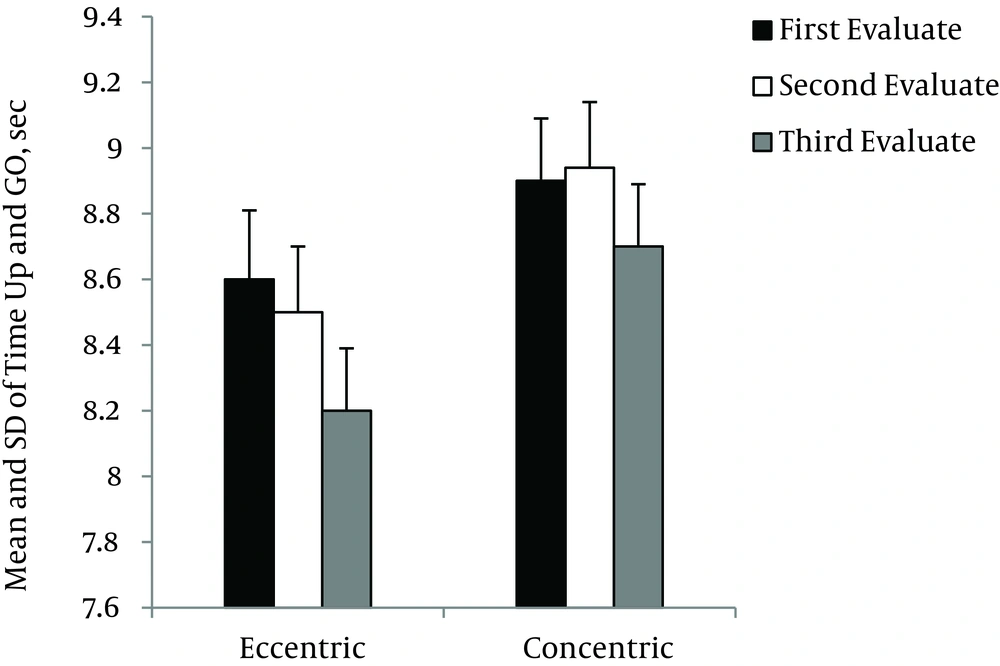
Figure 1.
Effects of Eccentric and Concentric Exercises on Time up and Go Test.
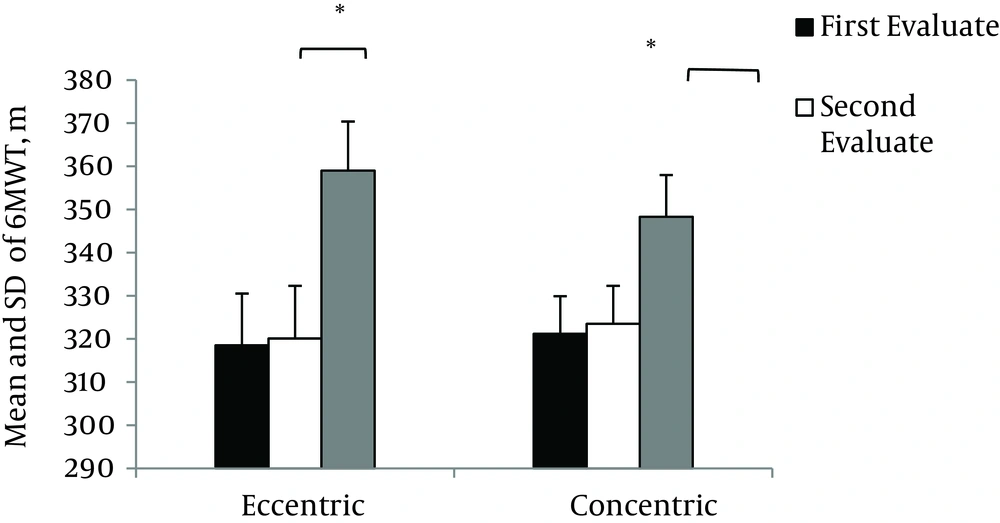
Figure 2.
Effects of Eccentric and Concentric Exercises on 6MWT Test.
Table 1.
Comparing the Average Effects of Eccentric and Concentric Groups on Time up and Go Variable a
| Exercise | Eccentric | Concentric | 95% Cl | P Value |
|---|---|---|---|---|
| Time up and Go | 0.24 ± 0.24 | 0.22 ± 0.11 | 0.12 – 0.71 | 0.736 |
aData are presented as mean ± SD
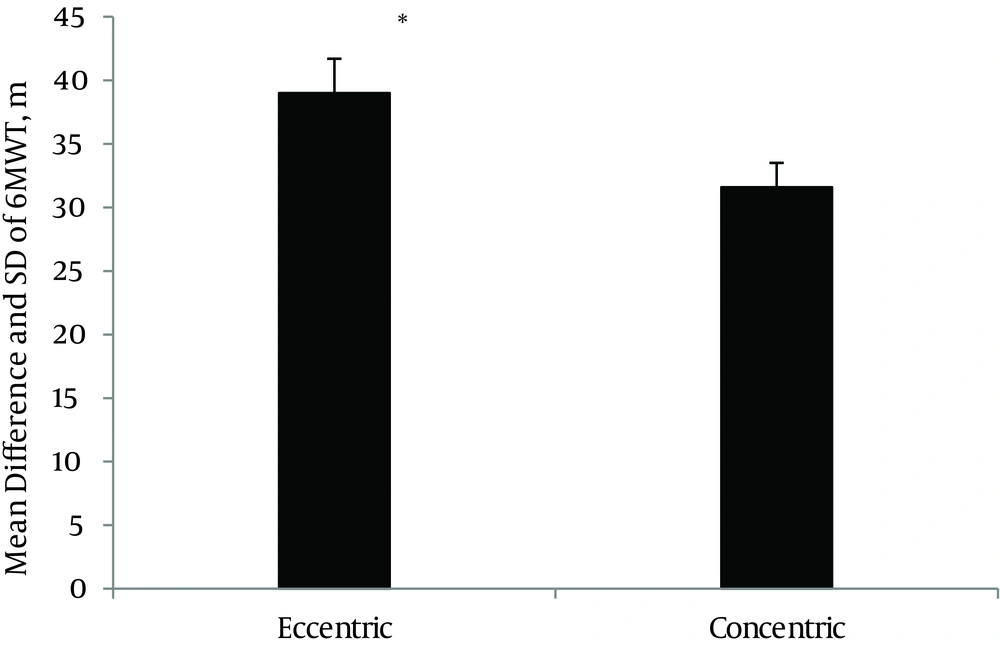
Figure 3.
Comparing the Effects of Eccentric and Concentric Exercises on 6MWT test
5. Discussion
Results of the current study showed that both eccentric and concentric exercises significantly decrease the result of Time up and Go test, and improve functional activity of patients with diabetes. It is reported that patients with diabetes walk slowly and suffer from postural imbalance which results in lower functional activity and changes the result of the Time up and Go test (13). These disorders are especially revealed more significantly in old patients with neuropathy diabetes. Therefore, eccentric and concentric exercises increase muscular ability and improve balance and functional activity in these patients which affects results of the test (21). Another study showed that fear of falling and low self-confidence of patients are some other reasons for their low scores in Time up and Go test. Simakopoulou et al. reported that patients with diabetes type 2 significantly encountered decrease in the functional activity which was due to more focus on movement to prevent balance disorder and risk of injury (13).
Ble et al. evaluated direct relation between glycaemia and cognitive function of patients with diabetes and based on the findings regarding the nervous system reported an alteration in the brainstem of these patients. They also added that hyperglycemia develops organic brain disorder and decreases the ability of sensory, motor and cognitive systems in these patients. The results of their study showed that these disorders can significantly decrease the functional ability of these patients, and they may also have disruptive effects on doing exercises and walking (31). Strachan et al. reported that hyperglycemia in patients with diabetes significantly decreases the rate of data processing such as working memory and details of mechanism of attention. Changes in data processing may cause depression and distress in the patients and also disrupt their function and activity. Hence, considering the effects of eccentric and concentric exercises on the control of hyperglycemia, these exercises can decrease the adverse effects of hyperglycemia on the sensory, motor and cognitive systems of patients with diabetes and prevent the complications (32).
The results of the current study also showed that eccentric exercises have no significant effect on the result of Time up and Go test in comparison with concentric ones. Although there is no significant difference between the two groups, it seems that the results are clinically valuable. Hence, the effect of these exercises on the functional index may change due to increase the intensity or time of exercises; further studies seem to be necessary. Although distance traversed by the participants of the current study in the control period was 321 m, which was 40% lower than the average rate of normal people (450 m) (33), the present study showed that eccentric exercises (354 m) and concentric exercises (389 m) significantly increased the distance traversed within six minutes and improved the functional activity of the patients with diabetes.
Diabetes is associated with the loss of skeleton muscle mass and muscle dysfunction. Skeleton muscles have the largest storage of glucose in the body (more than 80% of glucose disposal). Exercise therapy can improve the volume, power, function and ability of muscular system, and facilitates glucose consumption and decreases its storage in the patients with diabetes (34). Marcus et al. reported that eccentric exercises lead to progressive production of more muscular power, improve body composition (increases contractile tissue and decreases adipose tissue) and improve functional activity in patients with diabetes and impaired insulin resistance. They also added that eccentric exercises significantly increase the distance traversed by brisk walking within six minutes (25). The obtained results showed that eccentric exercises significantly increase the distance traversed in 6 MWT test, in comparison with the concentric ones. These results confirmed those of Lindstedt et al. they believe that eccentric exercises produce more power than concentric ones and metabolism is increased due to regular exercises. Increasing muscular strength increases the tolerance of the patient which results in his agility and quick action during walking (12).
Eccentric exercises, especially if repeated regularly, affect fast contracting muscle fibers along with slow contracting ones and also lead to more recruitment of motor units and synchronize their activity, and in fact cause neural adaptation. This neural adaptation causes higher quality functional activities (33). On the other hand, the eccentric exercises decrease the level of activity in motor units and increase the rate of energy absorption and storage; lactate and ammonia production is also decreased. These metabolic advantages delay and decrease the level of tiredness and lead to more movement and functional activity in comparison with concentric exercises, and cause patients to traverse the distance in 6 MWT test faster and more energetically (22).
Since cardio-vascular system significantly improves in eccentric exercises, it can increase physical ability of the patients and prolong their activity; and can also directly affect their walking speed and improve the results of 6 MWT test (35, 36). The current study showed that eccentric and concentric exercises can improve functional activity of the patients with non-insulin dependent type 2 diabetes, although eccentric exercises leave more effects on 6MWT results rather than the concentric ones. It seems that exercise therapy by eccentric exercises increases the functional activity and time of activity more than the concentric exercises. It is noteworthy that factors such as nutrition, physical movement, stress and mental status of the patients with diabetes may affect the data. Although the current study tried to minimize the effects of these factors by some methods, it seems that to eliminate their effects some other methods should be employed. The small population of the current study, due to inclusion criteria and the long period of the research (control and intervention periods) can be considered as one the problems and limitations. Conducting similar studies with a larger population with different intensities for eccentric exercises may be helpful in providing proper therapeutic programs for the patients with diabetes type 2.