
1. Background
Low back pain is the second cause of absenteeism after common cold and can cause disability (1). By the determination of occupational risk factors and repairing them we will able to early diagnose and prevent chronic disorders (1).
Each occupation has some different risk factors for the cause of disorders for example; health care is one of these occupations. The frequency of musculoskeletal pain in health care workers in the worlds is 30% to 70% (2). The important risk factors for low back pain are flexion, extension and bending, rotations of lumbar spine, pulling or pushing things or carrying patients more than 23kgs (1). Low back pain has some types and one of them is chronic low back pain with more than 12 weeks pain (3).
Omokhodion et al. studied on clinical rural hospitals in Nigeria, the staff had low back pain in about 69% of nurses , 55% of office workers, 47% housekeeping service providers, 47% of staff with heavy work had low back pain, staff with unsuitable posture had 20% low back pain , 20% of staff with longtime sitting and standing had low back pain (4).
Feyer et al. in Australia demonstrated that general health questionnaire (GHQ) with high score was a risk factor for low back pain (5). Roupa et al. in Greece showed that 40% of nurses with some history of low back pain that had effects on their mood and sleep quality (6). Maul et al. in Germany demonstrated that the frequency of low back pain was common among 73to 76% of nurses and they had recurrent low back pain more than progressive low back pain (7). Lorusso et al. in Italy found that the prevalence of low back pain in nurses were 33 to 86% and it depended on gender, physical and psychological risk factors (8). Nielsen et al. in Europe showed that there was a relationship between working in hospitals and low back pain. The prevalence of low back pain was 23.3% to 56.6% among hospital staff (9).
Plouvier et al. in France demonstrated that low back pain was related to work and driving duration (10).
Mechanical chronic low back pain is the subject of this study. Chronic low back pain lasts more than three months. It is aggravated with physical activity and it becomes better with rest and during vacations (1, 2).
Because of high frequency of low back pain and its importance also could be caused disability and few studies were done in Khorasan Razavi , this study was performed. In Iran some studies were researched about the occupational risk factors of musculoskeletal disorders (11-13).
There were a few studies in this subject about the office staff risks but there were some reports from low back pain in clinical staff group.
Because there were some preventive methods those must be done for prevention of low back pain in hospital staff such as clinical and official, and their risk factors must be found this study was done.
2. Objectives
The objective of this study is the comparison of low back pain frequency and its risk factors between clinical and office staff in hospitals of Mashhad there are only a few studies considering clinical staff.
3. Patients and Methods
3.1. Study Setting
The study setting was the hospitals of the city of Mashhad (10 hospitals).
3.2. Study Design and Target Population
This was a cross-sectional study. The population of this study was clinical and office staff working in hospitals, who were selected with simple random sampling (α = 0.05, β = 0.80, P1 = 40% and P2 = 20%). There were 100 people, in each group of clinical and administrative staff, from 10 hospitals. About 650 people were evaluated for having the inclusion criteria, and those who did not meet these criteria were excluded from study. The author interviewed 650 people for assessment of exclusion and inclusion criteria and then filled the questionnaire and checklist for 200 people; 100 people in the clinical and 100 people in the office staff groups.
Inclusion criteria were being a clinical or office staff with work duration of one year or more. The exclusion criteria were having had trauma out of the work environment, non-mechanical pain, inflammation and rheumatologic disorders, fever and major infection. Office staffs were studied because they did not have as many occupational risk factors and were only at risk of factors such as flexion, extension, lumbar rotation and prolonged sitting.
The two groups were matched for age, family history of low back pain and Body Mass Index (BMI). More than 90% of clinical and office staff were females.
3.3. Questionnaire Design
This study was done by completing a checklist and a questionnaire, which was done by interviewing clinical and office staff. Both the checklist and the questionnaire were obtained by the quick exposure check (QEC) method. For validity and reliability of the research tool; the questionnaire was improved at the education department with related professors’ opinions (about 22 faculty members), we also performed a pilot study with a correlation coefficient of 85% with a thirty-day interval between the two trials. The questionnaire of this study had questions about low back pain and its duration, and whether it is aggravated with physical activity and if it becomes better with rest and vacation (1, 2). Furthermore, non-occupational and occupational risk factors for chronic low back pain were included in the questionnaire (1-3).
Measurements: occupational risks from quick exposure check (QEC) tools were determined. Non occupational risks included; age, weight and height, body mass index, duration of driving, history of previous mechanical low back pain, family history, absenteeism, duration of low back pain and psychological stress. Occupational risks included; job history, number of flexions and extensions, bending, rotation in an hour, carrying, pushing, pulling more than 23 kg or number of times they carried a patient in one day, specially among clinical personnel, and the duration of sitting at the station during one day, specially among office staff (1-3).
3.4. Statistical Analysis
Data were gathered and analyzed by the SPSS software version 16, for calculating frequencies, and means. T-test was used for quantitative variables, χ2 for qualitative variables and regression with P < 0.05. In the regression analysis, occupational risk factors such as the number of flexions and extensions, bending, rotation, carrying, pushing, pulling, sitting and non-occupational risk factors, such as driving, were analyzed.
3.5. Ethical Consideration
This study was approved by the university board, for research ethics. Oral consent was taken from participants.
4. Results
In this study 100 people from clinical departments (general workers, nurses and physicians) and 100 from office departments were included. The mean of age in clinical was 35.2±7.5 years old and in office group was 33.5±6.6 years old. No significant difference between two groups ( P=0.082). There was no significant difference between the two groups in terms of the frequency of chronic low back pain; amongst clinical staff there were 18 people (18%) and amongst office staff there were 17 people (17%) with low back pain (P = 1.000). According to quick exposure check results there was a low risk for musculoskeletal disorders.
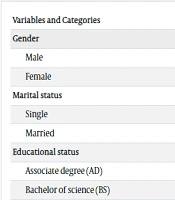
Comparison of the general information of clinical and office staff revealed that there was no significant difference between the two groups in terms of gender; clinical participants included 92 females (92%) and eight males (8%), and office staff included 93 females (93%) and seven males (7%) (P = 1.000).
There was no significant difference between the two groups in terms of smoking; amongst clinical participants 98 (98%) were non-smokers and amongst office staff 99 (99%) were non-smokers (P = 0.561).
Regarding personal risk factors, there was no significant difference between the two groups in terms of sports training; in clinical participants eleven (11%) individuals and in office staff eight (8%) cases were involved in sport activities (P = 0.631).
There was no significant difference between the two groups in terms of driving history; amongst clinical staff eleven (11%) and amongst office staff fourteen (14%) individuals had a history of driving (P = 0.834.)
There was no significant difference between the two groups in terms of psychological history; in the clinical group one (1%) and in the office group two (2%) individuals had a psychological history (P = 1.000). Other risk factors are demonstrated in Table 1.
Table 1.
Comparison of Risk Factors Between Clinical and Office Workers (P < 0.05)
| Variable | Group | |||
|---|---|---|---|---|
| Clinical Worker a | Office Worker a | t-Test | P Value | |
| Age, y | 35.29 ± 7.50 | 35.4 ± 6.67 | 1.750 | 0.082 |
| Body mass index, kg/m2 | 26.12 ± 3.43 | 25.53 ± 3.45 | 1.206 | 0.229 |
| Work duration, y | 10.38 ± 5.20 | 9.62 ± 5.17 | 1.035 | 0.302 |
| Driving duration, hours in a day | 0.13 ± 0.35 | 0.15 ± 0.40 | -0.465 | 0.643 |
| Flexion, Extension in an hour | 4.91 ± 8.35 | 3.96 ± 7.92 | 0.410 | 0.410 |
| Rotation in an hour | 2.79 ± 5.42 | 2.70 ± 5.62 | 0.115 | 0.908 |
| Pull/Push in an hour | 0.65 ± 1.67 | 0.16 ± 0.61 | 2.742 | 0.007 |
| Carrying in a day | 2.24 ± 1.65 | 0 | 13.558 | < 0.001 |
| Patient handling in a day | 2.60 ± 1.56 | 0 | 16.630 | < 0.001 |
| Sitting hours in a day | 5.67 ± 0.57 | 6.92 ± 0.35 | -18.560 | < 0.001 |
a Data are presented as mean ± SD.
The comparison of general information of clinical and office staff with chronic low back pain, indicated no significant difference between the two groups in terms of gender; amongst clinical staff there were 16 (88.9%) females and two (11.1%) males, and among office staff there were 15 (88.23%) females and two (11.76%) males (P = 1.000).
There was no significant difference between the two groups in terms of smoking; in clinical staff there were 17 (94.44%) and in office staff there were 16 (94.11%) non-smokers (P = 1.000).
Regarding personal risk factors, there was no significant difference between the two groups in terms of sports training; in clinical staff there was one (5.5%) and in office staff there was one (5.9%) individual involved in sport activities (P = 1.000). There was no significant difference between the two groups in terms of driving history; amongst clinical staff there were two (11.1%) and amongst office staff there were eight (47.05%) individuals who had driving history (P = 0.019). None of them had psychological disorders.
There was no significant difference between the two groups in terms of history of low back pain; amongst clinical staff seven (38.9%) and amongst office staff five (29.42%) individuals had a history of low back pain (P = 0.555). Other risk factors are presented in Table 2.
Table 2.
Comparison of Risk Factors Between Clinical and Office Workers Who Had Low Back Pain (P < 0.05)
| Variable | Group | |||
|---|---|---|---|---|
| Clinical Worker a | Office Worker a | t-Test | P Value | |
| Age, y | 37.77 ± 8.56 | 34.88 ± 8.34 | 1.413 | 0.319 |
| Body mass index kg/m2 | 26.61 ± 3.90 | 24.89 ± 3.65 | 0.002 | 0.163 |
| Work duration, Years | 12.66 ± 5.91 | 10.58 ± 7.09 | 0.607 | 0.352 |
| Driving duration, hours in a day | 0.11 ± 0.32 | 0.55 ± 0.65 | 1.245 | 0.019 |
| Flexion, Extension in an hour | 21.50 ± 3.74 | 20.95 ± 1.02 | 2.113 | 0.557 |
| Rotation in an hour | 13.94 ± 2.55 | 14.70 ± 2.28 | 0.637 | 0.360 |
| Pull/Push in an hour | 3.16 ± 2.70 | 0.11 ± 0.48 | -0.834 | < 0.001 |
| Carrying in a day | 4.22 ± 1.11 | 0 | 11.596 | < 0.001 |
| Patient handling in a day | 4.33 ± 0.90 | 0 | 14.210 | < 0.001 |
| Sitting hours in a day | 4.88 ± 0.58 | 7.00 ± 0 | -17.293 | < 0.001 |
| Low back pain duration, months in one year | 7.11 ± 2.02 | 6.82 ± 0.63 | 0.559 | 0.573 |
| Absenteeism time, days in a month | 4.11 ± 2.60 | 4.48 ± 3.08 | -0.373 | 0.712 |
a Data are presented as mean ± SD.
4.1. Regression Analysis
Regression analysis demonstrated that low back pain of the clinical group might be related to flexion and extension, rotation, pull or push, and carrying heavy items. Regarding the number of patients handling and sitting (P < 0.001), who were office workers with chronic low back pain, it could be suggested that this pain might be related to flexion and extension, rotation and driving duration (P < 0.001) (Table 3).
Table 3.
Regression Analysis for Assessment of the Relationship Between Each of the Risk Factors and Low Back Pain in the Two Groups With Significance Level of r < 0.05
| Risk Factor | Regression Analysis, r Value | |
|---|---|---|
| Significance Clinical | Significance Office | |
| Flexion, bending per hour | < 0.001 | < 0.001 |
| Rotation per hour | < 0.001 | < 0.001 |
| Push or pull per day | < 0.001 | 0.754 |
| Carrying per day | < 0.001 | - |
| Patient handling per day | < 0.001 | - |
| Sitting hours per day | < 0.001 | 0.303 |
| Work duration years | 0.039 | 0.359 |
| Driving duration in hours per day | 0.805 | < 0.001 |
5. Discussion
According to the results the frequency of low back pain was 18% amongst clinical and 17% amongst office workers; there was no significant differences between the two groups. This means that the frequency of chronic low back pain between the two groups was similar. Amongst clinical staff, low back pain might be related to flexion, extension, twisting or rotation, pulling or pushing, carrying, sitting and work duration (P < 0.001). However, amongst office staff low back pain might be related to flexion, extension, twisting or rotation, and driving duration (P < 0.001) (Table 3). There were no differences between the two groups regarding the frequencies of smoking, psychological history, gender and sport activities; these items were non-occupational risk factors. This means that chronic low back pain was related to occupational risk factors in clinical staff. Chronic low back pain was related to occupational and only one non-occupational risk factor (driving) in office workers. In other studies the frequency of low back pain among hospital staff was 19 to 70% (1-3). Although in the study of Omokhodion et al. it was demonstrated that 69% of nurses and 55% of office workers had low back pain (4), in the current study, staff were at a better status, which was related to good occupational health in hospitals. They had pre placement examination in the recent years and the staffs were younger.
Nielsen et al. showed the relation between low back pain and working at hospitals (9). Lorusso et al. showed that frequency of low back pain in nurses were 33% to 86% and it depended on gender, physical and psychological factors (8).
In this study, low back pain in hospital staff had not significant difference between men and women, many of our participants were women.
In this study one of the clinical staff had a psychological disorder and occupational stress yet this did not result in a significant difference between the groups. Feyer et al. demonstrated that a high score for the general health questionnaire (GHQ) was related to low back pain (5). In this study the population had a good mental health status. Similar to previous studies, low back pain was related to some physical or mechanical risk factors.
Omokhodion et al. demonstrated that low back pain was related to pull or push, carrying items and patient handling in clinical sittings with a significant difference (4). In this study after regression analysis among clinical staff, it was demonstrated that low back pain might have been related to flexion, extension, twisting or rotation, pulling or pushing, carrying, sitting and work duration; while in office staff low back pain might have been related to flexion, extension, twisting or rotation and driving duration. Office staff spent more time sitting yet their low back pain was more related to some non-occupational risk factors such as driving. Similar to the current study, Plouvier et al. found a relationship between low back pain and work duration, flexion, extension, rotation and driving (10). The duration of low back pain was longer in clinical and the duration of absenteeism was longer among office staff, yet these differences were not significant. These results were similar to previous studies (14-16).
Other studies showed that early therapy, short resting time, home exercises and return to light work could help prevent chronic low back pain and disability (17, 18).
Clinical jobs such as nursing have greater occupational risk factors for low back pain such as, flexion, extension, twisting or rotation, pulling or pushing, carrying, handling of patients and specific helping behaviors. Among office staff, duration of driving was more effective on chronic low back pain than sitting for a long time, since during driving the vibration of the car is translated to the lumbar spine.
Musculoskeletal disorders were the most common disorders in some occupations and industries (19-22). Such industries must implement preventive methods for related disorders. Pre-placement programs and periodic examinations should pay attention to the person’s musculoskeletal system.
In this study there was no exact job analysis and the data was gathered from the staff’s memory, however some previous studies had performed an exact job analysis (12, 13). Unfortunately the number of people that could participate after the application of the exclusion criteria was low especially the number of males. It seems that a complementary study can be helpful. Future studies should perform exact job analyses and determine further occupational risk factors for clinical personnel yet they should also pay more attention to non-occupational risk factors such as driving for office workers.
In clinical staff low back pain might be related to occupational risk factors yet among office workers this pain might be related to occupational and non-occupational risk factors such as duration of driving. Duration of driving was more effective on low back pain than sitting for a long time. Future studies should investigate risk factors for other health care workers.