
1. Background
Alzheimer’s disease (AD) is the most common type of dementia, which is categorized as a cortical dementia. The main feature of this progressive disease is loss of cognitive function during eight to 12 years, which leads to the vegetative situation in the last stages and finally, death.
Although clinical Symptoms of AD usually appear in the late stages of life, the pathologic features might have been started much earlier. Approximately 60% to 70% of patients with dementia have AD and about four million to five million Americans are affected by AD. Most patients with AD are over 65 years old and without any known genetic cause. After 65 years of age, the incidence rate approximately doubles for every five years. In other words, it can be said that less than 5% of people aged over 65 have AD and nearly 50% of people over 85 years and older are at risk of AD. AD is the fourth most common cause of death in America. Major risk factors include ageing, female sex, menopause, traumatic brain injury, and genetic factors associated with apolipoprotein E 4 (APOE*E4). AD is diagnosed by history and neuropsychologic tests. In addition, biomarkers and genetic tests can be used to detect it marginally.
AD usually presents with changing in memory and orientation including frequent amnesia, difficulty with complex daily tasks such as planning events or projects, word retrieval problems, and errors in recognizing people or places. Initial phases may take several years. Mild cognitive deficits in this phase are due to the side effects of drugs, psychiatric or medical conditions, or syndromes such as age-associated memory impairment or mild cognitive impairment. Cognitive deficits are worsened as the disease progresses (1). The speech of patients with AD is described as empty; in other words, although their speech contain a lot of words, the words do not convey any information (2).
These patients have semantic knowledge deficits; although their grammatical ability is intact, verb is affected. Recent studies suggest that there are deficits in verb naming and understanding related information to the verb in the sentence. Generally, it can be said that both syntactic and semantic aspects are susceptible to impairment in these patients (3).
Word finding and naming are the mental processes in which a word is chosen to name an object in mind. In some disorders, accessing to desired word is affected. Naming can be evaluated in different ways including picture naming, naming the written word, matching picture with word, picture description, retelling the story, completing the story, and verbal fluency.
Among these tasks, verbal fluency is assessed by semantic and letter fluencies. Semantic fluency is the ability to name specific semantic categories within the specified time. In Semantic fluency task, animal and fruit categories are used. Moreover, letter fluency performance is the ability to name words that begin with a particular letter at specified time (4).
Verbal fluency tasks are widely used in neuropsychologic research because they can be performed easily and are sensitive to various cognitive deficits (5). Recently, verb fluency has been established in verbal fluency tasks (6). Verb fluency has some common characteristics with other executive functions and considers some deficits that could not be diagnosed with traditional tests (7). Performing tests to assess the reliability of verb fluency is important for its construct validity. In addition, determining important and reliable changes of verb fluency could be potentially used for longitudinal studies (8).
Kim and Thompson found that verb fluency task could separate patients with nondemented from those with demented Parkinson's disease and control groups while semantic and letter fluency could not discriminate these groups. They suggested that verb fluency was sensitive to Parkinson's disease-associated frontostriatal pathophysiology; therefore, the verb fluency could be used as an indicator of executive function (3). In other words, verb fluency task can show verb deficit of these patients better than their verb naming. Verb fluency is referred to as verb production ability in the absence of external stimuli (i.e. retrieve the verb in its purest form) (7). Studies have shown that verb fluency has relatively small differences with tests that measure related cognitive structures (8).
Pasquier et al. compare semantic and letter fluency in three groups of frontal lobe dementia, AD, and controls who were matched for age, sex, and education level. They showed that the number of word production and preservation were significantly lower in patients than in controls and similar in patients with dementia; moreover, both performances were more impaired than letter fluency was. They concluded that verbal fluency tasks were sensitive tools for determining dementia but they could not differentiate various types of dementia from each other (i.e. AD and frontal lobe dementia in the early stages) (9).
Bushell and Martin investigated the semantic representation of nouns (concrete and abstract) and verbs in patients with AD and normal controls using Positron Emission Tomography (PET) and reported that nouns and verbs activated different neural regions. Control groups showed automatic activation of concrete nouns and action verbs while patient with AD only showed automatic activation in concrete nouns (10).
In a meta-analysis of 153 studies on semantic and letter fluency tasks in patients with AD and healthy controls, semantic fluency performance was worse than letter fluency. Moreover, the study showed that confrontation naming is a type of semantic memory assessing that requires minimal effort to retrieve names (11). Ostberg et al. evaluated verb and verbal fluency in 199 individuals with cognitive impairment. They divided their participants into three groups: subjective cognitive impairment, mild cognitive impairment, and AD. Results showed that verb fluency and verbal fluency were separated tasks and verb fluency performance was significantly lower in patients with cognitive impairment than in two other groups. They suggested that decreased verb fluency performance could indicate initial stage of dementia (12).
In a study of 76 healthy elderly subjects and 77 patients with mild dementia of the AD type, Gomez and White reported that the number of produced words, clusters, and switching of healthy individuals were better than that of patients. The results showed that the combination of semantic fluency and narrative speech could be useful, especially in the differentiation of healthy elderly people from mild dementia of the patients with AD (13).
In a study about phonemic and semantic fluency in 46 healthy subjects, 33 subjects with mild cognitive impairment, and 33 subjects with AD, Murphy et al. found that semantic fluency was better than letter fluency consecutively in healthy individuals, patients with mild cognitive impairment, and patients with AD (14).
Nutter Upham et al. investigated verbal fluency tasks in 107 elderly in three groups, namely, mild cognitive impairment, cognitive complaints, and healthy controls. The results showed that patient with mild cognitive impairment had worse results in all verbal fluency tasks (ie, letter, semantic, and switching) than healthy subjects did (15).
McDowd et al. evaluated verb and verbal fluency as a part of the executive function tests in healthy young and elderly subjects, patients with Parkinson's, and those with AD. Results showed that verbal fluency performance was low in patients with AD, average in those with Parkinson's disease and aging participants, and good in the young people. Nevertheless, verb fluency was worst in people with Parkinson's disease in comparison to other groups (16).
Lai and Lin investigated the nature of noun and verb impairment in semantic and verb fluency task and picture naming in Chinese patients with and without AD. They evaluated 20 patients with AD, 20 elderly (65-83 years old) subjects, and 20 adults (43-58 years old). The results showed that the content in patients with AD was severely impaired. Verb and verbal fluencies were significantly worse in patients with AD than in other groups. Such a distinction in verb fluency was not observed between the two groups of healthy adults. Another important finding was that noun fluency was significantly better than verb fluency in control groups. Semantic fluency evaluation showed no significant differences between verb and noun deficits in patients with AD, but this superiority was quite evident in the control groups (17).
2. Objectives
According to the nature of naming deficit in patients with neurologic disorders and cognitive impairments, this study examined verbal and verb fluency performances in patients with AD. The initial aim of this study was to compare verb and verbal fluency in patients with AD. In addition, we aimed to study relevance of disease severity and verbal fluency types.
3. Patients and Methods
In this cross-sectional study, patients were selected through simple sequentially sampling method according to the inclusion criteria. The inclusion criteria were as follows: 1) absence of neurologic diseases such as parkinsonism, multiple sclerosis, or other medical conditions that might affect the cognitive functions such as acquired immunodeficiency syndrome, epilepsy, brain trauma, neoplasms, and cerebrovascular disease; 2) absence of mental retardation; 3) lack of mental disorders; 4) absence of sensory disorders such as hearing loss and blindness; and 5) avoiding the use of alcohol and drug and lack of bilingualism.
Thirty Patients with AD (14 males, 16 females) were selected from Roozbeh Hospital and the Iranian's Alzheimer's Disease Association. Then severity of AD was categorized as mild, moderate, and severe based on Mini-Mental Status Examination (MMSE) and the medical report of the neurologist. For assessment of verb fluency, patients were asked to tell as many different things as they can think of that people do. The instructions were performed on verbal fluency (semantic and letter). The participants were asked to name the semantic categories of animals and fruits and the words that initiate with /f/, /a/, and /s/ letter in one minute. If participants had difficulty in understanding tasks, examples were used for clarification in each category. Scoring was based on the number of items that participants produced in a given period. Words produced by the subjects were recorded for later analysis. It should be noted that the repeated and specific names were not calculated.
One-sample Kolmogorov-Smirnov and Levine’s tests were used to assess the assumptions of normality and homogeneity of variances. Pearson's correlation coefficient was used to determine the association between semantic, letter, and verb fluency. Association between severity and education level was assessed using Chi-Square test. Independent-samples t test was used for comparing the letter, semantic, and verb fluency between sexes. ANOVA was used to compare the mean of semantic and verb fluency according to severity. Duncan test was used to detect significant differences among different levels of severity. Considering the lack of homogeneity of variances, Brown-Forsythe and Games-Howell tests were used to compare the mean of letter fluency according to severity. The SPSS 16 (SPSS Inc. Chicago, IL, USA) was used for data analysis and P value < 0.05 was considered as statistically significant.
4. Results
A total of 30 patients with AD (14 males and 16 females) with the mean age of 75.23 ± 9.33 years were enrolled. Three patients (10.3%) had no education, 14 (48.3%) had under diploma, 7 (24.1%) had Diploma, and 5 (17.2%) had graduate level of education. Regarding the severity of AD, eight patients (26.7%) had mild, 15 (50%) had moderate, and 7 (23.3%) had severe AD. Mean of responses in the category of animals was more than that of fruits category. Words that initiated with letter /a/ were more frequent than the /s/ and the words beginning with the letter /f/ had the lowest frequency. In general, the means score was 4.86 for semantic (animals and fruits), 1.39 for letter, and 3.7 for verb fluencies. The findings showed that semantic fluency was better than letter as well as verb fluency. In these patients, verb fluency was affected more than verbal fluency was.
Regarding the association between semantic fluency, letter fluency, and verb fluency in patients with AD, there were significant positive associations between letter fluency and verb fluency (P = 0.013; r = 0.448), between letter fluency and semantic fluency (P < 0.001; r = 0.588), and between verb fluency and semantic fluency (P = 0.002; r = 0.549).
All variables in participants had normal distribution (P > 0.05) and the assumption of equal variances were established between semantic fluency and verb fluency (P > 0.05) but not letter fluency (P = 0.023). The results of letter fluency indicated significant differences regarding severity of AD (P < 0.001) (Table 1). Games-Howell test results showed that letter fluency in patients with severe disease was significantly lower than was in patients with mild and moderate disease (P < 0.05) but there was no difference between patients with mild and moderate severity (P > 0.05). There were significant differences between patients with different levels of severity in semantic fluency (P < 0.001). Duncan test results indicated that the mean of semantic fluency was significantly higher in the patients with mild than in those with moderate and severe disease (P < 0.05) and higher in patients with moderate disease than in those with severe disease (P < 0.05). Regarding verb fluency, there was significant differences between patients with different levels of severity (P = 0.034). Duncan test results indicated that the mean of semantic fluency was significantly higher in patients with mild than in those with severe disease (P < 0.05); however, there were no significant differences in verb fluency between patients with mild and moderate disease as well as between those with moderate and severe disease (P > 0.05). Comparisons of verbal and verb fluency with respect to the severity of AD are shown in Figure 1 to 3. It should be mentioned that this study results suggested no significant correlation between severity and education (χ2 [6] = 6.370; P = 0.383).
Table 1.
| variable | Severity | ||
|---|---|---|---|
| Mild | Moderate | Severe | |
| Letter Fluency | 6.75 ± 1.11 | 4.46 ± 0.83 | 0.71 ± 0.18 |
| Semantic Fluency | 14.62 ±1.87 | 9.80 ± 1.13 | 4.00 ± 1.02 |
| Verb Fluency | 5.75 ± 1.56 | 3.80 ± 0.75 | 1.14 ± 0.70 |
a Data are presented as mean ± SD.
b The means by distinct letter stressing faintly different at 0.05.
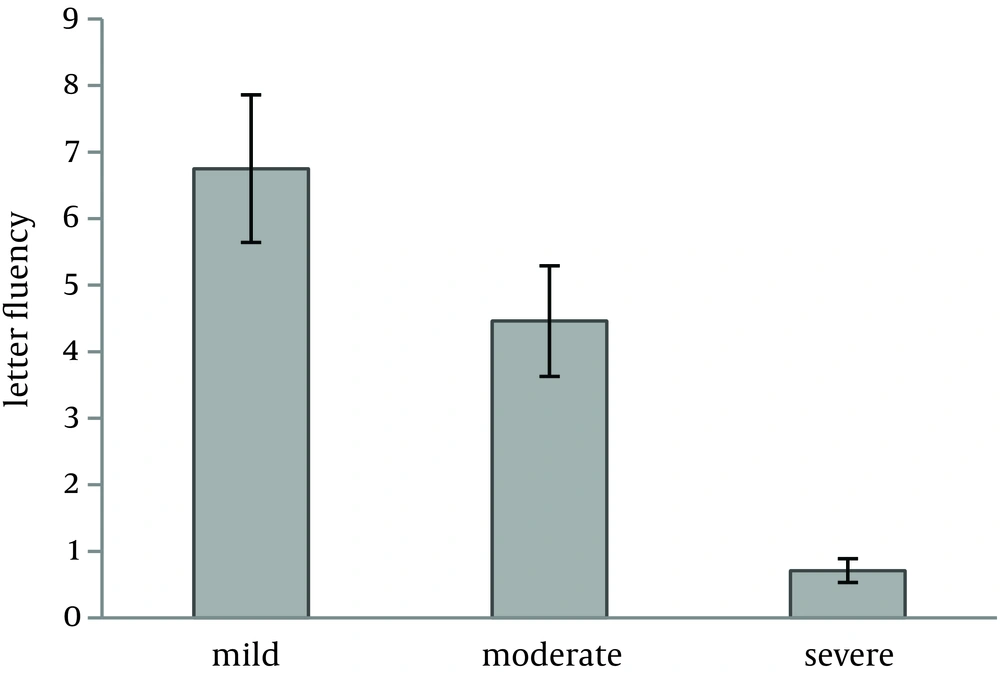
Figure 1.
Data are presented as mean ± SEM.
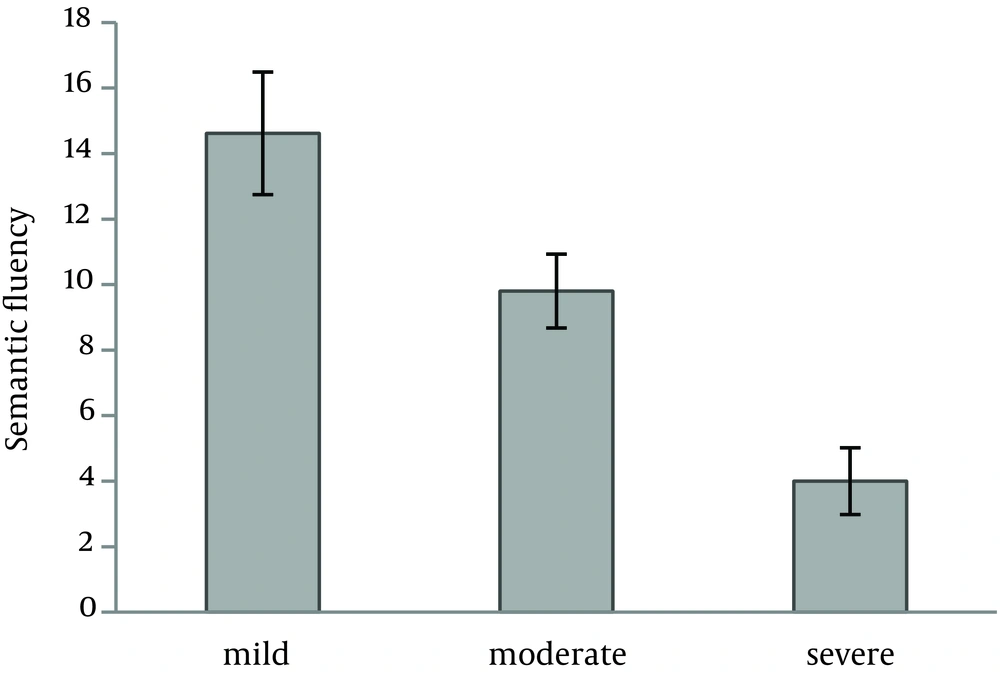
Figure 2.
Data are presented as mean ± SEM.
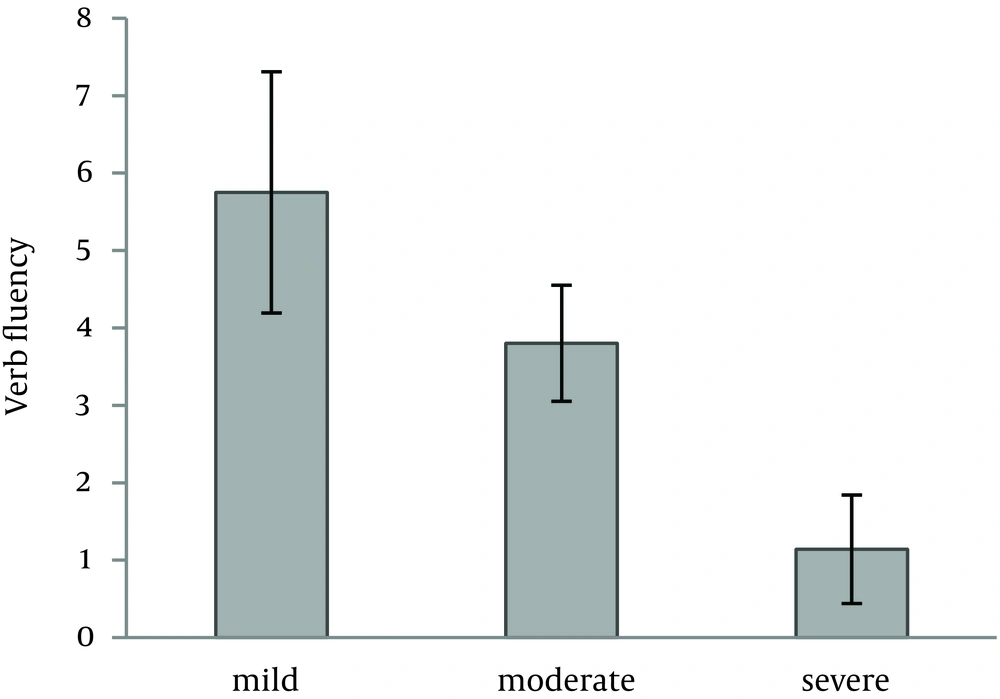
Figure 3.
Data are presented as mean ± SEM.
5. Discussion
Several studies have investigated verbal and verb fluency in patients with AD and have compared their skills with other disorders (e.g. Parkinson's disease, mild cognitive impairment, and Huntington's disease) as well as healthy peoples (12, 14, 16, 18, 19). Results of studies have indicated the types of impaired fluency in AD. Regarding the site of lesion, some of these studies have assessed the noun and verb retrieval and showed verb production primarily in relation to integrity of fronto-striato-thalamo-cortical loops.
According to our findings, there was a significant positive correlation between letter and verb fluency, between letter and semantic fluency, and between verb and semantic fluency. These results showed that when the mean of the one fluency was decreased, the mean score of other fluency would be low.
The mean of correct responses was more in animal than fruits category. This finding was in agreement with Seyedin et al. study. They obtained semantic fluency for normal subjects with 57 to 69 years of age with mean score of 20.33 ± 4.24 and 16.95 ± 3.09 for animal and fruit categories, respectively (20). It seems that living category was retrieved better than nonliving category in semantic category; however, the difference was not significant (P = 0.2).
In letter fluency, words started with letter /a/ were more frequent than those started with letter /s/ and words started with letter /f/ had the least frequency. One reason might be more frequency of the words with letter /a/ in Farsi language. The mean of semantic fluency was 3.5 times as high as the mean of letter fluency. One of the main causes of declining in letter fluency in comparison to semantic fluency was that patients had to recall specific nouns. Finally, these words were not calculated.
Verb fluency was impaired more than semantic fluency was; generally, the verbs from nouns are more complex semantically and broader areas of the brain are involved in retrieving verbs (21). This result was in agrees with Piatt et al. who believe that in the diagnosis of Parkinson's dementia, verb fluency was more sensitive in comparison to animal and letter fluency (6). Ostberg et al. suggested that decreased verb fluency might be an indicator of language impairment in primary dementia (12).
As mentioned in this study, semantic fluency scores were more than letter fluency ones (mean score of 4.86 and 1.39, respectively). The same conditions were observed with different severity of AD. This finding did not match Henry et al. who obtained the opposite results (11). Discrepancy could be due to language study and the sample size. However, this result was similar to that of Murphy et al. (14).
Finding showed that there were significant differences between letter, semantic, and verb fluency at different levels of severity. Therefore, it can be concluded that early detection of AD can prevent regression of speech and language skills, particularly naming. Since the nouns and verbs naming deficit is the first signs of dementia and AD, the prognostic-treatment professionals should be sensitive to this issue and take appropriate actions as soon as possible. Most studies have focused on the naming picture but Piatt et al. and Ostberg et al. suggested verb fluency as a better indicator for measuring verb processing (6, 7, 12). This task can be used as a pure measure of verb retrieval in comparison to verb picture naming. The verb picture naming requires visualizing each caption and needs to storing the meaning of words by vision system while in the verb fluency, lexical decision and speech production system is involved (22).
Our findings showed impaired verbal fluency (semantic-letter) and verb fluency in patients with AD. Verb fluency task is an important indicator in the diagnosis of early dementia. Thus, the study of these skills might help to prevent dementia progression in susceptible individuals. More research in this area could be a useful therapeutic strategy in rehabilitation of communication disorders in these patients. According to this study, assumption about the association between the lexicon and the conceptual category was weak.