
1. Background
Physical disability refers to a limitation in physical functions of clients caused by an impairment (1), and consists of a range of medical disorders such as complex diseases (cerebral palsy, brain injury, and spina bifida), motor-developmental disabilities, and specific syndromes. These children have congenital or acquired physical disabilities with functional limitations in performing the activities of daily living such as self-care, communication, mobility, transmission, and education leading to a delay in many of their growth areas (2, 3). These functional constraints require medical interventions, rehabilitation, and educational services to promote the active participation and health quality of these students in educational settings (4). Participation of children with physical disabilities will increase remarkably the use of the appropriate facilities of schools and welfare services (5). The activities related to school performance are referred to non-educational functional activities that support children’s participation in educational and social aspects (6). Studying the various activities of these students at school shows that non-educational activities affect the rate of participation and its quality more than other activities. In this field, occupational therapists use different approaches, such as changing activity, skill promoting, environmental modification, ergonomic changes, and counseling. For implementing better interventions, the proper evaluations are required. The number of tools used to assess the non-academic activities of children with physical disabilities is low, and the school function assessment (SFA) test is one of the most commonly used functional tools in this area (7-9). In most studies on the performance of normal and functionalized children, more attention has been paid to the cognitive and behavioral aspects. It seems that lack of a valid assessment is one of the existing gaps in assessing children's ability and physical environment and evaluating their impact on the quality of students' academic performance (6, 10). Given that the number of students with different disabilities is increasing in the educational curriculum, the need for evaluation tools has also increased. The limitation of the current evaluations is the weakness in evaluating functional behaviors such as changes in position, displacement distance, and the location of school supplies that can affect physical disorders of children with physical and behavioral problems (6, 11). The SFA is designed to assess the functional skills of healthy students and students with disabilities in primary school. The test examines the extent of student participation in non-educational and social aspects. SFA evaluates the strengths and weaknesses of each student in functional activity and school participation at three levels: 1- Participation 2- Supporting the performance of activities 3- Performing activities (12). The results of SFA validity and reliability are reportedly excellent (8, 12-14). The SFA is a questionnaire that is completed by one or more active specialists who know the students very well and observe the students’ daily routine while doing homework and school activities. As the educational system in Iran for students with physical disabilities is different from the system of ordinary children’s schools, occupational therapists need good tools for evaluating, planning, and implementing the interventions related to participation and environment of children with disabilities. The aim of the present study was to assess the psychometric properties of the Persian version of school function assessment (SFA) in 6 to 12-year-old children with physical disabilities.
2. Methods
In this research, after translating and assessing the validity and reliability of the Persian version of SFA that was approved by the research committee of Iran University of Medical Sciences, each participant received a copy of SFA and the required manual. The purpose of the study was explained to school administrators and participants. The researcher then obtained the written consent of the parents and gathered the demographic information form in the first session. Next, a copy of SFA was given to those who were aware of the conditions of the children, such as the superintendent, teacher, therapist, and parents who accompanied their children at school to complete the test. The teacher was responsible for completing the test and those parts out of his scope or knowledge were completed through interaction between teacher, parents, and the superintendent.
The inclusion criteria of this study were (a) age of the children (between six to twelve), and (b) medical history (having a disease that causes impairment in the mobility of the child due to physical disability such as cerebral palsy, brain injury, spina bifida, musculoskeletal disorders, neuropathy, motor-developmental disabilities, and specific syndromes resulting in physical disabilities diagnosed by a neurologist or orthopedic specialist). The exclusion criteria were (a) refusal of participation by the family, (b) unwillingness of the administrator, the superintendent, or teacher to continue the cooperation.
2.1. Evaluation Measures
2.1.1. Demographic Questionnaire
At the beginning of the study, first few pages of the Persian version of SFA containing demographic information were completed. Using this questionnaire, age, gender, level of education, and the status of employment of parents and some other information were gathered.
2.1.2. Persian Version of SFA
The Persian version of SFA provides a comprehensive assessment of performance and participation for preschoolers up to grade six. SFA includes three parts: 1. Participation: Assessment of student participation in six school-related activities, including normal or special education, playground or recreational rhythm, mobility in class, toileting, and the way to go to school and mealtime, and Snack. 2. Task support: Measuring the amount of support and matching that is currently offered when the child is involved. Two types of support are considered separately, including adult help and necessary arrangements (changes in the student's program or the environment, such as special equipment or modified instruments). 3. Activity performance: Assessments of the student's ability to perform specific activities and physical and cognitive aspects, such as having mobility in the classroom and school, using the available facilities at the school, interacting with students of the same age, and following school regulations. The tool consists of 320 items (26 scales); each item is scored using a scale of four scores (part one, participation, used six-score scale) that should be scored by any of teachers, the superintendents, occupational therapists, and speech and language pathologists who had observed and monitored child involvement and performance in at least several environments. Individual scales can be completed in 10 minutes, but completion of the entire tool takes about 2 hours.
2.2. Procedure
In the present study, the content validity, test-retest reliability, and internal consistency of the Persian version of the SFA were examined. This study was done in exceptional schools in Tehran. Considering the fact that in contrast to the country in which SFA was developed, in Iran, ordinary and exceptional schools are separated. After assessing the reliability of SFA in a population of normal students, it was more desirable to evaluate the performance of students with physical disabilities at different times. For this purpose, by calculating the content validity of the test, the content validity index (CVI) and content validity ratio (CVR) were estimated. For estimating CVI and CVR, this test was given to 20 occupational therapy experts (with Ph.D. and Master’s degrees), who had at least five years of experience in the assessment and clinical interventions in the field of pediatrics. Then, to assess the test-retest reliability and internal consistency in the first step, 80 tests were completed by respondents. After completing the test, 30 tests were again completed by respondents after two weeks.
2.3. Statistical Analysis
To analyze the data in this study, we used SPSS version 21 software. To assess the content validity, CVI and CVR were used. For assessing the test-retest reliability of the SFA and internal consistency, ICC and Cronbach’s alpha were used, respectively.
3. Results
In this study, 80 children with different physical disabilities were studied, with the sex distribution of 40 (50%) males and 40 (50%) females. The age range of the participants was six to twelve years with an average of 9.6 (SD = 1.1) (Table 1).
Table 1.
Descriptive Statistics of Qualitative Variables
| Variable | Results | Frequency | Percentage |
|---|---|---|---|
| Gender | Male | 40 | 50 |
| Female | 40 | 50 | |
| Grade of school | First | 21 | 26.3 |
| Second | 8 | 10 | |
| Third | 17 | 3.21 | |
| Fourth | 15 | 18.8 | |
| Fifth | 14 | 17.5 | |
| Sixth | 5 | 6.3 | |
| Kind of disability | Cerebral palsy | 75 | 93.8 |
| Others | 5 | 6.3 |
The results of the content validity index showed some items with unacceptable CVI score as listed in Table 2. These statements were discussed by the researchers and specialists during the frequent panel meetings, and required modifications were applied. Clearer, simpler, and more expressive phrases were replaced by more difficult and ambiguous phrases. Finally, the experts reached a consensus about the revised terms and the phrases approved by the specialists. The content validity ratio for the 23 items was obtained to be slightly less than 0.42. Certain items were accepted after the negotiations of the experts and some of them were approved after little modifications. Finally, the specialists agreed on the necessity of all 23 items and all of the items were approved.
Table 2.
Items with Unacceptable Content Validity Index (CVI) Score
| Part | Item | CVI Score |
|---|---|---|
| Part 2: task support (cognitive-behavioral tasks) | Task behavior/completion | Simplicity 0.65 |
| Part3: activity performance-written work- 6 | Keeps place on worksheet with multiple items; does not omit items | Clarity 0.60 |
| Part3: activity performance-functional communication- 13 | Communicates complex (3step) directions to other | Clarity 0.55 |
| Simplicity 0.46 | ||
| Part3: activity performance- positive interaction-14 | Makes positive comments to peers (e.g., on successful performance) | Simplicity 0.65 |
| Part3: activity performance (cognitive-behavioral tasks)-behavior regulation-2 | Accepts unexpected changes in routine | Simplicity 0.60 |
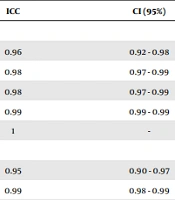
To assess the test-retest reliability, the intraclass correlation coefficient (ICC) was used. The results are given in (Table 3). According to the results of the study, all items have an ICC above 0.90, and the ICC of the total score is 0.96, which indicates the reliability of the test was at a very desirable level. Cronbach’s alpha (α) coefficient was used to assess the internal consistency of the SFA. The sample size for internal consistency of the SFA was 80. Cronbach’s alpha (α) for the total score was excellent (α = 0.96), indicating the SFA internal consistency is at the desired level. The results are given in Table 3. In comparison with the original version, which has used different samples such as cerebral palsy, autism, hearing impairments, and mental retardation (MR), a slight difference indicates a good level of internal consistency between the items used in this study among children with physical disabilities.
Table 3.
Cronbach’s Alpha and Intraclass Correlation Coefficient (ICC) of the School Function Assessment (SFA) Items in the Present Study
| Scale | Internal Consistency | P Value | ICC | P Value |
|---|---|---|---|---|
| Participation | 0.87 | < 0.0001 | 0.90 | < 0.0001 |
| Task-support (physical) | ||||
| Assist | 0.95 | < 0.0001 | 0.95 | < 0.0001 |
| Adapt | 0.94 | < 0.0001 | 0.97 | < 0.0001 |
| Task-support (cognitive behavioral) | ||||
| Assist | 0.94 | < 0.0001 | 0.99 | < 0.0001 |
| Adapt | 0.94 | < 0.0001 | 0.97 | < 0.0001 |
| Travel | 0.96 | < 0.0001 | 0.90 | < 0.0001 |
| Creational movement | 0.94 | < 0.0001 | 0.96 | < 0.0001 |
| Position | 0.96 | < 0.0001 | 0.96 | < 0.0001 |
| Manipulation | 0.95 | < 0.0001 | 0.97 | < 0.0001 |
| Using materials | 0.98 | < 0.0001 | 0.90 | < 0.0001 |
| Setup and cleanup | 0.97 | < 0.0001 | 0.93 | < 0.0001 |
| Eating and drinking | 0.96 | < 0.0001 | 0.94 | < 0.0001 |
| Hygiene | 0.97 | < 0.0001 | 0.97 | < 0.0001 |
| Clothing management | 0.97 | < 0.0001 | 0.97 | < 0.0001 |
| Down/up stairs | 0.98 | < 0.0001 | 0.93 | < 0.0001 |
| Written work | 0.98 | < 0.0001 | 0.98 | < 0.0001 |
| Use of computer | 0.96 | < 0.0001 | 0.92 | < 0.0001 |
| Communication | 0.94 | < 0.0001 | 0.94 | < 0.0001 |
| Memory | 0.96 | < 0.0001 | 0.95 | < 0.0001 |
| Social interaction | 0.97 | < 0.0001 | 0.97 | < 0.0001 |
| Acceptance of law | 0.96 | < 0.0001 | 0.98 | < 0.0001 |
| Task behavior | 0.98 | < 0.0001 | 0.95 | < 0.0001 |
| Positive interaction | 0.98 | < 0.0001 | 0.98 | < 0.0001 |
| Behavior regulation | 0.96 | < 0.0001 | 0.95 | < 0.0001 |
| Safety | 0.96 | < 0.0001 | 0.96 | < 0.0001 |
| Self-care | 0.97 | < 0.0001 | 0.97 | < 0.0001 |
4. Discussion
The present study was conducted in three sections: content validity, test-retest reliability, and internal consistency of the Persian version of SFA. One of the strong aspects of this study is the presence of multiple responders for each test; each item was completed by the person who most closely related to the student in that area. After determining the results of CVI, questionable items were resolved in collective discussions to reach an ultimate agreement. This agreement showed that all phrases in the Persian version of SFA are simple, meaningful, and clear. In the Iranian version of SFA, which is performed in normal schools, content validity is reported to be high (15). The Chinese version was performed in cerebral palsy children recently and showed high enough content validity, too (13). In this study, the test-retest reliability of the Persian version of SFA was obtained to be adequately high. This result is almost in line with the results of other studies. For example, in the original version of SFA, the test-retest reliability was 0.82 to 0.98. In the Chinese version of SFA, ICC was in the appropriate range of 0.87 and 0.98 (14). In a recent study performed on children with cerebral palsy, ICC was reported in the good range of 0.75 and 0.97 (13). The test-retest reliability of the Taiwanese version of SFA was also reported at an appropriate level of 0.87 to 0.98 (12). In the present study, the ICC of the Iranian version of SFA was 0.96 for the whole test, which indicates the reliability of the test at a very desirable level. The results of the internal consistency analysis in this study indicate that the Cronbach’s alpha of Iranian version of SFA is excellent. In this case, the results are in line with the studies on the other version of this tool. For example, for assessing the internal consistency of the SFA items during the development of the SFA, several other studies used the Rash Analysis and reported the internal consistency of the SFA in the range of 0.82 to 0.98 (12). In the Chinese version of SFA on both normal and cerebral palsy students, Cronbach's alpha was reported to be in the range of 0.94 to 0.98, which is desirable (13, 14). In the Taiwanese version, Cronbach’s alpha has been reported between 0.49 and 0.98 (12). The Cronbach’s alpha coefficient for the whole test is α = 0.96, which indicates the desired level of internal consistency of the Persian version of SFA. The only item with a score below 0.93 is the participation item. The low score of this item can be due to the lower self-esteem of these students because of their problems such as weakness of the educational system, insufficient facilities, and inappropriate environment, besides other problems.
4.1. Limitations of the Study
Difficulties and limitations of this work included a large amount of time needed to complete the test and the number of questions that resulted in the low level of cooperation of teachers with the therapists. This, in turn, led to the extension of the time needed to complete this research.
4.2. Conclusion
School function assessment is an appropriate tool for initial assessment, planning, and implementation of necessary interventions and environmental modifications in schools of children with physical disabilities who do not know their basic facilities and rights. Considering the lack of reliable tools in Iran to study the educational issues and the overall performance of children with physical disability, and according to the results of this research, SFA can be an appropriate tool to study the motivation and guidance in interventions for students with physical disabilities. To complete SFA, due to having different items, a cooperation with the teacher, the superintendent, and the parents is needed. Since this test has different parts each of which addressing different aspects of school performance and considering the fact that each section in the present study showed that the tool has an appropriate validity and reliability, each item can be used as an outcome measure separately. This study can be performed on populations with a different diagnosis of physical and mental disabilities. It should be stated that content validity of the SFA for children with physical disability is under investigation.