
1. Background
The Arbaeen pilgrimage in Karbala has garnered significant attention in recent years as one of the largest human gatherings globally (1). According to the World Health Organization (WHO), mass gatherings are defined as events where a large number of people gather in a specific place for a specific purpose, requiring meticulous planning and public health monitoring (2). In 2017, the number of Iranian pilgrims participating in the Arbaeen pilgrimage reached 2,320,000 (3), making it one of the largest mass gatherings in the Middle East (1, 4). Given the massive scale of this event and the healthcare needs it entails, a formal memorandum of understanding (MoU) was signed between the Iranian Ministry of Health and the Iraqi Ministry of Health to provide healthcare services to Arbaeen pilgrims (5). This collaboration is particularly crucial for promoting health and preventing disease spread in such a large population (6).
Providing healthcare services during mass gatherings, particularly along the 70-kilometer Arbaeen pilgrimage route from Najaf to Karbala (7), is essential. These services are typically offered through field hospitals designed for rapid deployment and mobility. Field hospitals can take various forms, including containers, tents, inflatable structures, and portable shelters, with the choice depending on available resources, weather conditions, and the specific healthcare needs of the pilgrims (8). These healthcare centers, by providing medical treatment and emergency services, play a critical role in reducing health risks and enhancing the safety of pilgrims. Additionally, they are a key mechanism in preventing disease outbreaks among the massive crowds.
Oral health is a fundamental component of overall health and well-being (9), and dental care becomes especially crucial in emergencies. Dental diseases, including toothaches and related infections, are common public health issues that can significantly impact individuals' general health. If left untreated, these problems may lead to more severe complications, such as advanced infections or sepsis, which not only prolong the treatment process but also increase healthcare costs and exacerbate patients' suffering (10). In mass gathering settings, these issues become even more pressing as healthcare facilities are often limited, and access to dental services is significantly reduced.
Mass gatherings, particularly in environments where public health standards are compromised and unhygienic behaviors are common, create ideal conditions for the spread of epidemics and widespread health issues. In such settings, oral and dental diseases can rapidly escalate due to limited access to healthcare and insufficient infrastructure. Environmental factors, including poverty, malnutrition, and lack of sanitary facilities, further heighten the risk of oral and dental health problems (9, 10).
Dental services play a critical role in crisis and disaster scenarios, where oral health should not be considered a secondary concern. Ignoring dental issues can significantly impact quality of life, and in cases of severe infections and delayed treatment, it can even lead to fatalities. Forensic dentistry and non-governmental organizations (NGOs) providing emergency dental care are therefore essential for crisis management and reducing mortality (11, 12).
One of the most prominent examples of a mass gathering is the Arbaeen pilgrimage, where millions of pilgrims participate in the annual walk from Najaf to Karbala. The unique environmental conditions and dense crowd present numerous challenges in delivering healthcare services, particularly in oral and dental health. While many studies on mass gatherings focus on general health issues, scientific research on oral health during events like the Arbaeen pilgrimage remains limited. A notable study conducted in 2017 examined the relationship between oral hygiene, smoking, and systemic diseases among pilgrims (13).
2. Objectives
This study aims to report on the voluntary dental services provided in field hospitals during the 2019 Arbaeen pilgrimage. Field hospitals, with their mobility and rapid setup, are among the most effective means of delivering healthcare in mass gatherings. This research seeks to offer a model for dental service provision at large-scale events, potentially serving as a blueprint for similar future gatherings.
3. Methods
This cross-sectional, descriptive-analytical study examines the dental services provided at a field hospital during the 2019 Arbaeen pilgrimage. The range of services included patient consultations, medication prescriptions, dry socket treatments, suturing, tooth extractions, pulpotomies, dressings, restorations, and scaling, catering to both Iranian and non-Iranian patients.
3.1. Location of Services
The Mukab Ali Ibn Musa Al-Reza Clinic, serving as a field hospital, was located approximately 40 kilometers from Karbala along the 80-kilometer pilgrimage route between Najaf and Karbala in Iraq. This clinic operates exclusively during the Arbaeen pilgrimage each year and is equipped with three dental units, along with essential medical equipment, to address the healthcare needs of pilgrims.
3.2. Medical Team and Shift Work
During the 2019 Arbaeen pilgrimage, a team of three experienced dentists, each with over 10 years of professional practice, along with three female dental assistants, delivered outpatient dental services in two shifts from 8 AM to 9 PM over a one-week period. To facilitate communication between Iraqi patients and the dental team, a female and a male translator were also part of the healthcare team. Dental services operated as an independent unit, positioned adjacent to other medical specialties within the field hospital.
3.3. Treatment Process
Patients were first registered at the triage unit, where general information such as age and gender was recorded. To ensure patient confidentiality, names were not documented; instead, each patient was assigned a unique treatment code. Some patients received only consultations and prescriptions, while others underwent necessary dental treatments based on their specific needs. The dental services provided included tooth extractions, pulpotomies, dressings, restorations, dry socket treatment, suture removal, abscess drainage, wisdom tooth surgery, crown cementation, and scaling.
3.4. Data Collection and Analysis
Data were collected daily from both the triage and dental units and recorded in Excel. Descriptive statistical analysis was conducted, and charts were created to illustrate the age distribution of patients and the types of services provided.
4. Results
Voluntary dental services at the field hospital for the 2019 Arbaeen pilgrimage were provided continuously over one week, with two shifts from 8 AM to 8 PM. During this period, 26,875 individuals visited the field hospital. After triage, 810 individuals with oral and dental issues, including 342 women (42.22%) and 468 men (58%), were referred to the dental department.
The majority of patients were in the 25 to 35 age group, accounting for 215 individuals (26.57%). The fewest visitors were in the over-55 age group, comprising 39 individuals (4.81%). The dental department at the field hospital treated patients over the age of 12, categorizing them into six age groups (Table 1).
Table 1.
Age Distribution of Dental Patients
| Age Group, (y) | Individuals; No. (%) |
|---|---|
| 12 to 18 | 134 (16.54) |
| 19 to 24 | 176 (21.73) |
| 25 to 35 | 215 (26.57) |
| 36 to 45 | 137 (16.91) |
| 46 to 55 | 109 (13.46) |
| Over 55 | 39 (4.81) |
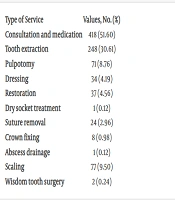
During this period, a wide range of dental services was provided. The most common service was consultation and medication prescription, which 418 patients (51.60%) received. The least common services were dry socket treatment and abscess drainage, with only one case of each (0.12%) (Table 2).
Table 2.
Type of Services Provided
| Type of Service | Values, No. (%) |
|---|---|
| Consultation and medication | 418 (51.60) |
| Tooth extraction | 248 (30.61) |
| Pulpotomy | 71 (8.76) |
| Dressing | 34 (4.19) |
| Restoration | 37 (4.56) |
| Dry socket treatment | 1 (0.12) |
| Suture removal | 24 (2.96) |
| Crown fixing | 8 (0.98) |
| Abscess drainage | 1 (0.12) |
| Scaling | 77 (9.50) |
| Wisdom tooth surgery | 2 (0.24) |
The most frequently provided services were consultation and medication prescription (418 cases, 51.60%) and tooth extraction (248 cases, 30.61%). The least commonly provided services were abscess drainage and dry socket treatment, with only one case each (0.12%).
5. Discussion
The dental services provided at the Ali Ibn Musa Al-Reza (AS) field hospital in 2019, situated 40 kilometers from Karbala along the Arbaeen pilgrimage route, underscored the essential role of voluntary healthcare during this mass gathering. Despite logistical limitations and the remote location, dental professionals successfully delivered a comprehensive range of services to 810 patients over a one-week period. These services included consultations, medication prescriptions, tooth extractions, pulpotomies, dressings, restorations, dry socket treatments, suture removals, crown placements, and abscess drainage. Additionally, specialized services such as scaling and wisdom tooth surgeries were offered.
A notable trend observed was the increase in patient numbers as Arbaeen approached, with the highest number of patients treated on the fourth day of the hospital’s operation, totaling 146 (18.02%). The peak for a single shift occurred on the fifth day, when 80 individuals (9.87%) visited during the afternoon shift, reflecting a heightened demand in the second half of the clinic’s operation. In contrast, the fewest patients were treated on the first day, with only 27 patients attending the morning shift.
Analysis of daily patient distribution revealed a gradual increase in patient visits as the pilgrimage progressed, underscoring the importance of heightened preparation during the final days, as the influx of pilgrims and demand for dental care increase. Therefore, careful planning is essential to ensure adequate supplies of equipment, medications, and fresh medical personnel, particularly in the concluding days of the event.
The study also highlighted a gender disparity among the patients, with a majority being male (58%). This could suggest a higher male presence at the Arbaeen pilgrimage or may reflect that women, potentially more attentive to oral hygiene, required fewer dental services.
The results underscore the importance of education and raising awareness about oral hygiene in large gatherings like the Arbaeen pilgrimage. Promoting preventive behaviors, such as regular brushing and flossing, can significantly reduce dental issues and ultimately decrease the number of individuals requiring dental services. Given the substantial increase in pilgrims during the final days of the pilgrimage, the implementation of educational and hygiene programs becomes increasingly critical.
The healthcare team provided voluntary, humanitarian services free of charge to pilgrims along the walking route. These services, especially dental care, which is often costly, were delivered with high quality and met with patient satisfaction. Dental services are among the essential yet expensive healthcare provisions, and offering them in mass gatherings like Arbaeen requires extensive coordination and careful planning (14).
The majority of dental patients were within the 25 - 35 age group, indicating insufficient oral hygiene practices among this demographic (15). In comparison, musculoskeletal issues were more common in the 35 - 45 age group, signaling a different health concern for middle-aged individuals (16). This finding suggests the need to prioritize oral and dental care for younger populations. Common oral conditions, such as dental caries and periodontal disease, can largely be prevented through proper education and preventive measures.
In this study, consultations and medication prescriptions were the most frequently provided dental services, with 418 patients (51.60%) receiving these treatments. This high demand for consultations suggests that chronic pain was a prevalent issue among patients, pointing to the need for improved health education and self-care initiatives, particularly concerning daily brushing and flossing practices, to enhance the overall health of pilgrims. Effective oral hygiene should be incorporated into a structured preventive program that includes oral health education, motivational support, dietary guidance, and fluoride use to manage gingival inflammation and prevent tooth decay (17). During large gatherings, oral hygiene is often neglected due to limited resources and restricted access to healthcare, reinforcing the importance of education and self-care promotion as essential strategies to reduce the demand for dental services during mass events like Arbaeen.
5.1. Conclusions
Dental care is a critical healthcare service that demands focused attention during mass gatherings like the Arbaeen pilgrimage. The demographic insights from the dental unit of the field hospital highlight an urgent need for comprehensive interventions in oral hygiene. Educational initiatives emphasizing proper brushing and flossing techniques, along with robust healthcare infrastructure, could alleviate dental pain and discomfort among pilgrims. Providing dental care in such large-scale gatherings requires specialized equipment, facilities, and logistical coordination by skilled dental professionals. Despite the increasing provision of healthcare services, particularly dental care, during recent Arbaeen pilgrimages, further strategic planning and attention from healthcare providers and researchers are essential to optimize and expand dental services in similar high-density events.