
1. Background
Mass gatherings are predetermined or spontaneous events in which many people convene at a specific time and place (1, 2). Arbon et al. defined a mass gathering as a situation in which a large number of people come together and create challenges in access to health care (3). Music festivals and sporting, religious, and political events are types of mass gatherings (2). The Arbaeen walking ceremony is a mass gathering that has attracted large numbers of people from different countries, including Iran, over the past 10 years. In this event, most pilgrims walk from Najaf to Karbala, a distance of nearly 80 km (4).
According to Arbon's model, three biological, psychosocial, and environmental factors affect the health of participants in mass gatherings. Biological factors include a person's health status, illnesses, and physical readiness for activity. Psychosocial factors include the mental state of the people present at the gathering, and environmental factors include characteristics such as weather and the location of the gathering. These variables affect one another; for example, environmental factors, such as heat and humidity, influence psychosocial factors, such as the population's mood and behavior (5). Therefore, according to Arbon's model, human crowding, inadequate transportation systems, inappropriate housing, a lack of specialist physicians, inadequate health systems, terrorist threats, climate change, and similar factors may contribute to health problems during the Arbaeen ceremony (5).
During such events, health care providers face a range of health problems, from simple wounds to cardiac arrest (6). Mohammadinia et al. demonstrated that the most common complaints reported by patients were musculoskeletal problems, foot blisters, and skin lesions (7). Nazari et al. also reported that pilgrims of the Arbaeen ceremony (AC) experienced various communicable and noncommunicable health complaints (8). Arbon et al. stated that respiratory illness, minor injuries, heat-related injuries, and other minor health problems, such as headaches, blisters, and sunburn, are the most prevalent health problems in mass gatherings (3). Farahmand et al. reported that upper respiratory tract infection was the most common complaint among patients and that cold tablets for adults, acetaminophen, and cetirizine were the most commonly prescribed drugs (1).
Other factors affecting the occurrence of digestive and respiratory diseases include food and drinks along walking routes and limited space for rest (9). Ensuring participant safety and health is one of the most important parameters for the successful management of mass gatherings (2). Public health managers should identify risk factors for health problems among participants to plan and prepare health services for such events (2).
2. Objectives
The present study aimed to identify predictors of health problems among pilgrims participating in the Arbaeen ceremony.
3. Methods
3.1. Study Design
This retrospective descriptive-analytical study assessed the prevalence and types of health issues and their association with overall health status and perceived physical preparedness for participation in the Arbaeen ceremony in 2023. The findings are reported in accordance with the Strengthening the Reporting of Observational Studies in Epidemiology (STROBE) guidelines.
3.2. Sample and Sampling Method
The study population comprised Iranian Arbaeen pilgrims in 2023. Data were collected from September to October 2023. The sample size was determined using Cochran's sample size formula, with a 95% confidence interval and a 5% sampling error, yielding a calculated sample size of 450. Participants were recruited using convenience and snowball sampling based on voluntary consent. The inclusion criteria were literacy, the ability to use a smartphone, and approval of the informed consent documents. There were no exclusion criteria.
3.3. Study Instruments
The data collection tool comprised 3 parts. The first part was a 13-item demographic form assessing age, gender, education level, type of transportation (public or private), departure border, trip length, previous Arbaeen trip, medical and medication history, and types of health problems on the way to Iraq and on the return from Iraq.
The second part was the 28-item General Health Questionnaire (GHQ-28). It includes four 7-item subscales: somatic symptoms (items 1 - 7), anxiety/insomnia (items 8 - 14), social dysfunction (items 15 - 21), and severe depression (items 22 - 28). Responses are rated on a 4-point Likert scale ranging from 0 = better than usual to 3 = much worse than usual, with total scores ranging from 0 to 84. Higher scores indicate poorer mental health. The GHQ-28 cutoff point is 24; scores lower than 24 indicate a healthy condition, whereas scores higher than 24 indicate an unhealthy condition (10). The GHQ-28 was developed by Goldberg and Hillier (10). The sensitivity and specificity of the GHQ-28 were 79% and 79%, respectively, and its receiver operating characteristic curve was 88 (11). Taghavi (2002) developed the Persian version of the GHQ-28 and reported an internal consistency of 90% (12).
The third part was the PPFS, which consists of 12 items and 5 subscales: physical condition, muscular flexibility, muscular condition, and body composition. Each item is rated from 1 to 5 on a Likert scale. Total PPFS scores range from 12 to 60, categorizing physical condition as follows: scores of 12 - 36 indicate weak physical condition, 37 - 48 indicate moderate status, and scores above 48 indicate good physical condition. The PPFS was introduced by Abadie, who reported an internal consistency of 78% (13). In addition, the scale demonstrated strong reliability, with a reported coefficient of 0.92 (13). The Persian version of the PPFS was approved by Farsi and Foladian in 2011, with an internal consistency of 84% (14).
3.4. Data Collection
The invitation to participate in this study was disseminated via family, occupational, and community groups on messaging platforms, including Rubika, Eita, Telegram, and WhatsApp. The research team then asked individuals who attended the Arbaeen pilgrimage to forward the invitation message to contacts known to have participated in the Arbaeen event. The introductory message described the study objectives and requested confirmation of informed consent for participation. After participants completed the questionnaire, they were not permitted to edit their responses.
3.5. Statistical Analysis
Data were analyzed using Stata version 13. Before analysis, the data were cleaned. First, to remove duplicate responses, the unique participant identifiers assigned through the data collection platform were checked for similarity. If similar identifiers were found, one response was deleted. No similar participant identifiers were identified. Next, potential data-entry errors were assessed using descriptive statistics. If an error was identified in a variable, it was replaced with the most frequent response for that variable. Two errors were identified in the age variable. Descriptive statistics, including mean (standard deviation) and frequency (simple and relative), were used to summarize participants' demographic characteristics. In the analytical stage, participants who reported any type of health problem were recoded as ill pilgrims during the Arbaeen ceremony, whereas those who reported no health problems were classified as healthy pilgrims. Univariate logistic regression was used to determine the predictive value of each variable for the occurrence of a health problem among pilgrims. Finally, multivariate logistic regression using the enter method was performed to calculate adjusted odds ratios for the occurrence of health problems. Statistical significance was set at 0.05 for all tests.
3.6. Ethical Considerations
The Institutional Review Board (IRB) of Kermanshah University of Medical Sciences approved the research proposal (IR KUMS.REC.1402.318), and all aspects of the study were conducted under IRB oversight. Participants confirmed their understanding of the informed consent document after reviewing the study objectives. Anonymity was ensured by not collecting participants' first and last names. Confidentiality was maintained by storing the data in a password-secured directory.
4. Results
The introductory research message was viewed approximately 900 times, and 461 individuals completed the questionnaire, yielding a response rate of approximately 51.2%.
4.1. Individual Characteristics of Participants
The mean age of the participants was 35.10 ± 14.65 years. Among the sample, 50.3% were female (n = 232), and 51.4% had educational qualifications above a diploma (n = 237). Additionally, 62.5% (n = 288) used public transportation, and 205 participants (44.5%) traveled for less than 5 days. The Khosravi and Mehran borders had the highest traffic, with 46.9% (n = 216) and 34.5% (n = 159) of participants using these routes, respectively. Furthermore, 9.1% of the sample reported a history of endocrine and metabolic diseases (n = 42) (Table 1). As shown in Table 1, the mean general health condition score of the participants was less than 20, and the mean perceived physical fitness score was 38.1.
Table 1.
Demographic Characteristics of the Participants (N = 461) a
| Variables | Values |
|---|---|
| Age (11 - 77) | 35.10 ± 14.65 |
| Gender | |
| Male | 229 (49.7) |
| Female | 232 (50.3) |
| Education | |
| < Diploma | 224 (48.6) |
| > Diploma | 237 (51.4) |
| Means of travel | |
| Personal transportation | 173 (37.5) |
| Public transportation | 288 (62.5) |
| Travel time (day) | |
| ≥ 5 | 205 (44.5) |
| 6 - 10 | 193 (41.9) |
| 10 < | 63 (13.7) |
| Previous Arbaeen experience | |
| 1 | 145 (31.5) |
| 2 - 4 | 212 (46.0) |
| 5 ≤ | 104 (22.5) |
| Departure board | |
| Mehran | 159 (34.5) |
| Khosravi | 216 (46.9) |
| Shalamcheh and Chazabeh | 53 (11.5) |
| Bashmaq and Tamrchin | 5 (1.1) |
| Airplane travel | 28 (6.1) |
| Past Medical History | |
| Yes | |
| Cardiovascular/Respiratory | 21 (4.6) |
| Gastrointestinal | 12 (2.6) |
| Metabolic and endocrine | 42 (9.1) |
| Neurological/Psychiatric | 12 (2.6) |
| Multisystem | 30 (6.5) |
| No | 344 (74.6) |
| Past drug history | |
| Yes | 100 (21.7) |
| No | 361 (78.3) |
| General Health Condition | 19.7 ± 11.6 |
| Perceived physical fitness | 38.1 ± 6.2 |
a Values are expressed as No. (%) or mean ± SD.
4.2. Prevalence of Health Problems
On the way to the Arbaeen ceremony, nearly 62% of participants experienced health problems. However, the prevalence of health problems among pilgrims was 54% on the way back from AC. The most prevalent health problems during travel to and return from AC were sunburn and skin blisters (43.3 vs 29.5), weakness or headache (30.6 vs 29), and vomiting and diarrhea (10.9 vs 8.2), respectively. The least prevalent health problems were hypo- and hyperglycemia, anxiety, and sleeplessness (Figure 1).
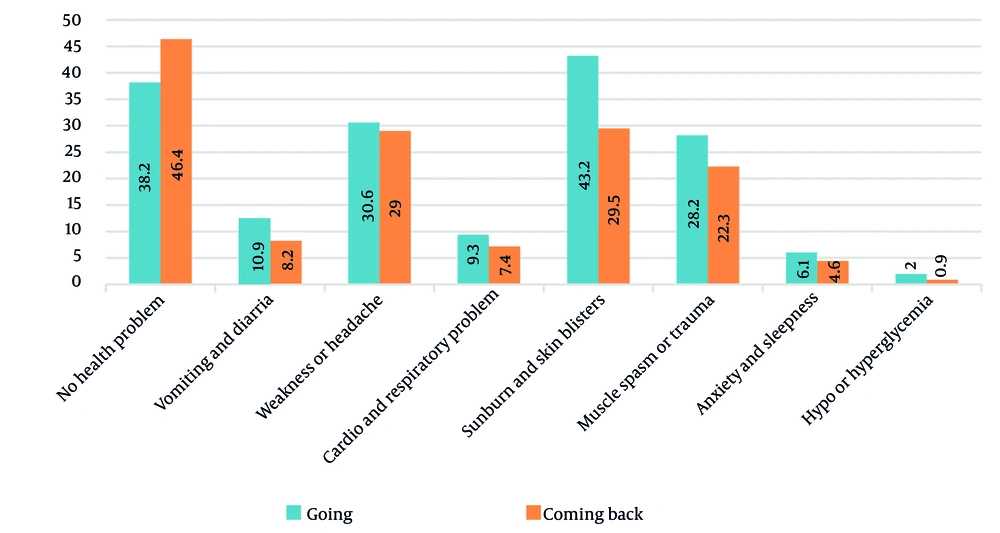
Figure 1.
Prevalence of health problems among Arbaeen pilgrims on the way to and back from the Arbaeen ceremony
4.3. Factors Related to Health Problems on the Way to the Arbaeen Ceremony
As shown in Table 2, univariate and multivariate logistic regression indicated that age was not an important predictor of health problems among pilgrims (OR = 1). Although univariate analysis indicated that women experienced 33% more health problems (OR = 1.33), the higher odds of health problems among women disappeared after controlling for other variables in multivariate regression (OR = 0.98). The regression results also indicated that the level of education was not an important predictor of health problems among pilgrims (OR = 1.22, P > 0.05).
Table 2.
Predictor Variables of Health Problems on the Way to the Arbaeen Ceremony a
| Demographic Variables | Health Problem | |||||
|---|---|---|---|---|---|---|
| Yes | No | Crude OR (CI) | P-Value | Adjusted OR (CI) | P-Value | |
| Age | 1.00 (0.99 - 1.02) | 0.14 | 1.00 (0.99 - 1.02) | 0.27 | ||
| Gender | ||||||
| Male | 134 (58.5) | 95 (41.5) | ||||
| Female | 150 (65.1) | 81 (34.9) | 1.32 (0.90 - 1.92) | 0.14 | 0.98 (0.63 - 1.15) | 0.93 |
| Level of education | ||||||
| < Diploma | 133 (59.4) | 91 (40.6) | ||||
| > Diploma | 152 (64.1) | 85 (39.9) | 1.22 (0.83 - 1.78) | 0.29 | 1.16 (0.76 - 1.76) | 0.47 |
| Transportation Vehicle | ||||||
| Personal Vehicle | 90 (52) | 83 (48) | ||||
| Public transportation | 195 (67.7) | 93 (32.3) | 1.93 (1.31 - 2.84) | 0.00 | 1.71 (1.12 - 2.60) | 0.01 |
| Traveling Borders | ||||||
| Mehran | 93 (58.5) | 66 (41.5) | ||||
| Khosravi | 128 (59.3) | 88 (40.7) | 1.03 (0.68 - 1.56) | 0.88 | 1.14 (0.72 - 1.81) | 0.57 |
| Shalamcheh and Chazabeh | 40 (75.5) | 13 (24.5) | 2.18 (1.08 - 4.40) | 0.02 | 2.30 (1.05 - 5.03) | 0.03 |
| Tamarchin and Bashmagh | 3 (60) | 2 (40) | 1.06 (0.17 - 6.54) | 0.94 | 0.80 (0.08 - 7.96) | 0.85 |
| Airport | 21 (75) | 8 (25) | 2.12 (0.85 - 5.29 | 0.10 | 1.44 (0.55 - 3.75) | 0.45 |
| Length of trip | ||||||
| 1 - 5 | 106 (51.7) | 99 (48.3) | ||||
| 6 - 10 | 138 (71.5) | 55 (28.5) | 2.34 (1.54 - 3.55) | 0.00 | 2.59 (1.63 - 4.11) | 0.00 |
| > 10 | 41 (65.1) | 22 (34.9) | 1.74 (0.96 - 3.12) | 0.06 | 1.72 (0.88 - 3.35) | 0.10 |
| Previous Abaeein trip Experience | ||||||
| 1 | 92 (63.4) | 53 (36.4) | ||||
| 2 - 4 | 127 (59.9) | 85 (40.1) | 0.86 (0.55 - 1.33) | 0.50 | 0.73 (0.45 - 1.18) | 0.20 |
| 5 ≤ | 66 (63.5) | 38 (36.5) | 1.00 (0.59 - 1.68) | 0.99 | 0.68 (0.37 - 1.25) | 0.21 |
| Past Medical History | ||||||
| No disease History | 201 (58.4) | 143 (41.6) | ||||
| Cardiovascular/ Respiratory | 15 (71.4) | 6 (28.6) | 1.77 (0.67 - 4.69) | 0.24 | 1.85 (0.61 - 5.60) | 0.27 |
| Gastrointestinal | 7 (58.3) | 5 (41.7) | 0.99 (0.30 - 3.20) | 0.99 | 0.82 (0.23 - 2.96) | 0.77 |
| Metabolic and endocrine | 29 (69) | 13 (31) | 1.58 (0.79 - 3.15) | 0.18 | 2.00 (0.77 - 5.16) | 0.15 |
| Neurological/Psychiatric | 10 (83.3) | 2 (16.7) | 3.55 (0.76 - 16.48) | 0.10 | 5.26 (0.79 - 34.96) | 0.08 |
| Multisystem | 23 (76.7) | 7 (23.3) | 2.33 (0.97 - 5.59) | 0.057 | 2.80 (0.91 - 8.54) | 0.07 |
| Past drug history | ||||||
| No | 217 (60.1) | 144 (439.9) | ||||
| Yes | 68 (68) | 32 (32) | 1.41 (0.88 - 2.25) | 0.14 | 0.62 (0.29 - 1.35) | 0.23 |
| General health condition | 1.01 (0.99 - 1.03) | 0.10 | 1.00 (0.99 - 1.02) | 0.31 | ||
| Perceived physical fitness | 0.97 (0.94 - 1.00) | 0.08 | 0.98 (0.94 - 1.01) | 0.28 | ||
a Values are expressed as No. (%) unless indicated.
Interestingly, the type of transportation significantly affected the occurrence of health problems among Arbaeen pilgrims. Health problems were significantly more prevalent among people who departed from Shalamcheh and Chazabeh (crude OR = 2.18 and AOR = 2.33). Notably, participants who traveled to AC by airplane experienced more health problems than those who crossed borders; however, this difference was not significant in either univariate (OR = 2.12) or multivariate logistic regression (OR = 1.44). However, participants who traveled through the Shalamcheh and Chazabeh crossing borders experienced a significantly higher rate of health problems (OR = 2.18).
Univariate and multivariate regression indicated that longer trips increased the likelihood of health problems among participants. Participants who reported an AC trip length of 6 - 10 days experienced significantly more health problems in univariate analysis (OR = 2.34). This effect remained significant after controlling for other variables in multivariate regression (P < 0.05). Although previous participation in AC decreased the likelihood of health problems (OR = 0.73), this effect was not significant in either univariate or multivariate regression (P > 0.05).
Although univariate logistic regression indicated that health problems were more prevalent among participants traveling to AC who had a past medical history (OR = 3.55 in participants who had neurological or psychiatric disease) or drug history (OR = 1.47), these factors had no significant effect on the occurrence of health problems among pilgrims. Multivariate analysis also indicated that past medical history was not an important predictor of health problems among participants (OR = 5.25, P > 0.05) (Table 2).
As presented in Table 2, univariate and multivariate logistic regression indicated that general health condition (OR = 1.01) and perceived physical fitness (OR = 0.98) had no significant effect on the occurrence of health problems among pilgrims on the way to AC (P > 0.05).
4.4. Factors Related to Health Problems on the Way Back From the Arbaeen Ceremony
As shown in Table 3, univariate regression indicated that age was a significant factor in the occurrence of health problems on the way back from AC. However, the effect of age did not remain significant after controlling for other variables in multivariate regression (P < 0.05). According to univariate and multivariate logistic regression, gender, level of education, type of transportation, departure border, length of trip, and previous Arbaeen trip were not important predictors of health problems among Arbaeen pilgrims on the way back from AC (P > 0.05). Pilgrims who returned from the Tamarchin and Bashmagh or Khosravi crossing borders experienced 48% and 25% more health problems than those who returned from the Mehran border, respectively. However, univariate logistic regression indicated that these differences were not important predictors of health problems among participants (P > 0.05). Multivariate logistic regression also indicated that the crossing border was not an important predictor of health problems among participants (P > 0.05).
Table 3.
Predictor Variables of Health Problems on the Way Back from Arbaeen a
| Demographic Variables | Health Problem | |||||
|---|---|---|---|---|---|---|
| Yes | No | Crude OR (CI) | P-Value | Adjusted OR (CI) | P-Value | |
| Age | 1.01 (1.00 - 1.03) | 0.00 | 1.01 (0.99 - 1.03) | 0.08 | ||
| Gender | ||||||
| Male | 121 (52.8) | 108 (47.2) | ||||
| Female | 124 (53.4) | 108 (46.6) | 1.14 (0.71 - 1.47) | 0.89 | 0.90 (0.59 - 1.38) | 0.65 |
| Level of education | ||||||
| < Diploma | 116 (51.8) | 108 (48.2) | ||||
| > Diploma | 129 (54.4) | 108 (45.6) | 1.11 (0.77 - 1.60) | 0.57 | 1.10 (0.73 - 1.65) | 0.62 |
| Transportation vehicle | ||||||
| Personal vehicle | 88 (50.9) | 85 (49.1) | ||||
| Public transportation | 159 (55.2) | 129 (44.8) | 1.19 (0.81 - 1.73) | 0.36 | 1.09 (0.72 - 1.66) | 0.65 |
| Traveling border | ||||||
| Mehran | 80 (50.3) | 79 (49.7) | ||||
| Khosravi | 119 (55.1 | 97 (44.9) | 1.25 (0.83 - 1.89) | 0.27 | 1.22 (0.77 - 1.92) | 0.38 |
| Shalamcheh and Chazabeh | 28 (52.8) | 25 (47.2) | 1.10 (0.59 - 2.06) | 0.75 | 1.04 (0.51 - 2.10) | 0.90 |
| Tamarchin and Bashmagh | 3 (60) | 2 (40) | 1.48 (0.24 - 9.10) | 0.67 | 0.37 (0.02 - 5.29) | 0.46 |
| Airport | 15 (53.6) | 13 (46.4) | 1.13 (0.50 - 2.54) | 0.75 | 1.03 (0.43 - 2.48) | 0.93 |
| Length of trip | ||||||
| 1 - 5 | 107 (52.2) | 98 (47.8) | ||||
| 6 - 10 | 108 (56) | 85 (44) | 1.18 (0.80 - 1.76) | 0.39 | 1.30 (0.83 - 2.04) | 0.24 |
| > 10 | 31 (49.2) | 32 (50.8) | 0.88 (50 - 1.56) | 0.67 | 0.85 (0.44 - 1.63) | 0.63 |
| Previous Abaeein trip experience | ||||||
| 1 | 68 (46.9) | 77 (53.1) | ||||
| 2 - 4 | 119 (56.1) | 93 (43.9) | 1.47 (0.96 - 2.25) | 0.07 | 1.41 (0.88 - 2.25) | 0.14 |
| 5 ≤ | 58 (55.8) | 46 (44.2) | 1.48 (0.89 - 2.46) | 1.35 (0.75 - 2.41) | 0.30 | |
| Past medical history | ||||||
| No disease history | 166 (48.3) | 178 (51.7) | ||||
| Cardiovascular/respiratory | 17 (81) | 4 (19) | 4.50 (1.48 - 13.66) | 0.00 | 4.17 (1.24 - 14.00) | 0.02 |
| Gastrointestinal | 4 (33.3) | 8 (66.7) | 0.52 (0.15 - 1.79) | 0.30 | 0.37 (0.10 - 1.36) | 0.13 |
| Metabolic and endocrine | 29 (69) | 13 (31) | 2.36 (1.18 - 4.70) | 0.01 | 2.30 (0.90 - 5.87) | 0.08 |
| Neurological/psychiatric | 10 (83.3) | 2 (16.7) | 5.29 (1.14 - 24.54) | 0.03 | 7.15 (0.9 - 51.57) | 0.05 |
| Multisystem | 20 (66.7) | 10 (33.3) | 2.11 (0.96 - 4.66) | 0.06 | 1.81 (0.65 - 5.07) | 0.25 |
| Past drug history | ||||||
| No | 181 (50.1) | 180 (49.9) | ||||
| Yes | 64 (64) | 36 (36) | 1.82 (1.15 - 2.89) | 0.01 | 0.77 (0.35 - 1.68) | 0.51 |
| General health condition | 1.02 (1.01 - 1.04) | 0.00 | 1.01 (0.99 - 1.03) | 0.09 | ||
| Perceived physical fitness | 0.99 (.96 - 1.01) | 0.56 | 1.01 (0.97 - 1.04) | 0.58 | ||
a Values are expressed as No. (%) unless indicated.
Univariate and multivariate logistic regression indicated that having cardiovascular disease (OR = 4.50) was associated with a greater likelihood of experiencing a health problem on the way back from AC. Past drug history was a significant predictor of health problems among participants (OR = 1.82, P < 0.05). However, after controlling for other variables, the effect of past drug history disappeared (P > 0.05).
Univariate regression indicated that general health condition was a significant factor in the occurrence of health problems (OR = 1.02, P = 0.01); however, after controlling for other factors in multivariate regression, this effect did not remain significant (P = 0.09). According to univariate and multivariate logistic regression, perceived physical fitness was not an important factor in the occurrence of health problems among pilgrims (P > 0.05).
5. Discussion
Participation in mass gatherings can lead to specific health problems among participants (15). This survey aimed to explore predictors of health problems among Arbaeen pilgrims. The most prevalent health issues were sunburn and skin blisters, weakness and headache, and muscle spasm and trauma. Selig et al. demonstrated that headache, laceration/abrasion, ear, nose, and throat problems, nausea, vomiting, and diarrhea were prevalent health problems among participants in a speedway event in Kansas (16). Mohammadinia et al. reported that the most common health problems during the Arbaeen pilgrimage were musculoskeletal problems, foot blisters, and skin lesions (7). These problems are possible signs and symptoms of heat-related disease. Therefore, health education programs should focus on the prevention and treatment of heat-related problems.
One interesting finding of the present study was that health problems were more prevalent on the way to Iraq than on the way back home (62% vs 54%). A possible reason for this finding is the long walking distance that pilgrims cover when traveling to AC. However, when returning from AC, pilgrims do not walk and instead travel to border crossings by car and bus.
The univariate and multivariate logistic regression results indicated that age was not an important predictor of health problems among Arbaeen pilgrims. Schwabe et al. reported that although older individuals experienced more health issues, these differences were not significant across age groups (17). Several reasons could explain this finding. Older people know that they are vulnerable to greater health problems and may therefore avoid walking long distances or pay more attention to hygiene during participation in AC.
Logistic regression results indicated that although women experienced more health problems during both travel to and return from AC (32% and 14%, respectively), this difference was not a significant predictor of health problems during AC. This result contrasts with the findings of Schwabe et al., who reported that women experienced significantly more medical problems during a road-racing event (17). However, Roberts also showed that gender was not a risk factor for health problems (18). A possible explanation for this finding is greater self-care and adherence to hygiene protocols among women. These factors may have reduced women’s susceptibility to health problems during mass gatherings.
Another important finding of this research is that education level did not predict health problems among Arbaeen pilgrims (P > 0.05). Multivariate analysis indicated that people with a diploma or higher level of education experienced more health problems (OR = 1.16). People with higher levels of education may have official jobs; therefore, their bodies may have lower resilience in crowded situations. These factors may have contributed to more health complaints than those among people with lower educational levels. To the best of our knowledge, the role of educational level remains largely unexamined in health care seeking in mass gatherings. Therefore, further research is needed to assess the role of educational level in experiencing health problems during mass gatherings.
Surprisingly, people who used public transportation experienced more health problems on the way to Arbaeen (OR = 1.71), but this difference was not significant when returning home (OR = 1.09). This result may be influenced by crowding or lower compliance with health measures in public transportation vehicles. It is suggested that health education should focus on diseases that may spread because of crowding in public transportation vehicles. Furthermore, more research is needed on the role of transportation type in the occurrence of health problems in mass gatherings.
Univariate and multivariate logistic regression indicated that people who traveled from Shalamcheh and Chazabeh (OR = 2.30) experienced significantly more health problems than those who traveled from other borders. As hypothesized by Arbon (5), our results indicated that higher temperature and humidity in Shalamcheh and Chazabeh led to more health problems. This finding is consistent with Locoh-Donou et al., who indicated that the heat index increased the chance of health problems among mass-gathering attendees (19). This inference is supported by the chance of health problems among pilgrims who traveled from the Tamarchin and Bashmagh border crossings (OR = 0.37). Therefore, additional facilities should be provided at border crossings with higher heat indices, such as Shalamcheh and Chazabeh, compared with other border crossings.
Although pilgrims who traveled to Arbaeen by airplane had a higher chance of experiencing health problems (OR = 1.44), this factor did not significantly predict health problems. Al-Ansari et al. reported that people who came to Arbaeen from high-income countries experienced more health problems (20). This higher chance of health problems in this group of pilgrims may be related to their hygienic lifestyle, which is not compatible with street food and crowding during the Arbaeen ceremony. This is an important subject for public education before and during participation in mass gatherings such as Arbaeen.
When returning from Arbaeen, univariate analysis indicated that people who returned from Tamarchin and Bashmagh had a higher chance of health problems (OR = 1.48). However, this chance decreased substantially in multivariate analysis (OR = 0.37). A possible reason for this finding is the longer distance that these pilgrims had to travel to reach Iran.
The regression results indicated that trip length significantly contributed to health problems on the way to AC (OR = 2.35 and 1.74 in pilgrims whose trips were longer than 5 days). However, this relationship was not linear. This means that pilgrims who reported a trip longer than 10 days had fewer health problems than those whose trips lasted 6 - 10 days. Van Poppel et al. showed that runners with moderate training frequency and distance had a greater chance of experiencing lower-extremity injuries (21). It seems that pilgrims who reported a trip length of 6 - 10 days may have walked longer distances on foot during AC. Further research is needed to explore the possible reasons for this finding.
Logistic regression results indicated that previous participation in AC more than 5 times decreased the chance of health problems among pilgrims (OR = 0.68). The findings of Schwabe et al. also confirmed that previous experience of attending running events decreased the chance of experiencing a health problem (17). Pilgrims with more experience participating in AC had greater knowledge of AC health conditions and of the centers, known as mokebs, with better health conditions for resting or bathing during their trip to Karbala.
The results of univariate and multivariate regression indicated that past medical history increased the chance of health problems during AC (OR = 1.77 to 5.26). Although the effect of past medical history was not significant on the way to AC, this factor significantly predicted the occurrence of health problems among pilgrims when returning to Iran (P < 0.05). The effect of past drug history was similar to that of past medical history. Al-Ansari et al. also reported that people with a previous history of allergy experienced rhinorrhea nearly 30% more often (20). Yezli reported that past medical and drug histories are risk factors for heat-related illness (22). Therefore, pilgrims with a past medical history should be educated and alerted about their vulnerability to experiencing health problems during participation in AC.
Notably, regression testing indicated that the effect of general health condition was not constant in relation to experiencing health problems. General health condition was an important predictor of health problems among AC pilgrims when returning home (OR = 1.02). However, general health condition was not an important predictor of health problems among pilgrims when traveling to Karbala (P > 0.05). This finding contrasts with the model introduced by Arbon on predictors of health problems in mass gatherings (5). Arbon stated that the psychosocial health of mass-gathering participants is a significant factor in experiencing health problems (5). Hutton et al. also believed that participants’ mood, such as anxiety or panic, is an important factor in the occurrence of health problems in mass gatherings (23). Because the effect of general health condition was not constant among our participants, the role of mental health should be assessed in future research projects.
Logistic regression indicated that although perceived physical fitness (OR = 0.97) decreased the chance of health problems among participants, its effect was not significant (P = 0.08). This finding also contrasts with Yezli, who reported that a low level of physical fitness is a risk factor for heat-related illness in Hajj pilgrims (22). Arbon, in his conceptual model, mentioned that better physical condition of participants could be a preventive factor for the occurrence of health problems during mass gatherings (5). This result may be due to the possibility that pilgrims with better physical fitness paid less attention to health issues. In addition, the high rate of crowding in AC may have caused people with better physical condition to experience communicable diseases, which have weak correlations with physical fitness. Azizi et al. showed that drinking unpacked water, inappropriate hand washing, ritual foods, and public toilets were important risk factors for diarrheal diseases among Arbaeen pilgrims (9). Further research is required to provide greater insight into the effects of pilgrims’ physical health on the occurrence of health problems in such mass gatherings.
5.1. Limitations
Several limitations could affect the findings of this research. First, the cross-sectional design of this study limits its ability to identify causal relationships between demographic and environmental variables and the occurrence of health problems among AC pilgrims. In addition, self-reported and online questionnaire responses could limit the generalizability of our findings.
5.2. Conclusions
Health problems were prevalent among AC pilgrims. A combination of demographic variables and environmental and travel conditions predicted the occurrence of health problems among participants in AC. Age and general health condition could predict the occurrence of health problems in AC pilgrims. In addition, different border crossings with varying heat indices and travel characteristics, such as type of travel vehicle, length of travel, and previous experience of participation in AC, were predictors of health problems. Additionally, our findings indicate the role of lifestyle, including a higher level of education and traveling by airplane, in the occurrence of health problems among Arbaeen pilgrims. Therefore, multimodal interventions focusing on self-care, environmental conditions, and travel conditions are required to prevent health problems among pilgrims. Furthermore, additional research is required on the main predictors of health problems in such religious mass gatherings.