
1. Background
A mass gathering (MG) is an event where people assemble in a specific location and time, either in an organized or spontaneous manner (1), for a particular religious, national, political, cultural, or sports purpose (2, 3), which requires careful planning and coordinated efforts to provide services (4). The number of participants in these gatherings can range from hundreds to millions of people (1, 4). The Hajj is an annual MG for the Islamic pilgrimage to Mecca, Saudi Arabia (1). Arbaeen is another significant Muslim MG in Karbala, Iraq, with approximately 17 to 20 million participants (5). The Kumbh Mela ceremony in India is another religious gathering, while the Olympic games and the FIFA World Cup are also considered MGs (2, 3). In 2019, the number of pilgrims who traveled from both inside and outside Saudi Arabia to perform Hajj reached 2,489,406 (1). The Kumbh Mela ceremony in India attracts up to 40 million worshipers (2). In 2012, around 8.8 million tickets were sold for the London Olympics, and over three million people attended the 2014 FIFA World Cup in Brazil (2).
The primary challenge in MGs with large attendance and crowding is ensuring the health and safety of the participants, the host country's population (6, 7), and global health (3). One of the global concerns regarding MGs is the transmission of infectious diseases, which can spread to other communities and potentially lead to epidemic outbreaks in different countries (3, 8). The concept of medical MG as a specialized field originated from the H1N1 influenza outbreak during the 2009 Hajj (6, 7).
The most significant challenge in MGs is ensuring the health and safety of participants (4). One way to improve health is by implementing programs that empower participants to take care of themselves and prevent diseases (9, 10). Training can be effective in various ways, and one of the most efficient methods is self-oriented training through the use of mobile applications (11). Given that most people now own mobile phones, it is beneficial to develop training programs that utilize mobile applications (12). The mobile phone stays with the owner throughout the day (13), providing an opportunity for the owner to receive health and treatment information at any time (14). Features such as availability (15), convenience (16, 17), fast and remote communication (9, 10), and satisfaction with the use of mobile for educational purposes (17) have made mobile technology a practical and useful tool for societal education (17, 18).
Sadeghi et al. stated that the use of a mobile application is effective in the early detection of colon cancer (10). Ghafouri et al. also found that the use of a mobile application can improve treatment adherence in heart patients. However, both studies emphasized that the content of the application impacts its effectiveness (19). In a 2023 study titled "Facilitators and Barriers of Using Mobile for Patient Education", Ghafouri emphasized that the development of these applications should be conducted as an academic study under specialist supervision to ensure their necessary effectiveness (9).
2. Objectives
Considering the beneficial effects that mobile phones have in the education of drug use, nursing interventions, treatment, and disease knowledge, they also enhance communication between care recipients and providers. Additionally, traditional educational methods, along with the use of computer-based methods, are helpful in this regard (9, 16, 20). Therefore, the researcher decided to develop a comprehensive mobile application to improve the health of participants in the Arbaeen MG.
3. Methods
In this research, the cascade model of software development was used for designing the software (21). The cascade model consists of six stages: Initial stage, analysis stage, design stage, programming stage, testing stage, and implementation stage. In the first stage, experts examine the necessity of developing the application, and in the second stage, the content is prepared with their input. This ensures that the application is designed with appropriate content. It is then tested by experts and users in two stages—alpha and beta—to identify any possible errors. Finally, the application is used in a clinical study to confirm its effectiveness. Therefore, this method is recommended for developing clinical applications.
3.1. Initial and Analysis Stage
In the first stage (the initial stage), the need for the application was reviewed. In this study, the issue was improving the health of the pilgrims to Karbala, and the primary question during the initial analysis was whether it was possible to provide technical solutions for this problem. If possible solutions were identified, their practicality was then evaluated. Key questions included: Does the desired product solve the problem? What is the cost? How much time is required to produce it? At this stage, an expert panel was held with 21 individuals (doctors and nurses present at Arbaeen, infectious disease specialists, and nurses who are faculty members).
3.2. Design Stage
In the design phase, the program content (addressing common seasonal diseases during Arbaeen) was developed based on a review of the literature. Data was gathered through an expert panel consisting of 21 experts (doctors and nurses present at Arbaeen, infectious disease specialists, and nurses who are members of the academic staff). The content of the program was evaluated and approved in terms of up-to-date information and clear, simple language for easy understanding by everyone, as assessed by the expert panel.
The inclusion criteria for the expert panel required that participants be clinicians or nurses with experience in MGs, particularly Arbaeen. The exclusion criteria were individuals who did not wish to participate.
3.3. Programming Stage
In the programming phase, after preparing the program design, a mobile application was developed based on the results of the initial and analysis stages. The application was created in Persian and for the Android platform, requiring 5 megabytes of memory. The content of the application was categorized by the severity of the disease.
3.4. Test Stage
In the next step (the testing stage), the prepared mobile application underwent alpha and beta testing (21-23). During the alpha test, 25 specialists participated (doctors and nurses present at Arbaeen, infectious disease specialists, and nurses who are faculty members). In the beta test, 54 individuals, all at least 18 years old, participated and evaluated the applicability, convenience, and simplicity of the prepared application.
3.5. Implementation Stage
In the next stage (the implementation stage), the application was continuously monitored for public use, with any possible errors addressed through updates (21-23). A parallel, one-sided blind clinical trial was conducted at this stage. The application was presented to 88 individuals who participated in the Arbaeen ceremony, and their ability to take care of themselves was assessed before and after using the app. Additionally, 88 individuals with previous experience participating in Arbaeen were educated using pamphlets, serving as a control group.
The inclusion criteria for participants required them to be individuals involved in MGs who owned a smartphone and were willing to use the mobile application. The exclusion criteria included participants who did not complete the post-test, did not wish to continue the research, or lost access to their mobile phones. Randomization was performed using the study randomizer software.
3.6. Intervention
In the intervention group, the prepared application was presented, and their knowledge of identifying seasonal diseases, such as influenza and heatstroke, was assessed. In the control group, pamphlets were distributed, and their knowledge of identifying seasonal diseases, such as influenza and heatstroke, was also evaluated.
3.7. Data Gathering Tools
Data were collected using a knowledge questionnaire. The questionnaire contained 5 multiple-choice questions about influenza and 5 multiple-choice questions about heatstroke. The validity of the questionnaire was examined through a qualitative validity study and was confirmed by the opinions of 10 nurses and specialists in infectious diseases and internal medicine. The reliability of the questionnaire was assessed and confirmed through a retest after a two-week interval. Ten participants took part in the test-retest, and the correlation coefficient of the responses was 0.9.
One month after using the application, the participants' ability to identify the symptoms of heatstroke (dizziness, pressure drop, and heart palpitations in hot environments) and the occurrence of flu symptoms (fever, weakness, lethargy, and fatigue) was evaluated.
3.8. Data Analysis
SPSS 20 was used for data analysis. The normality of the data was assessed using the Kolmogorov-Smirnov test. Data were reported with descriptive statistics, including the mean and standard deviation (SD). The Wilcoxon signed-rank test and the Mann-Whitney U test were used to compare the groups. A significance level of less than 0.05 was considered for all tests.
4. Results
4.1. Analysis Stage
In the initial analysis stage, focusing on the issue of improving the health of pilgrims to Karbala and considering the provision of health and care for all individuals, as well as the history of producing and using similar applications in this field, it was confirmed that there is a need for a comprehensive and accessible program to help improve the knowledge of pilgrims. At this stage, an expert panel was convened, consisting of 21 nursing and infectious disease specialists, to discuss the necessity of developing a program to improve the health of pilgrims in Karbala. The assumption of providing health and care for all individuals, along with the history of creating and utilizing similar software, led to justified answers to the questions raised during this stage.
4.2. Designing
At this stage, the common diseases during gatherings were identified based on the time and geographical location, following the guidelines of the World Health Organization (1). Appropriate educational content was then prepared.
4.3. Programming
In the programming phase, the program plan was first developed by the experts. Based on the plan, a mobile application was created according to the results of the initial and analysis stages (Figure 1).
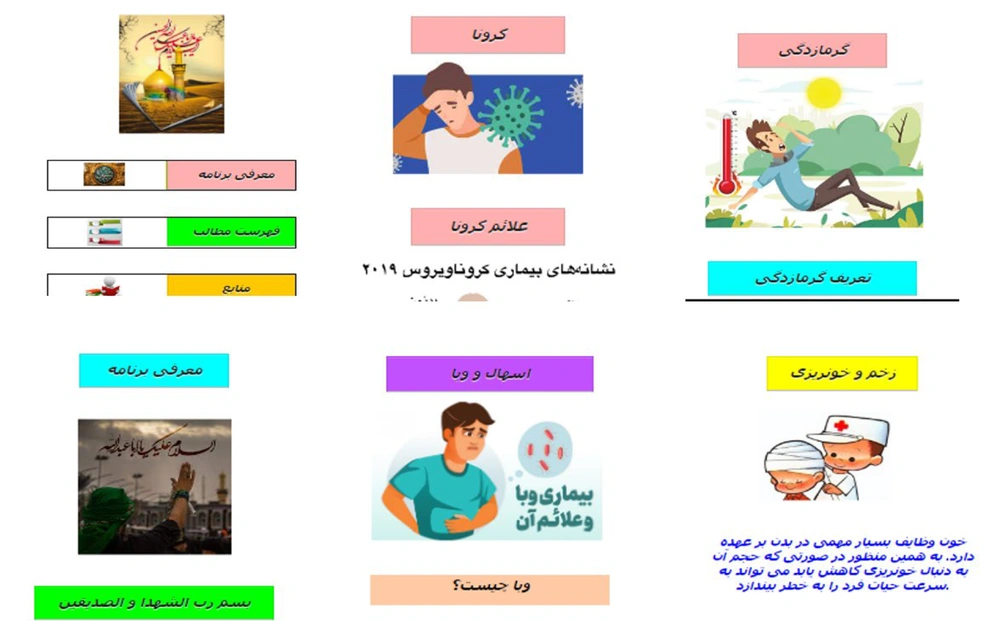
Figure 1.
Screenshots of the mobile application
4.4. Test Stage
In the next step, the testing stage, the prepared mobile application underwent alpha and beta testing (21-23). In the alpha test, 25 specialists (doctors and nurses present during Arbaeen, infectious disease specialists, and nurses who are members of the academic staff) participated, with a mean age ± SD of 38.2 ± 7.39 years. Additionally, 5 IT experts, with a mean age ± SD of 32.6 ± 7.27 years, evaluated the program. In the beta test, the prepared mobile application was provided to 54 individuals over 18 years old, with an average age ± SD of 31.56 ± 11.81, who were surveyed about the applicability, convenience, and simplicity of the software. The first version of the mobile application was deemed appropriate by participants in both the alpha and beta tests.
4.5. Implementation
In this phase of the research, 176 volunteers participated, consisting of 84 (47.7%) men and 92 (52.3%) women, with an average age ± SD of 36.07 ± 11.24. There was no significant difference between the two groups in terms of age, gender, level of education, place of residence, or identified symptoms (Table 1).
Table 1.
Demographic Characteristics of the Participants a
| Parameters | Total | Groups | Test Results | |
|---|---|---|---|---|
| Control | App | |||
| Age, y | 36.07 ± 11.24 | 36.64 ± 12.20 | 35.51 ± 10.23 | Pmann = 0.64 |
| Gender | χ 2 = 0.09; df = 1; P = 0.76 | |||
| Male | 84 (47.7) | 41 (23.3) | 43 (24.4) | |
| Female | 92 (52.3) | 47 (26.7) | 45 (25.6) | |
| Total | 176 (100) | 88 (50) | 88 (50) | |
| Education | χ 2 = 6.74; df = 3; P = 0.81 | |||
| High school | 36 (20.5) | 16 (9.1) | 20 (11.4) | |
| Diploma | 65 (36.9) | 28 (15.9) | 37 (21.0) | |
| College education | 68 (38.6) | 42 (23.9) | 26 (14.8) | |
| Primary education | 7 (4.0) | 2 (1.1) | 5 (2.8) | |
| Total | 176 (100) | 88 (50) | 88 (50) | |
| Residency | χ 2 = 2.14; df = 1; P = 0.14 | |||
| Urban | 138 (78.4) | 73 (41.5) | 65 (36.9) | |
| Rural | 38 (21.6) | 15 (8.5) | 23 (13.1) | |
| Total | 176 (100) | 88 (50) | 88 (50) | |
a Values are expressed as mean ± SD or No. (%).
The mean self-care knowledge ± SD before the study was 4.61 ± 2.56, and after the education, it was 6.41 ± 1.81. In the comparison of self-care knowledge before and after the study, the Wilcoxon signed rank test indicated a significant difference between the two groups (P < 0.01). In the comparison between the groups, a significant difference in self-care knowledge was found using the Mann-Whitney U test (P < 0.001) (Table 2). The results of the self-assessment also showed a significant difference between the groups, according to the results of the chi-square test (Table 2).
Table 2.
Results of the Comparison Between the Two Groups a
| Parameters | Total (N) | Groups | Test Results | |
|---|---|---|---|---|
| Control | App | |||
| Knowledge before | 4.61 ± 2.56 | 4.73 ± 2.49 | 4.50 ± 2.63 | Pmann = 0.60 |
| Knowledge after | 6.41 ± 1.81 | 5.73 ± 1.48 | 7.12 ± 1.86 | Pmann < 0.001 |
| Self-assessment | χ2 = 12.23; df = 1; P = 0.00 | |||
| No | 116 | 69 (65.5) | 47 (39.2) | |
| Yes | 61 | 19 (34.5) | 41 (10.8) | |
a Values are expressed as mean ± SD or No. (%).
5. Discussion
The aim of this study was to prepare a comprehensive mobile application for improving the health of participants in the Arbaeen MG. The results confirmed the simplicity and comprehensiveness of the prepared application content and its effectiveness in improving users' ability to take care of themselves against common diseases during Arbaeen (P < 0.01).
Global health risks are an important challenge in MGs, and preparation to address these diseases is a critical issue (5). Respiratory tract infections were common during the Hajj, affecting 50 - 93% of pilgrims (5, 8), while diarrhea was less common, affecting 1.1 - 2.3% of pilgrims (4). On the other hand, diarrhea was most common during the Grand Magal of Touba, the largest MG in Africa (5).
Events such as the Olympics lead to improved infrastructure, economic benefits for various sectors, and enhanced surveillance. As a result, disease outbreaks are less common. One characteristic of large-scale outdoor festivals is that, in many cases, they are not organized and managed by professionals (2). Disease transmission in MGs depends on factors such as population size, density, and duration of the gathering (3). Various types of diseases have been reported in large gatherings, including those transmitted through respiratory routes, feces, oral contact, sexual contact, and blood transfusions (3). In large gatherings that bring together participants from all around the world, including both the northern and southern hemispheres, a combination of seasonal epidemiology and regional diseases emerges (1). Common digestive and respiratory diseases, along with heatstroke, are considered in the software.
Arbaeen walking is one of the most passionate and widely attended human gatherings, where followers of Aba Abdullah al-Hussein, from different religions and various parts of the world, travel to Karbala. Participants come from low- to middle-income countries and developed nations such as Iran, India, Pakistan, Afghanistan, Azerbaijan, Turkey, Lebanon, Kuwait, Bahrain, Saudi Arabia, and Western countries (4). As a result, those participating in the Arbaeen ceremony may be exposed to the risk of communicable diseases (4, 5). Governments and health authorities use technological interventions to support public health surveillance, as well as to prevent and control infectious diseases (3). To improve self-care and prevent diseases, necessary recommendations have been incorporated into the mobile application (9, 10, 24).
Nan et al. proposed the use of platforms and dynamic applications, where professionals use checklists to monitor users' general conditions and medication use (25). A smartphone-based program for improving the health of pilgrims (focusing on infectious diseases and their prevention) can be beneficial in enhancing pilgrims' capabilities. With its user-friendly and convenient interface, this software is suitable for educating society.
5.1. Limitations
One limitation was that the software was provided only in the national language, whereas different dialects and languages are commonly spoken in Iran. Therefore, it is recommended that future versions of the software support multiple languages or include the option for text translation. Another limitation was that the program could not be installed on iOS platforms, which prevented some users from accessing it.
5.2. Conclusions
The results of the research indicated that the smartphone-based program designed to improve the health of pilgrims (by addressing common diseases in the Arbaeen MG and their prevention) is effective in empowering participants to take care of themselves. The program is both convenient and easy to use, making it valuable in preventing diseases within the Arbaeen community.