
1. Background
Mass gatherings — such as concerts, festivals, protests, and sporting events — bring together large numbers of individuals in shared physical spaces, fostering unique social experiences and collective emotions (1, 2). These large-scale events have historically been celebrated for their role in cultural expression, community engagement, and public discourse. However, they also present inherent challenges, particularly from a psychological standpoint (3-5). As the density of attendees increases, so do stressors such as noise, limited personal space, unfamiliar group dynamics, and sensory overload (6). These conditions can elevate arousal levels, disrupt coping capacities, and lead to psychological strain, especially in vulnerable populations. In recent years, increased focus has been placed on physical safety in crowded environments, but mental well-being has often been overlooked or insufficiently addressed (7, 8).
Several studies have suggested that exposure to crowded environments may provoke acute stress responses — including heightened cortisol levels, anxiety, and panic symptoms — among attendees (9). Women, in particular, report higher anxiety in crowded contexts due to factors such as perceived vulnerability and social pressure (10, 11). Moreover, personality traits like introversion, limited prior exposure to mass events, and pre-existing mental health conditions have all been shown to influence individuals' emotional responses (12, 13). While these findings underscore the psychological risks associated with such gatherings, few studies have adopted a structured scientific approach to examine them in an integrated manner (14, 15).
However, despite increasing attention to the psychological impact of such events, the precise effects on attendees remain insufficiently explored. This study aims to bridge this knowledge gap by identifying the primary psychological stressors in mass gatherings and assessing their influence on participants' mental health. Given the increasing frequency and scale of public events worldwide, it is essential to investigate how different demographic and psychological factors interact to shape experiences in mass gatherings. Identifying these patterns is vital for developing inclusive event environments that prioritize both physical safety and mental health.
2. Objectives
This study aims to explore the psychological well-being of participants in mass gatherings by assessing levels of stress and anxiety using a descriptive cross-sectional design.
3. Methods
3.1. Study Design and Sampling
This study employs a descriptive cross-sectional design to assess the psychological effects of mass gatherings on participants in 2025. A stratified random sampling approach was used to ensure diverse representation of individuals attending three different mass gatherings: A music festival (n = 180), a political rally (n = 160), and a football sporting event (n = 160). The sample consists of 500 participants, selected based on key demographic variables, including age, gender, prior experience with mass gatherings, social interaction preference, education, occupation, and pre-existing mental health conditions. Data collection took place at various locations within the venues, where attendees were invited to complete a structured questionnaire assessing their levels of stress and anxiety.
1. Inclusion criteria: Adults aged 18 - 65, capable of providing informed consent.
2. Exclusion criteria: Individuals were excluded if they: Had a documented history of severe psychiatric illness, defined as current or past diagnoses of schizophrenia, bipolar I disorder, or hospitalization for psychiatric crises within the past 12 months; used psychiatric medication known to affect anxiety or mood regulation at the time of the survey; demonstrated obvious signs of distress, intoxication, or cognitive impairment during initial screening.
Confounding variables such as the presence of accompanying family members, known to influence individual stress responses through social buffering or perceived safety, were documented during data collection. These variables were included in the analysis as potential moderators.
3.2. Demographic Variables
3.2.1. Age
Participants were categorized into three groups: Eighteen to thirty, 31 - 45, and 46 - 65 years, to examine differences in stress and anxiety levels across different age brackets.
3.2.2. Gender
Male and female participants were analyzed separately to determine gender-related differences in psychological responses.
3.2.3. Prior Experience with Mass Gatherings
Individuals were classified as first-time attendees, occasional attendees (a few times per year), or frequent attendees (regular participants), to assess familiarity with crowded environments as a factor influencing stress regulation.
3.2.4. Social Interaction Preference
Participants self-reported their comfort levels in large gatherings, categorized into introverted, ambivert, and extroverted, to evaluate how personality traits affect anxiety responses.
3.2.5. Education & Occupation
Educational background and occupational status were documented to provide additional context for individual stress responses.
3.2.6. Pre-existing Mental Health Conditions
Participants were asked if they had prior anxiety-related disorders to examine their susceptibility to stress in high-density settings.
3.2.7. Questionnaire and Scoring System
The study utilized two standardized self-report instruments to measure psychological responses to mass gatherings.
3.2.7.1. Generalized Anxiety Disorder-7
This tool consists of seven items, rated on a Likert scale from 0 (not at all) to 3 (nearly every day). Scores range from 0 to 21, with higher values indicating greater anxiety severity.
3.2.7.2. Perceived Stress Scale-10
This questionnaire measures stress levels through ten items, scored from 0 (never) to 4 (very often). The total score ranges from 0 to 40, categorized into low, moderate, and high stress levels.
Participants completed the questionnaire anonymously using digital survey forms accessible via mobile devices. To reduce external influences, surveys were administered in designated rest areas within the mass gathering locations. The average completion time for the questionnaire was 8 - 12 minutes, depending on reading speed and digital familiarity.
3.3. Data Collection and Statistical Analysis
Data collection was conducted over three consecutive days during peak hours of the mass gatherings. Researchers provided instructions and assisted participants in completing the survey. All responses were securely recorded and analyzed using SPSS (version 26).
3.4. Descriptive Statistics
Descriptive statistics were used to analyze mean, standard deviation, and frequency distribution. An independent t-test was conducted to compare group differences. ANOVA was applied to assess variations across multiple groups.
3.5. Ethical Considerations
This study adhered to strict ethical guidelines to protect participants' rights and well-being. Participants were informed of the study's purpose, assured of their voluntary participation, and provided informed consent. Personal data was not recorded, and responses remained anonymous to prevent bias or confidentiality concerns. Additionally, participants could withdraw at any time without consequences. Measures were taken to minimize psychological distress, including access to mental health support resources for any participant who experienced discomfort during the survey.
4. Results
This table presents the demographic characteristics of the study participants, highlighting age, gender, prior experience, social interaction preferences, education level, occupation, and pre-existing mental health conditions. The majority of respondents are aged between 18 - 30 years (40%) and have prior experience with mass gatherings (45%). Gender distribution is nearly balanced, with 52% female and 48% male participants. Notably, 18% of respondents reported pre-existing mental health conditions, which may influence their psychological responses to crowded environments (Table 1).
Table 1.
Distribution of Demographic Variables
| Demographic Variables | Values; N (%) |
|---|---|
| Age | |
| 18 - 30 | 200 (40) |
| 31 - 45 | 175 (35) |
| 46 - 65 | 125 (25) |
| Gender | |
| Male | 240 (48) |
| Female | 260 (52) |
| Prior experience | |
| First-time attendees | 150 (30) |
| Occasional attendees | 225 (45) |
| Frequent attendees | 125 (25) |
| Social interaction preference | |
| Introverted | 140 (28) |
| Ambivert | 200 (40) |
| Extroverted | 160 (32) |
| Education level | |
| High school or below | 100 (20) |
| Bachelor’s degree | 250 (50) |
| Master’s or higher | 150 (30) |
| Occupation | |
| Student | 125 (25) |
| Employed | 275 (55) |
| Retired/unemployed | 100 (20) |
| Pre-existing mental health conditions | |
| Yes | 90 (18) |
| No | 410 (82) |
This table presents the mean and standard deviation of dependent variables across different psychological dimensions. Social anxiety and crowding-induced stress have slightly higher means, indicating that interaction pressure and crowded environments contribute significantly to distress in mass gatherings. Standard deviation values suggest moderate variability, reflecting individual differences in psychological responses (Table 2).
Table 2.
Mean and Standard Deviation of Dependent Variables by Dimension
| Variables | Values (Mean ± SD) |
|---|---|
| General anxiety level | 7.8 ± 2.4 |
| Social anxiety | 8.1 ± 2.6 |
| Environmental anxiety | 7.5 ± 2.3 |
| General stress level | 11.9 ± 3.1 |
| Crowding-induced stress | 12.3 ± 3.4 |
| Sensory overload stress | 11.5 ± 3 |
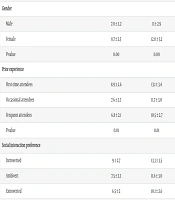
This table provides precise P-values for both anxiety and stress scores across demographic variables. Significant differences (P < 0.05 or P < 0.01) were observed in age, gender, prior experience, social interaction preference, and pre-existing mental health conditions, confirming their strong influence on psychological distress in mass gatherings. Education level and occupation did not show significant effects (P > 0.05), suggesting they do not strongly impact anxiety or stress responses in this context (Table 3).
Table 3.
Dependent Variables by Demographic Categories a
| Demographic Variables | Anxiety (GAD-7) | Stress (PSS-10) |
|---|---|---|
| Age | ||
| 18 - 30 | 8.2 ± 2.4 | 12.5 ± 3.1 |
| 31 - 45 | 7.8 ± 2.3 | 11.9 ± 3.0 |
| 46 - 65 | 6.3 ± 2.1 | 10.2 ± 2.8 |
| P-value | 0.02 | 0.01 |
| Gender | ||
| Male | 7.0 ± 2.2 | 11 ± 2.9 |
| Female | 8.7 ± 2.5 | 12.8 ± 3.2 |
| P-value | 0.00 | 0.00 |
| Prior experience | ||
| First-time attendees | 8.9 ± 2.6 | 13.1 ± 3.4 |
| Occasional attendees | 7.6 ± 2.3 | 11.7 ± 3.0 |
| Frequent attendees | 6.8 ± 2.1 | 10.5 ± 2.7 |
| P-value | 0.01 | 0.01 |
| Social interaction preference | ||
| Introverted | 9 ± 2.7 | 13.3 ± 3.5 |
| Ambivert | 7.5 ± 2.3 | 11.6 ± 3.0 |
| Extroverted | 6.5 ± 2 | 10.1 ± 2.6 |
| P-value | 0.01 | 0.01 |
| Education level | ||
| High school or below | 7.9 ± 2.4 | 12.2 ± 3.1 |
| Bachelor’s degree | 7.6 ± 2.3 | 11.8 ± 3.0 |
| Master’s or higher | 7.3 ± 2.2 | 11.5 ± 2.9 |
| P-value | 0.30 | 0.28 |
| Occupation | ||
| Student | 8.1 ± 2.5 | 12.6 ± 3.3 |
| Employed | 7.5 ± 2.3 | 11.7 ± 3.0 |
| Retired/unemployed | 7.2 ± 2.2 | 11.3 ± 2.8 |
| P-value | 0.20 | 0.22 |
| Pre-existing mental health conditions | ||
| Yes | 9.2 ± 2.8 | 13.7 ± 3.6 |
| No | 7.4 ± 2.2 | 11.4 ± 2.9 |
| P-value | 0.00 | 0.00 |
Abbreviations: GAD-7, Generalized Anxiety Disorder-7; PSS-10, Perceived Stress Scale-10.
a Values are expressed as mean ± SD.
5. Discussion
This study highlights significant psychological responses in mass gatherings, revealing how age, gender, prior experience, social interaction preference, and pre-existing mental health conditions impact anxiety and stress levels. The findings confirm trends observed in previous research while also introducing new insights into the psychological mechanisms involved in large-scale public events.
The age-related differences in anxiety and stress levels found in this study align with research by Hopkins and Reicher (16, 17), who emphasized that younger individuals (18 - 30 years) tend to experience heightened anxiety due to overstimulation in crowded settings. This study reinforces that claim, as younger participants had higher mean anxiety (8.2) and stress (12.5) scores than older participants, suggesting that environmental overload plays a crucial role in their emotional responses.
Furthermore, gender-based differences were prominent, with women experiencing significantly higher anxiety (8.7) and stress (12.8) levels than men, a trend consistent with findings by Cruwys et al. (18). They suggested that women's stress responses in mass gatherings could be linked to greater safety concerns and heightened emotional sensitivity, which this study confirms.
Another critical finding is the impact of crowd density on psychological distress, reflected in the strong correlation (R = 0.72, P < 0.001). This observation supports Beckwith et al. (2023) (15), who identified that individuals in high-density environments exhibit greater physiological and psychological stress responses due to restricted movement and sensory overload. Notably, this study expands on their findings by incorporating social interaction preference, showing that introverted individuals (mean anxiety = 9.0, mean stress = 13.3) are disproportionately affected by crowded environments compared to extroverts. This provides a new perspective on the role of personality traits in stress regulation during mass gatherings.
One of the strengths of this study is the relatively large sample size of 500 participants, which enhances the generalizability of the results. Additionally, the use of standardized tools such as Generalized Anxiety Disorder-7 (GAD-7) and Perceived Stress Scale-10 (PSS-10) ensures the reliability of anxiety and stress measurements. The stratified sampling method also maintained demographic diversity, allowing for the examination of psychological differences across various groups. However, this study has some limitations, including the reliance on self-reported data, which may be influenced by individual biases. Moreover, the cross-sectional design prevents the assessment of the long-term psychological effects of mass gatherings. Additionally, focusing only on three specific types of events might limit the applicability of findings to other large-scale gatherings.
For future research, it is recommended to conduct longitudinal studies to examine the sustained effects of mass gatherings on mental health. Expanding studies to include different cultural contexts would also help in understanding cross-cultural variations in stress and anxiety responses. Investigating intervention strategies to reduce psychological distress in high-density environments could further contribute to developing safer and more comfortable spaces for participants.
Moreover, based on the findings, it is recommended that event organizers implement targeted interventions such as designated quiet zones, real-time psychological support stations, and crowd management strategies (e.g., limiting density in specific areas) to reduce emotional overload. Providing attendees with pre-event information about mental health coping strategies and ensuring staff are trained to recognize and respond to distress can further enhance psychological safety during large events.
5.1. Conclusions
This study underscores the psychological impact of mass gatherings, demonstrating that age, gender, prior experience, social interaction preference, and pre-existing mental health conditions significantly influence anxiety and stress levels. Younger individuals and first-time attendees experience greater distress, while women and introverted participants report higher psychological strain due to environmental and social factors. The strong correlation between crowd density and psychological distress highlights the need for effective crowd management strategies to minimize stress in high-density events. Despite limitations such as self-reported data and cross-sectional design, the study provides valuable insights that can inform future research, policy decisions, and intervention strategies to promote mental well-being in mass gatherings.