
Withdrawal is the formal removal of a manuscript from the editorial and publication process at the authors’ request before the article has been published. Withdrawal requests are assessed according to the manuscript’s current stage, the reason provided, publication ethics requirements, and any contractual obligations that may already apply.
When withdrawal applies
Withdrawal may apply while a manuscript remains unpublished and is still undergoing initial editorial assessment, peer review, revision, editorial decision-making, or pre-publication processing.
An article that has already been published online, including as an Early Release, Online First, or Ahead of Print article, is part of the published scholarly record and cannot be withdrawn. Concerns arising after publication must instead be addressed through a correction, expression of concern, retraction, or another appropriate post-publication notice.
Authors may request withdrawal because of a serious error discovered after submission, an accidental duplicate submission, an unresolved authorship dispute, concerns about ethical approval, unreliable data, or another legitimate issue that prevents the manuscript from proceeding responsibly.
Brieflands does not charge a separate withdrawal penalty fee. However, withdrawal should not be used to avoid responding to reviewers, to transfer a manuscript to another journal after editorial resources have been substantially used, or to interfere with an investigation into possible misconduct.
Withdrawal is not retraction
Withdrawal
Applies before publication. The manuscript is removed from the editorial or production process and does not become part of the published scholarly record.
Retraction
Applies after publication. The article remains permanently identifiable in the scholarly record, and a public retraction notice explains why its findings or content should no longer be relied upon.
For further information, see Withdrawal vs. Retraction and the Retraction Regulations.
Withdrawal at different stages
The requirements for withdrawal depend on the stage reached by the manuscript.
No separate withdrawal penalty fee
Brieflands does not impose a fixed financial penalty merely because an author requests withdrawal. If a manuscript has already been accepted, any previously agreed publication contract, invoice, article processing charge, third-party service charge, or other documented financial obligation will be handled according to the applicable agreement and is not classified as a withdrawal penalty.
Legitimate reasons for withdrawal
Once peer review has begun, the authors should provide a clear and truthful explanation. Legitimate reasons may include:
A request based only on dissatisfaction with the editorial decision, unwillingness to complete requested revisions, or a preference to submit the manuscript to another journal may not, by itself, constitute a compelling reason after substantial editorial or peer-review work has been completed.
Author agreement and editorial review
A withdrawal request should normally be submitted or confirmed by the corresponding author. The journal may require written confirmation that all listed authors have been informed and agree with the request.
Where authors disagree about withdrawal, authorship, ownership of the data, or authority to act on behalf of the research group, the journal may pause consideration of the request and seek clarification from the authors’ institution or another appropriate authority.
Approval of a withdrawal request does not confirm the validity of the authors’ explanation and does not prevent the journal from retaining internal records necessary for editorial administration, publication-ethics review, legal compliance, or the prevention of duplicate submission.
Misconduct and abusive withdrawal
Withdrawal does not end or prevent an investigation into suspected plagiarism, duplicate submission, fabricated or falsified data, authorship manipulation, peer-review manipulation, undisclosed conflicts of interest, or another possible breach of publication ethics.
Where appropriate, Brieflands may continue its investigation after withdrawal and may communicate with the authors, their institutions, research-integrity offices, ethics committees, funders, or other journals in accordance with applicable publication-ethics procedures.
Repeated or unjustified withdrawal
Brieflands may temporarily restrict new submissions from an author who repeatedly withdraws manuscripts without adequate justification, submits the same manuscript simultaneously to multiple journals, refuses to cooperate with an ethics investigation, or otherwise misuses the editorial process. Any restriction will be proportionate, documented, time-limited, and subject to editorial or publisher review.
How to request a withdrawal
From the author dashboard. A Withdraw option may appear under Actions when the manuscript is in an author-controlled status, including:
Sent back to the author Major revision Minor revision
Open the relevant status list, locate the manuscript, and select Withdraw. The system may ask you to provide a reason before the request is submitted.
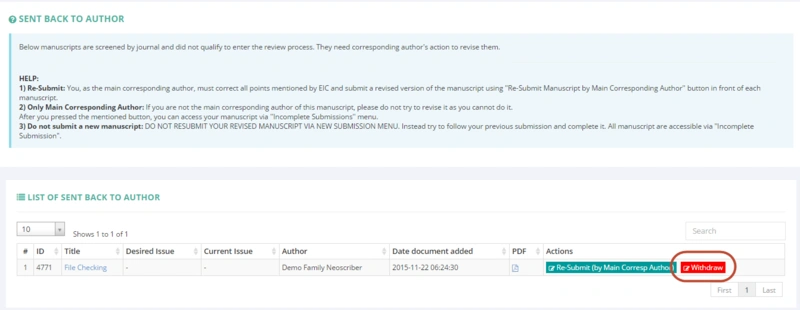
The Withdraw button in the Actions column of the author dashboard.
At any other stage. If the Withdraw option is unavailable, authors must submit a support ticket containing:
- The manuscript ID and title.
- The corresponding author’s name and registered email address.
- A clear explanation of the reason for withdrawal.
- Confirmation that all authors have been informed and agree with the request.
- Any supporting documentation requested by the journal.
The manuscript should not be submitted to another journal until Brieflands has issued written confirmation that the withdrawal has been approved and the submission has been formally closed.
What happens after a withdrawal request
The editorial office reviews the manuscript’s status, the reason given, author agreement, any ethical or legal concerns, and any contractual obligations that may apply.
If the request is approved, Brieflands will close the submission, discontinue editorial or production work, and issue written confirmation to the corresponding author. The authors may then submit the manuscript elsewhere, provided that no ethical, legal, contractual, or duplicate-publication restriction prevents them from doing so.
If additional information is required, the request may remain pending until the authors provide the necessary clarification. In exceptional cases, the journal may decline or postpone withdrawal while a serious ethics, authorship, legal, or research-integrity concern is being assessed.