
1. Background
Surgery as a treatment approach can encounter serious and life-threatening postoperative problems and complications. So, this area requires planning and vigilance (1). Every year, more than 200 million adults undergo surgery worldwide, with an increasing slope (2). According to the Ministry of Health statistics, an average of 1.5 million major surgeries are performed annually in Iran (3). Studies show that 36.57% of patients undergoing surgery have experienced at least one postoperative complication; about 20% of all patients undergoing abdominal surgery experience fever regarding pulmonary complications (4). Vaziri et al 2008 study on 122 patients undergoing trans- Hiatal esophagostomy revealed that respiratory failure accounts for 38%, pleural effusion 35%, pneumothorax 24%, pneumothorax 17%, pneumonia 10% and empyema 2% of postoperative complications (5). More recently, World Health Organization's reported that about 10% of patients who have undergone surgery develop cyanosis, tachypnea, bradypnea, and fluctuations in O2Sat% as the most common Respiratory complications (4).
Postoperative complications include hyperthermia and decreased arterial O2Sat% (4). Hyperthermia may cause other complications, readmission, and long hospitalizations. Hence, it disturbs the care and treatment process and differentiating between postoperative fever and infection-related fever is very important (6, 7).
On the other hand, it is obvious that chest and upper abdomen surgeries are associated with impaired breathing and ineffective coughing, leading to decreased vital capacity, atelectasis, and pneumonia (8). Following sternotomy, its surgical incisions, and its dressings, the function of the respiratory system becomes more limited, which causes postoperative pulmonary complications in many patients (9).
Managing postoperative complications and reducing their incidence is one of the necessities and bases of nursing care (10). As a golden opportunity, nurses and clinical staff should seek new therapeutic interventions that are safer, more effective, less costly, and more practical to care for significant surgeries (11). Some drugs like NSAIDs and opioids to control postoperative pain and fever, sugammadex, and neostigmine to prevent postoperative pulmonary complications may be used (12, 13). But, they have already been linked to adverse outcomes, such as the risk of drug dependence, low blood pressure, impaired vital signs, drowsiness, laryngospasm, nausea, and vomiting. So, they can impose a high cost on the health care system (13). Therefore, there is no excuse for such complications and costs while there are more cost-effective, accessible, simpler, and healthier ways to relieve patients' complaints (14). Cold therapy has been used effectively with fewer side effects in vast and various ranges of patients. Local cold therapy by itself is effective in relieving inflammation and soft tissue injuries that facilitate wound healing (15). The cooling effect on superficial and deep tissues causes physiological changes such as vasoconstriction, decreased metabolism, reduced muscle cramps, reduced inflammation, and relieved pain (16). Yeung et al. 2016 specifically stated that cold-water immersion causes peripheral vasoconstriction that increases central blood volume, followed by peripheral vasodilation immediately after emerging from the cold water. This mechanism may improve the rate at which muscles become re-oxygenated (17). Nursing care in significant surgeries can provide a suitable platform for using local cold therapy to improve the management, planning, and resource management in a safer manner (18, 19).
Ebrahimi-Rigi et al. (2016) investigated the effect of local cold therapy on deep breathing, effective cough ad pain after open-heart surgery and showed that cold therapy with Peg gel in patients undergoing open-heart surgery was effective on deep breathing and cough ability (20). Moghimi Hanjani (2016) also investigated the effect of local cold therapy on labor pain in primiparous women and stated that labor pain intensity and duration in the first and second stages of delivery was diminished, and patient satisfaction was promoted (21). Earlier, Forootan et al. (2006) examined the effect of local pressure and cold on the severity of pain caused by intramuscular injection in 5 to 12 years old children and reported that the interventions were not effective (22). Zgavc et al. (2012) stated that when it is used in the early stages, local cold therapy can reduce the inflammatory response and edema of damaged tissue (23). Despite various studies about the effect of local cold therapy on patients after surgery, no study was found about its effect on body temperature and O2Sat%. Nevertheless, Shakouri et al. (2015) stated that a little research has been done on non-pharmacological methods and suggested cold therapy as a non-pharmacologic method to help the patient with surgical problems (24).
As a non-pharmacological treatment method, local cold therapy has been used in various studies, and the results are conflicting. However, its effect has been less studied on postoperative O2Sat% and body temperature, and further studies in this field are needed. Due to the importance of controlling postoperative complications in patients undergoing major surgery and also the necessity for less expensive and safer methods to manage these complications, the present study was conducted to investigate the effect of local cold therapy on body temperature and O2Sat% in patients undergoing abdominal and thoracic surgery.
2. Methods
This is a quasi-experimental study with before and after a design that was conducted in 2019 at Shahrekord University of Medical Sciences. The sampling was based on convenience sampling. The sample size was calculated based on a 95% confidence and a power of 80% to have an effect size equal to 0.75. The sample size was estimated to be 30 patients in each group. Inclusion criteria included having chest and abdomen surgery, the age of 18 to 64 years, and having no history or active state of underlying diseases, such as hypertension, allergies, and immediate postoperative cardiovascular arrhythmias, preoperative coagulation disorder, severe mental disorders, such as depression, preoperatively diagnosed infection, Raynaud's disease, and cryoglobulinemia (abnormal extra serum immunoglobulin proteins that are reversible at low temperatures).
Exclusion criteria included allergies and skin complications, early postoperative complications (acute infection and fever, cardiac arrhythmia needed treatment, coagulation disorders, and abnormal bleeding, acute pulmonary disorders, such as pulmonary embolism and pneumonia), reoperation within 48 hours after the first surgery, multiple simultaneous surgeries, and packed or massive dressings in abdominal and thoracic regions intervening cold therapy. Written permission to conduct the study was obtained from the Shahrekord University of Medical Sciences, and their letter of introduction was used to contact Ayatollah Kashani hospital of Shahrekord officials. The study method and its objectives were explained to patients and their families. Those willing to participate in the research signed the written consent. The sampling process was continued daily to reach the final sample size, and 60 people entered the study. Then, patients were allocated into four blocks based on the type of surgery and the type of physician using block randomization; first, the researcher determined which block the patient belonged to. We put up four sheets of paper, which included two "A" (for local cold therapy) and two "B" (for control) in one envelope, and requested the patient to pick up a paper from the envelope. Then, based on the extracted sheet, the patient was assigned to the relevant group. This process continued for each patient until the completion of the quadruple block. After completing one block, the next block is completed with the same algorithm.
The patient's demographic and surgery data (age, education, physician number, surgery site, and anesthesia approach) questionnaires were completed by the researcher. Before the interventions, the O2Sat% was measured using a finger-type "SA model pulse oximeter made in Iran," and body temperature was measured by a "Biorer contact thermometer made in Germany". Both devices were controlled and calibrated before use by the researcher. When the patients became conscious after the surgery, temperature changes and O2Sat% were measured and recorded by the researcher. In addition, to routine care, intervention group patients received local cold therapy in the form of a standard frozen pack ”Cold Pack” made in Germany" (5 × 9.5", 0.5 Ibs). The pack was taken out of the refrigerator, and its temperature was measured (4°C) and was placed on the dressing site for 20 minutes (25) while the researcher was present at the patient's bedside and cared only for local cold therapy. The dressing should be a maximum of two layers at the intervention time. Temperature and O2Sat% were measured for both groups after the intervention (48 hours after the patient’s alertness).
In the process of conducting the study, all ethical considerations were taken into account. After obtaining permission from the Shahrekord University of Medical Sciences (IR.SKUMS.REC.1398.110) and the Ayatollah Kashani hospital of Shahrekord, informed written consent was signed by the patients. All demographic data were coded and considered anonymous for observing confidentiality. Sampling lasted for one month, from August to September 2019.
The normal distribution for quantitative variables was proved by the Shapiro-Wilk test; thus, the parametric tests were used to compare continuous variables between the two groups. Comparisons between two groups were made using the chi-square or Fisher’s exact tests for categorical variables and independent-samples or paired-samples t-test for continuous ones. Statistical analysis was done using SPSS 20 software, and P-values < 0.05 were considered statistically significant.
3. Results
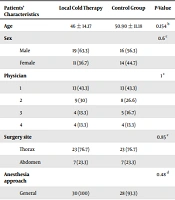
First, we categorized patients into male or female, abdominal surgery, or chest surgery. We divided them into four groups based on their physicians (four physicians), and regarding the type of anesthesia, they were divided into the general and spinal groups. Demographic and surgery data were not significantly different between the two groups before the intervention (P > 0.05) (Table 1).
Table 1.
Demographic Characteristics of the Studied Subjects by Different Groups (n = 60) a
| Patients’ Characteristics | Local Cold Therapy | Control Group | P-Value |
|---|---|---|---|
| Age | 46 ± 14.17 | 50.90 ± 11.18 | 0.154 b |
| Sex | 0.6 c | ||
| Male | 19 (63.3) | 16 (56.3) | |
| Female | 11 (36.7) | 14 (44.7) | |
| Physician | 1 c | ||
| 1 | 13 (43.3) | 13 (43.3) | |
| 2 | 9 (30) | 8 (26.6) | |
| 3 | 4 (13.3) | 5 (16.7) | |
| 4 | 4 (13.3) | 4 (13.3) | |
| Surgery site | 0.85 c | ||
| Thorax | 23 (76.7) | 23 (76.7) | |
| Abdomen | 7 (23.3) | 7 (23.3) | |
| Anesthesia approach | 0.48 d | ||
| General | 30 (100) | 28 (93.3) | |
| Spinal | 0 | 2 (6.7) |
a Values re expressed as No. (5) or mean ± SD.
b Based on independent samples t-test.
c Based on chi-square test.
d Based on Fishers’ exact test.
The results of the independent sample t-test showed that the mean of O2Sat% in the two groups before the intervention had no significant differences (P = 0.89); however, they showed a difference after the intervention (P = 0.028), which was confirmed by the mean differences of O2Sat% (P < 0.001). The mean body temperature before the intervention did not show a significant difference between the two groups (P = 0.83), and this status was repeated after the intervention (P = 0.12), but the within-group results of paired sample t-test showed that the mean temperature had significant differences in the local cold therapy group (0.014). Also, the mean differences in body temperature were significant in both groups after the intervention (P < 0.001) (Table 2).
Table 2.
The Mean of O2Sat% and Body Temperature During the Study Between Groups
| Variables | Local Cold Therapy (Mean ± SD) | Control (Mean ± SD) | P-Value (Between Groupsa) |
|---|---|---|---|
| O2Sat% | |||
| Before | 89.7 ± 5.8 | 89.7 ± 4 | 0.89 |
| After | 92.5 ± 4.5 | 91.2 ± 4.7 | 0.028 |
| P-value (within group b) | < 0.001 | < 0.001 | - |
| Difference | 2.71 ± 2.25 | 1.5 ± 1.95 | 0.036 |
| Temperature (ºC) | |||
| Before | 37.2 ± 4.2 | 37.95 ± 0.36 | 0.83 |
| After | 37.1 ± 0.2 | 37.25 ± 0.33 | 0.12 |
| P-value (within group b) | 0.014 | 0.42 | - |
| Difference | -0.1 ± 0.2 | -0.05 ± 0.32 | 0.49 |
a Based on independent samples t-test.
b Based on paired sample t-test.
4. Discussion
The aim of this study was to determine the effect of local cold therapy on O2Sat% and body and local temperature of patients undergoing thoracic and abdominal surgery. The results showed that local cold therapy was effective on O2Sat% and had no effect on postoperative body temperature.
Various studies have been done on the effect of local cold therapy and have indicated its positive effects on various variables, but no study was found on the effect of local cold therapy on postoperative temperature and O2Sat%.
On the other hand, according to the results, the oxygenation status of the control group, despite the fact that they did not receive cold therapy, showed a significant increase. It can be said that anesthesia disappeared a few hours after surgery, and muscle relaxation (respiratory muscles and vascular wall muscles) was reduced or destroyed. Then, respiratory and circulatory conditions returned to normal, and temperature and oxygenation status improved.
Physiologic changes in the vessel diameter due to heat changes can alter the blood volume and reoxygenation (17). These changes can affect the body temperature too, but practically it does not happen. It may be due to differences in cold therapy method, dressing, or time of the intervention; however, more studies are suggested.
Shakoori et al. (2015) proved that local cold therapy could control pain in patients undergoing open-heart surgery (24) and Forouzannia et al. proposed that cryoanalgesia is a safe and effective method for a reduction in pain following CABG operation (26). Bardutzky and Schwab (2007) also stated that local cold therapy could act like antipyretic drugs without having a systemic adverse effect (27). Khalkhali et al. (2013) studied the effect of using cooling gel at the sternal incision site on patients' anxiety and stated that cold therapy could reduce the anxiety caused by coughing and deep breathing in patients undergoing surgery (28). Pain and anxiety can cause poor breathing and oxygenation (29), and then, we can conclude that pain and anxiety relief can promote patients’ breathing and all these studies support our results regarding promoting blood oxygenation after local cold therapy.
Forootan et al. (2006) examined the effect of local pressure and cold therapy on the severity of pain caused by intramuscular injection in children aged 5 to 12 years and reported that these interventions did not have a significant effect on pain of these children (22), which does not support our findings. They conducted their study on children with fewer resistance than adults against pain.
Although no mere study was found about the effect of the local cold therapy on the body temperature, studies about different variables indicate conflict results (22, 23, 30).
Various factors may influence body temperature and O2Sat%, like an inflammatory response, tissue damages (31), and pain and anxiety (22, 23). In the present study, local cold therapy did not have a significant effect on patients' body temperature.
Considering the relationship between fever and inflammation, we can conclude that the results of Nasrollahzadeh et al. (31) do not confirm our results about the body temperature that the differences in the study condition can cause; they studied the subjects in the laboratory condition, and we did not. Another cause may be the short-term use of cold therapy in our study.
Forouzannia et al. (2009) said that cold compresses have an influential role in reducing body temperature during fever (26), and Zgavc et al. (2012) stated that local cold therapy in the early stages of the disease could reduce the inflammatory response and edema of damaged tissue (23). However, in our study, the use of cold compresses at the surgical incision site did not decrease the hyperthermia, and other studies do not support our finding. This conflict may originate from the difference in the site of local cold therapy because they had used cold therapy in the more circulated area.
As mentioned, various interventions from touch to breathing exercises have a positive effect on O2Sat%. In the present study, local cold therapy in the operating area was able to improve O2Sat%. Also, O2Sat% of patients undergoing surgery was significantly better after the intervention. Considering influencing factors on the O2Sat%, it must be said that the former studies confirm our results.
4.1. Conclusion
The results of the present study indicated that local cold therapy at the site of surgery could improve O2Sat%, but it had no significant effect on body temperature. Cold therapy for improving the nursing care quality of patients undergoing surgery and as a method of care must be considered by health care providers. In this regard, it is recommended that the use of cold therapy in in-service training programs be considered. It is also recommended that other studies be performed in this field and on other patients.
The convenience sampling method was the limitation of the present study; it should be noted that we tried to control this limitation by random allocation method. Moreover, blindness was not possible in this study.