
1. Background
Admission to the intensive care unit (ICU) is considered a stressful phenomenon in a person’s life since it indicates the existence of a serious and life-threatening problem (1). Factors exacerbating the patient’s stress and anxiety in ICU include sleeplessness, shortness of breath, inability to move, painful medical interventions such as endotracheal tubes, nasogastric tubes, as well as disturbing sound in the ICU produced by ventilators, medical equipment, and staff’s routine activities (2). Part of this stress and anxiety is also caused by patients’ lack of access to family members (3). Restlessness, complete wakefulness, and irritability are associated with increased motor activity due to disturbance of comfort, illness, pain, anxiety, and delirium (4).
Agitation is defined as a state of strong and violent emotions, along with sudden and intense movements with unpredictable behaviors and a lack of awareness of time, place, and people (5). In this regard, ‘sensory deprivation’ and ‘sensory overload’ are two important problems experienced by ICU patients (6, 7). Sensory overload refers to the experience of receiving too much sensory stimulation due to additional noises such as the sound of ventilator alarms and heart monitoring, staff voices, etc., which in some cases have been considered inevitable. These factors cause anxiety and biological rhythm disturbances, including sleep disorders, low Glasgow Coma Scale (GCS) scores, agitation, and hemodynamic disturbances (8).
Agitation occurs frequently and to varying degrees in patients, making them involved in actions such as constant shaking, disrupting the bed, and pulling pipes and fittings. Studies have reported agitation in 72% of ICU patients (9). Pharmacological agents are used frequently in the ICU to control agitated patients and to prevent physiological changes and disturbances in vital signs (10, 11). However, improper and excessive use of sedatives leads to changes in the condition of mechanical ventilation devices, disproportionate respiratory settings, and instability of the cardiovascular condition. Statistical studies have shown that patients who have received a high dose of sedation or have been very agitated have not only had a longer length of hospital stay and a lower recovery rate, but also higher heart and respiration rates and blood pressure (12). Therefore, the fluctuations of vital signs during the use of sedatives are noticeable (13).
To control agitation in ICUs, sedatives and analgesics are usually prescribed by doctors in the form of continuous infusions, and nurses often administer sedatives or analgesics without using a protocol or instrument to measure the patient’s agitation. These measures cannot manage and control patients’ agitation and pain, or if there is no need or change in the patient’s need for sedation and analgesia, the infusion of the drug can continue with the effects of anesthesia higher than the exposure level (14). Therefore, due to the potential side effects of drugs, non-pharmacological interventions, which usually fall under nursing practices, can be considered as a complementary strategy in controlling agitation and its complications in patients under mechanical ventilation. Accordingly, the use of complementary therapies such as aromatherapy, massage, music, and touch can have many benefits (9).
One of the main causes of agitation in ICU patients is being away from family members and the restricted appointment time (15) as the family is an essential part of every person’s health and can play a significant role in the patient’s health (16). Currently, the treatment environment is a caring environment that includes the family and patients and covers comprehensive care for the family and patient. Performing a limited appointment program can reduce patients’ anxiety and agitation without affecting nurses' care activities (17). Family members play a very important role in the healing process, and patients are less likely to have delusions in the presence of family members. Being away from family and limited visits are some of the main causes of stress in ICU patients. Admission to the ICU exposes the patient and their family members to a lot of stress (18). The family members play a vital role in caring for the patient because their support accelerates the patient’s recovery (19). Since an appointment in the ICU is mutually important for the patient and the family, these patients tend to be visited by close family members and consider family presence to be effective in reducing anxiety, and thus they feel better after the visit (20, 21).
However, despite the positive effect of the family in the recovery process, several studies suggested that one of the reasons why the patient is admitted to the ICU alone and the family presence and visitation is prevented the belief that the presence of family members causes anxiety and hemodynamic disturbances in the patient, and most hospital staff consider the patient’s attendant as a factor disturbing the treatment process (22, 23). Mohammadi and Salmani also pointed to challenges such as lack of time to complete the patient care program, lack of sufficient and separate space, and incompatibility of the physical space of the ICU with the appointment plan as the main reasons for the reluctance of ICU nursing teams to implement a family visit plan (24). However, Rahmani et al. found that patients who do not have a visitation restriction have a better heart rate and more relaxation compared to patients who have a visitation restriction (25).
A large number of patients, despite having a level of consciousness above 9, are admitted to the ICU for reasons such as neck trauma and damage to the autonomic system, multiple trauma, rib fractures, preeclampsia, ischemic stroke, etc. These patients experience higher levels of agitation due to environmental awareness. Furthermore, controlling agitation in patients admitted to the ICU is very important and has a positive impact on the process of patients’ recovery and reducing the length of hospitalization. Thus, given the contradictory results of some studies, the lack of a standard family-centered plan for family visits, and the lack of similar studies on ICU patients and their agitation, it seems that there is a gap in the literature on the effectiveness of appointment and visitation plans for ICU patients.
2. Objectives
The present study aimed to determine the effect of scheduled family appointments on the agitation of patients admitted to 2 ICUs of teaching hospitals affiliated to Zahedan University of Medical Sciences, Iran.
3. Methods
This quasi-experimental study was conducted on patients admitted to ICUs of teaching hospitals affiliated to Zahedan University of Medical Sciences, Iran, in 2020.
Following a similar study by Sharafi et al. (26) and test power of 95%, the sample size was estimated as 32 individuals per group using the following formula:
where α = 0.05, κ = 1, σ2 = 23, β = 0.05, ε = 0.04, δ = 1.5, and the design effect = 1.2.
Considering the 10% probability of dropout, the sample size was considered to be 40 patients in each group (80 individuals in total). Finally, due to a good access to the people who met the inclusion criteria, 35 patients were selected for each group at the data collection and analysis stage.
Using convenience sampling method, the patients meeting the inclusion criteria entered the study. The selected patients were randomly divided into two groups of control and intervention (age range: ± 10 years). Figure 1 shows the patient selection flow chart:
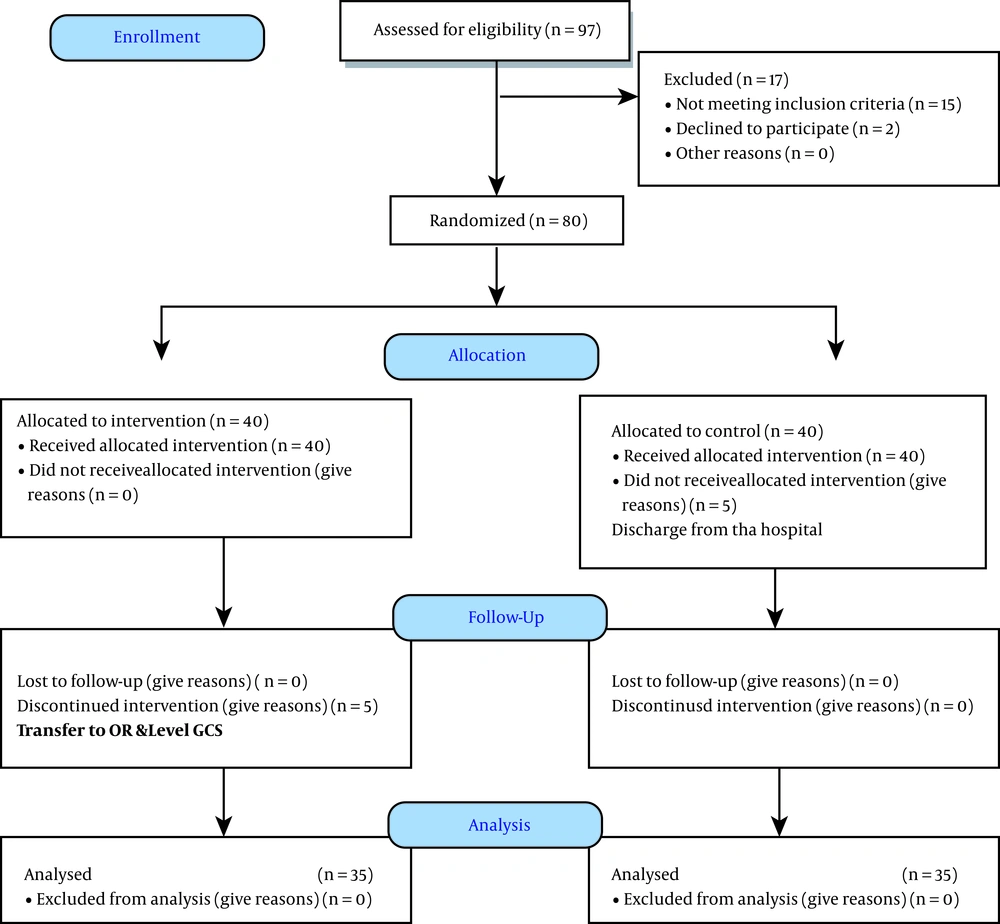
Figure 1.
The patient selection flow chart
The inclusion criteria for the patients were having no artificial airway, no history of addiction and use of sleeping pills, level of consciousness equal to or higher than 9, no history of ICU hospitalization, no surgery in the first three days of hospitalization, being in the age range of 18 - 65 years, having no history of psychiatric hospitalization, GCS fluctuations of less than 5 points, and ICU admission for less than 3 days. Moreover, the exclusion criteria were the patient’s need for artificial ventilation, reduced level of consciousness, referral to other centers, brain death, and aphasia or hearing loss. The inclusion criteria for the visitors were being the main family member as confirmed by the patient, being over 18 years old, and being educable.
The data in this study were collected using a demographic information form and the Richmond Agitation Sedation Scale (RASS). RASS is a suitable tool for measuring the relaxation levels of patients in the ICU and has inter-rater reliability of 0.95. It can be administered in 30 to 60 seconds using three sequential steps: observation, response to auditory stimulation, and response to physical stimulation. Its score range is from +4 to -5. Since in this study, alertness was not measured, and the only agitation was assessed in conscious patients, we only used the observation stage. The score of patient agitation range was 0 (calm and alert), +1 (restless), +2 (agitated), + 3 (very agitated), and +4 (aggressive). According to Tadrisi et al., the use of positive scores is a more logical approach to measuring the level of agitation in ICU patients (27). RASS measures the patient’s level of agitation with indicators including attention to the patient’s temperament and aggressiveness, type of movements of the limbs in terms of purposefulness and execution of orders, the degree of danger to themselves and others, the state of alertness, and the way of responding to orders (28).
The reliability and validity of this instrument were evaluated by Tadrisi et al. at Baqiyatallah University, Iran. The inter-rater reliability of the instrument was equal to 0.95 implying that it was a suitable tool for Persian speakers to measure the relaxation level in ICU patients (27).
After obtaining the necessary permits, the researcher referred to 2 ICU wards of medical centers affiliated to Zahedan University of Medical Sciences (Iran). She explained the objectives of the study to the ICU officials. After identifying eligible patients, she invited the patients’ families to participate in the study. Afterward, written informed consent was obtained from the patients’ family members who were willing to participate in the study. The participants were selected based on the inclusion criteria using convenience sampling and block randomization (age range: ± 10 years) and were assigned into two groups. To this end, every 4 patients were assigned to the groups (2 patients in the intervention group and 2 in the control group). Then, 6 groups each with 4 individuals, were selected. Finally, 10 groups of 4 were selected (29).
First, the demographic information form and RASS were completed for the participants in both groups. Then, the standard principles and the steps of scheduled appointments were instructed separately to each family before the start of the appointment process. The instructions were provided by the researcher to the members of the intervention groups at the ICUs of Khatam al-Anbia and Ali-Ibn-Abi Talib Hospitals. Besides, the visiting people were instructed via teaching aids, verbal training, and educational pamphlets.
Following a review of the literature and similar studies, the appointments were made during three days at 10 - 12 AM and 8 - 10 PM (26, 30, 31). The appointment protocol, its components, and the training provided during the standard scheduled appointment plan were developed following some previous studies (32, 33).
Following the standard content of the scheduled appointment plan, the visitor was instructed on the following points: agitation, its causes and related factors and ways to prevent it, effective verbal communication, not talking about annoying issues, touching the patient during the whole visit, assuring the patient that the treatment process is being performed by the treatment team, informing about the time, place, and persons, using the maximum ability of the patient to eat, drink, and move, and giving the objects (pen, paper, prayer books, hearing aid, glasses, etc.) to the patient if needed. The principles of scheduled appointments were also instructed to the visitors using an educational pamphlet and they were warned not to interfere in matters related to the patient’s treatment and medical and nursing procedures. They were also asked to establish an effective relationship with the medical staff. Finally, at the end of the third day of the intervention (visit), the RASS was completed again for the patients in both control and intervention groups. Throughout the visits, the researcher acted as an observer and was always present during the intervention and verified and controlled how the visitor performed the steps of the scheduled appointment using a checklist. In the control group, the visits were performed routinely according to the hospital’s policy, which usually took 2-5 minutes in person or through a camera or behind glass, and the visitors did not receive any training.
The collected data were entered into SPSS software (version 24) and analyzed. First, the data were summarized using descriptive statistics, including frequency and descriptive indicators. The chi-square and Fisher’s exact tests were used to compare qualitative variables between the two groups. Moreover, independent samples t-test and Mann-Whitney U test were run to compare the mean of quantitative variables between the two groups. The normality of data distribution was also checked using the Shapiro-Wilk test, and the significance level was considered less than 0.05 (P < 0.05).
4. Results
The results showed that none of the participants in the two groups smoked, and the two groups did not differ significantly in terms of gender, medical history, marital status, age, education, and the average level of consciousness (P > 0.05) (Table 1).
Table 1.
The Patients’ Demographic Data and the Median Level of Consciousness a
| Variables | Groups | P-Value | |
|---|---|---|---|
| Intervention | Control | ||
| Gender | 0.38 b | ||
| Male | 29 (82.9) | 26 (74.3) | |
| Female | 6 (17.1) | 9 (25.7) | |
| Medical history | 0.35 b | ||
| Yes | 5 (14.3) | 8 (22.9) | |
| No | 30 (85.7) | 27 (77.1) | |
| Marital status | 1 b | ||
| Single | 17 (48.6) | 16 (45.7) | |
| Married | 17 (48.6) | 17 (48.6) | |
| Divorced | 1 (2.9) | 2 (5.7) | |
| Education | 0.31 b | ||
| High school diploma and lower education | 30 (86) | 33 (94) | |
| Bachelor’s degree and higher | 5 (14) | 2 (6) | |
| GCS (Glasgow score) | 10.57 ± 1.35 | 11.11 ± 1.30 | 0.09 c |
| Age (y) | 33.26 ± 13.35 | 34.86 ± 13.77 | 0.62 c |
aValues are expressed as No. (%) and mean ± SD unless otherwise indicated.
bChi-square
cIndependent samples t-test
Before the intervention, the mean scores of agitation for the patients in the control and intervention groups were 1.142 and 1. 428, showing no significant difference as indicated by the Mann-Whitney U test (P = 0.74) (Table 2). The mean scores of agitation after the intervention for the patients in the control and intervention groups were 1.149 and 0.371, respectively, and the results of the Mann-Whitney U test indicated that the agitation score significantly decreased in the patients of intervention group after scheduled appointments (P < 0.001). Furthermore, the results of the chi-square test indicated that the levels of agitation were significantly different between the two groups (P < 0.001) (Table 3).
Table 2.
Comparison of the Agitation Scores Between the Two Groups Before and After the Intervention a
| Agitation Scores | Pre-intervention Scores (0 ± 4) | Post-intervention Scores (0 ± 4) |
|---|---|---|
| Group | ||
| Control | 1.14 ± 0.69 | 1.42 ± 0.55 |
| Intervention | 1.14 ± 0.35 | 0.37 ± 0.59 |
| Total | 1.14 ± 0.54 | 0.90 ± 0.78 |
| P-value b | 0.749 | 0.001 |
aValues are expressed as mean ± SD unless otherwise indicated.
bMan Whitney-U
Table 3.
Comparison of the Agitation Levels Between the Two Groups Before and After the Intervention a
| Agitation Scores | Pre-intervention | Post-intervention | ||||||
|---|---|---|---|---|---|---|---|---|
| Alert | Restless | Agitated | Very Agitated | Alert | Restless | Agitated | Very Agitated | |
| Group | ||||||||
| Control | 4 (11.4) | 24 (68.6) | 5 (14.3) | 2 (5.7) | 1 (2.9) | 18 (51.4) | 16 (45.7) | 0 (0) |
| Intervention | 0 (0) | 30 (85.7) | 5 (14.3) | 0 (0) | 24 (68.8) | 9 (25.7) | 2 (5.7) | 0 (0) |
| Total | 4 (5.7) | 54 (77.1) | 10(14.3) | 2 (2.9) | 25 (35.7) | 27 (38.6) | 18 (25.7) | 0 (0) |
| P-value b | 0.52 | 0.001 | ||||||
aValues are expressed as No. (%) unless otherwise indicated.
b Chi-square
5. Discussion
The present study showed that the implementation of planned visitation steps for patients admitted to the ICU significantly reduced the agitation in the intervention group, highlighting the positive effect of this type of visit in controlling the agitation of ICU patients. These findings were consistent with some studies in this field. For instance, Alimohammadi et al. showed that the implementation of a family-guided visit program can be effective in the level of consciousness in traumatic brain injury patients admitted to the ICU (34). This study was similar to the present study as it was shown that sensory stimulation of ICU patients during scheduled appointments can affect their level of consciousness. However, it differed from the present study in terms of the procedure taken during the intervention. Moreover, a review study by Haghbin et al. showed that the ‘open visit’ policy is an essential need for patients and families in the ICU (35), highlighting the need for family visits to meet the needs of patients admitted to the ICU. Other studies emphasized the adjustment of the patient’s physiological parameters after the family visit (36-38). However, unlike the present study, they did not consider the effect of visitation on the agitation and anxiety of ICU patients and focused only on the physical and physiological parameters, while many psychological symptoms, such as delirium at the time of hospitalization, persist even for a long time after discharge. In addition, Woods and Dimond, Cohen-Mansfield et al., and Nobahar et al. examined the effect of touch therapy on patients admitted to the ICU and showed that touch therapy reduces agitated behavior, cortisol levels, and anxiety levels in patients and is an effective factor in overcoming agitation (9, 39, 40). This finding was partly supported in the present study, but in these studies, touch was not performed by families. Hasanshahian et al. also stated that agitation in many patients admitted to the ICU is associated with delirium and found that family visits can help reduce the incidence of delirium in these patients (30). Rosa et al. also examined the effectiveness of a flexible family visitation model for delirium prevention and agitation reduction in ICU patients. In line with the present study, the results pointed to the positive effect of family visitation on delirium prevention and agitation reduction (32). These studies suggested that family visits can be effective in reducing the agitation of ICU patients, and the longer the visit time, the greater the impact on the level of agitation of patients. However, some studies did not report the effect of visitation on the agitation of ICU patients as significant. For instance, Mohammadi and Salmani conducted a review study to explore the main barriers to restricting family visits to ICUs from 1990 to 2017 and reported that the increased risk of infection, increased psychological and physiological stress, and patient and family fatigue were reported in most studies as the main barriers to family visits (24). This was contrary to the results of the present study and some other studies. These conflicting results may be due to differences in the family visit program so that the principles of visiting and treating the hospitalized patient should be instructed to visitors, and they must receive necessary training (wearing gowns, masks, gloves, etc.) to prevent fatigue and infection. In Iran, the visiting hours in ICUs have traditionally been subject to strict and restrictive rules and regulations, and it seems that there is no will to change these conditions, with the main reason being the disagreement of the medical staff (41). The researcher’s 5 years of experience in ICUs shows that the occurrence of agitation in ICU patients with high levels of consciousness for various reasons is inevitable. Accordingly, ICU conditions should be taken into account in such a way that the worries of medical staff, as the main reason for disagreement with the visitation process, are addressed and resolved. This enables families of these patients to have longer visits with patients.
As one of the most important limitations of this study, which could affect the results, the average agitation score of conscious patients was not taken into account. Changing and moving the visiting hours during the intervention was not possible due to the special conditions of the ICU environment (changing the visiting hours, admission and discharge of patients, etc.). Moreover, intervening variables such as patients’ awareness of the disease, the relaxation of the visitor and their abilities to learn the instructions, and the performance of medical measures at the time of the visit could affect the results of this study.
5.1. Conclusions
The results of present study showed the positive effect of family-centered visits on reducing the agitation of patients admitted to the ICU. Reducing agitation is followed by reducing stress and anxiety of the patient, and this, as stated earlier, improves many physiological parameters of the patient and accelerates the process of recovery and discharge from the ICU. Therefore, visit-oriented policies can be promoted and implemented in hospitals and ICUs in line with the structure and facilities of ICUs in Iran and in accordance with the culture of each region.