
1. Background
Epilepsy is the most common chronic neurological disorder in childhood (1), which is created like recurrent seizures due to sudden, periodic, and so much discharge of brain neurons (2, 3). According to the World Health Organization (WHO), there are fifty million people with epilepsy worldwide (4). The most widespread occurrence time of the disease is from birth to adolescence (5), which have, in turn, been found to have a significant influence on the physical, emotional, and psychosocial development and growth of children and adolescents and has the most complications (6, 7). When the natural changes caused by adolescence in patients with epilepsy are accompanied by abnormal changes and conditions caused by the disease, Behavioral, learning, cognitive, developmental, anxiety, depression, humiliation, and low self-esteem, social isolation and limitations can have a significant impact on the physical and mental functioning of the patient as well as their families (8).
The unpredictable period, long duration, and lifespan of the disease has a negative impact on the family than the other chronic diseases (9) and face the family with crisis (1, 10). When, for example, a child experiences epileptic seizures, the mother feels that she has failed to play a supportive role properly and is frustrated (11), and when she interacts with her child, she shows some reactions such as rage, anger, and disturbances (1) and less intimacy with him/her (11, 12). She also suffers from mood disorders, anxiety, depression, isolation, fear, reduced tolerance, feeling of guilt, decrease in mental well-being (9, 12, 13), and shows physical complications such as fatigue, headache, muscle aches and pains, digestive problems, and sleep disorders (12, 14). Thus these individuals are considered hidden patients (15, 16). In addition, the existence of social attitudes and community discriminations against the patients with epilepsy and their families (9, 12), along with economic problems caused by costs treatment (17), causes mental burden on family members (18).
Many caregivers of patients with epilepsy report that they do not have sufficient skills and knowledge for long-term care of their patients, which indicates the importance of training them by healthcare providers (19, 20) such as some nurses who are responsible for training families of patients with epilepsy (4, 10, 15). If family psychosocial training provides accurate information about illness and treatment, it can reduce the negative attitude and make family feel better, and, in turn, control the negative emotions expressed (7). Since psycho-educational training can lead to learners' participation and focuses on psychosocial issues, in turn, this training will be able to apply stress control methods (21). Consequently, most chronic patient care is provided by family caregivers (14). Moreover, caregivers, especially parents, consider themselves responsible for the disease and suffer from feelings of guilt, helplessness, disability, and low self-esteem (11, 22). The resulting stress affects the parent's communication with the child. In this regard, the results of various studies also show that patient care leads to various problems in family caregivers (23).
2. Objectives
The aim of this study was to determine the effect of a psycho-educational training program on caregiver burden in families with school-age epileptic children.
3. Methods
This is a clinical trial study (IRCTID: 2017080335483N1) with two groups of experimental and control with three stages of pre, during, and one month after design. Seventy families of children (ages 6 - 18years) with epilepsy participated in this study in 2018. The statistical population of the study consisted of family caregivers of children with epilepsy referring to Imam Hossein and Kashani Hospitals in Isfahan, Iran. The sample population was randomly selected from 70 families of patients with epilepsy using probability sampling, and then they were randomly assigned to the experimental (24) and control (24) groups using sequential convenience sampling method (Figure 1). The participants had to be 18-65 years old and take care of a family member aged between 6 - 18 years old for at least one year, and had no previous experience in family training sessions. The exclusion criteria were the existence of physical and psychological problems in the participants, decision of the relevant physician that the participant cannot continue the study, reluctance to attend training sessions, facing severe stressful life events such as divorce, mourn, and severe harassing incidents.
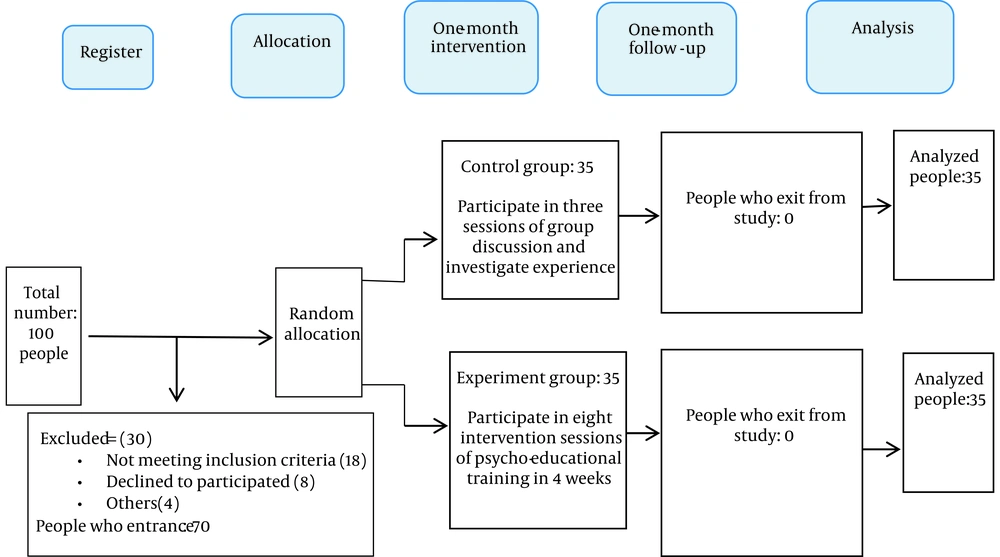
Figure 1.
Consort diagram
This study was designed to determine the influence of psycho-educational training on caregiver burden of family in children with epilepsy (Clinical trial). The level and amount of caregiver burden on the family of patients were assessed at first because there is a caregiver burden in caregivers of patients with epilepsy (2, 18). Then a comprehensive study was carried out on the literature, and appropriate solutions were extracted based on the problems, and a suitable training method was predicted for each of them, and the psycho-educational training was implemented based on RAM method (RAND appropriateness method) (23). For this purpose, the implemented program was provided with the members of the expert group (including 10 people who had experience and expertise in the field of care and treatment of epileptic patients and were interested in the subject), and they were asked to comment and grade on each action in terms of relevance, usefulness, executable functionality, and performance based on 1 - 9 scale (23). Then, the researcher evaluated the scores given and calculated the mean scores for each action separately. The program was developed and finalized after applying the comments and drafting modifications. Then, an operation plan was implemented in a clinic of Imam Hossein Hospital as a clinical trial and assessed by Zarit Caregiver Burden Questionnaire. This questionnaire consisted of 22 items rated on a 5-point Likert scale that ranged from 0 (never) to 4 (nearly always) with the sum of scores ranging between 0 - 88.9. The ZBI consists of 22 items rated on a 5-point Likert scale that ranges from 0 (never) to 4 (nearly always) with the sum of scores ranging between 0 - 88. The questionnaire specifically examines the relationship between the caregiver and the patient and assesses the health, well-being, financial well-being, and social life of the caregiver. For this purpose, education training was performed on face-to-face subjects during eight sessions, which was held twice a week for 90 minutes during one month using PowerPoint, photos, pamphlets, and speeches. At the end of each question and answer session, group discussion and home assignment were performed (Table 1). At intervals of the sessions, taking calls to caregivers was done to yield better effectiveness, and they answered questions and ambiguities of participants. In this research, the control group discussed issues and problems in just three separate sessions. Then, training information was provided in the form of a booklet, and their questions were answered.
Table 1.
Summary of Executive Instruction of Training Sessions
| Sessions | Goals and Materials | Educational Method |
|---|---|---|
| First session | Strengthening insight and awareness of caregivers by understanding the concept of epilepsy (definition, etiology, types, symptoms, complications of disease, marriage, and pregnancy, types of treatment, and emphasis on the importance of adherence to treatment) | Ice-breaker technique, brainstorming technique, speech |
| Second session | Strengthening insight and awareness of caregivers by familiarizing themselves with the management of epileptic seizures and the common complications of the disease and preventing recurrence such as the use of drugs, activity and diet, familiarity with the concept of burden and caregiver burden, quality of life, and the factors affecting it. | Speech, brainstorming, questions, and answers, |
| Third session | Strengthening mental health of caregivers through familiarizing with communication skills and improving this process in the family, effective ways of expressing feelings, how to deal with negative feelings such as (feeling despair, guilty, shame and fear and negative perception of Self) | Speeches, Role Playing, Brainstorming |
| Fourth session | Strengthening mental health of caregivers through familiarizing them with development of communication skills, stress and the importance of managing them, developing adaptive skills | Speech by a religious expert, Brainstorming |
| Fifth session | Strengthening mental health of caregivers through familiarizing them with communication skills, stress and the importance of managing them, developing adaptive skills | Speeches, brainstorming, questions, and answers |
| Sixth session | Strengthen mental health of caregivers through familiarizing them with anger and aggression control techniques, familiarity with relaxation technique (mental imagery), home assignment (relaxation) | Speeches, brainstorming, questions, and answers |
| Seventh session | Strengthening the physical health of caregivers and strengthening the economic and social dimension of caregiver's lives by familiarizing them with the importance of self-care (adequate sleep and rest, exercise and activity, etc.), the introduction of family support resources, and access to supportive and educational services | Speeches, brainstorming, role-playing techniques, questions, and answers |
| Summarizing the contents, review the homework of the previous sessions, receiving feedback from members on the topics, asking and answering and discussing the members of the group, completing the Zarit Caregiver Burden Questionnaire | Speech, brainstorming |
The data gathering tool in this study included: the first part was a checklist for family caregivers, which included data profile demographic (gender, age, marital status, level of education, employment status, relation to the patient, duration of care, family income, place of residence, number of households, Status of residence) and patients (age, gender, education, starting time of disease, type of epilepsy, cause of epilepsy, frequency of seizure, time of last seizure, frequency of admission due to seizure, number of medications consumed, compliance with a particular diet). The second part was Zarit Burden Interview (ZBI) (1980) (25), which included 22 questions to assess the psychological caregiver burden of caregivers. Each question was scored as follows: Never = zero points, rarely = 1, sometimes = 2, most often = 3, always = 4. The lowest score of zero care burden = no care burden, the most care burden = 88, intense care burden = 61 - 88, average care burden = 30 - 60, and mild care burden = less than 30. Its validity and reliability have been adjusted and validated in 2001 in Zahedan according to the cultural conditions of our country. For its scientific reliability, the retest method (r = 94%) has been used. In addition, CVR = 0.62 and CVI = 0.8 were calculated. Also, its reliability was 0.86 (26). The study used independent t-test and covariance test with repeated sizes in intervals before, immediately later, and after one month after the intervention to compare the level of caregiver burden in the experimental group compared to the control group. Data were analyzed using SPSS software version 18. The significance level was considered P < 0.05.
4. Results
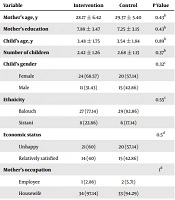
The mean age of caregivers in the control group (38.5 years) and the experimental group (38.2 years) and the duration of care were in the control group (7.25 years) and the experimental group (8.35 years). Most caregivers in both groups of experimental and control were female (97.1%). Also, most caregivers were married in both control (88.6%) and experimental (82.9%) groups. The caregivers in the control group (25.7%) and in the experimental group (8.6%) had a university education, and the majority of caregivers in both control (40%) and the experimental (51.4%) groups had a diploma. In addition, the highest proportion of caregivers were housewives in the control (68.6%) and the experimental groups (82.9%). The results of this study showed that using sequential convenience sampling method and chi-square test, all quantitative and qualitative variables were divided into two control and experimental groups before the study in terms of age, gender, marital status, employment status, level of education, relation of family, caregivers' duration of care, and income were homogeneous (P > 0.05) (Table 2). The results also showed that the caregiver burden was reduced in the experimental group and the average score of caregiver burden was 37.46 and 41.37, and 58.29 in intervals before, immediately later, and one month after implementing the psycho-educational training, respectively (P = 0.001*; f = 489) (Table 3). Comparison of averages of caregiver burden in the experimental group using ANOVA with repeated measures showed that there was a significant difference between them (P < 0.05). This meant that the caregiver burden before intervention was greater than immediately later intervention and one month after the intervention. The findings of the study showed that the level of caregiver burden did not significantly decrease in the control group, and the mean score of caregiver burden in the three intervals before, immediately later, and one month after the implementation of the psycho-educational training was 59.15, 58.24, and 58.00, respectively. Comparison of caregiver burden averages in the control group using ANOVA with repeated measures showed that there was no significant increase in this group (P = 0.85). Independent sample t-test showed that the changes in the average caregiver burden were significantly higher in the experimental group than the control group immediately after the intervention compared to before the intervention (P = 0.001). Also, this test showed that changes in average score of caregiver burden were significantly more than the control group before the intervention compared to one month after the intervention (P < 0.05). Interactive results of time-group showed that the intervention of psycho-educational training could reduce the care burden in caregivers of children with epilepsy over time (P = 0.043).
Table 2.
| Variables | Experiment | Control | P-Value c |
|---|---|---|---|
| Gender | 0.754 | ||
| Female | 97.1 | 97.1 | |
| Male | 2.9 | 2.9 | |
| Age (y) | 0.282 | ||
| Under 35 | 28.6 | 17.6 | |
| 35 and higher | 71.4 | 82.4 | |
| Education | 0.156 | ||
| Under the diploma | 40 | 34.3 | |
| Diploma and higher | 60 | 65.7 | |
| Occupation | 0.272 | ||
| Employed | 14.3 | 20 | |
| Unemployed and housewife | 85.7 | 80 | |
| Marital status | 0.736 | ||
| Married | 82.4 | 88.6 | |
| Widow/widower and divorced | 17.6 | 11.4 | |
| Relation | 0.513 | ||
| Father | 5.9 | 5.9 | |
| Mother | 94.1 | 94.1 | |
| Income | 0.206 | ||
| Low income | 80 | 68.6 | |
| High income | 20 | 31.4 |
a The results of the independent sample t-test.
b The results of the chi-square test.
c Sig < 0.05.
Table 3.
Comparison of Caregiver Burden Between the Control and Experimental Groups at Different Times
| Variables | Mean ± SD | In Group (Repeat) | Interactive Time *Group (Repeat) | ||
|---|---|---|---|---|---|
| Before Intervention | Immediately After Intervention | One Month After the Intervention | |||
| Experiment | 58.29 ± 10.71 | 41.37 ± 12.32 | 37.46 ± 17.76 | F = 60.489; P = 0.001* | F = 4.267; P = 0.043* |
| Control | 58 ± 12.01 | 58.24 ± 12.01 | 59.15 ± 12.53 | F = 3.511; P = 0.036* | |
| Intergroup (independent t) | t = 0.104; P = 0.917 | t = 5.736; P = 0.001* | t = 5.788; P = 0.001* | ||
| Intergroup changes compared to before intervention (independent t) | - | t = 14.662; P = 0.001* | t = 1.711; P = 0.001* | ||
5. Discussion
The present study evaluated the effect of a psycho-educational training program on caregiver burden in families with school-age epileptic children. According to the results, the mean score of caregiver burden in families with school-age epileptic children in the intervention group was significantly lower immediately and one month after the intervention than before the intervention. This study was conducted to evaluate the effect of psycho-educational training programs on caregiver burden of some results of studies.
The results of this study showed that before the study, most of the samples in both groups suffered from moderate caregiver burden, which was similar to the work of Karakis et al. in Greece (27). However, there was a significant decrease in the experimental group than the control group in terms of immediately after intervention and one month after the intervention. The reduction of caregiver burden has been confirmed by Palli et al. through interventions such as psycho-educational training (28), which seems to increase the mental, physical, and social health of parents due to the positive impact of the program on the level of their knowledge and attitude. The results of a study conducted by El-Malky et al. (2016) in Egypt " showed that training of families could reduce the caregiver burden in controlling epileptic seizures, the necessity of adherence to treatment, how to deal with unpredictable behaviors of patients, dealing with stigma, managing stress and improving adaptation strategies (10).
The results of studies on children with epilepsy and their families indicated that psychological training could increase self-efficacy, while it reduced anxiety, worry, fear, and stigma by increasing family awareness and increasing self-confidence in the patient and parents. As a result, epilepsy seizures are better controlled (4, 29), and caregiver burden is decreased (5).
Also, the study of Etemadifar et al. (2018) showed that family interventions could be useful through improving self-efficacy and creating positive self-esteem in caregivers, increasing self-esteem, and decision-making power in reducing anxiety, stress, and depression of caregivers of patients with epilepsy and consequently, it can enhance their mental health (30). In this case, group training is more efficient and effective because samples can address practice-learned skills and share their experiences through role-play, group discussion, and question and answer (8). A qualitative study that evaluated psychosocial training intervention in people with schizophrenia and their families showed that these trainings could be achieved through increasing awareness, strengthening adaptive skills, reducing stress and anxiety, enhancing motivation, increasing self-confidence, expanding social activities, and improving care skills in caregivers with schizophrenia disorder which also they could improve their health and well-being (23). In contrast to the results of the above studies, a study by Martin‐Carrasco et al. (2009) that evaluated the benefits of a psychological training program on the burden of family caregivers of Alzheimer's patients showed that between the average score of the previous care burden, immediately after (4 months after Study), there was no significant difference in the experimental group. Possibly, the reason for the program's ineffectiveness is related to the type of disease in this study (31). A study by Creedle et al. (2012) on patients with cancer showed that the care score in the experimental group not only did not decrease from the time of admission to one month after discharge but also significantly increased. It has also been shown to be ineffective (32). However, Palli (2017) believes that psycho-educational training can enhance solidarity and intimacy among family members by encouraging them to engage in collective activities. It also can reduce the aggressive behaviors of family members, especially the patient, and minimizes the contradiction between them. Also, it helps engage caregivers in participating in social activities to better serve their care role (33). Epilepsy is one of the chronic diseases that can cause stress in parents. In the meantime, lack of adequate knowledge about the illness, how to care for the patient, medical treatment, how to communicate and support the patient may disrupt caring and supportive roles and even may encounter their social and psychosocial health and other family members with risk (7).
Considering the results of this study, the level of caregiver burden of the family decreased one month after the intervention compared to before the study. It indicates that the effect of this program is persistent, which can be related to follow-ups that the researcher has had within the interval in the form of frequent contact and question and answer with test samples. From the point of view of Michaelis et al., face-to-face psycho-educational training along with telephone conversation training can also increase the effectiveness of the results (8). In addition, factors such as the content of the program, which are based on the needs of the caregivers and with regard to the assignments assigned to each session, allow caregivers to perform interventions at home and discuss the bugs in the implementation of the program at a subsequent meeting with the researcher. In this regard, trying to eliminate them, as well as providing a booklet and compact disc to caregivers, have provided more impact on intervention. Since the effect of psycho-educational training can be continuous and long-lasting on all family members, it can be used as a valuable resource in the treatment of chronic diseases (24). The limitations of this study were short follow-up time after the intervention. Also, three sessions were considered for the control group as a placebo to transfer experiences, which was less than the experiment group in terms of the number. Moreover, individual differences in response to treatment and impact of environmental factors, which could potentially affect the patient’s perception of cognitive-behavioral therapy effects. We restricted the effect of these limitations by allocating the patients to the control and intervention groups randomly. One of the remarkable features of this study compared to other similar studies is as follows: first, the content was compiled based on needs assessments of the caregivers. Second, various scientific and applied methods have been used in education. And more importantly, the review of the educational booklet by the caregivers followed up them by telephone call and did the homework by the caregivers.
5.1. Conclusion
In this study, the effect of group mental training programs on the burden of caregivers of patients with epilepsy was discussed. The results show that this training program reduces the burden of care, and this can prepare caregivers for a better role of caregiver and better management of the care process. Therefore, it can be said that training of caregivers can increase their knowledge and skills to control and deal with the physical and psychological pressures caused by the role of caregiver, and by transferring more comfort and more effective services to the patient to improve it more effectively.