
1. Background
Culture affects the perception of health and illness, decisions for treatment, experiences, and outcomes of healthcare (1). Cultural diversity can lead to a communication challenge in therapeutic environments and might introduce undesirable outcomes for patients (2). When the healthcare needs of cultural diversity are not well provided, it can result in the isolation and dissatisfaction of patients. Therefore, to provide effective care for patients with different cultures, it is necessary to understand their cultural diversity (3).
The cultural intelligence of healthcare staff members is considered among the most important and effective factors in having effective interactions with patients and their families of different cultures (4, 5). Cultural intelligence is defined as the ability and capability of individuals to have effective performance in different cultural environments (6). Cultural intelligence is an ability directly associated with individuals’ communicational skills and social interactions. Additionally, cultural intelligence eliminates the gap in the transfer of concepts from one culture to another (7). As a result, an increase in cultural intelligence can lead to an increase in staff’s performance and organizational commitment, a decrease in their stress level, and an increase in the quality of their healthcare and organization dynamics (8). According to previous studies, high cultural intelligence results in a decrease in the stress and anxiety of patients and their families, thereby promoting their satisfaction (9).
The emergency department (ED) is the first medical environment that most patients experience. The healthcare staff of the ED communicates regularly with patients from different cultures (10). In an ED, in addition to other medical treatment units, social interactions are considered among the main pillars of healthcare that affect the performance of staff members (11). Some studies have reported a high number of conflicts between patients or their families and healthcare staff members in critical situations. These conflicts are exacerbated when patients are unable to communicate or are in end-of-life situations. Conflicts, especially in the face of different cultures, can cause frustration and threaten the individual identity of the patient and his/her family (12-14). It has been evidenced that other factors, such as the high-risk situation of patients, their psychological conditions that create these conflicts, and cultural diversity between staff members and patients, can also exacerbate these conflicts (15, 16). In this context, providing high-quality service and satisfying the patients in an ED are not possible unless by understanding their problems through proper communication (17).
Communication is not simply talking one to another but understanding true cultural diversity and how those differences affect both providing and receiving healthcare. Cultural diversity, particularly not having a common language, poses barriers to the establishment of effective communication. Even nonverbal communications have various implications in different cultures (18). Proper knowledge of clinicians about the cultures, languages, values, traditions, practices, and beliefs of patients can be of great assistance in communication with patients without prejudgment (19). In this regard, the communication and interactions of ED staff members are of particular importance in the satisfaction of patients and their relatives (20, 21).
The investigation of the status of communication skills and social interactions in healthcare staff members in multicultural environments might have great benefits. In Zanjan, Iran, migration from other cities has caused a variety of demographics and cultures. The population of Zanjan speaks the Azeri language, and their religion is Islam (Shia). Due to the proximity to the Kurdish cities and the northern cities of Iran, where individuals speak in local dialects, Zanjan encounters a wide variety of languages (e.g., Gilaki dialect and Kurdish language) and Sunni Muslims. Some ED staff members of Zanjan are nonnative and speak only Persian. On the other hand, most illiterate patients cannot speak Persian and only speak their native languages and dialects. Therefore, communication between staff and patients is a difficult task. Since patients and their families face different staff members in the ED, the proper interaction between them is critical.
2. Objectives
Considering the multicultural nature of Zanjan and the lack of a study in this regard, this study aimed to investigate the status of cultural intelligence and its relationship with the social interactions and communication skills of staff members in the ED of hospitals affiliated with Zanjan University of Medical Sciences.
3. Methods
3.1. Study Design and Sampling
This cross-sectional study was conducted in the ED of hospitals affiliated with Zanjan University of Medical Sciences within October 7 to December 23, 2019. The study population was selected from the ED staff members in Zanjan province using convenience sampling. The sample size was estimated using a pilot study conducted on 30 ED staff members. Using G*Power software (version 3.1), the sample size was estimated to be 196 by considering a 95% confidence level, 0.232 correlation coefficient between cultural intelligence and communication skills, and 80% power. A total of 220 questionnaires were distributed considering a 10% sample dropout. The inclusion criteria were at least one year of experience working in the ED and the desire to participate in the study.
3.2. Data Collection
The data needed in the present research were collected using three questionnaires of the Cultural Intelligence Scale, Social Interactions Questionnaire, and Communication Skills Scale. All three scales were translated to Persian and back-translated to English. The translation process was developed in relation to the principal guidelines (22).
The forward translation was performed by two experts fluent in English, and the Persian version of the scales was independently back-translated by one bilingual expert and one expert fluent in English, both blinded to the original English version. An expert panel consisting of two nursing faculty members with experience in instrument development and translation compared all versions with the original. In the present study, qualitative and quantitative content validity was used to assess the validity of the scales. The scales were provided to 10 experts, and the necessary corrections were made. Finally, the content validity index (CVI) and content validity ratio (CVR) of the scales were calculated.
The researcher referred to the ED and explained the study goals to the subjects meeting the inclusion criteria. Then, if they were willing to participate in the study, they granted informed consent and received a small gift for completing the questionnaire. The questionnaires were distributed on paper. The time of returning the questionnaire to the researcher was decided by the participants; accordingly, they could fill out the questionnaire accurately and conveniently. The data were collected over 3 months.
3.2.1. Data Collection Tools
3.2.1.1. Cultural Intelligence Scale
Cultural intelligence was evaluated using the Cultural Intelligence Scale developed by Earley and Ang (23). The scale includes four dimensions with 20 items, namely metacognitive cultural intelligence (4 items), cognitive cultural intelligence (6 items), motivational cultural intelligence (5 items), and behavioral cultural intelligence (5 items). This scale is scored based on a 7-point scale (ranging from 1 = strongly disagree to 7 = strongly agree), with its scores within a range of 20 - 140 (20 - 60: low cultural intelligence; 61 - 100: moderate cultural intelligence; 101 - 140: high cultural intelligence). This scale has been used in several studies in Iran (24, 25). Shomoossi et al. (2019), in a study on 136 employees in Sabzevar University of Medical Sciences, Khorasan, Iran, calculated the reliability of the total score of cultural intelligence using Cronbach’s alpha as 0.85 (25). However, in the current study, reliability was reported as 0.75. In this study, the CVI and CVR were estimated to be 0.83 and 0.79, respectively.
3.2.1.2. Social Interactions Questionnaire
The 30-item Social Interaction Self-Statement Test was used to study the participants’ social interactions developed by Glass et al. (26). This scale includes two dimensions of negative and positive thoughts in communication. Each dimension contains a 15-item 5-point Likert scale, where the scores are within a range of 15 - 75. A high score in the negative dimension indicates weak social interactions, suggesting that the individuals believe in the negative role of inappropriate conditions in communication and a feeling of fear and anger in social situations. However, a high score in the positive dimension shows the high ability of individuals in communication with others, low anxiety, and their belief in facilitating communication with others. In the present study, the reliability of the questionnaire was calculated to be 0.701 by Cronbach’s alpha. Additionally, the CVI and CVR of the questionnaire were estimated to be 0.87 and 0.89, respectively.
3.2.1.3. Communication Skills Scale
Communication skills were calculated using an 18-item scale developed by Ersanlı and Balcı (27). The scale has three dimensions of verbal, listening, and feedback skills, each containing 6 items. The scoring is performed based on a 5-point Likert scale. The minimum and maximum scores of each dimension are 6 and 30, respectively. The total score of the scale varies from 18 to 90 (< 42: low communication skills; 42 - 66: moderate communication skills; > 66: high communication skills). In Iran, the scale was psychometrically analyzed on 191 health volunteers, and its Cronbach’s alpha was reported to be 0.91 (28). However, in the present study, the reliability of the scale was 0.787. Furthermore, in this study, the CVI and CVR were estimated to be 0.87 and 0.89, respectively.
3.3. Ethical Considerations
This study was conducted after obtaining the approval of the Ethics Committee of Zanjan University of Medical Sciences (ethics code: IR.ZUMS.REC.1396.305). After referring to the research environment and explaining the research goals, the author obtained written consent from the participants. The participants were assured that all their information would remain confidential. Moreover, the subjects could withdraw from the study at any time they wished. The participants were asked to complete the questionnaires at any time they desired to make them feel comfortable and control the confounding factors, such as noise and workload in the hospital.
3.4. Data Analysis
The data were analyzed using SPSS software (version 16). The Shapiro-Wilk test was employed to evaluate the normality of the data. The Pearson correlation coefficient was used to investigate the relationship of cultural intelligence with communication skills and social interactions. Finally, the multivariate analysis of variance (MANOVA) was utilized to predict the cultural intelligence for variables of communication skills and the positive and negative thoughts dimensions of the Social Interaction Questionnaire. A significance level of 0.05 was considered statistically significant.
4. Results
Of the 217 distributed questionnaires, 200 questionnaires were filled out by the staff members and returned to the researcher. Among the completed questionnaires, only three questionnaires were excluded from the samples due to missing data. Finally, the information of 197 subjects was analyzed. Most of the participants were female nurses with different educational levels. Table 1 shows the demographic information of the participants.
Table 1.
Demographic Variables of Emergency Staff Department
| Demographic Variables | No. (%) |
|---|---|
| Gender | |
| Male | 94 (47.7) |
| Female | 103 (52.3) |
| Marital status | |
| Single | 66 (33.5) |
| Married | 131 (66.5) |
| Age (y) | |
| Under 25 | 26 (13.2) |
| 25 - 34 | 68 (34.5) |
| 35 - 44 | 55 (27.9) |
| 45 - 54 | 37 (18.8) |
| Over 54 | 11 (5.6) |
| Occupational type | |
| Hospital cleaner | 18 (9.1) |
| Emergency department guard | 16 (8.1) |
| Nurse aid | 24 (12.2) |
| Nurse (diploma) | 42 (21.3) |
| Nurse (bachelor’s degree/master’s degree) | 85 (43.1) |
| Physician | 12 (6.1) |
| Educational level | |
| Diploma | 32 (16.2) |
| Associate degree | 38 (19.3) |
| Bachelor’s degree | 91 (46.2) |
| Master’s degree | 24 (12.2) |
| Doctor of medicine | 12 (6.1) |
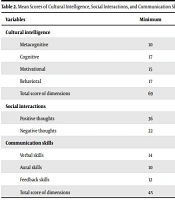
The findings of this study indicated that the mean cultural intelligence score of the participants was 85.78 ± 6.26 out of 140; accordingly, 99.5% (n = 196) and 0.5% (n = 1) of the staff members had moderate (61 - 100) and high (101 - 140) cultural intelligence levels, respectively. In terms of social interactions, the mean score of the positive thoughts dimension (47.86 ± 4.14) was higher than the mean score of negative thoughts (33.01 ± 3.92). Moreover, the total mean score of communication skills was 55.41 ± 3.9 out of 90; accordingly, 100% of the participants (n = 197) had moderate communication skills (43 - 66) (Table 2).
Table 2.
Mean Scores of Cultural Intelligence, Social Interactions, and Communication Skills of Participants
| Variables | Minimum | Maximum | Mean ± Standard Deviation |
|---|---|---|---|
| Cultural intelligence | |||
| Metacognitive | 10 | 22 | 16.06 ± 2.06 |
| Cognitive | 17 | 34 | 25.98 ± 3.1 |
| Motivational | 15 | 27 | 21.31 ± 2.22 |
| Behavioral | 17 | 29 | 22.59 ± 2.21 |
| Total score of dimensions | 69 | 102 | 85.78 ± 6.24 |
| Social interactions | |||
| Positive thoughts | 36 | 58 | 47.86 ± 4.41 |
| Negative thoughts | 22 | 43 | 33.01 ± 3.92 |
| Communication skills | |||
| Verbal skills | 14 | 27 | 19.71 ± 2.12 |
| Aural skills | 10 | 23 | 17.44 ± 2.29 |
| Feedback skills | 12 | 24 | 18.25 ± 2.05 |
| Total score of dimensions | 45 | 66 | 55.41 ± 3.09 |
The results of the Pearson correlation coefficient indicated a statistically significant and positive relationship between the total score of cultural intelligence and communication skills (r = 0.361, P = 0.001) (Table 3).
Table 3.
Relationship between Cultural Intelligence with Social Interactions and Communication Skills in Participants
| Variables | Cultural Intelligence | Communication Skills | Social Interaction (PTs) | Social Interaction (NTs) | ||||
|---|---|---|---|---|---|---|---|---|
| r | P-Value | r | P-Value | r | P-Value | r | P-Value | |
| Cultural intelligence | 1 | - | ||||||
| Communication skills | 0.361 ** | 0.001 | ||||||
| Social interaction (PTs) | 0.308 ** | 0.001 | 0.158* | 0.027 | 1 | - | ||
| Social interaction (NTs) | -0.218 ** | 0.002 | -0.159* | 0.026 | -0.116 | 0.106 | 1 | - |
Abbreviations: PTs, positive thoughts; NTs, negative thoughts.
The results of the Pearson correlation coefficient revealed a significant and positive relationship between the positive thoughts dimension of the Social Interactions Questionnaire with cultural intelligence total score (r = 0.308, P = 0.001); accordingly, an increase in cultural intelligence correlated with an increase in positive thoughts. Moreover, there was a statistically significant negative relationship between the negative thoughts dimension of the Social Interactions Scale with cultural intelligence total score (r = -0.218, P = 0.002) (Table 3).
The results of the Pearson correlation coefficient indicated a statistically significant positive relationship between the positive thoughts dimension of the Social Interactions Scale with the total score of communication skills (r = 0.158, P = 0.027); accordingly, an increase in communication skills was associated with an increase in positive thoughts. Moreover, there was a significant negative relationship between the negative thoughts dimension of the Social Interaction Questionnaire with the total score of communication skills (r = -0.159, P = 0.026); accordingly, an increase in the total score of communication skills correlated with a decrease in negative thoughts (Table 3). The results of MANOVA showed that cultural intelligence could not predict communication skills and negative thoughts and only can predict 1% of positive thoughts (Table 4).
Table 4.
Relationship of Cultural Intelligence with Positive Thoughts, Negative Thoughts, and Communication Skills in Participants Using Multivariate Analysis of Variance
| Variables | Type III Sum of Squares | df | F | P-Value | 95% Confidence Interval | B | Partial eta Squared | R-Squared | Adjusted R-Squared | |
|---|---|---|---|---|---|---|---|---|---|---|
| Lower Bound | Upper Bound | |||||||||
| Cultural intelligence | ||||||||||
| Positive thoughts | 51.13 | 1 | 3.00 | 0.084 | -15.32 | 0.99 | -7.17 | 0.015 | 0.015 | 0.010 |
| Negative thought | 9.08 | 1 | 0.59 | 0.444 | 0.44 | -4.75 | 3.02 | 0.003 | 0.003 | 0.002 |
| Communication skills | 26.84 | 1 | 0.44 | 0.508 | -20.65 | 10.26 | -5.19 | 0.002 | 0.002 | 0.003 |
5. Discussion
The findings of the present study revealed that the cultural intelligence level and communication skills of the staff members in the ED were at a moderate level. In addition, in terms of the Social Interactions Questionnaire, the scores of positive thoughts were higher than negative thoughts. Cultural intelligence had a statistically significant positive correlation with communication skills in participants. Based on the obtained results, an increase in the cultural intelligence level correlates with an increase in positive thoughts and a decrease in negative thoughts.
In agreement with the results of the present study, another investigation showed that the cultural intelligence of the staff members was at a moderate level (28). Furthermore, some studies indicated a low communication level between medical staff members and patients (2, 18, 29). However, it seems that staff members in EDs require higher cultural intelligence and communication skills.
Cultural intelligence plays an important role in communication of staff members who deal with individuals with different cultures daily. Considering the need to establish communication between staff members and patients to prevent undesirable outcomes, cultural diversity should not hinder the proper communication between staff members and patients. In line with the results of the present study, Bucker et al. (2014) demonstrated a positive and significant relationship between cultural intelligence and the effectiveness of communication (30).
In the present study, cultural intelligence was positively associated with positive thoughts and negatively associated with negative thoughts of the Social Interactions Questionnaire. Since some parts of the Social Interactions Questionnaire and Communication Skills Scale are associated with nonverbal communication skills, it seems that in the present study, staff members with higher cultural intelligence levels had higher nonverbal skills, and their language barrier could be solved in this way.
It is necessary to enhance the cultural intelligence and cultural competence of staff to have effective communication in hospitals due to the changes in cultural diversity (31, 32). The high cultural intelligence and cultural sensitivity of the staff members not only improve the relationship between patients and staff members but also enhance their performance. As a result, it reduces the stress level of staff members working with patients with different cultures (33). The results of a study showed that metacognitive cultural intelligence and cognitive cultural intelligence, motivational cultural intelligence and behavioral cultural intelligence, and metacognitive cultural intelligence and behavioral cultural intelligence could predict the cultural judgment of the staff members, cultural adaptation, and task performance, respectively (7).
In contrast with the results of the present study, Ahanchian et al. (2012) reported the lack of any significant relationship between cultural intelligence and social interactions (28). The difference between the current study and the study by Ahanachian et al. (2012) could be attributed to the communication of staff members of the ED with different individuals due to the nature of the unit. Ahnachian et al. (2012) selected the samples from all general units. In comparison, in the present study, the participants had at least 2 years of work experience in the ED; therefore, contacting more patients in the ED might result in an increase in cultural intelligence and positive thoughts in the social interactions of ED staff members (2).
In the ED, patients and their families are more sensitive. Under such stressful conditions, cultural characteristics and differences are more obvious. Therefore, better and quicker perception and analysis of proper behaviors from different cultures correlate with patients’ satisfaction. Typically, managers tend to assign employees with effective communication skills to EDs. However, they might forget that the stress-resolving skills of such staff members are due to their high cultural intelligence. By understating various cultural contexts, such employees offer peace to the ED. In general units, communications occur more peacefully, and the staff members have enough time to analyze the behaviors and understand the cultural contexts of patients. Additionally, since patients and their families experience less stress, cultural diversity between patients and staff members is less apparent under such conditions.
It has been reported that frequent contact with different cultures is associated with an increase in the cultural competence of staff members (10, 34, 35). Furthermore, it has been evidenced that training cultural competence and practicing cultural competency communication increase the communication skills of staff members (35-38). Therefore, authorities are suggested to hold education workshops on dealing with different cultures to promote the cultural intelligence and competence of ED staff members. In this way, they can improve the communication and interactions of staff members with patients and their families.
In Iran, despite considerable cultural diversity, few studies have been conducted on cultural intelligence. The present study aimed to provide basic knowledge about the state of cultural intelligence, communication skills, and social interactions of ED staff members in Zanjan. However, the obtained results are not generalizable to other societies due to the specific culture of Zanjan. Moreover, since all questionnaires were simultaneously provided to the participants, social response bias might threaten the validity of the results. Therefore, the authors tried to minimize this bias by anonymizing the name of those who filled out the questionnaires.
5.1. Conclusions
According to the results of the present study, an increase in the cultural intelligence level was associated with an increase in the communication skills and social interactions of ED staff members. Considering the globalization and confrontation with different cultures and ethnicities, managers should increase the cultural intelligence level of the staff members. In this way, staff members can enhance their cultural competence to increase their service quality and patient satisfaction. Since most parts of cultural intelligence, communication skills, and social interactions can be acquired and enhanced, authorities of medical science education should try to enhance the cultural intelligence and cultural competence of students in a multiethnic country, such as Iran, to have healthcare staff members with high cultural intelligence in the future. In addition, hospital managers should identify the strengths and weaknesses of their staff members by measuring their cultural intelligence and providing retraining courses based on the obtained results.