
1. Background
In healthcare, particularly in the nursing profession, effective communication among nurses, patients, families, and other members of the healthcare team is crucial. Effective communication not only builds patient trust and satisfaction but also directly affects care quality, reduces medical errors, and improves health outcomes (1). Communication skills are essential to the nursing care process, facilitating greater patient participation, reduced anxiety and stress, and increased satisfaction.
Numerous studies have highlighted challenges nurses face in communicating accurately and effectively with patients and colleagues (2). Research indicates that nurses’ communication skills are often at an average or low level, leading to reduced patient satisfaction, increased errors, and decreased care quality (3, 4). For instance, only 23% of patients in one study were completely satisfied with nurses’ communication, indicating a need for training and skill improvement in the profession (3).
Several factors contribute to the development and improvement of communication skills, one of the most important of which is social intelligence (5). Social intelligence involves understanding, managing, and interacting effectively with others and is crucial for establishing healthy relationships in work and social settings (6). Individuals with high social intelligence can better understand others’ feelings and needs, fostering stronger emotional and professional relationships (7). In healthcare settings, social intelligence contributes to better interactions with patients, families, and colleagues, ultimately enhancing care quality (5, 8).
The results show that social intelligence not only improves interpersonal relationships but also increases nurses’ job satisfaction and reduces stress and job pressure (6). Nurses with high social intelligence can make better decisions in critical situations, manage conflicts, and more effectively understand individual and cultural differences (9). Therefore, developing and strengthening social intelligence in nurses can improve their communication skills and lead to enhanced professional performance and patient satisfaction.
Understanding the relationship between social intelligence and communication skills among nurses is crucial for improving patient care and healthcare outcomes (5). Social intelligence, defined as the ability to understand and manage social interactions effectively, directly affects a nurse’s ability to build rapport, demonstrate empathy, and collaborate with colleagues (10). Effective communication skills are essential for accurate patient assessment, conveying complex medical information, and fostering a therapeutic environment (4).
Research indicates that higher social intelligence is positively correlated with improved communication skills in healthcare professionals (5). Nurses with strong social intelligence are better able to recognize patients’ emotional states, adapt their communication styles, and manage challenging interactions, thereby reducing misunderstandings and enhancing patient satisfaction (11). Conversely, deficits in these areas can lead to miscommunication, decreased patient trust, and compromised safety.
Conducting a study on this relationship is necessary to identify specific social intelligence competencies that influence communication effectiveness in nursing. Such insights can inform targeted training programs aimed at developing these skills, ultimately improving nurse–patient relationships and clinical outcomes. Furthermore, understanding this dynamic can contribute to better interprofessional collaboration, thereby reducing errors and increasing team cohesion (5). Given the critical role nurses play in healthcare delivery, exploring these psychological and interpersonal factors is essential for advancing nursing practice and patient care quality.
2. Objectives
Accordingly, the aim of the present study was to investigate the relationship between social intelligence and communication skills among nurses in educational-therapeutic centers affiliated with Iran University of Medical Sciences. The findings may provide valuable information for health-sector managers and planners to identify educational needs, develop nurses’ personal and professional skills, and ultimately improve the quality of nursing care.
3. Methods
3.1. Study Design and Setting
This analytical cross-sectional study was conducted between January 20, 2024, and April 15, 2025. Participants were selected from nurses working in 12 educational-therapeutic hospitals affiliated with Iran University of Medical Sciences, including intensive care and general wards.
3.2. Participants and Sampling
The inclusion criteria were at least 6 months of work experience as a nurse, direct contact with patients during the care process, and no psychological conditions that would prevent questionnaire completion, such as crises including bereavement, divorce, or similar circumstances.
Stratified random sampling was used, with each hospital considered a stratum. Based on the total sample size and the number of nurses in each hospital, a specific quota was allocated to each hospital. Participants were then selected from each stratum using simple random sampling. The study objectives were explained to the participants, and written informed consent was obtained. Nurses were assured of confidentiality, voluntary participation, and anonymity of the results. All questionnaires were completed in person.
3.3. Sample Size
The sample size was calculated using the formula for correlation studies (12):
N= [(Zα +Zβ/C)] 2+3, C = 0.5 * ln [(1+r)/ (1-r)], r = 0.2, α=0.05, and power = 80%.
N final = 194 × 83/100 ≈ 233
The result was n = 194; we enrolled 233, assuming a 17% non-response rate.
3.4. Instruments
3.4.1. Demographic information questionnaire
The demographic questionnaire included items such as age, gender, education level, work experience, employment status, type of work shift, and the department in which the participant worked.
3.4.2. Tromsø Social Intelligence Scale (TSIS)
This scale includes 21 questions and measures social intelligence through three subscales: Social Information Processing (SIP), social awareness, and social skills. Responses are recorded on a Likert-type scale ranging from strongly disagree (1) to strongly agree (7). The minimum possible score is 21, and the maximum is 147. Higher scores indicate higher levels of social intelligence and its subscales, and vice versa (13). This questionnaire has been validated in Iran and found to be reliable; the Cronbach's alpha for the total scale was 0.75. In the present study, reliability was assessed in 30 nurses, and Cronbach's alpha was 0.85.
3.4.3. Barton Communication Skills Questionnaire
Developed by Barton in 1990, this questionnaire consists of 18 items assessing feedback skills, listening skills, and verbal skills. It uses a Likert scale scored from completely disagree (1) to completely agree (5). The minimum possible score is 18, and the maximum is 90, with 90 indicating the highest communication skills score. In the study by Hosseini Nasab, Cronbach's alpha was used to assess reliability, and the reliability of communication skills was reported as 0.87. In the present study, reliability was assessed in 30 nurses, and Cronbach's alpha was 0.89. No measurement bias was evident, as both the Tromsø Social Intelligence Scale (Cronbach's alpha = 0.85) and the Barton Communication Skills Questionnaire (alpha = 0.89) showed high reliability in our pilot version.
3.5. Ethical Considerations
The study was conducted in accordance with the Declaration of Helsinki and was approved by the Ethics Committee of Iran University of Medical Sciences with the ethics code IR.IUMS.REC.1403.056. All research was performed in accordance with relevant guidelines and regulations. The study purpose was explained to the participants, and those who wished to participate signed an informed consent form. They were assured that all information would be kept confidential.
3.6. Statistical Analysis
All data were analyzed using SPSS software version 22 (SPSS Inc., Illinois, USA). Descriptive statistics were presented as frequency, percentage, mean, and standard deviation. The Kolmogorov-Smirnov test was used to assess the normality of the data distribution. The Pearson correlation coefficient was used to evaluate the relationship between communication skills and social intelligence. Multiple linear regression analysis was conducted to determine factors related to communication skills. P < 0.05 was considered statistically significant.
4. Results
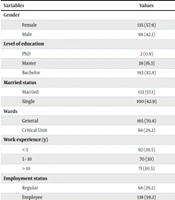
Of the 233 nurses, 57.9% (n = 135) were female and 42.1% (n = 98) were male. The mean age of the participants was 32.55 ± 6.59 years, and the mean weekly work hours were 55.86 ± 19.54. The demographic characteristics of the nurses are presented in Table 1. The total social intelligence score and communication skill score were 49.7 ± 6.8 and 23.5 ± 7.2, respectively (Table 2).
Table 1.
Demographic Details of the Study Population a
| Variables | Values |
|---|---|
| Gender | |
| Female | 135 (57.9) |
| Male | 98 (42.1) |
| Level of education | |
| PhD | 2 (0.9) |
| Master | 38 (16.3) |
| Bachelor | 193 (82.8) |
| Married status | |
| Married | 133 (57.1) |
| Single | 100 (42.9) |
| Wards | |
| General | 165 (70.8) |
| Critical Unit | 68 (29.2) |
| Work experience (y) | |
| < 5 | 92 (39.5) |
| 5 - 10 | 70 (30) |
| > 10 | 71 (30.5) |
| Employment status | |
| Regular | 68 (29.2) |
| Employee | 138 (59.2) |
| Probationary | 27 (11.6) |
| Work shift | |
| Morning | 51 (21.9) |
| Evening | 3 (1.3) |
| Night | 52 (22.3) |
| Rotation | 127 (54.5) |
a Values are expressed as No. (%).
Table 2.
Standard Deviation and Ranges of Communication Skills, Social Intelligence, and Its Dimensions a
| Variables | Mean ± SD | Max-Min |
|---|---|---|
| Social intelligence | ||
| SIP | 15.9 ± 2.9 | 28 - 6 |
| SA | 18.6 ± 3.41 | 27 - 9 |
| SS | 15.1 ± 2.9 | 29 - 8 |
| Total score | 49.7 ± 3.8 | 75 - 25 |
| Communication skills | 23.5 ± 7.2 | 56 - 8 |
| Feedback | 30.0 ± 7.8 | 49 - 7 |
| Listening | 23.2 ± 5.2 | 39 - 6 |
| Verbal | 76.9 ± 13.2 | 122 - 21 |
| Total score | 23.5 ± 7.2 | 56 - 8 |
a Abbreviations: SIP, social information processing; SA, social awareness; SS, social skills; Max-Min, maximum-minimum.
The study showed a positive and significant correlation between the total social intelligence score and communication skills, indicating that higher social intelligence scores were associated with higher communication skill scores (r = 0.39, P < 0.001). There was also a positive and significant correlation between the total social intelligence score and the feedback skill score (r = 0.3, P < 0.001) (Table 3).
Table 3.
Pearson Correlation Coefficient Between Communication Skills and Social Intelligence of Nurses
| Variables | r a | P-Value |
|---|---|---|
| Total social intelligence score - total communication skills score | 0.39 | 0.001 |
| Feedback skills - social intelligence | 0.30 | 0.001 |
| Listening skills - social intelligence | 0.27 | 0.001 |
| Verbal skills - social intelligence | 0.28 | 0.001 |
| Social information processing (SIP) - communication skills | 0.20 | 0.002 |
| Social awareness (SA) - communication skills | 0.30 | 0.001 |
| Social skills (SS) - communication skills | 0.24 | 0.001 |
a Pearson correlation coefficient.
In addition, the results of the multiple linear regression analysis, with an adjusted R-squared of 0.17, indicated that both age (B = -0.34, P = 0.005) and social intelligence (B = 0.19, P < 0.001) were significantly associated with communication skills, even after adjustment for other variables (Table 4).
Table 4.
Result of the Multiple Linear Regression Analysis for Factors Influencing Communication Skills
| Variables | B | SE | t | P-Value | 95% Confidence Interval for B | |
|---|---|---|---|---|---|---|
| Lower Limit | Upper Limit | |||||
| Constant | 41.45 | 4.83 | 8.59 | 0.001 | 31.94 | 50.97 |
| Age | -0.34 | 0.12 | -2.83 | 0.005 | -0.58 | -0.10 |
| Sex (Male) | 1.21 | 0.88 | 1.38 | 0.169 | -0.52 | 2.94 |
| Married status (Single) | 1.45 | 1.14 | 1.27 | 0.204 | -0.79 | 3.69 |
| Level of education (Bachelor) | ||||||
| Master | -0.28 | 1.14 | -0.25 | 0.805 | -2.54 | 1.97 |
| PhD | 5.44 | 4.59 | 1.19 | 0.237 | -3.60 | 14.49 |
| Work experience (< 5 y) | ||||||
| 5 - 10 | -0.51 | 1.23 | -0.41 | 0.679 | -2.94 | 1.92 |
| > 10 | 1.88 | 1.78 | 1.06 | 0.292 | -1.63 | 5.38 |
| Employment status (regular) | ||||||
| Contract | 0.88 | 1.60 | 0.55 | 0.583 | -2.27 | 4.02 |
| Probation | -0.84 | 1.13 | -0.74 | 0.457 | -3.06 | 1.38 |
| Work shift (morning) | ||||||
| Evening | 0.23 | 3.74 | 0.06 | 0.951 | -7.14 | 7.60 |
| Night | 1.92 | 1.28 | 1.50 | 0.135 | -0.60 | 4.43 |
| Rotation | 0.80 | 1.11 | 0.72 | 0.472 | -1.39 | 2.99 |
| Wards (critical unit) | 0.63 | 0.93 | 0.68 | 0.499 | -1.20 | 2.45 |
| Weekly work hours | -0.02 | 0.02 | -1.11 | 0.268 | -0.07 | 0.02 |
| Social intelligence | 0.19 | 0.03 | 5.97 | 0.001 | 0.13 | 0.25 |
5. Discussion
The findings of this study reveal a positive and significant correlation between social intelligence and communication skills among nurses working in selected hospitals affiliated with Iran University of Medical Sciences.
Nurses with higher scores on social intelligence assessments exhibited superior communication skills. This association was particularly evident for feedback competencies; thus, nurses with higher social intelligence demonstrated better skills in both providing and receiving appropriate feedback. The results indicate that nurses with higher social intelligence can facilitate more effective and efficient communication with patients and colleagues, ultimately enhancing healthcare quality.
These results align with previous research indicating that social intelligence significantly affects communication skills and, subsequently, job performance (14). Özdoğru et al. also found that individuals with higher social intelligence tend to have better communication skills (15). Comparable research on the importance of social intelligence in healthcare professions, particularly nursing, has shown that individuals in these fields require a high degree of social intelligence to interact effectively and enhance the quality of patient services (5).
The study revealed that nurses generally had average communication skill scores around the median level, with a mean score of 50, indicating a need to improve communication abilities. This finding contrasts with several previous studies; for example, research by Ghrayeb et al. conducted in four government and private hospitals indicated that nurses’ average communication abilities were higher (16). This disparity may stem from differences in hospital settings or the distinct communication requirements of various departments. In the emergency department, high workload and substantial patient volume may affect communication abilities, which can differ from those in other departments for several reasons.
This study found no significant effects of demographic variables, including gender, age, marital status, work experience, and type of employment, on social intelligence and communication skills. This contrasts with previous research reporting significant differences in communication skills by gender and other demographic factors. For instance, Mansouri reported notable disparities in communication skills between men and women (17). Such differences may result from variations in cultural, educational, and social structures across communities or specific health centers. Furthermore, variables such as age and work experience, which have been highlighted in other studies, did not show significant effects in this research. This may be attributable to greater diversity in the study sample and differing hospital environmental conditions.
This study underscores the importance of the correlation between social intelligence and communication abilities, suggesting that strengthening these domains can positively influence nurses’ professional performance. These findings highlight the need for targeted training programs to enhance nurses’ social intelligence and communication abilities. Programs incorporating workshops and courses focused on social skills, including empathy, effective feedback, emotion regulation, and other facets of social intelligence, may substantially improve healthcare quality. Such initiatives may also reduce stress and increase job satisfaction among nurses.
Accordingly, the findings suggest that nursing school curricula, particularly those implemented in hospital environments, should prioritize the development of social intelligence and communication skills. Strengthening these abilities can improve nurse–patient relationships and may influence nurses’ mental health and quality of work life. This study emphasizes the importance of communication skills training in nursing and recommends that hospitals and health centers implement effective measures to enhance nurses’ social intelligence and communication abilities, thereby improving service quality and patient satisfaction.
5.1. Limitations
This study has several limitations. It was conducted only in hospitals affiliated with Iran University of Medical Sciences, which may limit the generalizability of the results. Therefore, studies in more diverse settings are recommended.
The cross-sectional design limits causal inference regarding the relationship between social intelligence and communication skills. Future longitudinal studies are recommended to validate these findings.
The data were collected using self-report questionnaires, which may have been influenced by participants’ cognitive biases. Qualitative and interventional studies are recommended to minimize these effects.
5.2. Conclusions
This study confirms a positive relationship between social intelligence and nurses’ communication skills. This suggests that nurses with higher social intelligence communicate more effectively with patients and colleagues, potentially resulting in improved quality of care and greater patient satisfaction. Furthermore, given that communication skills were evaluated at an average level, there is an increasing need to develop and implement training programs to enhance these skills in healthcare settings.
The results indicated that demographic variables did not significantly influence social intelligence and communication skills, underscoring the need to prioritize education and training in these competencies across all levels and groups. Health system managers and policymakers are encouraged to implement targeted educational strategies to strengthen nurses’ communication skills and social competencies, thereby improving the quality of nursing services and interpersonal interactions within healthcare settings.