1. Background
Diabetes is a chronic and progressive metabolic disease worldwide that is considered a health problem especially in developing countries (1). The prevalence of diabetes is increasing due to cultural and social changes around the world. Thus, diabetes is becoming a common problem that increases the demand for health services (2). The International Diabetes Federation (IDF) considers the disease a global emergency as one person dies of diabetes every ten seconds (3). According to recent statistics from the World Health Organization (WHO), diabetes has affected approximately 347 million people worldwide and this figure is projected to increase to 592 million by 2035. Besides, type 2 diabetes in Iran will affect more than 14% of the adult population. It is also predicted that by 2030, more than 6 million Iranians will be affected by the disease (4-6). Complications of diabetes include cardiovascular disease, kidney disease, retinopathy, neuropathy, and amputation. These complications impose a heavy burden on the individual and family and reduce the quality of life and lead to the risk of premature death in patients (7). Type 2 diabetes is difficult to treat and causes the patient to suffer and increase treatment costs (8). Diabetes treatment includes blood sugar lowering methods, diet, exercise, constant care and monitoring, monitoring blood glucose levels, engaging in health behaviors, prescribing insulin, and contacting a health care provider. Even small improvements in blood sugar control can reduce long-term complications (9, 10). The cornerstone of preventing the complications of the disease and the greater effectiveness of drugs is to observe the use of diabetes drugs regularly; otherwise, it leads to poor blood sugar control, worsening of the patient's condition and other diseases, increased health care, increased costs, and higher mortality rates. This is why patient medication adherence has been considered an important factor for more effective outcomes (11). One of the most important goals of self-care in controlling diabetes is medication adherence (12). Adherence means that the patient follows a certain treatment method correctly. Adherence is a medical term because it represents the patient's active involvement and a therapeutic alliance between the patient and the physician. Long-term medication adherence in developed countries is approximately 50% one year after the start of treatment and is worse in low socioeconomic groups and developing countries. Non-adherence reduces the effectiveness of treatment, wastes health care resources, and leads to further counseling, referral, prescription, and hospitalization.
According to the model of the World Health Organization, medication non-compliance is a multidimensional phenomenon involving forgetfulness, carelessness, misunderstanding of treatment instructions, and lack of patient support outside the hospital (13). Aminde et al. found that the factors leading to non-compliance were forgetfulness (55.6%), financial problems (38.2%), and disappearance of symptoms (14.2%) (14). Different methods of follow-up care have been in-person referrals to care centers to attend lectures, questions, and answers, group discussions, and receive training booklets or home visits by health care providers. Although these measures are effective, they have some limitations such as the need for large manpower, time, and cost (15). Most of the problems related to the quality of care and patient safety issues are due to human negligence rather than lack of medical knowledge. Thus, these problems can be prevented with the help of information technology (16). Health information technology has evolved as one of the most important facilitators to increase health care knowledge among consumers (17). Mobile phones and text messaging are now part of people's daily lives and are powerful tools for improving health, warning about the risk of disease, and help prevent disease (18). The results of several studies have shown the effective role of self-care and medication adherence education to type 2 diabetes patients and their families via mobile phones and SMS (19-24). Nurses are among the most important members of the healthcare team. They can play an effective and important role in the patient's medication adherence by using telephone follow-up messages (25). Researchers have suggested the use of cell phone texting as a training and follow-up method to improve medication adherence and control complications in chronic diseases such as acute coronary syndrome, hyperlipidemia, tuberculosis anemia, and asthma, but more studies are needed to test this claim (13, 17, 26). The automated messaging system helps select message recipients for personalization, production, and tracking to send regular and frequent messages (27). Khonsari et al., confirmed the positive effect of using a reminder system using an automated short message service on medication adherence following acute coronary syndrome (13). Studies have also reported an increase in medication adherence through different texting techniques in AIDS, asthma, type 1 diabetes patients (28-30). The SMS system is a way to guide patients and encourage them to change their lifestyles. However, studies have shown this technique has some limitations. For instance, it is time-consuming and the operator may forget to send text messages. Thus, the use of an automated system can solve these problems (31-33).
2. Objectives
The present study sought to investigate the effect of education with an automatic SMS reminder system on type 2 diabetes patients’ medication adherence.
3. Methods
The quasi-experimental study was performed in Zahedan, a city located in Sistan and Baluchestan Province in southeastern Iran, Central Asia. The participants in this study were patients with type 2 diabetes who referred to Zahedan Diabetes Clinic in 2021. This research project was conducted under a permit from the Ethics Committee of Zahedan University of Medical Sciences with the code of ethics IR.ZAUMS.REC.1400.077.
The inclusion criteria were diagnosis of type 2 diabetes by the physician, adults 18 years and older, no gestational diabetes and no drug-induced diabetes, a history of at least one year of type 2 diabetes, willingness to participate in the study, minimum literacy, having a personal mobile phone, and the ability to use it to send and receive text messages. The exclusion criteria were hospitalization of the patient during the study and unwillingness to continue participating in the study.
The sample size was estimated as 55 persons per group with a 95% confidence interval, 95% statistical test power, and taking into account the mean medication adherence score in a similar study (Vervloet et al.) (34). Taking into account any possible dropout, the sample size in each group was estimated to be 60 persons (120 persons in the two groups).
The instruments used in the present study to collect the data were a demographic information questionnaire and the Morisky Medication Adherence Scale (MMAS-8). The questionnaire was used to assess the patients’ demographic characteristics and disease information including age, treatment method, duration of disease, etc.) the Morisky Medication Adherence Scale (MMAS-8) is an 8-item instrument developed by Morisky cited in Dianati and Taghadosi (35). The first 7 items on the scale are answered with either yes (0) or no (1). Item 8 is scored on a 5-point Likert scale (never = 0, rarely = 1, sometimes = 2, often = 3, and always = 4). The total score on the scale is calculated as the sum of the scores of all the items. Furthermore, a score of 6 or higher indicated desirable medication adherence (36). The validity and reliability of the scale were assessed and confirmed by Morisky et al. Its reliability was equal to 0.76 (37). The validity and reliability of this instrument for use in Iran were estimated and confirmed by Ebadi et al. (38). The reliability of the scale in the present study was estimated as 0.93 using Cronbach's alpha.
To collect data, after obtaining the required permits, the researcher referred to the Diabetes Clinic of Bu Ali Hospital in Zahedan. Then, the patients with type 2 diabetes who met the inclusion criteria were selected using convenience sampling and entered the study. The researcher provided some information about the objectives of the study and the procedure taken to conduct it. The patients were invited to attend the study and written consent was obtained from them. Then, using simple random allocation each patient was placed in either intervention or control group. Random allocation was performed using color cards (red for the intervention group and green for the control group). The cards were prepared in advance for all participants. After assigning the patients to the two groups, the demographic information questionnaire and the Morisky Medication Adherence Scale were completed for the patients in the control group. The items in the instruments were also completed for the patients in the intervention group. Besides, the patients’ disease information was collected from their medical records and conducting interviews with them. The Auto Massage Software (version 1.830) was used to remind the time of medication to the patients in the intervention group. This web-based software does not require any hardware and was installed on the researcher's mobile phone. The time and text of the messages were set in the system according to medication instructions. The messages were sent about 15 minutes before the scheduled time of the medication. The messages sent were short, simple, and understandable. After reminding the last medication of the day, a message titled “Did you take all your medications today?” was delivered to the patient to follow up on the medications. Through the software, the researcher received SMS delivery reports. If the patient did not receive the message for 2 consecutive days, the researcher would contact the patient and ask the reason. If it was necessary to obtain a new phone number to send an SMS, the number would be taken from the patient, and if for any reason the patient did not want to continue participating in the study, he would be removed from the study and replaced by another patient. Eighteen patients who did not respond to phone calls were excluded from the study and were replaced by new patients. Besides, the participants could contact the researcher by phone to solve any possible problems or if they had any questions. The intervention was conducted for three months, and one month after the last message, the items in the Morisky Medication Adherence Scale were completed again by the participants in both groups. Upon the completion of the intervention, an educational booklet was prepared based on the instructions provided to the patients in the intervention group and given to each patient in the control group.
The collected data were analyzed using SPSS software (version 26). The normality of the data was checked using the Shapiro-Wilk test. The independent samples t-test and paired samples t-test were also run for intergroup and intragroup comparisons of the mean scores of the participants in both groups before and after the intervention. Moreover, the chi-square test and Fisher's exact test were used to compare the frequency of qualitative variables in the two groups. Analysis of covariance (ANCVA) was also run to control the effect of the pretest and some quantitative variables. All statistical procedures were performed at the significance level of less than 0.05 (P < 0.05).
4. Results
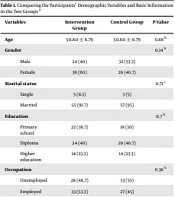
The findings showed that the participants in the intervention and control groups were not significantly different in terms of demographic characteristics such as age, gender, marital status, education, employment status, income, underlying diseases, and ethnicity. However, the mean scores for BMI, duration of disease, and triglyceride levels were different between the two groups before the intervention (Table 1).
Table 1.
Comparing the Participants’ Demographic Variables and Basic Information in the Two Groups a
| Variables | Intervention Group | Control Group | P-Value |
|---|---|---|---|
| Age | 50.60 ± 6.79 | 50.60 ± 6.79 | 0.88 b |
| Gender | 0.14 b | ||
| Male | 24 (40) | 32 (53.3) | |
| Female | 36 (60) | 28 (46.7) | |
| Marital status | 0.71 c | ||
| Single | 5 (8.3) | 3 (5) | |
| Married | 55 (91.7) | 57 (95) | |
| Education | 0.7 b | ||
| Primary school | 22 (36.7) | 18 (30) | |
| Diploma | 24 (40) | 28 (46.7) | |
| Higher education | 14 (23.3) | 14 (23.3) | |
| Occupation | 0.36 b | ||
| Unemployed | 28 (46.7) | 33 (55) | |
| Employed | 33 (53.3) | 27 (45) | |
| Ethnicity | 0.55 b | ||
| Baloch | 30 (65) | 42 (70) | |
| Fars | 21 (35) | 18 (30) | |
| Income (Toman) | 0.33 b | ||
| < 5,000,000 | 43 (71.7) | 38 (63.3) | |
| > 5,000,000 | 17 (28.3) | 22 (36.7) | |
| Underlying disease | 0.68 b | ||
| Heart | 12 (20) | 10 (16.7) | |
| Kidney | 6 (10) | 4 (6.7) | |
| None | |||
| BMI | 27.66 ± 2.26 | 28.60 ± 2.19 | 0.02 d |
| Disease duration | 2.52 ± 0.91 | 2.18 ± 0.83 | 0.03 d |
| Triglyceride level | 190.22 ± 60.35 | 170.32 ± 47.46 | 0.047 d |
a Values are expressed as No. (%) or mean ± SD.
b Chi-square test
c Fisher test
d Independent samples t-test
The data in the study indicated that the medication adherence scores of the patients in the intervention group after the training intervention increased significantly (P = 0.001) However, there was no significant difference in the medication adherence scores of the patients in the control group before and after the intervention (P = 0.051). Furthermore, the results of the independent samples t-test indicated that there was no significant difference in the medication adherence scores of the patients in the control and intervention groups before training with the automatic SMS reminder system (P = 0.052). However, the medication adherence scores of the patients in the intervention group were significantly higher after the training intervention compared to the medication adherence scores of the patients in the control group (P = 0.001) (Table 2).
Table 2.
A Comparison of the Medication Adherence Scores Between the Two Groups Before and After Intervention
| Variables | Medication Adherence Before the Intervention | Medication Adherence After the Intervention | P-Value |
|---|---|---|---|
| Intervention group | 1.95 ± 1.35 | 7.82 ± 0.43 | 0.001 a |
| Control group | 2.42 ± 1.23 | 2.90 ± 1.38 | 0.051 a |
| P-value | 0.052 b | 0.001 b |
a Paired samples t-test
b Independent samples t-test
Following the Shapiro-Wilk test (Statistic = 0.98; P = 0.1) and Levene’s test (F = 1.10; P = 0.08) confirming the assumptions of approximate normality, the equality of variances, and the regression homogeneity, and the lack of significant interaction between the independent and dependent variables, the requirements for using the analysis of covariance (ANCOVA) were met. The results of analysis of covariance (ANCOVA) to control the significant effect of the pre-test scores of three variables of BMI, disease duration, and triglyceride level revealed that the mean score of type 2 diabetes patients’ medication adherence in the two groups was statistically significant after conducting the treatment intervention (P = 0.001) (Table 3).
Table 3.
ANCOVA Results for Medication Adherence After the Training Intervention with Control of the Pre-test Effects
| Source of Changes | Sum of Squares | df | Mean Squares | F | Effect Size | Test Power | P-Value |
|---|---|---|---|---|---|---|---|
| Pre-test | 0.004 | 1 | 0.004 | 0.04 | 0.01 | 0.05 | 0.94 |
| BMI | 8.55 | 1 | 8.55 | 8.72 | 0.07 | 0.83 | 0.004 |
| Disease duration | 2.69 | 1 | 2.69 | 2.74 | 0.02 | 0.37 | 0.1 |
| Triglyceride level | 0.65 | 1 | 0.65 | 0.66 | 0.006 | 0.12 | 0.41 |
| Group | 636.49 | 1 | 636.49 | 649.06 | 0.85 | 1 | 0.001 |
| Error | 111.79 | 144 | 0.98 | ||||
| Total | 4295 | 120 |
5. Discussion
The data in this study indicated there was no significant difference between the medication adherence scores of the patients in the control group before and after the training intervention. However, the medication adherence scores of the patients in the intervention group after the training intervention increased significantly compared to their scores before the intervention, confirming the positive effect of training with the automatic SMS reminder intervention. Accordingly, it can be argued that the automatic SMS reminder system improves medication adherence of patients with type 2 diabetes. The number and content of text messages, ensuring the delivery of text messages, and regular monitoring of the patient's condition provide ample opportunity for patients to learn the skills of adherence to the treatment regimen and improve their active participation. Consistent with the findings of the present study, Estaji et al. examined the effect of training through text messaging via cell phones on the compliance of patients undergoing hemodialysis and the results showed that this training method can be effective in patients’ compliance (25). Although the target group in this study was patients undergoing hemodialysis, their intervention is completely the same as the training intervention conducted in the present study.
Ahmadi et al. examined the effect of short message service reminders on medication adherence in patients with chronic hyperlipidemia, and the results confirmed the effectiveness of the intervention on medication adherence to the treatment regimen in patients with hyperlipidemia (26). These findings were consistent with the results of the present study, in which patients in the intervention group received a daily reminder message for six weeks. A study by Pernell et al. in the United States examined medication adherence with two-way short message service reminders in sickle cell disease and asthma. The results indicated that the patients in the intervention group showed a statistically significant improvement in medication adherence scores. These findings were consistent with the results of the present study. Besides, the two studies were similar in terms of sample size. However, the above study was conducted for one month and the final evaluation was performed immediately (17). The effects of the intervention were measured in all studies immediately after the intervention and the interventions were effective. One of the possible reasons for these consistent findings is that patients welcome distance education and the presentation of the materials needed by patients immediately and without any trouble. However, it has not been explored how long medication adherence would be effective if patients do not receive reminder messages. In their study in Turkey, Güner and Coşansu examined the effect of diabetes education and short message service reminders on metabolic control and disease management in patients with type 2 diabetes mellitus. The results indicated that diabetes education and short message service reminders for six months improved metabolic control and disease management in patients with type 2 diabetes (39), as was confirmed by the present study. The sample size was almost equal to the sample in the present study, but the advantage of this study was that the intervention was conducted for six months and group training was also used at the beginning of the intervention. Khonsari et al. investigated the effect of a reminder system using an automated short message service on medication adherence following acute coronary syndrome and reported that this training method was effective in medication adherence. The results were consistent with the data in the present study but it was performed on a smaller sample of patients (13). Peimani et al. examined the effect of short message service-based intervention (SMS) on self-care in patients with type 2 diabetes. The results showed that sending SMS regularly on special occasions was more effective than sending messages suitable for the patient's conditions. It means that sending a text message would not be effective under any circumstances and was not statistically significant (1). This study was similar to the present study in terms of the sample but a shorter intervention, inadequate follow-up, and lack of need assessment of patients led to different results compared to the findings of the present study. Thus, it is better to consider a comprehensive process for this type of communication with patients.
5.1. Conclusions
The results of this study indicated using an automatic reminder mobile SMS service can improve medication adherence in patients with type 2 diabetes. The findings of this study can further be tested in more extensive studies and with larger samples. This will help to apply the results for more effective education at a lower cost in persuading patients with chronic diseases, including patients with diabetes to comply with medication at the prescribed hours.
5.2. Limitations
Since this study was conducted during the COVID-19 outbreak, there was a decrease in the number of patients referred to the diabetes clinic and the sampling process was performed slowly.
5.3. Ethical Considerations
This article reported the results of a master's thesis in internal surgery nursing, which was conducted with code 10169. The authors would like to appreciate the managers and staff of Zahedan University of Medical Sciences and all the patients who contributed to conducting this research project.