
1. Background
The global prevalence rate of diabetes mellitus (DM) is still less than half a billion cases, but it is estimated to reach 51% worldwide by 2045, and 9.2 million people in Iran by 2030 (1, 2).
This common chronic health condition disrupts the normal life process and can lead to long-term complications, such as neuropathy, retinopathy, nephropathy, and ketoacidosis. In view of this, DM self-management training and support help expand patients’ knowledge and attitudes, consequently preventing adverse side effects (3).
Self-management training programs generally facilitate knowledge and skill development, leading to empowerment in daily life across many psychosocial dimensions, such as medication adherence. These programs require patient participation in daily self-care, thereby increasing their awareness. They also improve patients’ attitudes and ensure better performance, thereby enhancing their ability to prevent disease complications (4).
Notably, empowerment goes beyond simply selecting health-related behaviors. This concept typically reflects the desire to change, enabling individuals to take responsibility for their health and well-being and to participate in promoting health and preventing disease (5). Empowerment is also an intervention or strategy to support behavioral changes that lead to treatment adherence.
Adherence to treatment (AT) has been documented as a key factor in increasing patients’ quality of life and minimizing medical and pharmaceutical spending, which is two to three times higher for patients living with DM than for those without this condition, as the former may not even afford regular doctor visits or hospital referrals (6).
Awodele and Osuolale found that lack of AT could lead to significantly more complications and even death in patients with DM (7). Similarly, patients with type 2 DM (T2DM) have shown poor AT. In a cohort study conducted in Brazil, AT in terms of foot care was reported to be 59%, blood glucose monitoring was 56%, and adherence to dietary and physical activity guidelines was less than 30% (8).
In a review study, concluded that the main issue in treating patients with T2DM was the lack of medication adherence (9).
In this context, self-management training programs for patients with T2DM emphasize AT and active patient participation in daily care routines, as these improve awareness, attitudes, and performance, thereby empowering patients to prevent T2DM-related complications (6). The Diabetes Education Package (DEP) is therefore recommended to cover all aspects of daily life, including healthy eating, regular physical activity, blood glucose monitoring, timely medication intake, and psychological skill development (9). However, delivering all these elements during a short hospital stay in a busy clinical setting appears to be unfeasible.
Implementing self-management training programs for DM has shown that using new technologies increases AT among patients and is even more cost-effective (10). By integrating information about medications and enabling two-way communication, web-based programs are considered an innovative and efficient strategy to improve attitudes, knowledge, self-care, and ultimately AT among patients (11).
The use of web-based services also helps patients gain easy access to educational resources and share their own experiences, in any volume or format and at any time. Therefore, self-management programs for patients with T2DM should be available online, and the use of social media should be promoted to reduce poor AT outcomes and the associated high costs (12).
Technology-based distance education has also been recommended to enhance awareness among patients and their families. In this regard, Yang et al., who recruited 47 patients with T2DM, confirmed that a one-year follow-up using a smartphone improved blood glucose test results, highlighting the crucial role of post-discharge monitoring in such cases (13, 14).
Therefore, considering the importance of web-based education in the follow-up of treatment and self-care for chronic patients, its accessibility at any time and place, the possibility of personalized education, and the need for further studies tailored to the culture and age of patients, the present study was conducted in the city of Bam in southeastern Iran.
2. Objectives
The aim of study was to evaluation the effect of a Web-Based Self-Management planing on Treatment Adherence in Patients with type 2 diabetes in Bam city.
3. Methods
3.1. Study Design
The study was a quasi-experimental research.
3.2. Sample Size
As stated in Amal et al. (2019) (4), the sample size was estimated to be 44 individuals in each group, but it was adjusted to 50 for each group and 100 for both study groups, allowing for sample attrition (significance level 0.05, test power 80%, mean difference in two groups 10, standard deviations in the intervention group 17.5, standard deviation in the control group 15.8).
3.3. Sampling Procedure
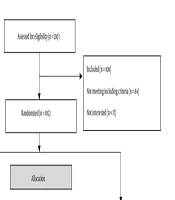
Initially, samples were selected by convenience sampling method based on the inclusion criteria, and then they were randomly assigned to two groups (intervention and control) using a colored cards method. Fifty blue cards were prepared for the intervention group and 50 red cards for the control group.
3.3.1. Inclusion and Exclusion Criteria
Inclusion criteria included filling out a consent form by patients and primary family caregivers to participate, age of 18 years or older, at least six months after T2DM diagnosis by a specialist doctor, literacy, no history of self-management training, access to smartphones and the internet, no cognitive or psychiatric problems, and no use of psychotic drugs. Exclusion criteria included non-regular participation in the training sessions, death, or withdrawal from the study for any reason.
3.4. Study Setting
The study was conducted in Pastor Educational Hospital of Bam city (in the southeast of Iran and east of Kerman province), and the sampling continued from January 2023 to June 2023.
3.5. Data Collection Tool
The data collection tool comprised the Adherence Questionnaire in Patients with Chronic Diseases (AQPCD), developed by Fatemi et al. (15), and a needs assessment checklist. Initially, there were 14 items about demographic characteristics and phone numbers of the patients and caregivers along with information related to the disease. The AQPCD was designed and psychometrically evaluated in 2013, containing 40 items and seven domains, including interest in treatment (9 items), willingness to participate in treatment (7 items), adaptability (7 items), integrating treatment with life (5 items), AT (4 items), commitment regarding treatment (5 items), and hesitation to implement treatment (3 items). The scoring procedure in this questionnaire was based on a six-point Likert-type scale from “completely agree” with 5 points to “not at all” with 0 points. Items no. 33, 34, 35, 37, 38, 39, and 40 were scored in reverse. The maximum and minimum scores could be calculated, with scoring having a positive direction, meaning the added degree of desirability led to higher points; thus, the higher the total score or the score of each domain, the higher the respondent’s AT. The AT rate was interpreted as very good (75 - 100%), good (50 - 74%), moderate (26 - 49%), and poor (0 - 25%) based on the points obtained. To ensure content validity, content validity ratio (CVR) and content validity index (CVI) were calculated. The mean CVI of the questionnaire was 0.914. Its internal consistency was established by calculating Cronbach’s alpha (α = 0.921), and reliability was determined through test-retest with a two-week interval (intraclass correlation [ICC] = 0.92). This questionnaire had been administered in some works (16, 17). Using Cronbach’s alpha in the present study, the reliability of this tool was estimated at 0.89. A needs assessment checklist was also prepared, with an average content validity index of 0.897, and using Cronbach’s alpha in the present study, the reliability of this tool was estimated at 0.913.
3.6. Intervention
The present study was performed in three stages.
3.6.1. First Stage
The researcher identified patients with T2DM who met the inclusion criteria, determined their group with a colored card, explained the research objectives to both groups, and received written consent from them to participate in the study. Data were collected using a demographic characteristics form, the Adherence Modanloo Questionnaire in Patients with Chronic Diseases (AQPCD), a needs assessment tool, and HbA1C level, FBS, completed online in both groups and followed up by phone calls or online, before the intervention, four weeks later, and eight weeks after discharge.
3.6.2. Second Stage
At the time of discharge, both groups received routine care and training, and only the intervention group was given educational videos and booklets about the correct method of insulin injection and its importance. It was explained to the patient and their caregiver that in the next few days, the research team would contact them for training regarding this film and booklet.
3.6.3. Third Stage
The content in the educational videos and booklets, prepared based on analysis of checklists, searching for related resources, and consulting with experts (three assistant professors of the nursing department and one internal specialist), was listed, summarized, and scheduled (Table 1). The educational content was taught two to three days after discharge through an app, with a question and answer session at the end of each session. Patients were followed up by phone calls twice a week for eight weeks. If patients were not available, follow-ups were completed through their caregivers. Each call, either by phone or the app, lasted 15 - 20 minutes. Emphasis was placed on reinforcing the educational content before discharge, identifying patients’ problems and needs, and solving them. During each follow-up session in the intervention group through WhatsApp, the main objectives, progress, and barriers were discussed. Data were collected from each group at the onset of discharge, four weeks later, and eight weeks after discharge, by phone calls and through online questionnaires. To respect ethical principles, the educational booklets and videos were also provided to the control group at the end of the study.
Table 1.
The Educational Content of Every Session in Intervention Group
| Sessions | Content | Duration (min) |
|---|---|---|
| 1 | An overview of dm, its treatments, diagnosis, and complications, patient-related problems and how to manage them, and problem-solving (namely, active participation by patients in discussions, providing some examples, involvement in finding solutions for problems, treatments, and side effects); other cases addressed based on needs assessment outcomes; feedback | 15 - 20 |
| 2 | Importance of self-management and dm consequences in the absence of self-management; barriers to self-management (e.g., no support team, underlying diseases, forgetting to take medications, etc.); teaching self-management skills; patient participation in discussions and finding solutions; other cases raised based on needs assessment outcomes; feedback | 15 - 20 |
| 3 | Learning how to work with glucometers; teaching correct ways to inject insulin; participation in finding solutions to problems; re-recording hba1c level and fasting blood glucose concentration; feedback | 15 - 20 |
3.7. Data Analysis
The data were analyzed using SPSS software version 22. The normality of the data was confirmed via the Kolmogorov-Smirnov (K-S) test. Upon determining the effects of the groups on the outcomes over time and after removing the effect of confounding variables (age, gender, marital status, income, educational attainment, employment status, and smoking habits) in separate groups, repeated measures analysis of variance (ANOVA) and t-tests were used (P < 0.05).
3.8. Ethical Considerations
The study was approved by the ethics committee of Bam University of Medical Sciences (code no. IR.MUBAM.REC.1401.101).
4. Results
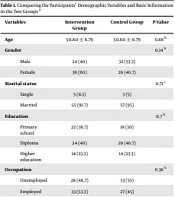
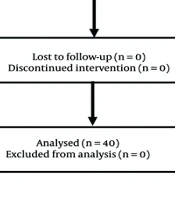
Four patients were excluded from the study due to non-participation in completing the questionnaires, resulting in 96 participants (49 individuals in the intervention group and 47 in the control group). The mean age of participants in the intervention group was 55.4 ± 17.6 years, and in the control group, it was 57.4 ± 14.6 years. The results of the t-test and χ² test showed that demographic characteristics were not statistically significant between the two groups before the intervention, except for the job variable, indicating that the control and intervention groups were homogeneous (P > 0.05).
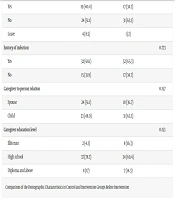
In the intervention group, 26 (53.1%) were female and 23 (46.9%) were male, while in the control group, 20 (42.6%) were female and 27 (57.4%) were male. More than half of the participants were married, with average income and no addiction in both groups. Most participants and caregivers in the intervention group had a high school level of education, with 27 (55.1%) of participants and 34 (69.4%) of caregivers. In the control group, 30 (63.8%) of participants and 37 (78.7%) of caregivers had a high school level of education. Most participants in both groups were housewives, with 34 (69.4%) in the intervention group and 18 (38.3%) in the control group. In the intervention group, most participants were cared for by their children, 31 (63.3%), while in the control group, they were cared for by their spouses, 24 (51.1%) (Table 2).
Table 2.
Comparison of the Demographic Characteristics in Control and Intervention Groups Before Intervention
| Variables | Control Group | Intervention Group | P-Value |
|---|---|---|---|
| Gender | 0.1 | ||
| Male | 27 (57.4) | 23 (46.9) | |
| Female | 20 (42.6) | 26 (53.1) | |
| Marital status | 0.682 | ||
| Single | 3 (6.4) | 5 (10.2) | |
| Married | 35 (74.5) | 37 (75.5) | |
| Divorced/widow | 9 (19.1) | 7 (14.3) | |
| Level of Education | 0.677 | ||
| Illiterate | 12 (25.5) | 16 (32.7) | |
| High school | 30 (63.8) | 27 (55.1) | |
| Diploma and above | 5 (10.6) | 6 (12.2) | |
| Income | 0.104 | ||
| Well | 8 (17) | 2 (4.1) | |
| Average | 29 (61.7) | 37 (75.5) | |
| Weak | 10 (21.3) | 10 (20.4) | |
| Job | 0.006 | ||
| Housewife | 18 (38.3) | 34 (69.4) | |
| Employee | 11 (23.4) | 2 (4.1) | |
| Free | 9 (19.1) | 5 (10.2) | |
| Retired | 9 (19.1) | 8 (16.3) | |
| Addiction | 0.251 | ||
| Yes | 19 (40.4) | 17 (34.7) | |
| No | 24 (51.1) | 31 (63.3) | |
| Leave | 4 (8.5) | 1 (2) | |
| History of infection | 0.773 | ||
| Yes | 32 (68.1) | 32 (65.3) | |
| No | 15 (31.9) | 17 (34.7) | |
| Caregiver to-person relation | 0.157 | ||
| Spouse | 24 (51.1) | 18 (36.7) | |
| Child | 23 (48.9) | 31 (63.3) | |
| Caregiver education level | 0.153 | ||
| Illiterate | 2 (4.3) | 8 (16.3) | |
| High school | 37 (78.7) | 34 (69.4) | |
| Diploma and above | 8 (17) | 7 (14.3) |
As illustrated in Table 3, the mean ± standard deviation (M ± SD) values of the AQPCD domains in the intervention and control groups were measured before and after the training program and were then compared using paired- and independent-samples t-tests. The results of the paired-samples t-test revealed a statistically significant difference in the mean scores in the domains of effort to treatment (P < 0.001), tendency to participate in treatment (P < 0.001), adaptability (P < 0.001), integrating treatment with life (P < 0.001), adherence to treatment (P < 0.002), commitment regarding treatment (P < 0.001), and hesitation to implement treatment (P < 0.001) in both intervention and control groups, before and after the training program. In this respect, adherence to treatment in all domains in the intervention group showed an upward trend over time, with the highest score occurring eight weeks after the completion of the web-based self-management training program. Therefore, the training program was effective in patients living with T2DM in all adherence to treatment domains (Table 3).
Table 3.
Comparison of Adherence to Treatment Index Domains in the Control and Intervention Groups Before and After the Intervention
| Domains | Control | Intervention | Total | P-Value |
|---|---|---|---|---|
| Effort to treatment | > 0.001 | |||
| Before training | 6.83 ± 23.31 | 8.25 ± 26.63 | 7.73 ± 25.01 | |
| After training | 6.84 ± 18.61 | 4.34 ± 33.77 | 9.50 ± 26.35 | |
| Tendency to participate in treatment | > 0.001 | |||
| Before training | 5.15 ± 17.04 | 6.42 ± 19.71 | 5.95 ± 18.40 | |
| After training | 7.33 ± 14.72 | 4.70 ± 28.81 | 9.34 ± 21.91 | |
| Adaptability | > 0.001 | |||
| Before training | 5.24 ± 16.93 | 6.73 ± 19.18 | 6.12 ± 18.08 | |
| After training | 6.84 ± 15.36 | 4.54 ± 28.73 | 8.84 ± 22.18 | |
| Integrating treatment with life | > 0.001 | |||
| Before training | 3.93 ± 11.65 | 5.28 ± 13.59 | 4.74 ± 12.64 | |
| After training | 5.26 ± 10.61 | 3.73 ± 20.28 | 6.63 ± 15.55 | |
| Adherence to treatment | 0.002 | |||
| Before training | 3.49 ± 9.93 | 4.89 ± 11.85 | 4.35 ± 10.91 | |
| After training | 3.63 ± 8.53 | 3.50 ± 16.16 | 5.22 ± 12.42 | |
| Commitment to treatment | > 0.001 | |||
| Before training | 4.38 ± 11.29 | 3.33 ± 11.89 | 3.87 ± 11.60 | |
| After training | 5.75 ± 10.78 | 3.89 ± 18.95 | 6.37 ± 14.95 | |
| Hesitation in the implementation of treatment | > 0.001 | |||
| Before training | 3.91 ± 6.93 | 3.49 ± 7.87 | 3.71 ± 7.41 | |
| After training | 4.68 ± 7.08 | 3.16 ± 12.36 | 4.76 ± 9.78 | |
| Total score | > 0.001 | |||
| Before training | 20.65 ± 97.12 | 22.25 ± 110.75 | 22.44 ± 104.08 | |
| After training | 34.19 ± 85.72 | 22.37 ± 159.10 | 46.67 ± 123.17 |
5. Discussion
This study was to investigate the effect of a web-based self-management training program on AT in patients with T2DM, admitted to a teaching hospital affiliated with Bam University of Medical Sciences, Bam, Kerman Province, Iran. The study findings established that the training program improved AT in these patients.
The study results were consistent with those in Lyu et al., examining the effect of web-based programs on blood glucose control in patients living with T2DM, two to three months after discharge, and demonstrating improvement in self-management skills (12), and those in Naderi and Naderyanfar in Iran, in which the implementation of video-based educational methods had boosted self-care behaviors in patients with T2DM (18).
In another study, web-based training had led to developments in knowledge and health-related behaviors in patients suffering from T2DM, so this type of training could be practical for managing chronic diseases, especially DM, due to the ease of access and easier use of phones (19).
The self-management scores in the AQPCD domains (namely, interest in treatment, willingness to participate in treatment, adaptability, integrating treatment with life, AT, commitment regarding treatment, and hesitation to implement treatment) significantly increased after the training program in this study. Awodele and Osuolale had similarly shown that training and counseling in patients with T2DM had led to improvement in AT in 86.8% of the cases (7).
In this regard, the results of a similar study had established that web-based training could elevate self-efficacy and AT (12). As individuals with T2DM are at risk of serious complications, web-based healthcare services, which require no physical presence of patients and nurses, could thus be a promising and effective intervention at any time and place to improve blood glucose and prevent the side effects of DM as a chronic condition.
Insufficient AT could also exacerbate complications and comorbidities in patients with T2DM, which could be prevented by self-management in terms of diet, timely use of medications, and physical activity, thereby reducing the use of healthcare services and minimizing costs (20).
While AT using web-based services together with the participation of patients and their families could play an important role in lowering DM complications and costs (12), 85% of the patients in the present study stated that using the web-based training program helped them find answers to their daily questions about the disease and prevented them from visiting doctors and referring to hospitals more often.
Although no significant correlation was found between the study variables and AT in the present study, age, educational attainment, income, addiction, main caregiver, and age contributed to AT among patients living with T2DM, similar to the outcomes reported in Abebe et al. (21) and Awodele and Osuolale (7). However, age had not been associated with no AT in a study in Ethiopia (21). It seemed that aging could affect the ability to perform daily activities, remember the time of taking medications, and then decrease AT.
In the present study, AT and duration of the disease augmented with the rise in educational attainment due to the higher levels of awareness and enhanced attitudes in individuals with a higher level of education.
Besides, AT was higher in men with T2DM. Since most women recruited in this study were housewives, this could be explained by the ability to pay for medications due to having a job and financial independence. The results in Awodele and Osuolale had further shown that 51.32% of women with T2DM had been unemployed or had low-income jobs, so they could not afford their medications (7). On the other hand, most patients suffering from T2DM in the present study had moderate income, so healthcare managers, financial providers, and charitable organizations are required to dedicate more attention to reducing high treatment costs in this regard.
5.1. Conclusions
The study findings demonstrated that web-based self-management training improved AT in patients living with T2DM. Since 8.7% of the Iranian population over the age of 4 had DM and the internet penetration in Iran was about 72.8% according to the statistics released in 2017 (22), web-based training programs could make it possible to provide effective large-scale interventions in the Iranian population, especially in relation to chronic diseases that are costly and impose heavy burdens on patients and their families. Notably, this efficient and effective method was available and up to date.
5.2. Limitations
The participants selected here were from those admitted to a teaching hospital in Bam city, so they could not represent the entire Iranian population. Therefore, some related issues and challenges were not investigated in this study.
Due to restricted internet access and speed, it was difficult to communicate, especially for older adults or companions.
Although a significant difference was not found between the demographic variables in the present study, such variables might have a direct effect on AT in many patients, which calls for further research with a larger sample size.
Considering the possibility of the effect of comorbidities on AT in patients with DM, it is vital to conduct more studies in this respect.
The participants were selected by consensus sampling. Because this method lacks randomization, bias may occur; therefore, the researcher tried to control it with mixed sampling methods, including randomization in the next stage, selecting diverse samples from different patients, appropriately designing questions, and analyzing data accurately using the opinions of relevant experts.