
1. Background
Cardiovascular disease (CVD) is the leading cause of death and a major contributor to disability worldwide (1). About 17.9 million people in the world died due to this disease in 2019, and 85% of these deaths were due to heart attacks and strokes (2).
Coronary artery disease (CAD) is one of the most serious diseases causing 7.4 million deaths worldwide every year (3, 4). In Iran, about 50% of deaths are reported annually due to CAD (5). CAD refers to a set of diseases related to the heart and circulatory system, including angina, heart failure, and heart attack (6), whose clinical symptoms are mostly caused by atherosclerosis which is a common cause of arterial diseases in coronary arteries (7). Atherosclerosis is an inflammatory response that begins with the accumulation of lipoprotein particles in the inner layer of the artery wall, followed by an inflammatory response and the damage to the vascular endothelium and an increase in oxidized LDL. Macrophages then release cytokines along with oxidized LDL to form a sponge cell and cause platelets to accumulate in that area and create clots. Then, the proliferation of the smooth cells of the vessel wall forms fibrous tissue around the fatty tissue and creates a dense tissue called atheroma or plaque, leading to narrowing and blockage of the blood flow in the artery (8).
Studies have shown that the measures taken to control and reduce risk factors are more effective than treatment in reducing CVD (9). The most important principle in disease management is acceptance, participation, and understanding of the patient to follow self-care behaviors, as ineffective self-care leads to poor health outcomes and lower quality of life (10). A correct illness perception can realistically lead to the recognition of the signs, symptoms, and aspects of the disease by the person, inducing the belief that the disease can be treated and controlled (11).
Illness perception is an organized body of knowledge or belief that patients have about their disease. A person who has a positive perception of their disease can realistically understand the symptoms and various aspects of the disease, and this perception can affect their health-promoting and adaptive behaviors through which the patient can manage the disease (12). On the other hand, a wrong illness perception can also lead to a weaker adherence to self-care behaviors because the patient with a correct illness perception is more likely to take more effective steps and is more motivated to prevent the occurrence and aggravation of disease symptoms (13).
Some studies have reported self-efficacy as a factor effective in improving self-care and modulating the risk of CAD (14). According to the literature, various factors such as attitudes, personal beliefs, self-confidence, social norms, and self-efficacy are predictors of self-care behaviors in patients, of which self-efficacy is the most important determining factor (15). According to Bandura, self-efficacy is a person’s belief in their ability to achieve a specific goal. In other words, the more a person feels confident about achieving a goal, the more likely they are to achieve that goal (16). Self-efficacy assessment is also considered an essential part of the care program for cardiac patients. Various studies have shown that higher levels of self-efficacy can improve cardiovascular risk factors, regulate drug regimens, and prevent readmission of CAD patients (17). Studies conducted on cardiac patients have reported self-efficacy as a predictor of cardiac recovery management, social, psychological, and physical performance, and a vital factor in accepting treatment and performing activities in cardiac patients (18).
Effective training of patients requires the use of training methods that have been proven effective. Accordingly, the teach-back method is one of the most successful methods based on the evidence from patient education. This educational method is a comprehensive, multi-faceted, and evidence-based strategy used to improve understanding and retain information; it is also one of the interactive methods of education in which the learner must reach a level of mastery and ability so that they can gain the skill and art of using what has been learned (19). In this method, the trainer teaches the materials in a simple and understandable language to the client without using specific medical terms. At the end of the training program, the client is asked to narrate the materials in their own words. If the client does not understand the material well, the trainer repeats the material until the client understands it perfectly. This process allows the nurse to evaluate the patient’s understanding of the instructed materials and whether the presented information is correct or incorrect (20).
Several studies have addressed the effectiveness of the teach-back method. For instance, White et al. showed that teach-back method helped patients learn self-care information (21). Besides, Brown et al. showed that the teach-back method can help patients retain self-care information and reinforce discharge instructions (22). Dalir et al. and Oshvandi et al. reported that the teach-back method can improve self-care behaviors in heart failure and diabetic patients (23, 24).
CAD is a chronic disease, and training programs are essential to ensure the understanding, recall, and retention of educational information and the use of self-care behaviors, which subsequently improve the self-efficacy of disease management in patients.
2. Objectives
The present study aimed to examine the effect of the teach-back method on illness perception and self-efficacy of patients with CAD hospitalized in the coronary care units (CCUs) of teaching hospitals affiliated to Zahedan University of Medical Sciences in southeast Iran in 2021.
3. Methods
The ethics committee of Zahedan University of Medical Sciences (IR.ZAUMS.REC.1400.050) approved the study protocol. Also, informed consent was obtained from all patients prior to the study.
This quasi-experimental study included 100 CAD patients hospitalized in the CCUs and post-CCUs. Using simple randomization method, the patients were assigned into two groups of intervention and control. Following a similar study Faraji et al. (25), the sample size was estimated as 46 persons per group using the following formula with a 95% confidence level and 85% statistical test power. Considering the possibility of the participants’ dropout, the sample size for each group was considered as 50 persons (100 persons in total):
Z (1-α/2) = 1.96 (at a 95% confidence interval); Z (1-β) = 1.03 (with an 85% test power); S1 = 1, S2 = 7.75,
The inclusion criteria were a definite diagnosis of CAD without myocardial infarction, aged 18 - 70 years, ejection fraction of higher than 40% (EF > 40%), the ability to speak and understand Persian, having minimum literacy, ability to communicate, non-attendance in similar face-to-face training programs, and the absence of mental disorders and severe chronic diseases (thyroid, cancer, obstructive lung disease, asthma and liver, and kidney damage). The exclusion criteria were the occurrence of any emergency for the patient, unwillingness to continue participation in the study, impossibility of communicating by phone, the patient’s failure to attend the training sessions, early discharge, non-participation in more than one training session, and the death of the patient.
The data in this study were collected using a demographic information form (age, gender, marital status, employment, education, place of residence, economic status, living conditions, and the disease-related variables, including the duration of the disease, underlying disease, and hospitalization history), the Brief Illness Perception Questionnaire (Brief IPQ), and the Cardiovascular Management Self-efficacy Scale (CMSES).
The Brief IPQ is a 9-item tool developed by Weinman et al. (1996) cited in Broadbent et al. to assess illness perception. The eight items (one open question is not included in the scoring) are ranked using a scale of 0 to 10. Items 3, 4, and 7 are reverse scored. A respondent’s total score ranges from 0 to 80. The Cronbach’s alpha value for the questionnaire was reported to be 0.80 and its test-retest reliability coefficient was reported from 0.42 to 0.75 (26). In the present study, the reliability of the tool was calculated as 0.75 using Cronbach’s alpha coefficient.
The CMSES was developed by Steca et al. (2015) cited in Jafari Sejzi et al. in Italy. The scale contains nine items that assess a person’s confidence in their self-efficacy in disease management using a 5-point Likert scale, ranging from 0 (not at all confident) to 4 (completely confident). Higher scores show a better cardiovascular management self-efficacy. The scale has three dimensions: self-efficacy in cardiac risk factors, which consists of four items that assess patients' beliefs about their ability to faithfully follow a set of restrictions for smoking, diet, physical activity, and avoiding stressful situations; self-efficacy in following treatment, which consists of strong beliefs from two items showing patients' beliefs about their ability to remember to take medication correctly; and self-efficacy in diagnosing symptoms that evaluates patients' beliefs about the ability to recognize signs and symptoms of worsening disease. The total score ranges from 9 to 45. The reliability and validity of the Persian version of the scale were confirmed for use in the Iranian community, and its validity and reliability were assessed, and its psychometric properties were confirmed (80%) using Cronbach’s alpha coefficient (27). The reliability of the instrument was assessed in this study, and its Cronbach’s alpha was reported to be 0.81.
After obtaining the ethical code, the researcher went to the heart departments of Zahedan teaching hospitals, presented the objectives of the study, and completed the three questionnaires (demographic, Brief IPQ, and the CMSES) for each patient by interviewing method. The teach-back method was carried out individually in three sessions over three days for the patients in the intervention group (Table 1). The first training session was conducted at the patient’s bedside one day after hospitalization upon the stability of the patient’s condition. Each training session lasted for 30-45 minutes based on the patient’s tolerance and learning rate. A total of six patients were discharged before the completion of the intervention sessions. Thus, the third training session was held at the patient’s home upon prior arrangements. During the training session, the patient was asked to repeat the instructed concept or topic in their own words. If the patient did not understand the instructed material, the material was instructed again to them. Then, at the end of the third training session, an education pamphlet prepared based on the content of the training sessions was given to the patients in the intervention group. The patients in the control group received only routine training in the CCUs. On the day of discharge, the patients of this group were also given the same educational booklet as the intervention group. One month after the intervention, the patients in both groups were asked to attend the hospital and complete the questionnaires.
Table 1.
The Content of the Training Program
| Session | Focus | Content | Duration (min) |
|---|---|---|---|
| 1 | Illness perception | Getting familiar with the patient; establishing rapport with the patients and creating a reassuring environment; explaining the training sessions; making arrangements for subsequent sessions; defining the disease, its nature, symptoms, risk factors, duration of the disease, the disease outcomes, effective treatments and controlling measures; changing the patient’s misconceptions about the disease; asking the patient to reproduce the instructed materials; and resolving any problem faced by the patient. | 30 - 45 |
| 2 | Self-efficacy | Reviewing the instructed materials; discussing the patient’s diet and medication; the significance of not smoking; stress control; sexual health; asking the patient to reproduce the instructed materials; and resolving any problem faced by the patient. | 30 - 45 |
| 3 | Overview | Reviewing the instructed materials; highlighting important issues; asking the patient’s opinions about the impact of the instructed materials; giving an educational pamphlet to the patient; asking the patient to reproduce the instructed materials; and resolving any problem faced by the patient. | 30 - 45 |
The Shapiro-Wilk test was used to assess the normal distribution of the data. The collected data were analyzed in the statistical package for the social sciences (SPSS v.22) software using the independent samples t-test, paired samples t-test, chi-square test, Fisher’s exact test, regression test, and analysis of covariance (ANCOVA) at a significant level of P < 0.05.
To improve the quality of implementing the feedback-based teaching method, special attention was paid to points such as the quality of the patients' memory, the patient's understanding of the various issues of the disease and its treatment, and the discovery of the patient's personality in terms of shyness. In the first training session, during the introduction, we assessed the quality of the patient's memory. Understanding the concepts related to the disease through open dialogue was considered in the interviews. By creating intimate and informal interviews, efforts were made to effectively reduce the patient's embarrassment in accepting the training and retelling these trainings without fear of the researcher. Also, at the end of each training session, the important and basic content was repeated, and the possible problems of the patients were resolved. This was emphasized with the principles of the feedback-oriented teaching method.
4. Results
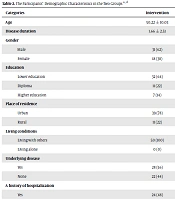
Analysis of the participants’ demographic characteristics indicated that the two groups did not have any significant difference in terms of gender, education, place of residence, living conditions, underlying diseases, history of hospitalization, and the duration of the disease (P > 0.05). However, the two groups were significantly different in terms of age, marital status, employment, and economic status (Table 2). To obtain the most important influencing variables, all the variables were analyzed by the regression linear test. The results showed that the economic variable had a significant effect (P = 0.023) on efficiency and could predict it. Other variables had no effect on self-efficacy and illness perception based on the general linear model test (Table 3).
Table 2.
The Participants’ Demographic Characteristics in the Two Groups a
| Categories | Intervention | Control | P-Value |
|---|---|---|---|
| Age | 50.22 ± 10.03 | 56.58 ± 9.36 | 0.001 b |
| Disease duration | 1.66 ± 2.51 | 1.64 ± 2.14 | 0.96 b |
| Gender | 0.31 c | ||
| Male | 31 (62) | 26 (52) | |
| Female | 18 (38) | 24 (48) | |
| Education | 0.17 c | ||
| Lower education | 32 (64) | 40 (80) | |
| Diploma | 11 (22) | 5 (10) | |
| Higher education | 7 (14) | 5 (10) | |
| Place of residence | 0.18 c | ||
| Urban | 39 (78) | 33 (66) | |
| Rural | 11 (22) | 17 (34) | |
| Living conditions | 0.31 c | ||
| Living with others | 50 (100) | 49 (98) | |
| Living alone | 0 (0) | 1 (2) | |
| Underlying disease | 0.30 c | ||
| Yes | 28 (56) | 33 (66) | |
| None | 22 (44) | 17 (34) | |
| A history of hospitalization | 0.84 c | ||
| Yes | 24 (48) | 25 (50) | |
| None | 26 (52) | 25 (50) | |
| Marital status | 0.01d | ||
| Married | 49 (98) | 42 (84) | |
| Single | 1 (2) | 8 (16) | |
| Occupation | 0.001 c | ||
| Employed | 22 (44) | 5 (10) | |
| Unemployed | 28 (56) | 45 (90) | |
| Income level | 0.008 c | ||
| Adequate | 42 (84) | 30 (60) | |
| Inadequate | 8 (16) | 20 (40) |
a Values are expressed as mean ± SD or No. (%).
b Independent samples t-test.
c Chi-square.
d Exact Fisher’s test.
Table 3.
Results of Regression Analysis for the Prediction of Demographic Variables on Perception of Illness & Self-efficacy
| Predict and Dependent Variables | B | SE | Beta | t | P |
|---|---|---|---|---|---|
| Constant variable | |||||
| Self-efficacy | 39.360 | 4.245 | - | 9.272 | < 0.001 |
| Illness perception | 58.709 | 9.699 | - | 6.053 | < 0.001 |
| Marital status | |||||
| Self-efficacy | 0.642 | 1.637 | 0.040 | 0.392 | 0.696 |
| Illness perception | -1.190 | 3.739 | -0.034 | -0.318 | 0.751 |
| Occupation | |||||
| Self-efficacy | -1.115 | 1.032 | -0.108 | -1.080 | 0.283 |
| Illness perception | 2.139 | 2.358 | 0.094 | 0.907 | 0.367 |
| Income level | |||||
| Self-efficacy | -2.397 | 1.041 | -0.236 | -2.303 | 0.023 |
| Illness perception | -3.278 | 2.378 | -0.146 | -1.379 | 0.171 |
| Self-efficacy | ADJ.R2 = 0.056, R2 = 0.085, R = 0.29 | ||||
| Illness perception | ADJ.R2 = -0.006, R2 = 0.025, R = 0.158 | ||||
The mean scores of illness perception in the intervention and control groups before the intervention were 51.02 ± 10.58 and 52.52 ± 11.50, respectively, indicating no significant intergroup difference (P = 0.49). The corresponding values for the two groups one month after the teach-back training intervention were 59.00 ± 07.80 and 52.88 ± 11.32, respectively, showing a statistically significant difference between the two groups (P = 0.002).
The results of the paired samples t-test indicated a significant improvement in illness perception scores of the participants in the intervention group after the intervention (P < 0.05) (Table 4).
Table 4.
Comparison of the Illness Perception Scores in the Two Groups Before and After the Intervention
| Groups | Pre-intervention | One Month After the Intervention | Paired Samples t-Test |
|---|---|---|---|
| Intervention | 51.02 ± 10.58 | 59.00 ± 70.80 | P = 0.001 |
| Control | 52.52 ± 11.50 | 52.88 ± 11.32 | P = 0.74 |
| Independent samples t-test | P = 0.49 | P = 0.002 |
The results of ANCOVA by controlling the effect of the pre-test showed that the mean scores of illness perception (P < 0.001) in patients with CAD in two groups were significantly different after one month of the intervention (Table 5). The mean scores of self-efficacy for the patients in the intervention and control groups before the intervention were 34.34 ± 2.25 and 31.94 ± 3.68, respectively, showing a significant intergroup difference (P = 0.001). The corresponding values for the two groups one month after the teach-back training intervention were 37.26 ± 4.17 and 33.92 ± 4.40, respectively.
Table 5.
The Results of ANCOVA for Illness Perception in the Two Groups Before and After the Intervention
| Source of Changes | Sum of Squares | df | Mean Squares | F | Sig. | Power |
|---|---|---|---|---|---|---|
| Pre-test | 4302.86 | 1 | 4302.86 | 83.97 | P < 0.001 | 1 |
| Group | 1227.270 | 1 | 1227.270 | 23.97 | P < 0.001 | 0.99 |
| Error level | 4970.412 | 97 | 51.24 | |||
| Total | 323138 | 99 |
The results of the paired samples t-test indicated a significant improvement in self-efficacy scores of the participants in the control and intervention groups before and after the intervention (P < 0.001) (Table 6).
Table 6.
Comparison of the Self-efficacy Scores in the Two Groups Before and After the Intervention
| Groups | Pre-intervention | One Month After the Intervention | Paired Samples t-Test |
|---|---|---|---|
| Intervention group | 34.34 ± 05.25 | 37.26 ± 04.17 | P = 0.001 |
| Control group | 31.94 ± 03.98 | 33.93 ± 04.40 | P = 0.001 |
| Independent samples t-test | P = 0.01 | P = 0.001 |
The results of ANCOVA by controlling the effect of the pre-test showed that the mean scores of self-efficacy in the two groups were significantly different after one month of the intervention (P = 0.007) (Table 7).
Table 7.
The Results of ANCOVA for Self-efficacy in the Two Groups Before and After the Intervention
| Source of Changes | Sum of Squares | df | Mean Squares | F | Sig. | Power |
|---|---|---|---|---|---|---|
| Pre-test | 777.63 | 1 | 777.63 | 73.40 | P < 0.001 | 1 |
| Group | 79.94 | 1 | 79.94 | 7.54 | P < 0.001 | 0.77 |
| Error level | 1027.66 | 97 | 10.59 | |||
| Total | 128749 | 100 |
5. Discussion
This study examined the effect of teach-back training on illness perception, and self-efficacy in patients with CAD admitted to the CCUs of the hospitals affiliated to Zahedan University of Medical Sciences in 2021. The results showed that teach-back training improved illness perception and self-efficacy in patients with CAD.
In line with the results of the current study, Yazdanparast et al. examined the impact of using the teach-back learning strategy on illness perception, nutritional knowledge, and dietary adherence in people with hypertension. The patients were trained individually for four days using the teach-back method. The illness perception scores increased significantly after 30 days of teach-back training (28), probably due to an increase in the knowledge of the patients in the intervention group, as in the teach-back method the learning process continues until the patient understands the instructed materials. Besides, the patients acquired more information about the disease, and thus were encouraged to engage in self-care behaviors. Furthermore, Pistoria et al. examined the effect of the teach-back method on reducing the readmission of patients with heart failure and showed that the teach-back method can positively affect the patients’ understanding of their disease process, confirming the potential and positive effects of this training method in people with heart failure (29). Slater et al. investigated the impact of the teach-back method on improving patient recall of discharge instructions in the emergency department, and the results confirmed that the teach-back method can improve the understanding of the contents and the recall of discharge information in patients regardless of age and education (20). In their study, the data was collected again after one week of the intervention. So, the post-test period was shorter than our study (one month). Nevertheless, all the mentioned studies confirmed the effectiveness of the teach-back method in improving the patient’s knowledge, self-awareness, and illness perception, and reducing the chance of readmissions and treatment costs.
Consistent with the present study, Zakerimoghadam et al. showed that the training program improved the patients’ self-care behavior (30). Although the research sample was different from the sample in the present study, its training intervention method was consistent with the teach-back method to provide individual and face-to-face training during three consecutive sessions. In the mentioned study, weekly counseling sessions were held for eight weeks after the intervention. However, the present study was carried out without any telephone follow-up intervention to examine the role of the teach-back method alone in shaping the patient’s perceptions and patient adaptation. In another study, Faraji et al. investigated the effect of pre-discharge education and telephone follow-up on illness perception and lifestyle in patients with myocardial infarction and found that pre-discharge education and telephone follow-up can improve illness perception in myocardial infarction patients (25). The instructions were presented to patients in a single session that lasted 60 minutes, but the phone follow-up conducted two months after discharge improved illness perception in the patients. Thus, the phone follow-up intervention was as effective as the teach-back method used in the present study.
Several studies have examined the effectiveness of educational interventions in improving self-efficacy in patients. Parallel to the present study, Farahaninia et al. examined the impact of the teach-back method on self-efficacy in patients with type 2 diabetes and reported that this educational method can significantly increase self-efficacy in diabetic patients. The research sample in this study was different from the sample in the present study, and four training sessions were held for the patients in the intervention group. However, the results demonstrated the effect of the teach-back method on improving self-efficacy in patients with chronic disease (31). Moreover, Hosaini Zare et al. compared the effect of teach-back training with video training on self-care and self-efficacy of diabetic patients and reported that the teach-back was more effective in improving patients’ self-efficacy than video training (32). The research sample in this study was different from the sample in the present study and the researchers compared the teach-back training group and the video training group with the control group. However, the teaching method was very similar to the method used in the present study, and the results demonstrated its effectiveness in improving the sense of self-efficacy in patients. In addition, Sol et al. studied the effect of a self-management intervention in reducing vascular risk factors in patients with manifestations of vascular diseases; the results indicated that nursing interventions reduced the number of cardiovascular patients who smoked and had high blood lipids (33).
In their study on heart failure patients, Bagheri-Saweh et al. showed that the higher the level of self-efficacy of the patients, the greater the control of heart failure among them (34). Peyman et al. explored factors related to self-care and self-efficacy in heart failure patients. They reported a positive and significant correlation between self-efficacy and self-care in patients (35) because one of the most important predictors of behavior is perceived self-efficacy. The results showed a statistically significant difference between the two groups in the pre-test stage as about half of the patients in both groups had a history of previous hospitalization, which could improve their knowledge of the disease and help them learn instructions on self-efficacy in disease management and self-care. Furthermore, due to their previous hospitalizations, the patients had received training related to self-care promotion from the medical staff, as well as other sources such as the internet. Moreover, the follow-up instructions led to the improvement of self-efficacy in disease management.
Accordingly, it can be argued that nursing interventions instructed to chronic patients such as cardiovascular patients to improve self-efficacy could motivate patients to engage in disease management and improve self-care in heart patients through health behaviors. Moreover, the evidence has shown that teach-back training is one of the most successful teaching methods. It can reveal the hidden angles of disease sensitivities, induce a complete understanding of risk factors for the disease, and increase the sense of self-efficacy. It also helps patients take medications on time, comply with the treatment, learn the long-term complications of chronic CAD, and accept the necessary preparations for aggressive treatment procedures without wasting time. So, the patients in the present study gained a higher illness perception after the training intervention and were more motivated to engage in self-efficacy behaviors in line with treatment goals.
One of the limitations of this study was that the patients in both control and intervention groups had access to information from other information sources (caregivers and media) other than the instructions provided by the researcher. As another limitation, the effectiveness of the teach-back method was not compared with other conventional training methods. Thus, future studies need to evaluate other teaching methods on patients with CAD and compare them with the teach-back method.
5.1. Conclusions
The data in the present study showed that the teach-back method increased illness perception and self-efficacy in patients with CAD. Since the teach-back method can be applied to help patients effectively learn the essential information about CAD, this educational method by nursing team can improve patients’ illness perception and self-efficacy.