
1. Background
Ventilator-associated pneumonia (VAP) is a type of hospital-acquired infection and a common and serious problem whose early diagnosis and treatment can save patients’ lives (1). Patients treated with ventilators fail to discharge lung secretions. Thus, due to the retention of secretions, there is a possibility of improper ventilation, atelectasis, and VAP in these patients (1, 2). Ventilator-associated pneumonia usually occurs 48 to 72 hours after the start of mechanical ventilation (3); hence, for each day of mechanical ventilation in the first to third weeks, this risk increases by 1 - 3% (2). Ventilator-associated pneumonia is the most common hospital infection in ICUs and the second most common hospital infection after administrative tract infection (1). In Europe, 5 - 40% of patients under mechanical ventilation for more than two days suffer from VAP (4). In Iran, this rate is 46% (5).
The Infectious Diseases Society of America (IDSA) and the American Thoracic Society (ATS), as cited in Wu et al.’s study, reported the mortality rate of VAP to be 13%, while a prospective study in Europe reported that the mortality rate of this pneumonia was 29.2%, up to 96 hours, 19.2% after starting mechanical ventilation, and 31.4% after 96 hours after starting mechanical ventilation for the average length of hospital stay of 30 days (6). Ventilator-associated pneumonia increases the duration of ventilation and harder isolation, the average length of stay, and medical costs (1). Previous studies have reported that the use of preventive methods reduces the rate of infection and the number of days under mechanical ventilation so that the rate of VAP decreases from 6.8% to 2%, and the average length of stay decreases from 36 days to 27 days (7). Several guidelines are available to prevent this type of pneumonia, all of which emphasize promoting the quality of care provided by all medical staff. Measures such as proper oral care, raising the head of the patient’s bed after feeding with a gastrostomy tube, and reducing ETT cuff pressure and tracheal suction can also prevent VAP (2, 7).
Tracheal suction is one of the most common methods in removing secretions to clear the airway and prevent VAP (2, 8). The main problem during tracheal tube suction is the blockage of the tube by secretions in the form of biofilm. Many antibiotic and non-antibiotic treatment methods are introduced to remove this type of blockage (9). One of the conventional and traditional methods to dilute thick secretions is using normal saline inside the tracheal tube (10). In their systematic study by Pinto et al., nurses believed that normal saline diluted the secretions, facilitated the insertion of the catheter into the tracheal tube, stimulated the cough reflex and discharge of secretions, and increased oxygenation (11). The findings of a study showed that the pneumonia rate was significantly higher in patients using normal saline to suction secretions (12). Some studies have indicated that using normal saline during tracheal suction causes hypoxia, high blood pressure, bronchospasm, and the displacement of bacterial colonies and their movement to the lower airways, thereby aggravating hospital-acquired pneumonia (13).
Another method to facilitate the discharge of secretions during suction is to use mucolytic drugs, including N-acetylcysteine (NAC) (9). N-acetylcysteine exerts its anti-mucosal effect by breaking down the disulfide bonds in mucus and reducing the viscosity of bronchial secretions. It also inhibits the formation of biofilms and reduces the incidence of VAP. N-acetylcysteine also affects biofilms produced by bacteria in laboratory environments (14). A study showed that mucolytics reduces lung secretions’ concentration and stickiness of lung secretions, increases the discharge of lung secretions, reduces bacterial accumulation, improves lung function, and ultimately preserves life. However, no significant difference is observed regarding the effects of normal saline and NAC (15). Another study reported that normal saline in suction is associated with severe complications, and that NAC is preferable in draining secretions (16). Sharafkhah et al. investigated the effect of oral NAC on preventing VAP and showed that using this drug is a safe way to prevent and delay pneumonia (17).
Various studies have highlighted the need for further extensive studies and other NAC methods to prevent biofilm formation and tracheal tube obstruction in patients under mechanical ventilation (9); however, there is no comprehensive study in this field. Furthermore, most studies have used oral and intramuscular forms of NAC. Relevant literature also reports contradictory findings (15, 17). Furthermore, given an increase in the incidence of pneumonia in patients undergoing mechanical ventilation, it is necessary to focus on treatment methods to prevent the incidence of VAP.
2. Objectives
To this end, the present study aimed to examine the effect of tracheal suction with NAC on the incidence of VAP.
3. Methods
This randomized clinical trial study was conducted on 60 patients admitted to the ICU of the Khatam Al-Anbia Hospital, affiliated with the Zahedan University of Medical Sciences, in 2020. The inclusion criteria were the age range of 18 - 65 years, the second day of intubation for patients with the diagnosis of trauma (multiple trauma with consciousness loss), undergoing mechanical ventilation, hemodynamic stability, and the score ≤ 5 for the modified clinical pulmonary infection score MCPIS (CPIS-Revised). The exclusion criteria were removing the patient’s tracheal tube before the end of the study, any chest surgery during the study period, contraindications to receiving NAC, and the patient’s death. The participants were selected using the convenience sampling method and were allocated to the intervention and control groups using random block permutation. Following a similar study by Amini et al. (18) and regarding a 95% confidence interval and test power of 90%, the sample size was estimated to be 22 persons per group using the following formula. However, to ensure sampling adequacy, 30 persons were assigned to each group (n = 60 persons):
The data were collected using two instruments: A demographic and clinical characteristic questionnaire was used to assess the patients’ age, gender, marital status, level of education, level of consciousness based on the Glasgow Coma Scale, the volume of nutritional solution, history of ICU admission, tracheal tube size, and ETT cuff pressure. Moreover, MCPIS was used to determine VAP. The MCPIS scale is a standard tool measuring five parameters (namely body temperature, leukocyte count, pulmonary secretions, PaO2/FiO2 ratio.1, and chest X-ray). Each scale parameter is scored 0 - 2, with the maximum score of 10. Scores ≤ 5 on this scale indicates pneumonia. Sabery et al. calculated the reliability of this scale using Cronbach’s alpha and internal consistency (91%) (19). In the present study, the scale was administered on a pilot sample of 30 persons, and its reliability was confirmed with Cronbach’s alpha of 0.80.
This study followed the principles of ethics in research. To this end, the study’s objectives, the research procedure, duration of the study, confidentiality of the data, and voluntary participation were explained to the legal guardians of the patients. Moreover, informed written consent was obtained from all participants. The patients were randomly assigned into six blocks of four. To this end, A, represented the suction group with intratracheal NAC; and B, showed the control group with ICU routine suction with normal saline (e.g., AABB, BBAA, ABAB, etc.). Thus, two patients were in each group in each block, who were divided into intervention and control groups. The order of the blocks was determined randomly using a random number table. A trained rater unified the selection procedures. The presence or absence of pneumonia was checked by the researcher and an anesthesiologist using the MCPIS scale, and the patients who scored ≤ 5 on this scale and met the other inclusion criteria were included in this study. To ensure the single blindness of the selection procedure, the anesthesiologist interpreting the radiograph, as part of the examination criteria, did not know the patients. To ensure the reliability of the GCS data, the patient’s level of consciousness was evaluated by the ICU staff and the researcher.
The intervention group received 100% oxygen for one minute before and after the suction. Then suction was performed according to a standard sterile procedure using a suction catheter occupying half of the space of the inner diameter of the tracheal tube, with suction pressure in the range of 80 - 120 mmHg immediately after injecting 2 cc NAC into the endotracheal tube for 10 to 15 seconds in a rotating cycle by the researcher and the assistant researcher. The interval between each suction session was at least two hours. The suction procedure in the control group was similar to that of the intervention group, and only 2 cc of normal saline was injected into the tracheal tube. The intervention continued for five days. At the end of the fifth day, the MCPIS was administered once more to the patients in the two groups.
The data were statistically analyzed with SPSS software (version 25) using descriptive and inferential statistics (P < 0.05). Descriptive statistics, including percentage, frequency, mean, and standard deviation, were used to summarize the data. The Shapiro-Wilk test was run to check the normality of the data. The data were analyzed using the independent samples t-test and chi-square tests.
4. Results
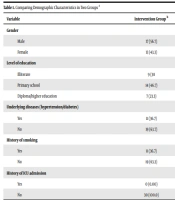
The patients’ age ranged from 20 to 62 years. Most of the patients in this study were male and married, and had primary school education. Moreover, a majority of the patients had no history of smoking or admission to the ICU, and there was no significant difference between the patients in the two groups in terms of these variables (P ≥ 0.05). Furthermore, there was no significant difference between the two groups in terms of demographic characteristics, gender, marital status, level of education, underlying diseases, admission to the ICU, and smoking (P ≥ 0.05) (Table 1).
Table 1.
Comparing Demographic Characteristics in Two Groups a
| Variables | Intervention Group b | Control Group | Chi-square |
|---|---|---|---|
| Gender | P = 079 | ||
| Male | 17 (56.7) | 18 (60.0) | |
| Female | 13 (43.3) | 12 (40.0) | |
| Level of education | P = 0.64 | ||
| Illiterate | 9 (30 | 9 (30) | |
| Primary school | 14 (46.7) | 11 (36.7) | |
| Diploma/higher education | 7 (23.3) | 10 (33.3) | |
| Underlying diseases (hypertension/diabetes) | P = 0.59 | ||
| Yes | 11 (36.7) | 13 (40.0) | |
| No | 19 (63.7) | 17 (60.0) | |
| History of smoking | P = 0.59 | ||
| Yes | 11 (36.7) | 13 (43.3) | |
| No | 19 (63.3) | 17 (56.7) | |
| History of ICU admission | P = 0.5 c | ||
| Yes | 0 (0.00) | 1 (3.3) | |
| No | 30 (100.0) | 29 (96.7) |
a Values are expressed as No. (%).
b N-acetylcysteine suction
c Fisher’s exact test
Table 2 presents no significant intergroup differences regarding demographic characteristics, age, consciousness level score, tracheal tube size, volume of nutritional solution, frequency of tracheal tube suction, and tracheal tube pressure (P ≥ 0.05).
Table 2.
Descriptive Statistics of Research Variables a
| Variables | Control | Intervention | t-test |
|---|---|---|---|
| Age | 39.23±13.62 | 34.80±15.36 | P = 0.24 |
| GCS | 5.99 ± 1.22 | 6.41 ± 1.35 | P = 0.20 |
| Tracheal tube size | 7.60 ± 0.36 | 7.58 ± 0.40 | P = 0.86 |
| Nutritional solution volume (per day) | 46.57 ± 11.56 | 51.45 ± 13.54 | P = 0.13 |
| Suction frequency | 3.34 ± 0.39 | 3.28 ± 0.42 | P = 0.56 |
| ETT cuff pressure | 22.61 ± 1.61 | 21.83 ± 1.58 | P = 0.06 |
a Values are expressed as mean ± SD.
The results of the Shapiro-Wilk test indicated the normal distribution of data (P > 0.05) as such parametric tests were used to analyze the data. The data analysis showed that 11 (n = 4 in the intervention group and n = 7 in the control group) (18.3%) out of 60 patients had VAP on the fifth day of ICU admission. Although the number of pneumonia cases was lower in the intervention group than in the control group, the chi-square test results revealed no significant difference between the two groups (P = 0.31) (Table 3).
5. Discussion
The results of the present study showed that the incidence of VAP was not statistically significant in the intervention group using NAC compared to the control group using normal saline. Sharafkhah et al. showed that the gavage of 600 mg of NAC twice a day for patients under mechanical ventilation compared to the placebo group could significantly decrease the incidence of VAP, and that NAC was effective in preventing and delaying pneumonia and its complete recovery in the ICU patients (17). Guo et al. examined the effect of NAC solution with fiberoptic bronchoscopy alveolar lavage in elderly patients with VAP (20). They noticed that VAP was less frequent in patients undergoing fiberoptic bronchoscopy with secretion lavage with NAC than in patients receiving secretion lavage with normal saline (20). Moreover, Qu et al. studied the effects of NAC inhalation on VAP caused by biofilm in tracheal tubes (21). Their findings showed that the amount of biofilm cultivation and the incidence of VAP decreased in the intervention group compared to the control group (21). Zhao and Liu confirmed the effect of NAC during endotracheal suction on inhibiting the movement of biofilms into the lower airways and preventing pulmonary infection (22). NAC reduces the incidence of pneumonia by preventing biofilm formation and facilitating the outflow of tracheal tube secretions in patients under mechanical ventilation (21, 22). In Masoompour et al.’s study, the intervention group received NAC using a nebulizer, and the control group received normal saline using a tracheal tube (15). In contrast to the present findings, their findings showed that the average concentration of secretions was significantly lower in the NAC group than in the control group (15).
Some studies have confirmed the side effects of normal saline in suctioning secretions. For example, Akbaryan Deheki et al. compared the effects of normal saline and NAC in endotracheal tube suction on physiological parameters and secretions in intubated patients under mechanical ventilation (16). Their findings indicated that blood pressure, heart rate, and breathing rate increased more significantly in the group receiving normal saline than in the NAC group. Furthermore, normal saline made secretions to move to the lower airways. This study reported that normal saline should not be used in endotracheal suction as much as possible, and intratracheal acetylcysteine should be used if it is necessary to remove secretions (16). Hussein et al. investigated the effect of normal saline serum on VAP and physiological parameters. The findings showed that normal saline effectively increased the incidence of pneumonia (12). Several studies have reported adverse effects of normal saline on physiological parameters and the likelihood of pneumonia in patients undergoing mechanical ventilation (1, 12, 22, 23).
The present study’s findings revealed no significant difference in the incidence of VAP when using normal saline and NAC as a diluent for the tracheal tube suction of lung secretions.
5.1. Conclusions
The data in the present study showed that the use of acetylcysteine and normal saline during endotracheal tube suction did not reduced the incidence of VAP. However, acetylcysteine left no specific complication in patients compared to normal saline leading to physiological changes in patients. Accordingly, nurses can use NAC during the tracheal tube obstruction to suction secretions.
5.2. Limitations
This study had some limitations, including the small sample size and the inclusion of only trauma patients from one hospital. Employing a larger sample size and multiple clinical samples would provide more reliable findings.