1. Background
Children and adolescents constitute a major segment of the world's population, and their health is particularly important in any society. In recent years, attention has been paid to the issues faced by children under the title of morbid psychology of children, which is one of the major topics in psychiatry and psychology (1). Recent research in the field of developmental pathology shows that two areas of childhood psychological disorders are particularly important in understanding the adaptation of children and adolescents: Internalized and externalized disorders (2). In the internalized group, disorders manifest themselves with anxiety symptoms, depression, and physical symptoms, whereas the externalized group includes destructive behavioral symptoms, impulsivity, and drug use (3). In research studying internalizing and externalizing disorders, interpersonal factors, such as the role of parents, are often examined (4).
The family is known as the builder and foundation of a child's personality and subsequent behaviors. Mothers spend more time with their children than other family members, and in this process, an attachment relationship is formed between them (5). Therefore, the mother, as the primary caregiver or attachment figure, is the first person with whom the infant communicates. Researchers have found that there is a relationship between the mother's low reflective capacity and behavioral problems in children, including attention problems, aggression, social isolation, anxiety, and disruption in parent-child interaction (6-8).
Parental acceptance involves attending to the interests of the child and offering unconditional love regardless of the child's appearance, abilities, or behavior (9). Parental acceptance helps the child learn that they can count on support and help from others in life. Acquiring a proper understanding and acceptance of children's behavior can be a predictor of parents' empathy with their children and their correct understanding of children's behavioral problems (10). The parent-child relationship can have a tremendous impact on various aspects of the parent-child dynamic, such as increasing the understanding and acceptance of the parents toward the child. Parental acceptance is emphasized as an effective factor in the formation of high levels of self-concept in children (11).
Among family members, the mother's personality and the way she communicates with the child are of fundamental importance (12). The child's behavioral problems in the early years of life are related to the mother's negative behavior and communication and her stress, and thus the child's problematic behavior causes unpleasant emotional reactions and a decrease in the mother's general health (13). Parenting self-efficacy is defined as one of the main variables of this research based on Bandura's concept of self-efficacy (14, 15). It has been proven that mothers who feel satisfied in their role as mothers have favorable relationships with their children, and unlike mothers who feel ineffective, they do not have problems in their relationship with their children (16). Children with behavioral problems, due to the presence of emotional, cognitive, and behavioral issues, cannot communicate with others like their peers, especially their mother. Therefore, mothers may be more confused when dealing with these children and may not be able to treat them correctly (17). According to Bandura, performance gains can lead to an increase or decrease in self-efficacy. Therefore, children who calm down easily give the mother a sense of security, and this self-efficacy improves the parent-child relationship and results in mutual satisfaction in both the parent and the child (18, 19).
Self-concept is a dynamic system that relates to a person's beliefs, values, desires, talents, and abilities. These factors determine a person's life path. The family is the first and most important social system influencing the formation of self-concept and self-esteem (20, 21). In fact, the primary interactions between parent and child are fundamental for the development of a sense of self-worth in early childhood (22). As stated, self-concept is a person's overall evaluation of themselves. This evaluation results from the individual's subjective assessments of their own characteristics, which may be positive or negative (23). A positive self-concept indicates that a person accepts themselves as someone with strengths and weaknesses, increasing their self-confidence in social relationships. A negative self-concept reflects feelings of worthlessness and inadequacy as well as an individual's perceived inability. Research shows that the development of self-concept in children and adolescents depends on their experiences and perceptions of the family, especially parents (24). The deep bond and emotional relationship between parents and children are important, as they foster self-confidence in children. A calm, obedient, and healthy child improves the parent's self-concept. On the other hand, a difficult child can weaken the self-concept of parents, especially the mother, and this weakened self-concept can damage the parent-child relationship and negatively affect the mother's self-concept (25).
In addition to children's behavioral challenges that are affected by neuropsychological and developmental issues, it seems that the family has a decisive role in managing this challenging behavior. Research has shown that family patterns can contribute to the creation of behavioral and emotional problems in children. On the one hand, these disorders are related to a child's reaction to family dysfunction, and on the other hand, to inappropriate environmental stimuli, such as non-acceptance of the child, and lack of affection and sufficient support from the parents (26). Therefore, timely and appropriate psychological interventions can significantly reduce problems related to children with these issues, and several treatments can be utilized in this regard.
The findings show that parent/child therapeutic relationship training has led to an increase in parental acceptance in children (27, 28). One of the most effective ways to communicate between parents and children is schema-based parenting (29). The main assumption of this theory is based on the principle that the root of the formation of maladaptive schemas arising from unsatisfied basic emotional needs is in the parenting perceived during childhood and adolescence (29). This theory explains why providing these needs is necessary and obligatory for raising children psychologically. In the formation of schemas, the inherent mood interacts with initial non-adaptive communication experiences (30). In a study, Graaf & Zarbock showed that understanding the interrelationship between parental schemas, family patterns, and child responses provides a rich opportunity for healing and early intervention to prevent the development of psychopathology (31). In examining the effect of parents' performance in relation to the three components of affection, authority, and control and the formation of primary incompatible schemas, Gunty concluded that parental performance is a significant predictor for some areas such as rejection and self-management (32).
One of the treatment methods whose effectiveness on parenting self-efficacy, self-concept, and parental acceptance of children with internalized problems has received less attention from researchers is parenting education based on compassion. In most families, according to the assigned roles and tasks, the mother has the most interaction with the child, and among the many factors of human relations that are effective in the development of the child, the mother's personality and the way she communicates with the child are of fundamental importance (33). Among the therapeutic and educational activities that focus on the parent, especially the mother, is education focused on kindness. Compassion involves providing empathy and non-judgmental understanding towards one's own pains, sufferings, mistakes, and inadequacies, in such a way that one sees one's bitter experiences as a larger part of human experiences (34). The basic principles in treatment based on compassion indicate that external soothing thoughts, agents, images, and behaviors must be internalized. Based on these findings and in line with the successes achieved, Gilbert started using this structure in therapy sessions and proposed the theory of "compassion-based therapy" (35). In this treatment method, instead of focusing on changing the "self-evaluation" of people, the relationship of people with their "self-evaluation" is changed (36).
Considering the mother-child interaction and the fact that many children's behavioral problems are caused by the way parents, especially the mother, deal with the child, research in this field seems necessary. By teaching self-compassion exercises, mothers seeking to find the principles of self-compassion realized that they could achieve a non-judgmental view of themselves, reflect on their problems and sufferings, and be more kind and patient towards themselves. In this way, by accepting their painful experiences and giving up excessive negative evaluations of experiences, mothers were guided to a position of kindness towards themselves. This, according to the sense of human commonality, allowed them to see themselves and others with more understanding and reduced their unnecessary stress by realizing that pain and failure exist in all human beings (35). Amini Naghani et al. found that parenting training and proper child therapy based on effective child-mother interaction reduced children's anxiety (37). In their research, Rezaei et al. showed that education based on mothers' affection may be a new and effective way to reduce the behavioral problems of preschool children with behavioral and cognitive issues; because the mental health of parents and the quality of their relationship affect the behavior of their children (38).
2. Objectives
According to the above, the aim of this research was to compare the effectiveness of schema-based parenting education with compassion-based parenting training on mothers' parenting self-efficacy, self-concept, and parental acceptance of children with internalized behavioral problems.
3. Methods
The current research was conducted as a semi-experimental pre-test-post-test and follow-up study. The statistical population included all primary school-aged children in Tehran and their mothers in Tehran in 2020. Forty-five children with internalizing problems and their mothers, who referred to counseling centers in Tehran and met the entry criteria, were selected through available sampling. They were then randomly assigned to two experimental groups (15 people in each group) and one control group (15 people).
In the first step, the Achenbach Children's Behavior Checklist (CBCL) was provided to the parents. Based on the internalizing scale cutoff scores (for girls, scores higher than 16 and for boys, scores higher than 14), 45 children who needed clinical attention were selected.
Entry criteria: Students aged 8 to 12 years who have internalizing problems and whose mothers are alive. The internalizing behavior problems scale includes items from the withdrawal/depression (WD), somatic complaints (SC), and anxiety/depression (AD) subscales. Children in need of clinical attention based on the cutoff score of the Achenbach Child Behavior Inventory (for girls, scores higher than 16 and for boys, scores higher than 14) on the internalizing scale were selected.
Exclusion criteria: Absence from more than one intervention session, simultaneous participation in other intervention programs, and lack of consent to continue cooperation.
The following tools were used to collect data:
3.1. The Child Behavior Checklist (CBCL; Achenbach, 1991)
The Children's Behavior Checklist (CBCL) is a tool that is completed by a parent or another person who is well acquainted with the competencies and behavioral problems of the child. Achenbach established the construct validity of this list by calculating the correlation between this list and the Wald Conners questionnaire, which ranged between 0.59 and 0.86 (39). Yazdkhasti and Oreyzi obtained Cronbach's alpha reliability coefficient for this questionnaire in three forms: Parent, teacher, and child, which were 0.90, 0.93, and 0.82, respectively. They also established the validity by correlating the subscales of the behavioral-emotional problems section with the total score of this section, resulting in correlations of 0.88, 0.91, and 0.85 for the parent, teacher, and child versions, respectively (40).
3.2. Piers-Harris Children's Self-concept Scale
This questionnaire was designed to measure the self-concept of children and adolescents aged 8 to 18 years (41). This test has been standardized in Iran among middle school students in the city of Mashhad, with validity coefficients reported between 0.91 and 0.94 among male and female students in the first, second, and third years of middle school in Mashhad, indicating high validity (42).
3.3. Rohner's Parental Rejection-Acceptance Questionnaire for Children (Mother's Form)
This questionnaire was designed to measure the experience of perceived rejection and acceptance by the mother during childhood and is completed by young people and adults. The questionnaire consists of 60 closed-ended questions, with answers graded from almost always false (1) to always true (4). The instructions specify that the total score for parental acceptance is obtained by summing the scores of the questionnaire items in both reverse and direct ways (43). In a research study, Yazdkhasti and Ghasemi found the reliability of this questionnaire to be 0.92 using the Cronbach's alpha method, and they reported the coefficient of similarity for the factors of the questionnaire to be 0.91 for the rejection factor and 0.88 for the acceptance factor (44).
3.4. Dumka Parental Self-Efficacy Questionnaire
This test evaluates the efficiency and frustration of parents when facing their child's situations, their ability to resolve parent-child conflicts, and their effort and persistence in parenting (45). Tylor reported the reliability of this questionnaire using Cronbach's alpha method as 0.54 and its validity as 0.88 (45). In Safarpour and Ashori's research, the reliability of this tool was obtained using Cronbach's alpha of 0.77 (46).
3.5. Intervention Methods
Schema-based parenting training sessions and compassion-based parenting training sessions were conducted for experimental mothers in eight 90-minute sessions according to the protocols. Finally, the post-test phase and a one-month follow-up were conducted for all three groups. The schema-based parenting training protocol was designed based on John Philip John Philip and Karen's book, translated by Mousavi Movahed (47), and the compassion-based parenting training protocol was based on Gilbert's research activities (35).
Table 1.
Summary of Schema-based Parenting Sessions
| Row | The content of the sessions |
|---|---|
| Session 1 | It was devoted to introduction, setting goals and teaching materials about schemas. |
| Session 2 | Knowledge about schemas, correct parenting method and parent-child relationship |
| Session 3 | While evaluating parenting methods based on schemas, cognitive techniques were taught to challenge incompatible schemas and destructive parenting styles. |
| Session 4 | Teaching correct parent-child communication, creating a sense of empathy with the child and identifying his emotions and feeling |
| Session 5 | Doing the homework of the previous session, strengthening the child-parent relationship and identifying destructive emotions |
| Session 6 | Identifying the strengths and weaknesses of the child and identifying the destructive emotions and feelings of the parent-child relationship |
| Session 7 | Identifying and solving the child's emotional problems and ways to strengthen the parent-child relationship |
| Session 8 | Examining the assignments of the previous sessions and discussing the correct and efficient parenting methods and summarizing |
As can be seen in Table 1, a summary of schema-based parenting sessions is given.
Table 2.
Summary of Parenting Sessions Based on Compassion
| Row | The Content of the Sessions |
|---|---|
| Session 1 | Introducing the members to each other and establishing initial communication, reviewing the rules of the group, explaining the structure and objectives of the meeting, conducting a pre-test and explaining the nature of kindness and its principles, presenting the assignment: Making a list of your sufferings |
| Session 2 | A summary of the previous session, reviewing the assignment of the previous session, performing a variety of mindfulness exercises: Breathing exercises, object-focused exercises, checking and touching the body, practicing eating and touching raisins), presentation of the assignment: Includes forty minutes of mindfulness exercises at home |
| Session 3 | Feedback from the previous session, a summary of the previous sessions, the importance of cultivating a kind mind, feeling warm and kind towards oneself, practicing the role playing of the kind self, teaching the styles and methods of expressing kindness using phrases and applying these methods in life. Also, practicing imagery from a safe place, presenting the assignment: Do the exercises presented in the meeting at home and in their daily lives |
| Session 4 | Reviewing the assignment of the previous session, getting feedback from the process of the sessions, strengthening self-compassion behaviors, practicing being kind to yourself using expressions (I love you and I don't want you to suffer, practicing being kind to others) and cultivating a kind mind. Assignment: Repeating these phrases in daily life as well as performing the assignment of being kind to yourself and others |
| Session 5 | Presenting a summary of the previous meetings, reviewing the assignments of the previous meeting, getting feedback from the process of the meetings, examining and discovering important things that give meaning to one's life, practicing visualization of a fruitful and valuable life, writing a letter about kind criticism of one's life, practicing the metaphor of a great day, presenting the assignment: Related to clarifying important points for group members |
| Session 6 | Providing a summary of the previous meetings, reviewing the tasks of the previous meeting, getting feedback from the process of the meetings, teaching the relationship between the physical, mental and mental components of difficult emotions and how these components affect each other, performing physical and mental and mental calming exercises, introducing logical reasoning and kind reasoning, introducing kind sensory experience, presenting tasks: Physical relaxation and mental relaxation with mindfulness exercises, as well as freeing your mind from negative thoughts |
| Session 7 | Feedback from the previous session, a summary of the previous sessions, identifying all the painful relationships that have been cut off with yourself and others and laying the groundwork for connecting this relationship with yourself and yourself with others, practicing reconciliation with yourself, recounting the characteristics of a kind person. Presenting the assignment: Identifying your anger with yourself, anger with situations, and anger with others, and practice reconciling and establishing relationships with these three types of relationships |
| Session 8 | First a summary of previous meetings. In this session, we try to target the negative prejudices of life, so that by relying on the good things in life and good qualities in our existence, we can reduce the negative prejudices and enjoy life more. Conducting the post-test, summarizing and finally providing solutions to maintain and apply this treatment method in life |
As can be seen in Table 2, a summary of parenting sessions based on compassion is given.
4. Results
Multivariate analysis of variance with repeated measurements was used to analyze the data. Before conducting this analysis, Levene's test, Mbox, Mauchly's sphericity test, and the Wilks Lambda test were used to check the assumptions of homogeneity of variance, homogeneity of variance-covariance, sphericity, and the significance of the effect of group and time variables. All these assumptions were confirmed.
Table 3.
Descriptive Indicators of Research Variables to Separate the Studied Groups and Stages a
| Variables | Pre-test | Post-test | Follow-up |
|---|---|---|---|
| Mothers' parenting self-efficacy | |||
| Control | 40.06 ± 4.22 | 40.50 ± 4.61 | 41.60 ± 4.45 |
| Schema-based parenting training | 42.26 ± 4.67 | 55.94 ± 5.44 | 51.53 ± 5.42 |
| Compassion-Based Parenting | 40.93 ± 4.14 | 57.60 ± 5.25 | 52.34 ± 5.09 |
| Self-concept | |||
| Control | 45.20 ± 3.61 | 45.27 ± 3.70 | 45.07 ± 3.54 |
| Schema-based parenting training | 44.74 ± 4.88 | 59.07 ± 3.89 | 53.60 ± 6.49 |
| Compassion-Based Parenting | 44.60 ± 5.76 | 57.47 ± 5.90 | 52.07 ± 3.09 |
| Parental acceptance | |||
| Control | 43.00 ± 3.23 | 42.20 ± 3.45 | 42.27 ± 3.16 |
| Schema-based parenting training | 43.87 ± 3.46 | 33.40 ± 4.43 | 35.54 ± 3.47 |
| Compassion-Based Parenting | 42.27 ± 3.27 | 30.34 ± 3.31 | 32.53 ± 3.42 |
a Values are expressed as Mean ± SD.
The findings in Table 3 show that the scores related to the parenting self-efficacy variable of the mothers in the control and experimental groups are almost close to each other in the pre-test phase. However, the average scores of the mothers' parenting self-efficacy in the schema-based parenting training group in the pre-test phase were 26.42. In the post-test and follow-up stages, these scores increased to 55.94 and 51.53, respectively. Similarly, the mean parenting self-efficacy scores of mothers in the post-test and follow-up stages in the compassion-based parenting training group were 57.60 and 52.34, respectively.
Table 4.
The Results of Wilks Lambda test in Multivariate Analysis of Variance
| Effect | Values | F | Hypothesis df | Error df | P | Partial Eta Squared |
|---|---|---|---|---|---|---|
| Within group | ||||||
| Time | 0.980 | 2 | 6 | 37 | 0.001 | 0.918 |
| Group × time | 0.973 | 2 | 12 | 74 | 0.001 | 0.599 |
| Between group | ||||||
| Group | 0.936 | 2 | 6 | 80 | 0.001 | 0.399 |
Based on Table 4, the results of the Wilks' Lambda test showed that the effectiveness of the schema-based parenting approach and the compassion-based parenting approach is significant on at least one of the variables (P < 0.001, Wilks' Lambda = 0.937). Therefore, the condition for using multivariate analysis of variance with repeated measurement has been met.
Table 5.
Results of Related Intra-group and Inter-group Effects in Research Variables
| Variables | Type III Sum of Squares | df | Mean Square | F | P | Partial Eta Squared |
|---|---|---|---|---|---|---|
| Mothers' parental self-efficacy | ||||||
| Within group | ||||||
| Time | 2945.31 | 2 | 1247.65 | 203.89 | 0.001 | 0.83 |
| Time × group | 1145.36 | 4 | 286.34 | 46.79 | 0.001 | 0.69 |
| Error | 514 | 84 | 6.20 | |||
| Between group | ||||||
| Group | 2250.77 | 2 | 1125.39 | 25.37 | 0.001 | 0.547 |
| Error | 1863.34 | 42 | 44.37 | |||
| Self-concept | ||||||
| Within group | ||||||
| Time | 1880.64 | 2 | 940.32 | 68.47 | 0.001 | 0.62 |
| Time × group | 941.72 | 4 | 235.43 | 17.14 | 0.001 | 0.45 |
| Error | 1153.64 | 84 | 13.74 | |||
| Between group | ||||||
| Group | 1391.30 | 2 | 695.65 | 18.12 | 0.001 | 0.46 |
| Error | 1612.36 | 42 | 38.39 | |||
| Parental acceptance | ||||||
| Within group | ||||||
| Time | 1340.4 | 2 | 670.2 | 155.32 | 0.001 | 0.87 |
| Time × group | 722.49 | 4 | 180.62 | 41.86 | 0.001 | 0.66 |
| Error | 362.4 | 84 | 4.31 | |||
| Between group | ||||||
| Group | 514.44 | 2 | 257.22 | 9.26 | 0.001 | 30 |
| Error | 1165.9 | 42 | 27.76 |
The results in Table 5 show that there is a significant difference in mothers' parenting self-efficacy, self-concept, and parental acceptance between the pre-test, post-test, and follow-up times (P < 0.05).
Table 6.
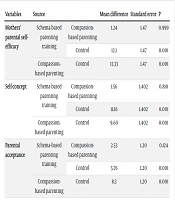
Bonferroni Post hoc Test Results for the Variables of Mothers' Parenting Self-efficacy, Self-concept and Parental Acceptance
| Variables | Source | Mean Difference | Standard Error | P | |
|---|---|---|---|---|---|
| Mothers' parental self-efficacy | Schema-based parenting training | Compassion-based parenting | 1.24 | 1.47 | 0.999 |
| Control | 12.1 | 1.47 | 0.001 | ||
| Compassion-based parenting | Control | 13.33 | 1.47 | 0.001 | |
| Self-concept | Schema-based parenting training | Compassion-based parenting | 1.56 | 1.402 | 0.810 |
| Control | 11.16 | 1.402 | 0.001 | ||
| Compassion-based parenting | Control | 9.60 | 1.402 | 0.001 | |
| Parental acceptance | Schema-based parenting training | Compassion-based parenting | 2.53 | 1.20 | 0.124 |
| Control | 5.76 | 1.20 | 0.001 | ||
| Compassion-based parenting | Control | 8.3 | 1.20 | 0.001 | |
The results in Table 6 show that both parenting education approaches had an effect on improving parental self-efficacy, self-concept, and parental acceptance (P < 0.05). However, there was no significant difference between the two treatment methods.
5. Discussion
The purpose of the present study was to compare the effectiveness of schema-based parenting training with compassion-based parenting training on mothers' parenting self-efficacy, self-concept, and parental acceptance of children with internalized problems. The results indicated that teaching schema-based parenting skills and compassion-based parenting skills were effective in increasing parenting self-efficacy and self-concept and reducing parental acceptance (a lower score means more favorable parental acceptance) of children with internalized behavior problems. This finding is consistent with previous studies such as Sabzi et al. (48) and Khorasanizadeh et al., who showed that parenting is related to early maladaptive schemas (49). As Sabzi et al. also stated, the effectiveness of parenting based on schema therapy emphasizes meeting the needs of children to prevent the formation and stabilization of maladaptive schemas (48).
In explaining the effects of these two types of intervention and the inherent differences between them, it can be stated, based on the obtained results and the literature, that the schema therapy approach addresses the deepest level of cognition and uses cognitive, emotional, interpersonal strategies and behavioral skills training (interpersonal skills, distress tolerance skills, emotional regulation skills, and mindfulness or comprehensive awareness skills). This approach helps a person generalize to situations in their life. On the other hand, compassion-focused therapy is a multifaceted therapy based on a wide range of behavioral psychological treatments and other interventions (35). In this therapy model, exercises emphasizing relaxation, a calm and peaceful mind, and mindfulness play a significant role in calming the mind and reducing anxiety and stress (32).
Although these two treatment approaches seem somewhat different, they share the assumption that manipulating acquired behavior along with correcting distortions and changes in the underlying cognitive processes will probably lead to more positive outcomes. Schema-based therapy interrupts the cycle of negative internal experiences of past events, thereby increasing mothers' ability to deal with children with internalized problems, ultimately improving these symptoms in children. By eliciting schemas and relating them to current issues, schema therapy provides the basis for emotional insight and subsequent improvement of schemas. The technique of mental imagery to break the pattern causes a shift away from avoidant coping styles and extreme compensations. According to Yang's perspective, schema therapy satisfies unmet emotional needs and lays the groundwork for improving primary schemas. Therefore, the greater effectiveness of schema therapy in the studied variables seems justified.
Schema therapy emphasizes changing maladaptive coping styles and schemas formed in childhood and explaining how they affect the processing and facing of events in mothers' lives. This provides an opportunity for mothers with problematic children, especially those with internalized problems, to stop negative evaluations and avoidance and instead use normal and adaptive coping strategies. The use of adaptive coping strategies can also lead to improved mental capacity, problem-solving power, and forgiveness, thereby enhancing self-concept and parental acceptance of their children (50).
Examining the results of this research on parenting based on affection showed that this model had a very small and non-significant superiority over schema-based parenting, with little difference in the dimensions of the studied variables in the post-test and follow-up stages. There are limited studies in this field that have compared schema therapy and compassion therapy on variables such as resilience, ambiguity tolerance, loneliness, and emotion regulation (49). The results of these studies have also shown that both interventions had relatively similar effects on the variables studied.
It should be noted that the schema therapy approach helps the individual through the use of dialectical strategies, cognitive problem-solving, and client management, as well as by reducing life-disturbing behaviors and teaching behavioral skills to generalize them to life situations. In this training, the emphasis is on the unpleasant experiences. The various techniques of this model for internalizing self-kindness include visualization, writing self-kindness letters, and learning the psychological knowledge of self-kindness. In the exercises of this therapeutic model, relaxation, a calm and compassionate mind, and mindful attention are emphasized, which play a significant role in calming the mind and reducing anxiety and stress (51).
Therefore, through education, parents can help the child's well-being and mental health and empower them. This is why research shows that parent training is an effective tool in changing and directing children's behavior (48, 51).
5.1. Conclusions
In general, the schema therapy approach emphasizes recording daily activities to face avoidances and include enjoyable and mastery activities in the client's program with their cooperation. It involves training and applying skills of evaluation, selection, observation of results, and never giving up. Overcoming avoidance patterns, self-care skills, assertiveness, and assertiveness help participants overcome their avoidance, which in turn helps to treat avoidant behavior and improve parental self-efficacy, self-concept, and parental acceptance of children.
One of the limitations of the present study is the varying experience of the years of awareness of the child's problem among the research sample, resulting in non-homogeneous groups in terms of time experience. Information and data were collected through self-reporting by the participants using a questionnaire, which may be influenced by factors such as the tendency of the respondents to present a positive image.
It is suggested that to clarify the therapeutic effects of the above approaches and to expand the results, future research should investigate the effects of having a child with internalized problems from the perspectives of both the husband and wife, in larger samples, and in samples that are experimentally equal. To investigate the long-term effect of the intervention, it is necessary to conduct follow-up tests at regular intervals. However, in this study, only one follow-up test stage was performed due to time constraints.