
1. Background
Burn lesions are usually associated with severe pain and they pose many physical and mental problems for patients. Dressing change causes unbearable pain in burn patients such that they describe this treatment process much more painful than burning itself (1). This pain requires high levels of opioids while sometimes there is a resistance to these analgesic drugs (2). If uncontrolled, the pain may entail many physiological and psychosocial consequences such as sleep deprivation, fear, anxiety, depression, anger, low-quality life, prolonged stress after burn injury, delayed recovery, and extended hospitalization (3, 4).
Intravenous morphine or other opioid analgesics are commonly used to relieve burn pain. Conventional opioids have multiple side effects, the most common of which are constipation, nausea, vomiting, and somnolence (1). On the other hand, non-pharmacological interventions aimed at pain management have much fewer complications and their combined use with analgesics can improve pain relief and reduce the dose of sedative and analgesic drugs (5).
Non-pharmacological therapies can be useful in controlling pain, reducing side effects, and achieving better medication results (6). In this regard, cognitive behavioral methods such as distraction are common therapies that effectively mitigate the pain caused by invasive interventions (7). To achieve distraction, one can use visual (watching TV and guided imagery) (8, 9), auditory (listening to the music or jokes) (10, 11), tactile (massage) (12, 13), and mental imagery (making bubbles) methods (7).
Respiratory techniques are examples of distraction. There are several types of breathing such as rhythmic breathing, abdominal breathing, hold breathing, regular smooth breathing, and breathing in various postural situations (14-16). Numerous studies have been conducted on the effectiveness of respiratory techniques. For example, the results of a study comparing the impact of two distraction techniques on the intensity of venipuncture pain showed that listening to the music and doing regular breathing helped patients feel less pain than they do when undergoing common methods of relieving pain (14). In another study, the use of respiratory patterns reduced labor pain (17).
Despite important advances in pain control and the fact that respiratory techniques are safe, non-invasive, and easy-to-implement (14, 15), patients with burn injuries continue to suffer from conventional methods of treatment (8, 18, 19). Besides, relatively few studies have been conducted on these patients.
2. Objectives
Therefore, this study addressed the effect of regular smooth breathing on the pain induced by dressing in patients with second-degree burns.
3. Methods
This clinical trial (IR.ZBMU.REC.1397.037) aimed at determining the effect of regular smooth breathing on the pain associated with dressing in patients with second-degree burns who had referred to Imam Hossein Burn and Rehabilitation Center of Zabol, Southeast Iran, between June and October 2018. The eligibility criteria included informed consent to participate in the study, 15 - 45 years of age, no addiction, lack of mental illnesses or specific underlying diseases such as diabetes, cancer, and thyroid disease, burn injuries between 5% and 45%, having second-degree burns, no burns in the abdomen and chest, having at least one dressing experience since the burn injury, and respiratory stability. Failure to perform the respiratory procedure when dressing was a criterion to disqualify the patients.
The sample size was estimated at 10 for each group using the following formula (20):
The above formula was solved based on the study by Bozorg-Nejad et al. (16), the mean pain score in the experimental and control groups, the 95% confidence interval, and the 80% power. Concerning the possibility of attrition, this size was increased to 15 for each group (30 in total).
A demographic questionnaire (including age, gender, type of burn, and burn percentage) was used to collect general data, and a visual analog scale (VAS) was employed to assess the intensity of pain. This scale included a 10-cm horizontal line. The validity and reliability of this tool have been confirmed in several studies (15, 16, 21).
In order to observe the ethical considerations, after explaining the goals of research to the patients, the researcher asked them to show their willingness to participate in the study by signing the consent form. The method of regular smooth breathing was taught by the researcher when the patient was at rest and under no stress. An audio file describing the procedure of the respiratory intervention was played for the patients so that they could coordinate their breathing with it. After performing the respiratory exercises and ensuring the acquisition of the required skills, eligible patients entered the study. In this method, the patient inhaled through the nose on a count of 4, paused on a count of 4, and exhaled on a count of 4 with the lips pursed. This is the modified version of the 4-7-8 technique or “relaxation breathing” (22).
The intensity of pain was measured after dressing. The dressing process took 30 minutes on average. The respiratory intervention began after painkiller injection and before dressing, and it continued until the dressing process finished. The experimental group did the respiratory exercises at least 20 times before dressing was over.
The control group, however, was provided only with the routine care, which included the intravenous administration of morphine (based on patient’s weight) about 5 min before dressing. This was carried out for patients of both groups.
After dressing, the pain score was calculated again in both groups. The intervention continued up to four consecutive sessions of dressing change. The related data were collected after each session. The obtained data were analyzed in SPSS 23 using the chi-square test, Fisher-exact test, and independent t-test. The significance level was set at < 0.05.
4. Results
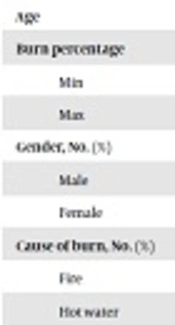
Table 1 shows that the majority of the patients in both groups were male. The fire was the most common cause of burns in both groups. There was no statistically significant difference between the two groups in terms of gender, age, burn percentage, and type of burn. Three individuals were unable to perform the [respiratory] intervention and they were excluded from the study.
Table 1.
Comparing the Demographic Characteristics of Patients with Second-Degree Burns in the Two Study Groups
| Variable | Intervention | Control | P Value |
|---|---|---|---|
| Age | 25.47 ± 9.55 | 28.06 ± 11.38 | 0.504a |
| Burn percentage | 19.37 ± 8.5 | 19.33 ± 11.78 | 0.874a |
| Min | 5 | 5 | |
| Max | 45 | 45 | |
| Gender, No. (%) | 0.705b | ||
| Male | 10 (66.7) | 9 (60) | |
| Female | 5 (33.3) | 6 (40) | |
| Cause of burn, No. (%) | 0.169c | ||
| Fire | 14 (93.3) | 10 (66.7) | |
| Hot water | 1 (6.7) | 5 (33.3) |
aIndependent t-test.
bChi-square test.
cFisher-exact test.
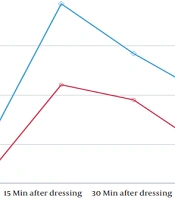
The results demonstrated significant differences in the dressing sessions such that the mean of pain intensity throughout the study was lower in the experimental group than in the control group (Table 2).
Table 2.
Comparing the Mean of Pain Intensity a the Two Groups in Four Dressing Sessions
| Dressing Session | Control Group, Mean ± SD | Experimental Group, Mean ± SD | P Value (Independent t-Test) |
|---|---|---|---|
| 1 | 7.87 ± 1.19 | 4.53 ± 0.99 | < 0.001 |
| 2 | 7.07 ± 1.28 | 4.07 ± 0.79 | < 0.001 |
| 3 | 6.20 ± 1.21 | 3.27 ± 0.46 | 0.004 |
| 4 | 5.93 ± 0.96 | 3.20 ± 0.56 | 0.019 |
5. Discussion
The purpose of this study was to investigate the effect of regular smooth breathing on the intensity of dressing pain in patients with second-degree burns admitted to Imam Hossein Burn and Rehabilitation Center of Zabol in 2018.
The findings suggested a descending trend in the mean score of pain intensity in both groups. In this regard, Jonsson et al. (23) proposed that the intensity of burn pain decreases over time. In line with the present study, Deniz and Arslan (24) observed that burn patients suffered from mild to moderate pain until complete recovery takes place. Meanwhile, ranging from mild to moderate in intensity, burn pain could be due to thermal, chemical, and mechanical stimuli. Since lesions are debrided and cleaned during dressing, various receptors of pain are stimulated (25) and consequently, the complete pain relief is unexpected.
The results of the current study also revealed a significant difference in terms of pain intensity between the control group and the experimental group, with the latter displaying comparatively lower pain scores after the intervention. These findings are confirmed by the results of some other studies such as Lalegani et al. (15) that used a VAS to assess the effect of respiratory techniques on pain intensity when changing burn dressing. It was found that such techniques considerably reduce the intensity of pain in burn patients. In Zanjan, central Iran, Bozorg-Nejad et al. (16) explored the effect of rhythmic breathing on the pain experienced when changing burn dressing. It was reported that 20-min rhythmic breathing had a positive impact on the pain felt by patients. In another quasi-experimental study, Park et al. (22) addressed the effect of relaxation breathing techniques on the pain caused by dressing change in burn patients. The results were similar to those of the present study.
In general, the results of the abovementioned studies substantiate the effectiveness of regular smooth breathing on the pain intensity of burn patients. Respiratory techniques exemplify distraction and relaxation methods. During respiratory techniques, neuromuscular activities decrease and as a result, the activity of the sympathetic nervous system and excitability of the cerebral cortex to harmful stimulants like pain dwindle (22, 25).
5.1. Conclusions
Regular smooth breathing can be helpful in alleviating the pain induced by dressing in burn patients. Therefore, it is suggested that this respiratory technique be administered as a non-pharmacological supplement to reduce the pain intensity in burn patients during treatments such as dressing change. Further studies need to be conducted in this area using other techniques for relieving the pain associated with dressing changes in burn patients.