
1. Background
Hemodialysis is one of the replacement therapies in acute and chronic kidney failure to maintain stability in the body's internal environment (1-4). However, renal failure may cause undesirable effects such as decrease of hemoglobin and hematocrit (5), sleep disorders (4), loss of blood pressure (6, 7), quality of life disorder, and pruritus (8-11). Decrease of hemoglobin and hematocrit is one of the common chronic problems in kidney failure, which can even further aggravate the other complications (12). This is found in 60% - 80% patients with advanced kidney failure (12, 13) its intensity increases with decreasing kidney function (13, 14).
Decrease in hemoglobin and hematocrit levels in these patients causes dizziness, light headache, tinnitus, palpitation, dyspnea, intolerance of cold, weakness, fatigue, and intolerance of activity, the lack of treatment associated with physiological disorders, mainly cardiovascular disease (15), left ventricular hypertrophy, heart failure, and death (13, 14, 16).
Anemia in these patients reduces their quality of life (12, 17) and is directly associated with the degree of physical activity, sleep and general health (12). Considering that anemia causes many problems for hemodialysis patients, this has been the focus of researchers, among these studies, the effect of cold hemodialysis in hemodialysis patients can be noted in Iran.
The use of cold hemodialysis as an effort to control hypotension during the hemodialysis began in 1980 (18, 19). After that, researchers found that cold hemodialysis not only reduces the periods of hypotension during hemodialysis but also has other useful effects on overall health and quality of life (20). The study of Imani and colleagues in 2011 was done in Semnan with the aim of investigating the influence of cold hemodialysis on the pruritus of hemodialysis patients. In this study, 35 hemodialysis patients were dialyzed for one month with the standard hemodialysis (37°C) and one more month with the same variables with the cold hemodialysis (35°C). The results showed the positive effect of cold hemodialysis on the reduction of the pruritus in these patients (8).
In the retrospective study of the total death and death rate from heart and non-heart disease in the two groups of patients who received cold hemodialysis with lower temperature of 35.5°C and standard hemodialysis with 37°C showed that cold hemodialysis significantly reduces the total mortality and mortality caused by heart disease but has no effect on non - heart disease death (21).
Another clinical trial aimed at investigating the influence of cold hemodialysis on the microscopic structure of the brain, in which 38 patients in the two standard and cold hemodialysis groups were studied for one year, brain scans revealed that cold hemodialysis significantly reduces brain damage, which is due to more hemodynamic stability in the cold method (22). Other similar studies indicate that cold hemodialysis improves sleep disorders (23), itching (8), and hemodialysis efficiency (24). In fact, cold- dialysis seems to be associated with a long-term improvement in the level of hemoglobin in patients because of less hypotension, better tolerance of dialysis which will improve the adequacy of dialysis and urea clearance. Some studies showed that hemodiafiltration is associated with better tolerance to ultrafiltration and less hypotension than hemodialysis due to lower temperature of dialysis solution (25).
Several articles have demonstrated that cold hemodialysis is a harmless procedure, we can refer to the review of Sakkas et al. in 2017; showing that cold hemodialysis did not have any hazardous effects (26). It seems, though that the harmor effectiveness of the cold hemodialysis on the hemoglobin and hematocrit changes have not been investigated and according to the adverse effects of anemia, we need to know how cooling of hemodialysis fluid affects the hemoglobin and hematocrit in hemodialysis patients.
2. Objectives
The aim of this study was to investigate the effect of cold hemodialysis on the rate of hemoglobin and hematocrit in hemodialysis patients.
3. Methods
This research was a double-blind crossover randomized clinical trial study, which was performed in Valliasr Hospital in the city of Zanjan in 2016. Patients were unaware of what type of hemodialysis they received, and the person who collected the information was unaware of the purpose of the study. When the patients came for obtaining the consent form, they were notified about cold hemodialysis; but they did not know when the cold hemodialysis would be received.
The number of 42 hemodialysis patients was selected based on the results of previous studies (4, 8). The inclusion criteria included: type of vascular access being fistula; previous hemodialysis for at least six months, three sessions of hemodialysis in a week four hours in every session The exclusion criteria included: bleeding during hemodialysis, patients receiving blood, change in erythropoietin dose, discontinuation of hemodialysis (kidney transplant, vascular problem), changes of hemodialysis dose.
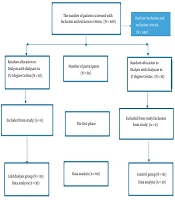
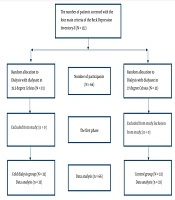
Before the intervention began, the study was approved by the Ethics Committee of Zanjan University of Medical Sciences (ZUMS.REC. 1394.75) and written consent was obtained from the patients. The sample was randomly divided into two groups of 20 and 22 numbers. The first group, which included 20 patients, received standard hemodialysis for the first four weeks (37°C) and cold hemodialysis (35°C) for the second four weeks. The second group, which included 22 patients, received cold hemodialysis for the first four weeks (35°C) and standard hemodialysis (37°C) for the second four weeks. The sequences of intervention for each group were randomly selected.
During the study, patients were dialyzed with available and fixed dialysis machine for three sessions, four hours each week. Type of dialysis machine, the pump type and UF were the same throughout different sessions in each patient. Before and after the intervention, the temperature of the dialysis fluid was regulated by the temperature adjustment profile on the dialysis machine.
The data collection tool included; demographic information form (age, gender, employment, marital status, education, duration of hemodialysis, cause of hemodialysis) and the amount of hemoglobin and hematocrit at three stages, i.e. before the beginning of the study, and the completion of the first four weeks and the end of the second four weeks. Prior to the separation of the patient from the machine, 1 ml of blood was derived from hemodialysis line and sent to the laboratory of Valliasr Hospital in a laboratory tube containing anti-coagulants to measure the level of hemoglobin and the hematocrit. In this laboratory, all blood analyses were carried out with a single cell counter device.
The obtained data was analyzed in SPSS 22 with descriptive statistics, Man Whitney and Freedman. The significance level of P < 0.05 was considered.
4. Results
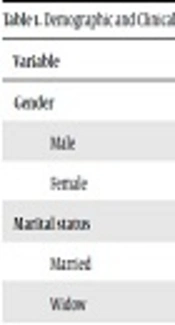
Of the 42 patients divided into two groups, there were 11 men (55%) and 9 women (45%) in the first group and 8 men (36.4%) and 14 women (63.6%) in the second group. Demographic data of the samples are summarized in Table 1. The mean and standard deviation of the hemoglobin level in the pre study stage was not statistically significant; but after the first four weeks of the mean and standard deviation of hemoglobin at the cold and standard hemodialysis stage respectively were 13.85 ± 1.81 and 11.09 ± 1.08. After the second four weeks, the mean and standard deviation of hemoglobin at the cold and standard hemodialysis stage respectively were 13.57 ± 1.50 and 11.47 ± 0.87. The cross sectional survey of groups showed that groups were significantly different; data are summarized in Table 2.
Table 1.
The Frequency Distribution Demographic Information of the Hemodialysis Patients in the Two Groups of Cold and Standard Hemodialysis
| Type of Hemodialysis/Variation | First Group | Second Group | ||
|---|---|---|---|---|
| Frequency | Percent | Frequency | Percent | |
| Age | ||||
| < 50 | 5 | 25 | 6 | 27.3 |
| 50 - 65 | 11 | 55 | 7 | 31.8 |
| > 65 | 4 | 20 | 9 | 40.9 |
| Marriage | ||||
| Single | 2 | 10 | 1 | 4.5 |
| Married | 16 | 80 | 17 | 77.3 |
| Widow | 2 | 10 | 4 | 18.2 |
| Education | ||||
| Uneducated and basic | 10 | 50 | 14 | 63.7 |
| Secondary education | 4 | 20 | 7 | 31.8 |
| Diploma | 6 | 30 | 1 | 4.5 |
| Employment | ||||
| Unemployed or retirement | 7 | 35 | 9 | 40.9 |
| Employee | 1 | 5 | 0 | 0 |
| Homemaker | 9 | 45 | 13 | 59.1 |
| Others | 3 | 15 | 0 | 0 |
| Residence | ||||
| Urban | 13 | 65 | 16 | 72.7 |
| Rural | 7 | 35 | 6 | 27.3 |
Table 2.
Comparison the Mean and Standard of the Hemoglobin Level on the Standard and Cold Hemodialysis in Hemodialysis Patients
| Time/Group | Hemoglobin Level | ||
|---|---|---|---|
| Number | Mean ± SD | P Value | |
| Before | 0.193a | ||
| First group | 20 | 13.70 ±3.52 | |
| Second group | 22 | 12.57 ±1.82 | |
| First 4 week | 0.001b | ||
| Cold | 20 | 13.85 ±1.31 | |
| Standard | 22 | 12.51 ±2.08 | |
| Second 4 week | |||
| Standard | 20 | 12.47 ±1.57 | |
| Cold | 22 | 13.57 ±1.50 | |
aManwhitney test.
bFridman test.
The difference in the mean of the hematocrit and hemoglobin level in the pretest study stage in the two groups was not statistically significant. After the first four weeks, the mean of hematocrit at the cold and standard hemodialysis stage were 43.83 ± 5.33 and 38.02 ± 2.15 respectively, and after the second four weeks, the mean and standard deviation of hematocrit at the cold and standard hemodialysis stage were 42.29 ± 5.53 and 39.18 ± 4.56, respectively. The crossover survey of groups showed that cold dialysis contributes to differences in the two groups; data are summarized in Table 3.
Table 3.
Comparison the Mean and Standard of the Hematocrit Level on the Standard and Cold Hemodialysis in Hemodialysis Patients
| Time/Group | Hematocrit | ||
|---|---|---|---|
| Number | Mean ± SD | P Value | |
| Before | 0.221a | ||
| First group | 20 | 42.24 ± 9.26 | |
| Second group | 22 | 39.27 ± 6.03 | |
| First 4 week | 0.001b | ||
| Cold | 20 | 42.83 ± 4.33 | |
| Standard | 22 | 40.02 ± 7.15 | |
| Second 4 week | |||
| Standard | 20 | 39.18 ± 4.56 | |
| Cold | 22 | 42.29 ± 5.56 | |
aMann Whitney test.
bFriedman test.
5. Discussion
The present study aimed to investigate the effect of cold hemodialysis on hemoglobin and hematocrit in hemodialysis patients. According to the results of this study, cold hemodialysis has not only a negative effect on hemoglobin and hematocrit but also contributes to differences in the two groups. As mentioned, the reasons for this research were the lack of an article in this regard, so in this section we have discussed the studies done on the topic of cold hemodialysis.
The study of Imani and colleagues in 2017, which was aimed at the effect of cold hemodialysis on the pruritus between 35 hemodialysis patients in a pre and post group, showed that cold hemodialysis significantly contributed to relief of pruritus and according to patients, they felt better and more comfortable with cold hemodialysis. Most of them tended to be dialyzed again with cold hemodialysis (8).
Another study was carried out by Parker et al. in 2007 in the United States with the aim of reducing the temperature of dialysis to improve sleep and changing night skin temperatures in chronic hemodialysis patients. Sleep criteria were assessed by the polysomnography device and axillary temperature was measured by the Minilogger 2000. During this study, the cold hemodialysis had been able to accelerate the start of the dream, although differences in other sleep factors such as REM and total sleep time were not statistically significant, but they were better than the standard hemodialysis (27). There were limitations in the Parker study which can be referred to as the low number of samples, short duration of follow-up and the sensitivity of polysomnography (23).
However, another clinical trial conducted by Ayub et al. in New Zealand, aimed at the effect of cooling the hemodialysis fluid temperature on the dialysis adequacy. Samples included 10 patients divided into two groups of 5. Patients were dialyzed 6 sessions, three sessions with normal temperature (standard hemodialysis) and three other sessions with cold temperature. This study showed that cold hemodialysis with the stabilization of hemodynamic status helps to increase ultrafiltration during and after hemodialysis. During hemodialysis, cold hemodialysis can be effective in Kt/V (K, dialyzer clearance of urea; t, dialysis time; V, volume of distribution of urea) and URR (urea reduction ratio) in patients with low blood pressure compared to patients with stable blood pressure. In both groups, the majority of patients (80%) reported being more energetic and had an enormous improvement in their overall health, they tended to be dialyzed with cold type (28). In this study, patients were not aware of the type of hemodialysis until they were questioned about the individual's sense of cold hemodialysis.
In another study, the results showed that patients who received cold hemodialysis at 35 ° C were willing to continue this approach in subsequent dialysis sessions, and 76% - 80% of the subjects had a high energy feeling and a significant increase in general health (24).
There is no hypothesis about the mechanism of the effect of cold hemodialysis on the increase in hemoglobin and hematocrit levels, but most of the studies on cold hemodialysis represent an increase in hemodynamic stability during the hemodialysis and prevention of blood pressure decrease (24, 27, 29, 30). Since the hypotensive episodes are one of the most common causes of the unwanted reasons for hemodialysis to be interrupted and these interruptions can reduce the effectiveness and adequacy of hemodialysis, it strengthens the hypothesis that intermittent hemodialysis interruptions may have led to an increase in uremia in these patients and then increase the negative effects of uremia on the blood factors such as Hb and Hct. Cold hemodialysis though, could prevent discontinuing the hemodialysis by the prevention of hypotension. On the other hand, research has shown that this method has had a positive effect on the removal of urea, Kt/v, (24, 28, 31). The cooling of hemodialysis fluid may reduce uremic effects as a destructive factor on red blood cells.
The result of this study showed that cold hemodialysis with a temperature of 35°C does not only have a negative effect on hemoglobin and hematocrit, but also contributes to differences in the two groups
5.1. Conclusions
This study demonstrates the positive effects of cold dialysis on Hb and Hct in hemodialysis patients. Therefore, it is suggested that this method be considered as an alternative treatment method along with drug therapy as a less costly method. Given the fact that the effect of cold dialysis on the anemia of dialysis patients is less studied, it is suggested that further studies in this area be conducted with a longer duration of intervention and follow-up period.