


1. Background
Varicocele is the most common cause of infertility (1), which is defined as the abnormal dilation of the pampiniform plexus veins (2), and is considered as one of the known causes of infertility. 10% to 15% of the general population has a varicocele, as well as 30% to 35% of people with primary infertility and 69% to 81% of people with secondary infertility (3). The most common abnormalities in sperm analysis indices in patients with varicocele are decreased motility and decreased sperm count, although 20% of patients have sperm counts above 20 million (4).
Several studies have been performed to determine the underlying pathophysiology of infertility in patients with varicocele. Despite these studies, is still unknown the main mechanism of infertility in varicocele. Cases that have been suggested as causes of infertility in patients with varicocele include dysfunction of the secondary germinal cell to hypoxia due to small vessel occlusion and venous stasis; also return of adrenal and kidney metabolites through the left spermatic vein, increased scrotal temperature secondary to varicocele, and endocrine disorders (5). Other mechanisms that cause infertility in men with varicocele are increased oxidative stress and decreased antioxidant content, which increases sperm DNA damage and increases DFI (6).
There are several hypotheses about DNA damage to sperm in varicocele due to oxidative stress, including a lack of protamine in the sperm nucleus or a lack of proper replacement of protamine with histone in the spermiogenesis stage, which predisposes DNA to damage. They can bind directly to sperm DNA bases and cause DNA damage by activating apoptosis (7).
In addition to varicocele, there are several other factors involved in DNA damage, including age, environmental factors (such as organophosphate and organochlorine toxins), heavy metals (such as lead), and carcinogens (such as polycyclic aromatic hydrocarbon), and diseases including varicocele, infections, tumors, spinal cord injuries, endocrine diseases, heat and lifestyle (8).
DFI is an important indicator in predicting fertility; DFI reduces the chance of pregnancy by more than 30% naturally or by assisted reproduction methods (9). Varicocelectomy plays an important role in improving sperm analysis indices including motility, number of sperm and, reducing DFI (10).
Obesity is one of the factors that increase oxidative stress and increase DFI in various organs including testis and germinal cells (11), and possibly reduces the chance of fertility; numerous hormonal changes are associated with obesity that can be responsible for changes in sperm parameters and abnormal sexual function. Evidence shows that in obese men, adipose tissue converts more androgens to estrogen, and testosterone levels decrease. On the other hand, the concentration of gonadotropins decreases with increasing negative estrogen feedback on the pituitary gland (12). In other studies, the effects of obesity on the testis have been reported to include normal testicular size, decreased total testosterone levels, decreased SHBG levels and normalized FSH, LH, and GnRH responses, and increased estrogen production (13). The association between obesity and DFI was ambiguous; some studies have reported an association between obesity and increased DFI, but other studies have not observed such an association (14, 15).
Considering the importance of DFI in infertility and the identification of varicocele as a cause of DNA damage and DFI enhancer and the ambiguous results of studies on the effect of obesity on DFI, the importance of such assessments has been determined. Primary is followed by varicocelectomy in different weight groups. Is BMI effective in varicocelectomy results, especially DFI?
2. Methods
This study is descriptive-analytical, 100 men were selected and studied with primary infertility and varicocele that were candidates for varicocelectomy surgery and were selected from hospitals in Ahvaz to compare the changes in DNA fracture index in 1399. Exclusion criteria included: previous surgical history, pregnancy history, history of abortion, history of chemotherapy, trauma, and diabetes, radiation and radiography, and other underlying diseases.
The method of selecting study samples was non-random. After the study samples were selected based on the items mentioned in this section, the necessary explanations about the study conditions and the necessary information about their treatment status and the benefits of the evaluation were provided and written consent was obtained from them to enter the study. Demographic information including age, weight, height, body mass index, varicocele grade, and the number of DNA fractures before surgery were recorded in the checklist. To evaluate DFI was used method of SCD (sperm chromatins dispersion test), which was compared with other tests by Kheradmand et al. (16).
Patients in terms of body mass index were divided into three groups with BMI less than 25 as normal weight, 25 to 30 as overweight, and 30 above as obese. Table 1 shows the relationship between the variables. Then, after the patients underwent microscopic varicocelectomy sub-inguinal surgery by the single surgical team, their postoperative status was determined and after ensuring the absence of active varicocele (recurrence), six months after surgery were evaluated and recorded the rate DFI.
Table 1.The Variables Studied in This Study
| Variable | Independent | Dependent | Quantitative | Qualitative | Practical Definition | Scale | ||
|---|---|---|---|---|---|---|---|---|
| Continuously | Discrete | Nominal | Ranking | |||||
| Age | * | * | Years passed | Year | ||||
| Weight | * | * | Weight measured | kg | ||||
| DFI | * | * | DNA fracture index rate | Based on laboratory results | ||||
| BMI | * | Ratio of weight to height squared | Kg.m-2 | |||||
| Severity of varicocele | * | * | Based on the opinion of an expert in examination | I/II/III | ||||
| Varicocele laterality | * | * | Based on the opinion of an expert in examination | Left/right/two-way | ||||
| Duration of varicocele | * | * | Based on the interview | Year | ||||
Finally, the information obtained from this study, which has been evaluated, has been entered into the statistical software SPSS 26, and for this purpose, the frequency and percentage along with graphs are used in the statistics, to compare the changes in DNA fracture index statistical t-test, chi-square and ANOVA were used so that the treatment results were compared in different stages before and six months after surgery according to different weight groups. Also, according to the study of Al Omrani et al. (17), severe cases of DFI had a prevalence of 30%, which was obtained according to the equation of sample size of 100 with 95% confidence level (Z = 3.84) and accuracy (d2 = 0.09):
where Z, P, and d2 are confidence level, percentage of severe incidence of severe fracture index in the community, and careful study, respectively.
3. Results
In this evaluation, we studied 100 patients with primary infertility and varicocele who were candidates for varicocelectomy surgery. Based on this, first, the demographic information including the mean and standard deviation of age, height, weight, BMI, and infertility period of individuals according to Table 2 is examined, and then the data are evaluated based on the objectives of the study.
Table 2.Demographic Characteristics of Patients Referred to Hospitals in Ahvaz in the Study of Varicocele in 1399
| Variables | Amounts (Mean ± SD) | Min | Max |
|---|---|---|---|
| Age | 33.6 ± 6.41 | 19 | 49 |
| Height | 177.8 ± 6.5 | 160 | 192 |
| Weight | 90.5 ± 15.09 | 62 | 121 |
| BMI | 28.6 ± 3.33 | 22.32 | 35.67 |
| Duration of infertility | 3.7 ± 3.3 | 1 | 12 |
Out of 100 patients participating in this study, 64 patients of varicocele had grade II and 36 patients had grade III, that mean of DFI before surgery and 6 months after surgery can be seen in Table 3. Of these patients, 49 patients had left varicocele and 51 patients had bilateral varicocele, of which 20 patients had a BMI less than 25 (normal), 49 patients had a BMI between 25 and 30 (overweight), and 31 patients had a BMI above 30 (obesity).
Table 3.Intensity and Side of Varicocele and BMI.
| Variables | Number | DFI Mean | |
|---|---|---|---|
| Before Surgery | 6 Months After Surgery | ||
| Grade | |||
| II | 64 | 33.50 ± 13.27 | 20.32 ± 8.04 |
| III | 36 | 32.67 ± 23.71 | 19.89 ± 10.22 |
| Laterality | |||
| Left | 49 | 28.98 ± 11.88 | 18.90 ± 6.09 |
| Bilateral | 51 | 37.25 ± 21.12 | 21.27 ± 10.78 |
| BMI | |||
| < 25 | 20 | 42.95 ± 27.92 | 19.95 ± 14.25 |
| 25 - 30 | 49 | 29.35 ± 11.62 | 18.8 ± 5.30 |
| > 30 | 31 | 33 ± 15.14 | 23.42 ± 8.10 |
As shown in Figure 1, the preoperative DFIN-OW difference between the normal weight and overweight groups was 13.6 ± 4.52 and PV = 0.09 and the preoperative DFIN-OB difference between the normal weight and obese groups was 9.95 ± 4.88 and PV = 0.109 and the difference of DFIOW-OB before surgery between overweight and obese groups was 3.65 ± 3.91 and PV = 0.620 which according to PV > 0.05, none of them are statistically significant. Therefore, it can be concluded that there is no statistically significant difference between body groups in terms of body mass index compared to preoperative DFI.
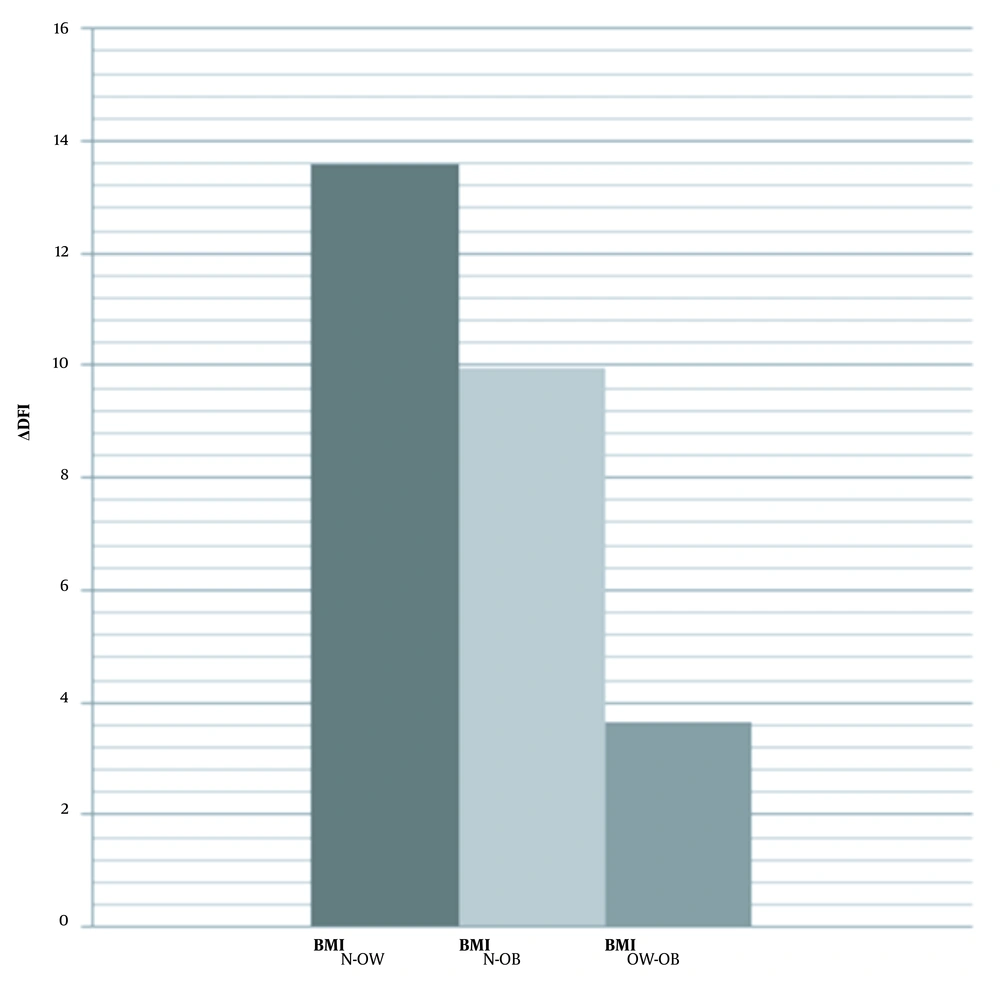
Figure 1.
Comparison of preoperative DFI between different groups based on BMI.
As can be seen in Table 4, the decrease in DFI before and 6 months after surgery of patients in terms of severity in II grade is 13.27 ± 5.23 and in III grade is three times 12.78 ± 13.49, which is statistically significant in both groups due to PV less than 0.05. Be. Also, the decrease in DFI before and 6 months after patients' surgery on laterality was 10.08 ± 13.04 on the left and 15.98 ± 18.16 on the right, which is statistically significant in both groups.
Table 4.Comparison of Severity and Laterality of Varicocele and ΔDFI Before and 6 Months After Surgery
| ΔDFI | P-Value | |
|---|---|---|
| Grade | ||
| II | 13.27 ± 5.23 | 0.001 |
| III | 12.78 ± 13.49 | 0.001 |
| Laterality | ||
| Left | 10.08 ± 13.04 | 0.002 |
| Bilateral | 15.98 ± 18.16 | 0.001 |
According to Table 5, the mean difference in DFI reduction before and 6 months after surgery between left and right varicocelectomy was 5.89 ± 5.12 with no significant difference between them (PV = 0.066 and also the mean difference in DFI reduction before and 6 months after From varicocelectomy surgery, between II and III grade was equal to 0.49 ± 8.26, which was not statistically significant (PV = 0.617).
Table 5.Comparison of DFI Reduction Before and 6 Months After Surgery in different Grade and Laterality
| Groups | ΔDFI | P-Value |
|---|---|---|
| Left to bilateral | 5.89 ± 5.12 | 0.066 |
| Grade of II to III | 0.49 ± 8.26 | 0.617 |
As can be seen in Table 6, the mean and standard deviation of patients before surgery in the total patient set was equal to 33.20 ± 17.6, which reached 20.31 ± 18.8 at 6 months after surgery, which shows a mean decrease of 12.89 ± 12.08, which is statistically significant (PV < 0.05).
Table 6.Mean and Deviation from DFI Criteria Before and 6 Months After Surgery in Terms of BMI
| BMI Groups | DFI Mean | ΔDFI | P-Value | |
|---|---|---|---|---|
| Before Surgery | 6 Months After Surgery | |||
| All | 33.20 ± 17.6 | 20.31 ± 18.8 | 12.89 ± 12.08 | 0.001 |
| BMIN | 42.95 ± 27.92 | 19.95 ± 14.25 | 23 ± 14.80 | 0.001 |
| BMIOW | 29.35 ± 11.62 | 18.80 ± 5.30 | 11.26 ± 11.69 | 0.001 |
| BMIOB | 33 ± 15.14 | 23.42 ± 8.10 | 9.58 ± 20.25 | 0.013 |
Also, the mean and standard deviation of patients with normal weight before surgery was 42.95 ± 27.92, which reached 14.25 ± 19.95 at 6 months after surgery, which shows an average decrease of 23 ± 23.80 which is statistically significant (PV < 0.05).
Also, the mean and standard deviation from of overweight patients before surgery was 29.35 ± 11.62, which reached 18.8 ± 5.30 at 6 months after surgery, which shows a decrease of 11.26 ± 11.69 on average, which is statistically significant (PV < 0.05).
Also, the mean and standard deviation of patients with obesity before surgery was 33 ± 15.14, which reached 23.42 ± 8.10 at 6 months after surgery, which shows a decrease of 9.58 ± 20.25 on average, which is statistically significant. (PV < 0.05).
In comparison with the reduction rate between different groups, in the normal weight group, a significantly greater DFI reduction is observed than in the overweight and obese group (Table 7), which has a difference of 11.73 ± 4.08 compared to the overweight group. Weight and 13.41 ± 4.41 were statistically significant compared to the obese group, which is statistically significant. The difference in DFI reduction before and 6 months after surgery between the overweight and obese groups was 1.68 ± 3.53, which was not statistically significant.
Table 7.Comparison of DFI Reduction Ratio Before and 6 Months After Surgery Between Different Groups in Terms of BMI
| BMI Groups | ΔDFI Mean | P-Value |
|---|---|---|
| BMIN | ||
| BMIOW | 11.73 ± 4.08 | 0.005 |
| BMIOB | 13.41 ± 4.41 | 0.003 |
| BMIOW | ||
| BMIOB | 1.68 ± 3.53 | 0.635 |
4. Discussion
Many problems, including diabetes and hypertension, and cardiovascular disease, and infertility in men and women, are associated with obesity and overweight (18). In addition to obesity, 30 to 50% of infertility cases in men are due to sperm disorders, which are important causes of infertility (19, 20).
According to the researches, the effects of increasing body mass index on DFI and the effect of BMI on DFI changes after varicocelectomy have not been studied. Therefore, in this study, the main purpose is to investigate these factors and the relationship between them.
The selected statistical population was 100 patients with primary infertility with varicocele who were candidates for surgery and were evaluated with no exclusion criteria. The age mean was 33.6 with a BMI mean of 28.6 and their mean infertility was 3.7 years. There were 64 patients with grade II varicocele and 36 patients with grade III varicocele, of which 49 patients underwent left varicocelectomy and 51 patients underwent bilateral varicocelectomy. Based on body mass index, individuals were divided into three groups with normal BMI (BMIN < 25), overweight (25 < BMIOW < 30), and obese (BMIOB > 30). The number of people in each group was 20, 49, and 31 patients, respectively. There was no statistically significant difference in body mass index on DFI and the relationship between DFI and BMI in all groups before surgery, but different results have been obtained in studies conducted in this field. This is consistent with a study conducted by Oliveira et al. (21) to evaluate the effect of BMI and, sperm quality and found no correlation between BMI and DFI, and a study by Andersen et al. (22), evaluation of BMI, waist circumference and sperm quality was performed. It was observed that a significant increase in BMI reduced movement and impaired normal sperm morphology and also an increase in BMI increased DFI, which had different results from the present study.
In another study conducted by Al Omrani et al. (17), investigated the study of lifestyle association and DFI values, it was found that BMI had a significant positive association with moderate DFI values (15 to 30%) while was not observed the association between BMI and DFI in mild cases (below 15 Percent) and severe (above 30%). To further compare the results of this study, we can refer to another study conducted by Lu et al., in assessing DFI and related factors and found no significant relationship between DFI and obesity indices including BMI and waist circumference (23) showed that it fitting well with the results. Therefore, according to the results obtained from several articles, the role of BMI on DFI was not clear and in the present study, no relationship was observed between BMI and preoperative DFI.
In this study, the rate of DFI reduction in patients with left and bilateral varicocelectomy showed that left varicocelectomy reduced DFI by 10.08% and bilateral varicocelectomy by 15.98%, which was significant DFI reduction before and after surgery in both groups, but there was no significant difference in the rate of DFI reduction between the two groups. The mean DFI of patients before surgery was 33.2%, which decreased by 12.89% to 20.31% 6 months after surgery, which is statistically significant. Also in the DFI study before and 6 months after surgery in the normal weight group showed that 6 months after surgery with an average reduction of 23% and in the overweight group with an average reduction of 11.27% and the obese group There was a 9.58% decrease in DFI, all of which are statistically significant.
Despite the significant reduction in DFI before and 6 months after surgery in all groups, but the benefit of the group with normal body mass index significantly compared to the overweight and obese group of surgery and also the reduction of their DFI has been higher, while there was no significant difference in the comparison of DFI reduction between the overweight and obese groups. Numerous studies have been performed to investigate the effect of varicocelectomy on DFI, and almost all studies point to the improvement of DFI after varicocelectomy.
A study by Alhathal et al. (24), Which examined microsurgical varicocelectomy and its effect on sperm DNA, found that varicocelectomy significantly reduced DFI from 16.3% preoperatively to 5.4% 6 months postoperatively. In the present study, the mean DFI was 33.2% before surgery, which decreased to 20.31% after surgery, and resulted in an average reduction of 12.89% DFI. There is a good agreement between the results. In confirmation of the obtained results, in another study conducted by Abdelbaki et al. (25), In which sperm analysis indices were evaluated before and 6 months after surgery, the reduction of DFI from 29.49 to 18.1 was reported, which is a significant correlation in These results were observed.
In another study conducted by Vahidi et al. (26), to evaluate the results of semen analysis, before and after surgery in different groups in terms of varicocele grade, it was observed that DFI decreased in patients with I grade varicocele from 15.4% to 5.6% before surgery. Arrived 6 months after surgery. Also in varicocele II grade from 16% before surgery to 12.7% after surgery and also in varicocele III grade from 16.8% before surgery to 11.9% postoperatively. It is noteworthy that in the present study, the DFI of patients with varicocele II grade decreased from 33.5 before surgery to 20.23 postoperatively and in patients with III grade varicocele from 32.67 to 19.86%, which is in good agreement with the results of this study.
Another issue to be noted in the present study, although the decrease in DFI before and after surgery was significantly reduced in both groups of patients with II and III grade, there was a significant difference between the groups of II and III grade varicocele compared to the reduction DFI was not observed before and after surgery. The main purpose of this study was to investigate the relationship between body mass index and changes in DNA fragmentation index in primary infertile patients following microscopic sub inguinal varicocelectomy, despite a significant decrease in DFI before and 6 months after surgery in all three. The group of patients with normal BMI, overweight and obesity was observed. However, in comparison with the reduction before and 6 months after DFI surgery between the three groups, the reduction in DFI in the normal BMI group was greater than in overweight or obese individuals. This difference was statistically significant but statistically significant compared to the reduction DFI was not observed between overweight and obese groups. Unfortunately, no study has been done to investigate the effect of BMI on DFI changes following varicocelectomy.
4.1. Conclusions
Based on the results, a decrease in DFI following microsurgical varicocelectomy was observed in all groups (normal BMI, overweight and obese), which was significant in all three groups. However, a significant difference in the rate of DFI reduction was observed only between the group with normal BMI compared to the overweight and obese groups, but no significant difference was observed between the overweight and obese groups.



