

1. Background
The COVID-19 pandemic sweeping across the whole globe has affected everyone in diverse ways. Chronic kidney disease patients have been affected in a very big way as they continue to visit the hospitals and hemodialysis units for continuity of care and to get regular dialysis sessions. The dialysis patients visit their dialysis center at least twice or traditionally thrice a week. The dialysis staff has also been working hard during these challenging times. Health care workers in the United States have expressed concerns about working with patients during the active pandemic (1). These challenges are complex and interact with each other. Hence, to prioritize the intervention and understand its complexity and interaction, we did a qualitative evaluation to understand the problem from team members’ point of view. Although qualitative research is increasingly used in many health care fields, it is underused and rarely reported in nephrology high-impact journals (2).
2. Objectives
The objective of the present study was to look at the problems afflicting the hemodialysis staff during the current COVID-19 pandemic in a rural medical setting.
3. Methods
Setting- The study setting was the hemodialysis unit of Sri Manakula Vinayagar Medical College Hospital, Pondicherry, India. Accreditation of the unit: This dialysis unit has been audited on a regular basis by an external nephrology consultant auditor for the last six years. It has also passed step ½ of the NABH accreditation process.
3.1. Design
It was an exploratory type of qualitative research using the free list and pile sort exercises. Free listing is an exercise that involves collecting mental thoughts in a dimension. It depicts the cultural salience of these thoughts within these groups. Written free listing is done with qualified staff and helps in rapid data collection (3, 4). It helps in identifying items in a cultural domain, indicates which of the things are most relevant, and shows us the extent of variation regarding the beliefs being probed (3-5). Pile sorting is also an exercise, which tells us how people think about certain ideas and how they organize their thoughts, about how they value things and attach importance to some particular themes.
Sample size and sampling - twelve dialysis unit staff members were interviewed as part of an FGD in the main hemodialysis unit of the Sri Manakula Vinayagar Medical College and Hospital. This is a busy hemodialysis unit catering to around 1300-1500 dialysis sessions a month. The patients have 24-hour access to dialysis facilities.
Data collection and analysis method - after exchanging pleasantries in the group and breaking the ice, “each dialysis unit staff was individually asked to make the free list of challenges faced by them during their work in the dialysis unit in the COVID-19 days. Each one of them wrote their responses on a paper. Participants were asked a primary stimulus question – “Please write down as many challenges as you face while working in dialysis unit during this COVID-19 time”. The responses for each of the participant was entered in a notepad and analyzed using the Visual Anthropac software package. The Smith's S value was calculated to identify the more prominent item in all the lists. We analyzed free listing using Anthropac software to get the most salient challenges faced by the team.
To understand the structure of the domain, we selected the top 12 salient items for pile sorting. The point, at which the Smith’s S score showed a sharp decline was taken a cut-off. All 12 participants were invited to join the pile sort exercise. Each of them was individually asked to group these items together to form the piles according to their criteria. Each staff member was interviewed again separately, and the reasons for their individual groupings were gathered. After pile sorting was done, a multidimensional scaling and hierarchical cluster analysis were done using Anthropac 4.983/X. The hierarchal mode of digital visualization of the perceptions in a cognitive domain emerged from the software. The concept of webbing or mental tapping (5) done here was a dynamic group interaction in the dialysis unit. The participants were dialysis nurses, technicians, and doctors. The key question in focus was their challenges during the present day COVID-19 pandemic. After the free listing and pile sorting were carried out, the input available from the listing and piles were taken up for analysis. Here, the major statistical analyses were done by a method called as multidimensional scaling, where all the pooled data (statements) were put into a basic map by using computer software. Here, each description/label/statement was represented by a point on the map. The main analysis involved taking the statements and dividing the map into groups or clusters (6-9) which should be logical and interpretative. After the concepts or labels were analyzed and interpreted, the results were available for further use. The final stage involved using the main thrust of the thoughts and ideas to be visualized clearly on the map generated as a form of pictorial depiction (10, 11) to bolster new changes or wants to be addressed for giving better care to our patients during these stressful and challenging times.
4. Results
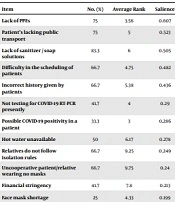
Out of 12 respondents, five were nurses, five were technicians, and two were doctors. Among them, three were males, and the remaining nine were females. Table 1 shows a free listing of twelve salient items in descending order of salience. As seen in Appendix 1 in Supplementary File, the structure of the cognitive domain of challenges faced by staff consisted of three sub-groups – (1) operational problems, (2) the major group consisted of items related to lack of personal safety for staff, and (3) concerns for lack of personal safety equipment for the staff. Appendix 2 in Supplementary File shows the Algorithm (flow chart) followed in the study.
Table 1.Free List of Salient Items (Challenges) Faced by the Dialysis Unit Staff
| Item | No. (%) | Average Rank | Salience |
|---|---|---|---|
| Lack of PPEs | 75 | 3.56 | 0.607 |
| Patient’s lacking public transport | 75 | 5 | 0.523 |
| Lack of sanitizer / soap solutions | 83.3 | 6 | 0.505 |
| Difficulty in the scheduling of patients | 66.7 | 4.75 | 0.482 |
| Incorrect history given by patients | 66.7 | 5.38 | 0.436 |
| Not testing for COVID-19 RT-PCR presently | 41.7 | 4 | 0.29 |
| Possible COVID-19 positivity in a patient | 33.3 | 3 | 0.286 |
| Hot water unavailable | 50 | 6.17 | 0.278 |
| Relatives do not follow isolation rules | 66.7 | 9.25 | 0.249 |
| Uncooperative patient/relative wearing no masks | 66.7 | 9.75 | 0.24 |
| Financial stringency | 41.7 | 7.8 | 0.213 |
| Face mask shortage | 25 | 4.33 | 0.199 |
5. Discussion
The main finding, as shown in Appendix 1 in Supplementary File, was about the issue of shortage of personal safety equipment (ie, lack of sanitizer, soap solutions, lack of hot water in the unit, lack of PPEs, and face mask shortage), which stood apart closely together despite repeated modeling a number of times on the software of the computer. The second finding as a cluster was that of the danger to the personal safety of the staff (incorrect history given by patients, relatives not following isolation rules, patients and relatives not wearing masks, unavailability of testing for RT-PCR, and fear/possibility of COVID-19 positivity. The third finding as a cluster highlighted was the logistics and operational issues (patient lacking public transport, difficulty in the scheduling of patients, and financial stringency)
In prioritizing the different clusters, the first cluster chosen was the one dealing with shortages of personal safety equipment for the dialysis staff. As a result of the information gathered from the dialysis staff, we immediately talked to the various stakeholders in the institution's hierarchy, apprised them of our findings, and showed them the results of the cluster mapping. They agreed to immediately order fresh standard masks, PPEs, and sanitizers and provide hot water for the unit. The dialysis staff was very appreciative of the immediate outcomes. There were remarkable transformation and positivity in the behavior and the work culture of the unit members.
The second group of clusters as regards the patients and their relatives not adhering to infection control practices, didactic meetings were held with them, and the wearing of face masks and following isolation and infection control measures were stressed upon. The issues touched upon in the above two clusters were within our purview, and we were able to address them successfully.
The problems regarding RT-PCR testing were the hospital management to ponder upon, which they readily agreed to discuss and act upon, and they stated that they will get the RT-PCR machine.
The third cluster of issues pointed out was really beyond our control, ie, regarding the lack of public transport owing to lockdowns, disarray in the scheduling of patients (again due to lack of transport), and the general financial depression. This was under the domain of the government and other official authorities. The patients successfully petitioned the collector and government officials to get them dropped to the hospital using government ambulances.
Nowadays, most people are usually more concerned about the RT-PCR and antibody testing, but our results showed that the concerns of dialysis staff were mainly centered upon protecting themselves (personal safety) by means of proper PPEs while caring for their patients.
The best strategy to prevent COVID-19 transmission is frequent hand washing, maintaining physical distancing, proper cough and sneeze etiquette, and regular environmental disinfection in the dialysis unit (12-14). Finding of the real issues bothering our health care staff was not a technical ability but was actually an elective, focused bonding towards them! The main direction of our outlook was to consider the staff working with us as an individual and not to just treat them like some stereotype. Finally, it was our job to consider them as our fellow human beings facing the fear of the unknown and uncertainity (15) and not to consider it serousely (16).
The challenges of COVID-19 in a rural health care facility has their own multidimensional impact, such as the lack of testing services, poor surveillance, and acute shortage of equipment and PPEs (17). Also, the financial burden during these challenging times casts a shadow on the smooth functioning of the dialysis units directly affecting patient care.
In challenging and high-pressure environments, the burnout rates are very high, like in busy dialysis units. The burden of the moral dilemmas afflicting the health care staff due to lack of equipment can easily lead to stress, depression, anxiety, post-traumatic stress disorder, and even suicide. Hence, as a clinical director of a dialysis unit or as a dialysis manager, it is our foremost duty to make sure the staff is provided with evidence-based care and support materials (18). Appreciation of the staff and expressing gratitude for their work during stressful times can raise their confidence levels and improve resilience (19).
Health care workers constantly face an ethical dilemma, which is fueled by the lack or inequitable distribution or even reusage of PPEs or masks (20). The similar challenges faced by staff in some health care centers across Africa are of gargantuan proportions because of global jostling (21), lack of low-cost face masks, and even lack of water for handwashing (22). Invaluable lessons were learned at the time of Ebola in Africa and even in HIV control, where dispelling myths and support to health care workers led the way forward (23).
A recent qualitative study from China using semi-structured in-depth interviews (empirical phenomenological approach) reported challenges faced by health care workers in COVID-19 wards, exhaustion, fear of getting infected, and infecting others (especially family).They suggest comprehensive support in the form of adequate protective gear, effective communication, monitoring, and surveillance of infection control (24).
5.1. Strengths and Limitations
The study procedure was sequential in nature, where the free listings directed pile sorting, which showed new direction to the focus groups, ultimately contributing to the validity of the findings. The study was rapid, and findings in visual format were easy to understand and evoked discussion among the participants. The findings were useful in understanding the dynamics for decision-making and action-taking. Data saturation was achieved, adding more weightage to this study. There is scope for transferability of these findings to other departments in a hospital and various institutions in the surrounding areas of Pondicherry, all over India, and elsewhere as such. The COREQ guidance (consolidated criteria for reporting qualitative research) as shown in Appendix 2 was applied while drafting this paper, which added to the rigor, clarity, and transparency of this study (24-26). There were some limitations in this study. The background of the researcher and personal biases of the researcher could not be eliminated fully. Another limitation was that we did not further analyze the subgroups by separating the dialysis nurses, dialysis technicians, and the doctors, as our aim was to see the whole dialysis unit as one cohesive and patient-centric group.
Despite all the challenges faced by the dialysis staff, the patients also have their challenges b, they demonstrate remarkable resilience (27). It would be worthwhile to get away from a traditional problem-oriented approach to examine the strengths and vulnerabilities of our dialysis staff as done in patient-oriented research (28).
5.2. Implications and Outcomes of This Study
This study also illustrated that such a qualitative research process by itself involves the subtle interrelationships, and the intricacies of human interaction (29). We can use these research methods to resolve problems confronting our health care units.
This study throws new light on the thoughts, doubts, fears, and priorities donning the minds of the dialysis staff members. This is also a novel and rapid way of getting more insight into the behaviors of the staff working in dialysis units. It also will help in improving the group dynamics in a fast-paced and high-stress area of hemodialysis.
5.3. Conclusions
The results of this qualitative study in dialysis staff showed the significance of the health care workers' thoughts, ideas, and fears need to be addressed appropriately during these mitigating circumstances. This will lead to better and focused patient care, yielding better clinical outcomes in the dialysis units, especially during pandemics and disasters.
5.4. Standard for Reporting
Consolidated criteria for reporting qualitative studies (COREQ guidelines and Methodology was followed while writing this manuscript).