



1. Background
Kidney transplantation is the preferred treatment for chronic renal failure (CRF), and perioperative fluid and acid-base management are crucial for graft perfusion and optimal outcomes. Arterial blood gas (ABG) analysis plays a key role in assessing acid-base balance in patients undergoing kidney transplantation, who often experience disturbances in acid-base equilibrium due to factors such as anesthesia, surgical stress, fluid management (1), and post-transplant changes in renal function (2). Arterial blood gas analysis serves as an early indicator of complications, like metabolic acidosis or respiratory alkalosis, which may signal graft dysfunction, inadequate perfusion, or electrolyte imbalances (3), all of which can influence transplant outcomes (4).
Monitoring ABG parameters, such as pH, bicarbonate levels, and base excess (BE), provides valuable insights into the functional status of the transplanted kidney (5, 6) and assists in guiding clinical decisions regarding fluid therapy, electrolyte supplementation, and ventilator adjustments. Furthermore, ABG results are instrumental in predicting long-term outcomes (7), including graft survival, recovery of renal function, and patient morbidity and mortality (8). Understanding these correlations aids in developing tailored post-transplant care strategies (9).
Comparative studies on different perioperative management protocols, particularly those guided by ABG analysis (10), emphasize the effectiveness of various fluid therapy regimens (11) in enhancing graft function and improving overall patient outcomes (12). These studies investigate the impact of balanced crystalloids versus saline solutions on post-operative renal function, electrolyte balance, and acid-base status (13), offering valuable insights into optimal strategies for managing patients undergoing kidney transplantation.
Finally, existing research lacks comprehensive evaluations of the comparative effectiveness of different treatment protocols guided by ABG analysis for optimizing kidney transplant outcomes. Research on ABG and its correlation with kidney transplantation outcomes could address critical clinical needs, including assessing acid-base status, early detection of complications, monitoring graft function, guiding treatment decisions, predicting long-term prognosis, and evaluating the effectiveness of various treatment protocols.
2. Objectives
To assess ABG changes before and after kidney transplant and identify predictors of post-operative acidosis in patients with renal failure through cross-sectional studies.
3. Methods
3.1. Study Design and Participants
This is a retrospective cohort study, based on data gathered from patients who underwent kidney transplants. The study was reviewed and approved by the University of Medical Sciences Ethics Committee with the IRB ethics number IRB.KMU.REC.1396.1246. The procedures conducted in this research adhered to the Helsinki Declaration-2013.
Recruitment was conducted using consecutive sampling based on the availability of patients at the time of the study, provided they met the inclusion and exclusion criteria. The inclusion criteria were patients aged between 25 and 70 years who were candidates for elective kidney transplantation. The exclusion criteria included severe congestive heart failure (EF ≤ 35%), serum potassium level > 6 mEq/L, serum sodium level > 155 mEq/L, severe hypotension (SBP ≤ 90 mmHg), and the need for catecholamine infusion due to uncontrolled surgical bleeding.
Sample size justification was based on a power analysis conducted by our research consultant from the Public Health Department, which indicated a minimum requirement of 90 patients. In total, 97 patients who had undergone kidney transplantation were enrolled in the study. All candidates for renal transplantation were informed that their participation in the study would not affect their treatment. This study included 97 patients, classified as American Society of Anesthesiologists (ASA) class 2 and 3, who underwent renal transplantation.
3.2. Interventions and Parameter Definitions
Standard monitoring, as recommended by the ASA, was implemented for all patients. A central venous catheter was inserted into the right internal jugular vein after anesthesia induction for the infusion of crystalloids and central venous pressure (CVP) monitoring. All patients underwent hemodialysis 24 hours prior to surgery.
General anesthesia was induced using a combination of intravenous midazolam (0.05 mg/kg), fentanyl (2 μg/kg), atracurium (0.5 mg/kg), and sodium thiopental (4 - 5 mg/kg). Maintenance of anesthesia was achieved with isoflurane in an air/oxygen mixture and bolus injections of fentanyl (2 μg/kg) every hour. Muscle relaxation was maintained with IV atracurium (0.2 mg/kg every 30 minutes).
Intraoperative fluid replacement therapy followed this protocol: Patients were divided into two groups, with 49 receiving only normal saline and 48 receiving only Ringer's lactate. Each patient was administered 20 - 25 ml/kg/h of crystalloid fluids, titrated continuously during anesthesia, with CVP maintained between 10 - 20 cm H2O.
Blood samples were collected by anesthesia-trained personnel at specific timelines and immediately sent to the laboratory. The data were promptly reported to the main anesthesiologist responsible for patient care and research. A research assistant recorded the data according to guidelines, and any missing data were addressed by the trained research assistant.
Acidosis was defined based on ABG parameters as follows: pH < 7.35 and HCO₃⁻ < 22 mEq/L. In cases of severe acidosis (BE ≤ −15 mEq/L, serum bicarbonate level ≤ 10 mEq/L, or pH ≤ 7.15), sodium bicarbonate was administered. Blood products were administered as clinically indicated following ASA recommendations. Any unexpected complications arising during anesthesia were managed by the attending clinicians.
The patients were ventilated using continuous mandatory ventilation (CMV) mode with the following initial settings: RR = 10, TV = 8 cc/kg, and an I/E ratio of 1 : 2. The ventilator settings (RR or TV) were adjusted every 30 minutes based on the ABG results by the clinician responsible for the patient's care to maintain PaCO₂ levels between 35 to 40 mmHg.
All transplantation surgeries were performed by the same surgical team, which included a urologist and a vascular surgeon. All donors received 0.25 g/kg of mannitol infusion just before the procurement of the left kidney via an open approach. The donor kidneys were flushed with lactated Ringer’s solution before being transferred to the operating room. The kidneys were implanted in the right or left retroperitoneal space of the recipients. Each recipient received 5,000 units of intravenous heparin three minutes before clamping. Additionally, all patients were administered 2 mg/kg of furosemide immediately after de-clamping the implanted kidney as part of the routine protocol. The patients’ mean arterial pressure (MAP) was recorded just before and 15 minutes after the furosemide injection.
3.3. Data Collection and Time Points
The study timeline was as follows: A pre-operative sample was collected 24 hours before surgery. Intra-operative measures began with the insertion of an arterial line after anesthesia induction, and the first ABG sample was collected via the arterial cannula immediately after anesthesia induction, serving as the pre-operative measure. An intra-operative sample was collected every hour during surgery, and a post-operative sample was taken 24 hours after surgery.
For monitoring additional parameters, the same time points were followed. Post-operative measurements were recorded every hour for the first 6 hours and then every 4 hours until 24 hours post-surgery. Parameters monitored included blood pressure, heart rate, respiratory rate, temperature, and oxygen saturation. Pain was assessed using the Numerical Rating Scale (NRS) every 1 - 2 hours initially, then every 4 - 6 hours as needed.
No post-operative complications such as atelectasis, pneumonia, cardiovascular complications like venous thromboembolism (VTE), infections, or acute kidney injury (AKI) were observed.
3.4. Data Analysis
Statistical calculations were conducted using SPSS 22 (IBM Corp., Armonk, NY, USA). The sample size was determined based on a 7% prevalence of acidosis, with a 95% confidence level and an allowable margin of error of ± 5%. Independent samples t-tests or Mann-Whitney U tests were used to compare post-operative ABG values between groups of patients who received Ringer’s solution versus normal saline. We also employed paired t-tests or Wilcoxon signed-rank tests to compare ABG variables before and after the operative measurements. The rationale for selecting pH and HCO3 was that they indicate acidosis in ABG analysis. All data were tested for normality using the Kolmogorov-Smirnov method. Parametric variables were presented as mean ± SD and were analyzed using the t-test or Mann-Whitney U test. For paired data, we utilized paired t-tests or Wilcoxon signed-rank tests for comparison. Non-parametric variables were analyzed using the chi-Square test or Fisher’s Exact test. A P-value of < 0.05 was considered statistically significant. For the potential confounding factors, such as BMI, ischemic time, and amount of fluid, we used multivariate regression analysis to assess the relationship between the dependent variable and the independent variables while controlling for these confounders.
4. Results
A total of 97 patients were enrolled in the study, of which 65 (69.4%) were male and 32 (30.6%) were female. The mean age was 38.6 ± 12.2 years, with the youngest patient being 20 years old and the oldest 64 years old. The causes of renal failure were as follows: Renal stone (16%), diabetes mellitus (DM) (10%), hypertension (HTN) (44%), polycystic disease (7%), and unknown causes in 23% of the patients (Table 1).
Table 1.Demographics Variables
| Variables | Values a |
|---|---|
| Age | 38.6 ± 12.2 |
| Gender | |
| Male | 65 (69.4) |
| Female | 32 (30.6) |
| Medical conditions | |
| Diabetes | 10 |
| Hypertension | 44 |
| Polycystic disease | 7 |
| Renal stone | 16 |
| Unknown | 23 |
| Donor | |
| Cadaver | 28 (29) |
| Live | 69 (71) |
| Anesthesia method | |
| Inhalational | 75 (77) |
| Total intra-venous anesthesia | 22 (23) |
| Height (cm) | 164.5 ± 67.7 |
| Weight (kg) | 62.5 ± 11.7 |
| BMI (kg/m2) | 23.16 ± 3.75 |
| Lasix dose administered (mg) | 67 ± 15.5 |
| Total fluid administered (mL) | 3885 ± 703 |
| Ischemic time (min) | 33.5 ± 12.6 |
a Values are expressed as mean ± SD, No., or No. (%).
The types of dialysis performed prior to transplant were hemodialysis in 93.8% of the patients and peritoneal dialysis in 6.2%. The mean duration of dialysis for these patients was 29.6 ± 33.8 months, with the shortest being 6 months and the longest 120 months. The mean total fluid administered perioperatively was 3885 ± 703 mL.
4.1. Arterial Blood Gas Analysis
Arterial blood gas was measured before and after surgery, and the values were compared (Table 2). Significant decreases were observed in HCO₃, pH, and BE post-operatively compared to pre-operative values (P < 0.001). There were no significant changes in other ABG variables. However, there was a significant increase in CVP post-operatively (P < 0.001) (Table 2).
Table 2.Arterial Blood Gas Variables in 24 Hours Pre- and 24 Hours Post-operative Measurement
| Variables | Pre-operative Value a | Post-operative Value a | Mean Difference (95% CI) | P-Value |
|---|---|---|---|---|
| HCO3 | 20.02 ± 3.9 | 16.1 ± 3.2 | -3.92 (-4.95, -2.89) | 0.0001 |
| pH | 7.38 ± 0.08 | 7.21 ± 0.24 | -0.17 (-0.21, -0.13) | 0.0012 |
| Base excess | -4.3 ± 4.6 | -9.1 ± 6.2 | -4.8 (-6.23, -3.37 | 0.0014 |
| Base excess (ecf) | -4.95 ± 3.4 | -8.61 ± 6.9 | -3.66 (-5.36, -1.96) | 0.29 |
| PaCO2 | 33.83 ± 5.3 | 36.65 ± 5.7 | 2.82 (1.19, 4.45) | 0.145 |
| PaO2 | 289.7 ± 117.2 | 288.2 ± 91.5 | -1.5 (-33.94, 30.94) | 0.32 |
| CVP | 13.56 ± 3.04 | 19.08 ± 4.35 | 5.52 (4.45, 6.59) | 0.0031 |
Abbreviations: CVP, central venous pressure; PaO₂, pressure arterial of oxygen; ecf, extra-cellular fluid.
a Values are expressed as mean ± SD.
4.2. Comparison of Fluid Types
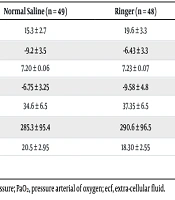
Arterial blood gas values for HCO₃ (p = 0.010), BE (P = 0.002), and pH (P = 0.023) were significantly lower in the normal saline group compared to the Ringer's lactate group (Table 3). There were no significant differences in PaCO₂ and PaO₂ between the two groups (Table 3). Post-operative CVP was significantly higher in the normal saline group (P = 0.031).
Table 3.Post-operative Arterial Blood Gas Values (24h) in Two Groups of Patients Who Received Ringer’s Solution Versus Normal Saline a
| Variables | Normal Saline (n = 49) | Ringer (n = 48) | Mean Difference (95% CI) | P-Value |
|---|---|---|---|---|
| HCO3 | 15.3 ± 2.7 | 19.6 ± 3.3 | 4.3 (3.2, 5.4) | 0.010 |
| Base excess | -9.2 ± 3.5 | -6.43 ± 3.3 | 2.77 (1.5, 4.04) | 0.002 |
| pH | 7.20 ± 0.06 | 7.23 ± 0.07 | 0.03 (0.01, 0.05) | 0.023 |
| Base excess (ecf) | -6.75 ± 3.25 | -9.58 ± 4.8 | -2.83 (-4.26, -1.40) | 0.014 |
| PaCO2 | 34.6 ± 6.5 | 37.35 ± 6.5 | 2.75 (-0.15, 5.65) | 0.42 |
| PaO2 | 285.3 ± 95.4 | 290.6 ± 96.5 | 5.3 (-28.38, 38.98) | 0.19 |
| Post-op CVP | 20.5 ± 2.95 | 18.30 ± 2.55 | -2.2 (-3.3, -1.1) | 0.031 |
Abbreviations: CVP, central venous pressure; PaO₂, pressure arterial of oxygen; ecf, extra-cellular fluid.
a Values are expressed as mean ± SD.
4.3. Multivariate Regression Analysis
Variables significantly associated with post-operative acidosis were total fluid administered (OR: 3.25, 95% CI: 1.45 - 4.58), post-operative CVP (OR: 2.31, 95% CI: 1.23 - 2.62, P < 0.05), and post-operative BE (OR: 2.16, 95% CI: 1.50 - 2.95, P < 0.05). Use of normal saline (compared to Ringer's lactate) was associated with post-operative acidosis (OR: 1.72, 95% CI: 1.26 - 2.45, P < 0.05) (Table 4).
Table 4.Association of Variables with Post-operative Acidosis
| Variables | OR (95% CI) | P-Value |
|---|---|---|
| Total fluid administered | 3.25 (1.45 - 4.58) | 0.020 |
| Post-op CVP | 2.31 (1.23 - 2.62) | 0.005 |
| Post-op base excess | 2.16 (1.50 - 2.95) | 0.035 |
| Normal saline | 1.72 (1.26 - 2.45) | 0.0016 |
| Ringer | 1.29 (0.89 - 1.70) | 0.33 |
| Post-op PaCO2 | 1.12 (0.65 - 1.30) | 0.065 |
Abbreviations: OR, odds ratio; CI, confidence interval; CVP, central venous pressure.
Variables significantly associated with increased post-operative CVP were total fluid administered, post-operative pH (OR: 1.44, 95% CI: 1.29 - 1.90), and post-operative BE (OR: 1.39, 95% CI: 1.18 - 1.78, P < 0.05). Neither normal saline nor Ringer's lactate was significantly associated with increased post-operative CVP (Table 5).
Table 5.Association of Variables with Post-operative CVP
| Variables | OR (95% CI) | P-Value |
|---|---|---|
| Total fluid administered | 2.41 (1.22 - 3.39) | 0.004 |
| Post-op pH | 1.44 (1.29 - 1.90) | 0.018 |
| Post-op base bxcess | 1.39 (1.18 - 1.78) | 0.029 |
| Normal saline | 0.84 (0.70 - 1.25) | 0.058 |
| Ringer | 0.75 (0.62 - 1.19) | 0.37 |
| Post-op PaCO2 | 1.36 (0.79 - 1.77) | 0.16 |
Abbreviations: OR, odds ratio; CI, confidence interval; CVP, central venous pressure.
Variables associated with post-operative BE included post-operative acidosis (OR: 2.30, 95% CI: 1.64 - 2.93), post-operative CVP, and the use of normal saline (compared to Ringer's lactate), which was significantly associated with post-operative BE (OR: 1.91, 95% CI: 1.56 - 2.77, P < 0.05) (Table 6).
Table 6.Association of Variables with Post-operative Base Excess
| Variables | OR (95% CI) | P-Value |
|---|---|---|
| Post-op acidosis | 2.30 (1.64 - 2.93) | 0.003 |
| Post-op CVP | 1.74 (1.25 - 2.40) | 0.015 |
| Normal saline | 1.91 (1.56 - 2.77) | 0.005 |
| Post-op HCO3 | 1.56 (0.75 - 1.87) | 0.064 |
| Ringer | 1.20 (0.89 - 1.60) | 0.16 |
| Post-op PaCO2 | 1.32 (0.63 - 1.79) | 0.22 |
Abbreviations: OR, odds ratio; CI, confidence interval; CVP, central venous pressure.
5. Discussion
Previous reports have indicated that ABG variables can vary significantly between pre- and post-operative periods following kidney transplantation. These ABG variables are vital markers for anesthesiologists, particularly as indicators for fluid therapy during the transplant process. The maintenance of optimal acid-base balance during renal transplant surgeries plays a critical role in determining the success of the procedure. Proper preload and electrolyte management are essential in achieving this balance.
Acidosis is a crucial factor influencing kidney transplant outcomes, as it directly affects renal function post-surgery. In our study, we observed a statistically significant decrease in pH levels during surgery, with post-operative acidosis being associated with the total volume of fluids administered, CVP, and post-operative BE. This association was particularly evident in patients who received normal saline compared to those who were administered Ringer’s lactate solution.
Our findings are consistent with other studies that suggest intra-operative acidosis, requiring bicarbonate infusion, is linked to improved early post-operative renal function in kidney transplant recipients. Interestingly, acidosis in transplant patients manifests at higher estimated glomerular filtration rate (eGFR) levels than in patients with chronic kidney disease (CKD), suggesting different underlying mechanisms (14, 15). This variation is likely due to normal anion gap acidosis caused by renal tubular acidosis (RTA) in transplant patients, in contrast to the high anion gap acidosis typically seen in CKD patients (16).
Additionally, our study demonstrated a significant post-operative decrease in BE compared to pre-operative levels. This reduction was more pronounced in the normal saline group (-9 mEq/L) than in the Ringer's lactate group (-6 mEq/L). The decrease in BE is primarily attributed to the increased chloride load associated with normal saline (approximately 10 mEq/L). According to the Stewart-Fencl approach, this excess chloride leads to a reduction in the strong ion difference (SID) (17), which, in turn, decreases BE. While other anions, such as sulfate, phosphate, and fumarate, accumulate in patients with CRF, their contribution to acid-base balance is minimal compared to chloride. Given that large volumes of crystalloids are often required during renal transplantation, the resultant hyperchloremia becomes a critical factor contributing to post-operative acidosis (18).
This hyperchloremia can lead to renal vasoconstriction and reduced renal blood flow (19), subsequently decreasing the glomerular filtration rate (GFR) post-transplant due to elevated chloride levels in the distal tubule (20). Therefore, our study suggests that BE should be regarded as a key indicator of hyperchloremia during kidney transplants, and controlling chloride levels may be essential for optimizing transplant outcomes (21).
Our study hypothesized that the choice of perioperative crystalloid solution would significantly influence post-operative acid-base balance and, consequently, kidney transplant outcomes. The findings support this hypothesis, demonstrating that post-operative ABG changes varied depending on the type of crystalloid used. Specifically, patients in the normal saline group exhibited higher levels of acidosis compared to those in the Ringer's lactate group. This aligns with our expectation that the higher chloride content in normal saline would result in more pronounced decreases in pH and BE, as observed in our results (22, 23). Conversely, the Ringer's group showed a greater increase in HCO₃ and PaCO₂, indicating a more favorable acid-base balance, further supporting the use of balanced solutions like Ringer's, which contain lower chloride levels and are less likely to induce acidosis.
The results of our study resonate with previous findings, which have prompted ongoing debate over the choice of perioperative crystalloids in renal transplant surgeries (24). While it has been reported that both Ringer's lactate and normal saline can cause acidosis during kidney transplants, our findings provide additional evidence that normal saline is more likely to induce significant acidosis compared to balanced solutions like Ringer's lactate (25, 26). This is particularly relevant, as acidosis is a frequent and potentially harmful complication during kidney transplantation, with the potential to adversely affect post-operative renal function if not properly managed.
An interesting finding in our study was the significant increase in CVP between the pre-operative and post-operative periods. This suggests that volume overload, potentially exacerbated by the type of fluid administered, may contribute to the observed changes in ABG parameters. This supports our hypothesis that fluid management during kidney transplant surgery is critical, not only for maintaining volume status but also for influencing acid-base balance, and thereby affecting transplant outcomes (27).
5.1. Limitations
However, our study has certain limitations. While ABG values provide valuable snapshots of the patients' physiological status, they do not reflect long-term outcomes or the overall success of the kidney transplantation process. Additionally, the heterogeneity among kidney transplant recipients, including differences in the underlying causes of kidney failure and variations in immunosuppressive regimens, complicates the interpretation of ABG findings. Future longitudinal or cohort studies are necessary to fully assess the impact of different crystalloid solutions on long-term transplant success.
5.2. Conclusions
In conclusion, the significant post-operative ABG changes, such as decreases in pH and HCO₃ levels, are key indicators of kidney transplant outcomes, reflecting graft function and patient stability. These findings underscore the importance of careful monitoring and timely management of acidosis to optimize transplant success and minimize complications. The choice of crystalloid solutions is essential in this context, with balanced solutions like Ringer's lactate demonstrating a more favorable acid-base profile compared to normal saline.
Future research should focus on conducting longitudinal studies to evaluate the long-term impact of ABG changes on transplant outcomes and investigate the mechanisms underlying the effects of different fluids. Additionally, further studies could aim to develop predictive models for identifying patients at higher risk for post-operative complications, facilitating more targeted interventions.