
1. Context
Multiple myeloma (MM), although generally considered rare, is the second most common blood cancer, with a significantly higher incidence in more industrialized areas. The disease predominantly affects older adults, typically in the seventh to eighth decades of life, and it is more common in men than in women. Because MM results in widespread end-organ damage, including bone disease, anemia, hypercalcemia, and renal involvement, it carries a significant burden of complications (1-6).
Renal failure is one of the most serious and debilitating complications of MM, affecting up to half of patients and significantly worsening prognosis, treatment tolerance, and survival. According to previous studies, patients presenting with multiple myeloma-related renal failure (MM-RF) may have a median survival of roughly 2 months, underscoring the critical impact of renal dysfunction on overall outcomes (7). The main cause of MM-RF is the overproduction of monoclonal free light chains (FLCs), which cause tubular obstruction and toxicity (8, 9). Although chemotherapy is essential to reduce light chain production, it may not act rapidly enough to prevent irreversible kidney damage in patients presenting with severe renal impairment. Plasmapheresis has been proposed as an adjuvant therapy capable of rapidly removing circulating FLCs, thereby potentially reducing tubular damage and promoting faster renal recovery (10-12).
There have been a few and limited number of studies evaluating the therapeutic efficacy of plasmapheresis as an adjunct to chemotherapy in the management of MM-RF, and their findings remain inconsistent. Therefore, a systematic review is necessary to synthesize and clarify the available evidence, assess whether plasmapheresis in combination with chemotherapy has meaningful renal or survival benefits, and identify knowledge gaps that should be addressed in future research.
2. Evidence Acquisition
The present systematic review was designed, conducted, and reported in accordance with the PRISMA 2020 (Preferred Reporting Items for Systematic Reviews and Meta-Analyses) guidelines (13). Each step was performed by two independent reviewers (RH and FM), and any discrepancies between reviewers were resolved through discussion or adjudication by a third reviewer (MM). The protocol for this study has not been registered with any organization.
3. Data Sources
A comprehensive literature search was performed covering PubMed, Web of Science, Cochrane Library, Embase, and Google Scholar databases from inception to October 2025 without any language restriction. The search terms and keywords used were: "myeloma" OR "multiple myeloma" OR "plasma cell myeloma" OR "plasmacytoma" OR "myxomatosis" OR "kahler disease" AND "plasmapheresis" OR "plasma exchange". We also searched the grey literature and ClinicalTrials.gov. Additionally, reference lists of the selected studies were manually examined to identify further eligible studies. The detailed search strategy is depicted in Appendix 1 in the Supplementary File.
4. Study Selection
4.1. Eligibility Criteria
Randomized clinical trials (RCTs) and observational studies were included if they evaluated the effect of plasmapheresis on kidney function or survival in adult patients (≥ 18 years) with MM and any degree of renal impairment, including those requiring dialysis. Eligible studies examined plasmapheresis administered alongside chemotherapy or standard anti-myeloma therapy. Case reports, small case series (fewer than five patients), reviews, editorials, letters, conference abstracts without sufficient data, and animal or laboratory studies were excluded.
4.2. PICO Framework
P (population): Adult patients (≥ 18 years) with MM and any degree of renal impairment; Intervention: plasmapheresis administered as an adjuvant therapy to standard chemotherapy or other anti-myeloma therapies; Outcomes: The primary outcomes of interest were survival and renal function outcomes. Secondary outcomes included hematologic response, proteinuria, and adverse events associated with treatment.
5. Data Extraction
Data comprising the name of the first author, the year of publication, sample size, patients’ demographics (i.e., age, sex), and clinical data including renal failure definition, the frequency of dialysis-dependent patients at baseline, chemotherapy regimen, plasmapheresis protocol, and serum levels of creatinine were extracted using a checklist. Data extraction was performed independently by two reviewers.
5.1. Risk of Bias Assessment
Two independent researchers evaluated the risk of bias of eligible RCTs according to the Cochrane Handbook recommendations (version 5.1.0) (14). Risk of bias assessment was performed based on 6 key domains: Random sequence generation, allocation concealment, blinding of participants and personnel, blinding of outcome assessment, data, and selective reporting. Ultimately, risk of bias was categorized as low, high, or unclear. For observational studies, quality evaluation was conducted based on the Newcastle-Ottawa Scale (NOS) by two independent researchers (15). According to the scale, each study could receive up to 10 points, with 5 points allocated for evaluating participant selection, 2 scores for comparability, and 3 scores for outcome assessment. A total score equal to or greater than 7 was indicative of high methodological quality.
5.2. Data Synthesis
A narrative evidence-based synthesis was performed to integrate findings from the eligible studies. A meta-analysis was not performed due to substantial methodological and clinical heterogeneity across the included studies. The RCTs and observational studies varied widely in study design, sample size, patient populations, definitions of renal failure and renal recovery, plasmapheresis protocols (number of sessions, exchange volume, replacement fluids), chemotherapy regimens, and duration of follow-up.
6. Results
6.1. Search
Figure 1 shows the flowchart of the study selection process. The initial systematic search yielded 3831 publications. Titles and abstracts of retrieved records were reviewed, excluding 1649 duplicates and 2169 unrelated records. The full texts of the remaining 13 studies were rigorously screened for eligibility. Finally, three RCTs (n = 147) (16-18) and five observational studies (n = 157) (19-23) were included. Table 1 summarizes the characteristics of the included RCTs, and Table 2 provides the corresponding details for the observational studies.
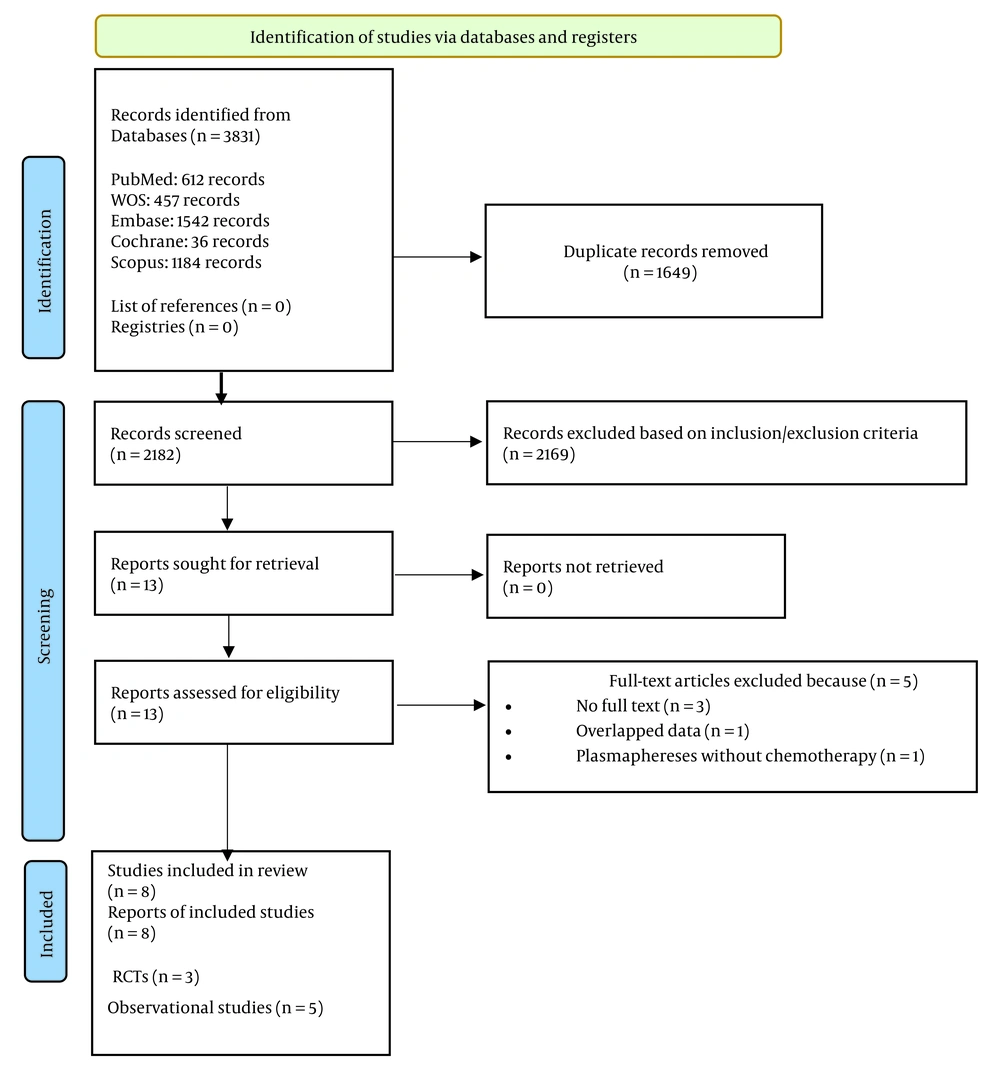
Figure 1.
PRISMA flow diagram for the present systematic review
Table 1.
Characteristics of Randomized Clinical Trials Evaluating Plasmapheresis in Multiple Myeloma-Related Renal Failure
| Study (Author, Year) | Renal Failure Definition | Sample Size | Mean Age (y) Control / Intervention | Male (%) Control / Intervention | Dialysis at Baseline (%) Control / Intervention | Baseline Serum Creatinine (µmol/L) Control / Intervention | Plasmapheresis Protocol | Chemotherapy Regimen | Risk of Bias |
|---|---|---|---|---|---|---|---|---|---|
| Clark et al., 2005, (16) | Serum creatinine > 200 µmol/L with ≥ 50 µmol/L recent rise despite correction of metabolic abnormalities | C: 39I: 58 | 61.3 / 65.2 | 71.8 / 63.8 | 48.7 / 41.4 | 460.4 ± 187.6 / 422.5 ± 213.6 | 5 - 7 exchanges; 50 mL/kg; 5% albumin replacement | Melphalan-prednisone cycles or VAD regimen | High |
| Johnson et al., 1990, (17) | Serum creatinine ≥ 270 µmol/L or rising despite correction of hypovolemia, infection, or obstruction | C: 10I: 11 | 67 / 64 | 50.0 / 54.5 | 50.0 / 63.6 | 730 ± 300 / 880 ± 540 | 3 sessions/week for 1 - 4 weeks; mean 48.6 mL/kg exchanged | Melphalan + prednisone (7-day courses every 6 weeks) | High |
| Zucchelli et al., 1988, (18) | Rapid rise in creatinine ≥ 5 mg/dL, not reversible by correction of volume or obstruction; previously normal renal indices | C: 14I: 15 | 63.2 / 62.9 | 66.7 / 78.6 | 78.6 / 86.6 | 986.8 ± 295.3 / 816.1 ± 207.8 | 5 consecutive daily exchanges; 3 - 4 L plasma removed/session | Methylprednisolone pulses + prednisone + IV cyclophosphamide | High |
Abbreviations: C, control group; VAD, vincristine, driamycin, and dexamethasone.
Table 2.
Characteristics of Observational Studies Evaluating Plasmapheresis in Multiple Myeloma-Related Renal Failure
| First Author and Year of PublicAtion | Renal Failure Definition | Sample Size | Mean Age (y) | Male | Patients Required Dialysis at Baseline | Mean Serum Creatinine at Baseline (µmol/L) | Plasmaphere Sis Protocol | Type of Chemotherapy | Quality |
|---|---|---|---|---|---|---|---|---|---|
| Moist et al., 1999, (19) | An acute rise in serum creatinine exceeding 25% of normal levels, even after correcting hypovolemia, hypercalcemia, infection, or obstruction. | 26 | 65.5 | 76.9 | 0 | 755.0 | 3 - 10 plasma exchanges of 50 ml/kg were performed with equal substitution with normal saline and 5% human serum albumin, using acid citrate dextrose as the anticoagulant. | Standard chemotherapy with melphalan and prednisone | 6 |
| Leung et al., 2008, (21) | Renal failure was determined by a ≥50% increase in serum creatinine from baseline or a level of ≥ 176.84 µmol/L when baseline values were not available. | 40 | NR | 60 | 22.5 | 424.4 | Patients received five exchanges with the plasma volume was replaced with 5% albumin. Exchanges continued until FLCs was below 200mg per 100 ml | The choice of chemotherapy was determined by the hematologist using corticosteroid in combination with melphalan, thalidomide, bortezomib, or cyclophosphamide, or VAD, or MPT, or alemtuzumab | 5 |
| Premuzic et al., 2018, (23) | Acute kidney injury was identified as an elevation of serum creatinine to at least 1.5 times the baseline level, developing within the previous seven days, and unresponsive to conservative treatment, in the absence of severe infection, dehydration, or hyperviscosity. | 29 (Bortezomib: 14; chemotherapy plus plasmapheresis:15) | 61.8 | NR | NR | 362.0 | Patients received two to five exchanges. Each treatment session involved removing roughly 3 - 5.5 L of plasma, equivalent to about 48 mL/kg of the patient’s body weight. Replacement fluids included balanced amounts of saline, albumin, and, when indicated, fresh frozen plasma. | Either VAD, or MPT, or CTD | 6 |
| Badri et al., 2022, (20) | Renal failure was identified as a sustained serum creatinine level exceeding 132.63 µmol/L despite correction of fluid imbalance or urinary tract obstruction. | 111 (chemotherapy only: 90; chemotherapy plus plasmapheresis: 21) | 51.8 | 67 | 80.9 | 707.4 | NR | Either dexamethasone and thalidomide, or dexamethasone, thalidomide, and bortezomib | 6 |
| Patir et al., 2024, (22) | Acute kidney injury was defined by the KDIGO guidelines | 55 | 62.9 | 60 | 40.0 | 361.6 | Patients received plasmapheresis at a dose of 40 mL/kg per day, for a duration not exceeding 8 days. Replacement fluids consisted of fresh frozen plasma and an albumin-saline mixture. | Bortezomib-based, or VAD, or Revlimid and dexamethasone | 6 |
Abbreviations: NR, not reported; KDIGO, kidney disease Improving Global Outcomes; FLCs, free light chains; VAD, vincristine, driamycin, and dexamethasone; MPT, melphalan, prednisone, and thalidomide; CTD, cyclophosphamide, dexamethasone, thalidomide.
a Values are expressed as No. (%).
The primary outcomes of interest were survival and renal function outcomes. Secondary outcomes included hematologic response, proteinuria, and adverse events associated with treatment.
6.2. Age and Sex
Patient age ranged from 61.3 - 67 years in control groups and 62.9 - 65.2 years in intervention groups, and all trials enrolled a predominantly male participant.
6.3. Survival Outcomes
Only one small RCT (n = 29) reported a substantial survival advantage with plasmapheresis (66% vs. 28%). Descriptive pooling across all RCTs showed survival rates of 43 - 66% in plasmapheresis groups compared with 28 - 67% in controls, indicating no consistent survival benefit. Observational studies similarly reported no meaningful differences in survival, with overall survival frequencies ranging from 24% to 60% across treatment groups.
6.4. Renal Function Outcomes
In two small RCTs, plasmapheresis was associated with a 50 - 80% incidence of renal improvement, reflected by greater reductions in serum creatinine and lower dialysis dependence compared with controls. However, the largest RCT, representing approximately 67% of all randomized participants, reported no statistically significant difference in renal function outcomes between the intervention and control group in creatinine reduction, estimated glomerular filtration rate (eGFR) change, or dialysis independence. Observational studies demonstrated similarly inconsistent results, with renal recovery rates ranging from 25% to 86% among patients receiving plasmapheresis, but these incidences were not substantially different from those treated with chemotherapy alone. Collectively, despite some isolated positive findings, the overall incidence of renal improvement remained inconsistent, and the evidence does not support a reproducible renal advantage attributable to plasmapheresis. Table 3 shows the summary of renal outcomes.
Table 3.
Summary of Renal Outcomes a
| Study Type | Renal Outcome in Plasmapheresis Group | Comparator Outcome | Interpretation |
|---|---|---|---|
| Small RCTs (n = 49) | 50 - 80 improvement | Lower, variable | Suggests potential benefit in small samples |
| Largest RCT (n ≈ 98) | 0 relative improvement | Similar outcomes | No renal effect detected |
| Observational studies | 25 - 86 renal recovery | 24 - 85 recovery range | No meaningful difference between groups |
| Pooled Interpretation | Highly inconsistent incidence | Comparable to controls | No reproducible renal benefit |
Abbreviation: RCT, randomized clinical trial.
a Values are expressed as No. (%).
6.5. Risk of Bias Assessment
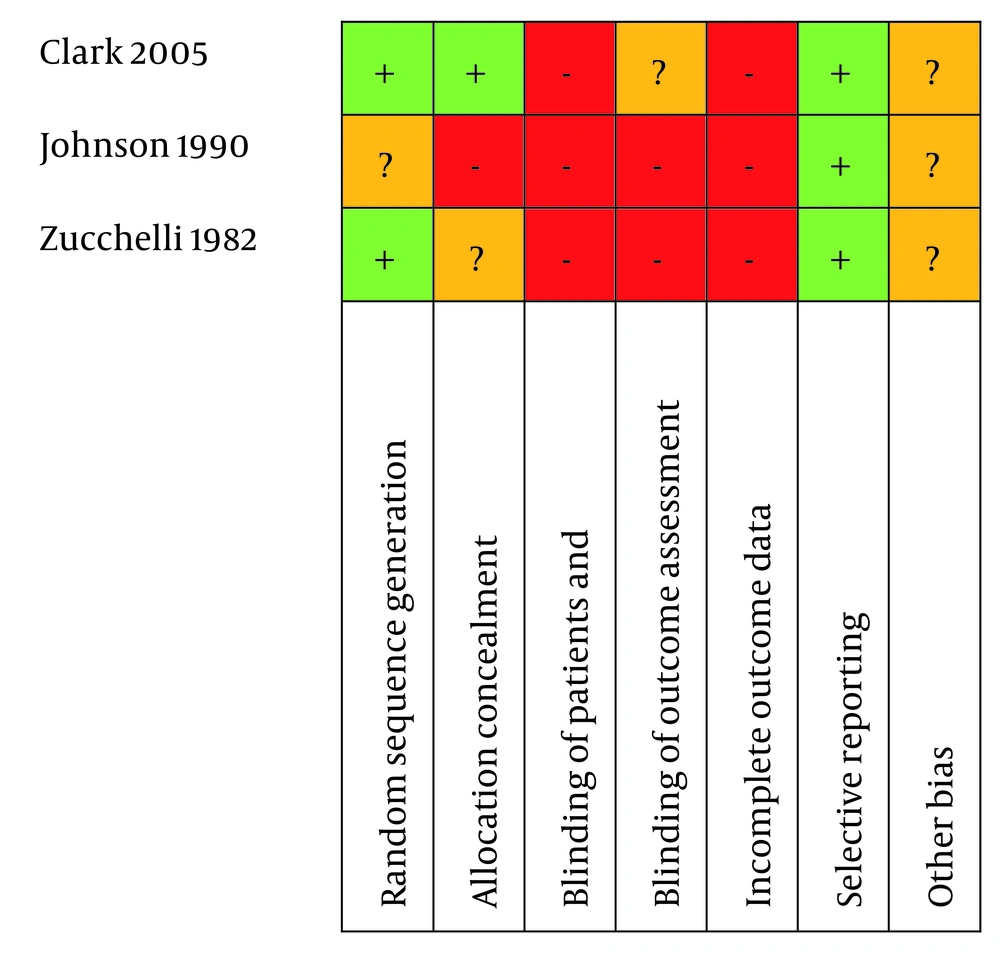
All three RCTs demonstrated a high overall risk of bias (Figure 2). None of the included RCTs adequately described methods for random sequence generation or allocation concealment. Blinding of participants, clinicians, and outcome assessors was not feasible or not reported, contributing to detection and performance bias. Although outcome data were generally complete, limited reporting in older trials (particularly the 1982 and 1990 studies) raised concerns regarding selective reporting. Collectively, the methodological limitations reduce confidence in the internal validity of the RCT findings.
According to the NOS, observational studies with scores of 5 - 6 were considered to have moderate methodological quality within the context of observational research; however, these studies were still judged to carry a generally higher risk of bias compared with randomized controlled trials, and their findings were interpreted cautiously (Table 4).
Table 4.
Quality Assessment for Each Observational Study Based on the Newcastle-Ottawa Scale a
| Study (Author, Year) | Representativeness of the Sample | Sample Size | Non-Respondents | Ascertainment of the Exposure (Risk Factor) | Comparability of Subjects in Different Outcome Groups | Assessment of Outcome | Statistical Test | Total Score |
|---|---|---|---|---|---|---|---|---|
| Moist et al., 1999, (19) | - | - | * | ** | - | ** | * | 6 |
| Leung et al., 2008, (21) | - | - | - | ** | ** | * | 5 | |
| Premuzic et al., 2017, (23) | - | - | * | ** | - | ** | * | 6 |
| Badri et al., 2022, (20) | - | - | * | ** | - | ** | * | 6 |
| Patir et al., 2023, (22) | - | - | * | ** | - | ** | * | 6 |
a Negative sign means no score in that second. One-star sign means one positive score. Two-star sign means two positive scores.
7. Discussion
Our systematic review demonstrated that the evidence regarding the use of plasmapheresis as an adjunct to chemotherapy in MM-RF remains highly inconsistent across both RCTs and observational studies. Two small RCTs suggested that plasmapheresis may improve renal parameters, including reductions in serum creatinine and dialysis dependence; however, the largest and most methodologically rigorous trial by Clark et al. (6), showed no significant renal benefit. Leung et al. (21) reported renal improvement in patients who achieved significant reductions in FLCs. However, remaining retrospective studies showed no advantage of plasmapheresis plus chemotherapy over chemotherapy alone.
Survival outcomes followed the same pattern of inconsistency. While the small RCT by Zucchelli et al. (18) reported a survival advantage with plasmapheresis (13), neither the larger RCTs nor the majority of observational studies found meaningful differences compared with standard therapy or modern regimens such as bortezomib (14, 17, 20, 23). Although some observational studies reported moderate survival or longer survival among biochemical responders (16, 21), these effects could not be attributed solely to plasmapheresis, given the lack of adequate control for confounding factors. Interpretation of observational studies is more limited due to the lack of consistent adjustment for key confounders, including baseline renal function, severity of renal impairment, and differences in chemotherapy regimens, all of which may have influenced renal outcome and survival.
Several factors may explain these discrepancies across studies. A major limitation is the substantial time gap between early and contemporary research. Older trials were conducted before the adoption of modern chemotherapy regimens, particularly bortezomib-based therapies, which can rapidly reduce FLCs and improve renal outcomes independent of plasmapheresis. This therapeutic evolution complicates direct comparison of studies and may be partly responsible for the apparent reduced benefit of plasmapheresis in newer cohorts. In addition, plasmapheresis itself may interfere with newer agents, as it can remove therapeutic monoclonal antibodies such as daratumumab, thereby reducing their pharmacological activity and complicating combination therapy in modern clinical practice.
Beyond treatment-related factors, the poor prognosis associated with renal failure in MM is multifactorial. Severe renal dysfunction increases susceptibility to treatment-related toxicity and often necessitates chemotherapy dose reductions, which may compromise treatment efficacy. Patients with renal failure also often present with more advanced disease, meaning that the association between renal dysfunction and mortality may be confounded by the underlying tumor burden. These considerations highlight the complexity of MM-RF treatment and help explain why improvement in renal parameters does not necessarily lead to improved survival (24).
The most recent study included in our review, by Patir et al., provides contemporary real-world data on plasmapheresis in newly diagnosed MM with acute kidney injury. Although short-term biochemical improvements were observed, these did not vary by the number of plasmapheresis sessions, and no difference in survival risk was identified between patients receiving ≤ 3 versus > 3 sessions. These findings align with previous observational data, reinforcing the conclusion that while plasmapheresis may lead to early laboratory improvements, it does not appear to confer sustained renal benefit or improved survival (22).
In summary, although plasmapheresis may provide limited short-term biochemical benefits in selected patients, current evidence does not support a consistent advantage in renal recovery or survival when used adjuvant with chemotherapy in MM-RF. Given the heterogeneity of existing studies and advances in anti-myeloma therapy, well-designed, large-scale randomized trials and prospective population-based studies that include modern treatment regimens are needed to clarify the role of plasmapheresis in contemporary clinical practice.
7.1. Limitations
The current systematic review has several limitations that should be acknowledged. First, the limited number of available studies restricts the generalizability of the findings. Second, the overall methodological quality of the included studies was low, further reducing confidence in the evidence. Furthermore, the included studies are heterogeneous regarding study design, chemotherapy regimens, plasmapheresis protocols, definition of renal recovery, or length of follow-up. An important limitation of this review is the absence of a quantitative meta-analysis, which was not feasible due to substantial heterogeneity in study designs, populations, outcome measures, and reporting across the included studies, thereby limiting the ability to generate pooled effect estimates. A further limitation is that several outcomes were reported as not reported (NR) in the included studies, which limited data availability and precluded quantitative synthesis or direct comparison for some variables.
7.2. Conclusions
In conclusion, although plasmapheresis may offer some renal recovery benefits in select patients, the current evidence does not demonstrate a meaningful improvement in either renal outcomes or survival in MM-RF.