


1. Background
Immune function and the activity of lymphocytes and regulatory cytokines depend on the function of minerals that play a role in the regulation and remodeling of cellular pathways (1). Zinc is one of the minerals whose deficiency in children results in increased production of the proinflammatory cytokines interleukin 6 (IL-6) and tumor necrosis factor (TNF)-α, both of which increase oxidative stress and tissue inflammation (2-4). Zinc supplementation has been shown to significantly improve clinical outcomes in children with pneumonia or influenza who experience clinical manifestations (5, 6). In addition, zinc has been shown to play a role in inflammatory pathways in the gut and negatively affect the NF-κB and MAPK signaling pathways, which ultimately disrupt the regulatory activity of T helper cells (7, 8), thereby promoting a proinflammatory immune response. The role of zinc in the regulation of inflammation and tissue repair, as well as the regulation of proinflammatory pathways, has made it a suitable supplement for the pediatric population (7, 9, 10).
However, although zinc has been demonstrated to have beneficial effects in the regulation of external infections involving external agents, as in gastroenteritis (11), its role in other infectious conditions remains insufficiently elucidated, including infections such as urinary tract infection (UTI) in children
Urinary tract infections are one of the most prevalent bacterial infections in children and can be manifested with fever, irritability, dysuria, and changes in urinary pattern (12). The diagnosis is made with appropriate urinalysis for nitrates, leukocyte esterase, and white blood cell (WBC), as well as a urine culture (13, 14).
Also, inflammatory markers include elevated serum C-reactive protein (CRP), erythrocyte sedimentation rate (ESR), and procalcitonin (PCT) (15). Procalcitonin is elevated in bacterial infections and has significant value in differentiating bacterial from viral infections (16). Procalcitonin has also been cited as a biomarker with higher accuracy for diagnosis of systemic infections and renal parenchymal involvement (17). Given the importance of early diagnosis and prevention of complications with UTI in children, theorizing there could be a possible correlate between zinc and PCT levels may have value in the clinical setting. While zinc has been established for regulating natural killer cells and T cells, it has not been definitively shown to regulate these inflammatory markers.
2. Objectives
Zinc deficiency has been associated with increased susceptibility to various infections, including UTIs, in children. Although lower zinc levels have been observed in children with UTIs compared to healthy controls, few studies have addressed this issue (18). This study aimed to evaluate the association between serum zinc levels and inflammatory markers, particularly PCT, in children with UTI. We also compared the serum zinc levels across UTIs caused by different bacterial pathogens. Our study questions the efficacy of zinc in pediatric UTIs.
3. Methods
3.1. Study Design
This cross-sectional study was conducted to investigate the relationship between serum zinc and PCT levels in children with UTI at Bandar Abbas Children's Hospital in 2022 - 2023. This study was conducted under the supervision and ethics approval of Hormozgan University of Medical Sciences, and data were collected through a review of medical records and tests of patients aged 2 months to 14 years. This study was reported in accordance with the STROBE checklist (19). Written informed consent was obtained from the parents or legal guardians of all children before entering the study.
3.2. Participants
Our participants included all children aged 2 months to 14 years who were admitted to our center during the period and had a confirmed diagnosis of UTI (Table 1). The diagnosis of UTI was defined by the American Academy of Pediatrics (AAP) as a positive culture with a single organism at 50,000 colony-forming units per milliliter in a catheter specimen or 100,000 colony-forming units per milliliter (20).
Table 1.Inclusion and Exclusion Criteria
| Inclusion | Exclusion |
|---|---|
| Children aged 2 months to 14 years; Definite UTI diagnosis: Presence of at least 105 CFU of bacteria per mL of cultured urine, accompanied by clinical symptoms (as fever, restlessness, or urinary symptoms) or findings of pyuria (positive pyuria with > 5 WBCs per microscopic field). This criterion is consistent with the recommendations of the AAP (2011) and the studies. Complete laboratory data: Availability of serum test results including zinc levels (µg/dl), PCT (ng/mL), CRP (mg/L), and ESR (mm/hr).; Absence of underlying diseases: Absence of chronic renal failure, diabetes, immunodeficiency, or other chronic inflammatory diseases that may affect inflammatory markers.; No antibiotic treatment before sampling: Patients who have not received antibiotics for at least 48 hours before sampling to prevent its effect on markers. | Zinc supplementation in the past month; Presence of concurrent infections: Presence of other systemic or local infections (such as pneumonia or meningitis) that may alter inflammatory markers; Antibiotic use before sampling: Patients who received antibiotics before sampling, due to the possibility of reducing inflammatory markers; Congenital or structural urinary anomalies: Presence of high-grade VUR, hydronephrosis, or anatomical renal anomalies that may alter the severity of UTI; Metabolic diseases or severe malnutrition: Conditions that independently affect zinc levels; Lack of consent or incomplete file: Lack of parental consent to participate in the study or incomplete patient demographic or clinical information. |
Abbreviations: UTI, urinary tract infection; CFU, colony-forming units; WBC, white blood cell; AAP, American Academy of Pediatrics; PCT, procalcitonin; CRP, C-reactive protein; ESR, erythrocyte sedimentation rate; VUR, vesicoureteral reflux.
3.3. Urinary Sampling
The urine sampling method included midstream urine collection and catheterization depending on the clinical conditions. In the midstream urine collection method, after placing the girls in the lithotomy position and washing the perineum with water, the initial and final part of the urine was discarded and about 200 cc of the midstream urine was collected. In the boys, after washing the glans and phallus with water, the collection was performed using the above method. In the catheterization method, after obtaining consent from the parents, a catheter number 6 or 8 was inserted into the bladder through the duct in a sterile manner and based on clinical standards, and about 15 cc of urine was collected.
3.4. Blood Tests
A blood sample was obtained for all patients including CBC diff, creatinine (Cr), sodium (Na), potassium (K), zinc, ESR, CRP, and PCT. The samples were taken on the first day of admission and transported to the center's laboratory in standard and defined test tubes to be centrifuged and analyzed under standard conditions in the hospital's central laboratory.
3.5. Zinc
Serum zinc levels were measured using atomic absorption spectrophotometer (AAS), which was measured by taking a fasting morning blood sample. The unit of measurement was µg/dL and values less than 60 were considered zinc deficiency. To minimize pre-analytical error, particular attention was paid to preventing blood hemolysis, which can cause falsely increased zinc levels. Therefore, standard precautions were applied to prevent hemolysis in taking the sample and transporting the sample to the laboratory.
3.6. Procalcitonin
Procalcitonin levels were measured by the electrochemiluminescence method using the cobas kit from Roche; the unit of measurement was ng/dL. According to the criteria, PCT values less than 0.5 indicate non-infectious inflammation, values between 0.5 and 2 indicate possible infection, and values greater than 2 indicate sepsis. This method was selected due to its reported high sensitivity and specificity.
3.7. Data Collection
The primary data collection tool for the research was a researcher-made checklist developed using the variables stated in the proposal. The checklist consisted of demographic information (age and gender), clinical information (including symptoms, fever, examination results), and laboratory data (including CBC diff, CRP, ESR, Cr, Na, K, zinc, and PCT). To confirm the accuracy of the data, investigators examined the available data by directly reviewing the patient medical records, and, as appropriate, laboratory results were obtained from the hospital's central laboratory. The content validity of the checklist was reviewed and confirmed by the research team, which included a pediatric infectious disease specialist, statistician, and other supervisors. To assess instrument reliability, investigators recorded part of the data and independently compared the data again in parallel to assess the accuracy of the data recorded by the investigators.
3.8. Statistical Analysis
We used version 22 of the SPSS statistical software for statistical analysis. We assessed the normality of the continuous variables included in this study (body temperature, WBC, neutrophil percentage, platelet count, Cr, ESR, CRP, PCT) using the Kolmogorov-Smirnov test. The findings indicated that none of the continuous variables were normally distributed (P < 0.05).
As the data did not follow a normal distribution, we primarily used non-parametric statistical tests. Quantitative variables were reported as median and interquartile range (IQR), and categorical variables were reported in frequencies and percentages. We compared the two independent groups (Escherichia coli and Klebsiella species) using the Mann-Whitney U test, and for comparisons across more than two groups, we used the Kruskal-Wallis test. We evaluated the homogeneity of variances between the microbial groups using Levene’s test and confirmed that the variances of the microbial groups were equal. We evaluated the relationships between serum zinc and inflammatory markers (PCT, CRP, and ESR) using the Spearman’s rank correlation coefficient. A P-value of < 0.05 was considered to be statistically significant in all analyses. All eligible hospitalized children diagnosed with UTI during the study period were included, and the minimum required sample size with a precision of 0.05 and a confidence level of 95% with 10% data loss was set to 93 people based on a previous article (21).
4. Results
4.1. Participants
Sixty point twenty-two percent (60.22%) of the 93-person population in our study were boys, with a mean age of all children of 3.81 years (45.76 months) with a standard deviation of 3.22 years (38.62 months). All children were grouped into 2-year age groups, with the largest age distribution being between 2 and 4 years old (Table 2).
Table 2.Descriptive Indices of Clinical and Laboratory Variables of Patients
| Variants | Mean ± Standard Deviation |
|---|---|
| Age (mon) | 45.76 ± 38.62 |
| Temperature (°C) | 38.27 ± 0.36 |
| WBC (cell/µL) | 11629 ± 3203 |
| Percentage of neutrophils (%) | 69.58 ± 7.37 |
| Platelets (number/µL) | 244280 ± 53638 |
| Cr (mg/dL) | 0.59 ± 0.16 |
| Zinc (µg/dL) | 53.49 ± 8.95 |
| ESR (mm/h) | 21.17 ± 5.36 |
| PCT (ng/mL) | 2.67 ± 0.67 |
Abbreviations: WBC, white blood cell; Cr, creatinine; ESR, erythrocyte sedimentation rate; PCT, procalcitonin.
Most children with UTI had fever and laboratory evidence of active inflammation at the time of admission. High WBC counts, neutrophil percentage, and PCT levels confirm the typical pattern of immune response to bacterial infections. Erythrocyte sedimentation rate was also slightly elevated, consistent with acute inflammation. Creatinine levels remained within normal limits, indicating relatively stable function, but zinc excretion was within normal limits.
4.2. Serum Zinc Levels Showed No Significant Correlation with Inflammatory Parameters
All research variables (temperature, WBC, percentage of neutrophils, platelets, Cr, PCT, ESR, and zinc) had a non-normal distribution. Levene's Test showed that the distribution of variables between the two microbial groups E. coli and Klebsiella was equal. Zinc did not show a positive correlation with ESR level; its relationship with CRP was positive but statistically insignificant (Figure 1). Considering that PCT is a specific marker of microbial inflammation and related infections, zinc did not show a significant correlation.
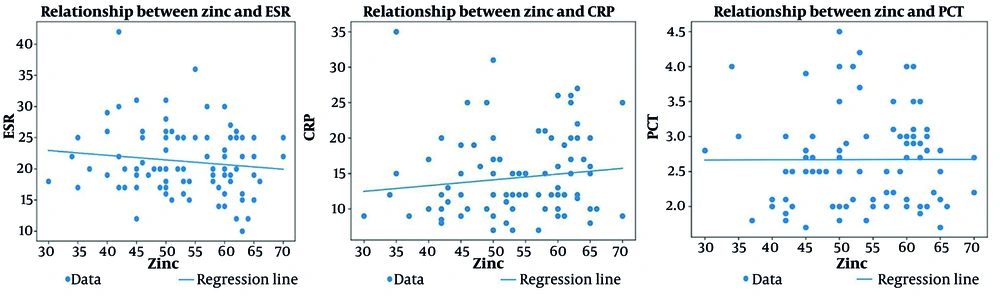
Figure 1.
Scatter plot of zinc and PCT (down one), zinc and ESR (up and left), zinc and CRP (up and right) (Abbreviations: PCT, procalcitonin; ESR, erythrocyte sedimentation rate; CRP, C-reactive protein)
4.3. Zinc and Procalcitonin Levels Did Not Change Between UTI Groups
Kruskal-Wallis test further demonstrated that the factor causing UTI does not enhance the changes in zinc levels. Zinc levels did not show a statistically significant difference between different microbial groups (P = 0.206). Considering that E. coli is the most important factor causing UTI, it was not associated with significant differences in serum zinc levels compared to Klebsiella (P = 0.199). Following zinc, PCT also did not show a significant correlation between different UTI factors.
Overall, serum zinc levels were not significantly correlated with inflammatory indices, and different UTI factors did not show a significant difference in zinc levels. Although there is no occupational relationship between zinc and PCT, both did not show a significant relationship with the factor causing UTI.
5. Discussion
Statistical analysis of the 93 children available to us showed that although patients with UTI had clear signs of inflammation at the time of admission, including high fever, increased WBC count, high percentage of neutrophils, and increased ESR and PCT levels, serum zinc levels remained within normal limits in most cases and did not show a significant relationship with inflammatory indices. The results of correlation tests showed that neither in the total sample nor in the microbial subgroups (E. coli and Klebsiella), was there a statistically significant relationship between zinc and PCT, nor was there a significant difference in serum zinc or CRP levels between the different microbial groups.
Zinc is an essential trace element that is important to the regulation of inflammation and the immune system (22). Deficiency in serum zinc is accompanied by increased inflammatory markers including ESR, CRP, and PCT (23). For instance, pregnant women with COVID-19 had zinc and the Zn/Cu ratio show a significant negative correlation with ESR, CRP, and PCT (r = - 0.243 for disease severity) (24, 25). In chronic inflammatory diseases such as psoriatic arthritis, a positive correlation was found in the Cu/Zn ratio with increased CRP and ESR, representing the imbalance of trace elements regarding inflammation (26).
Meta-analytic studies substantiate the impact of zinc supplementation to reduce CRP levels (3, 27), specifically in diabetic, cardiovascular patients, and the elderly, particularly with doses exceeding, but not limited to, 50 mg daily. In obese children, deficiency for zinc is associated with increased CRP and systemic inflammation (28), which heightens the incidence of metabolic disorders. Furthermore, in the context of perinatal depression, low zinc was associated with increased CRP, as well as signs and symptoms of physio-somatic, providing further evidence of the impact of zinc levels regarding mental health and inflammation. Conversely, our findings showed zinc did not show any significant associations with CRP and ESR. The mechanism of action of zinc is through inhibition of inflammatory pathways such as NF-κB and reduction of the production of proinflammatory cytokines such as IL-6 (9, 29). In infectious diseases, zinc can modulate PCT and reduce the severity of the inflammatory response, which was contradicted by our results (30). Overall, zinc supplementation has been proposed as a low-cost and effective strategy to reduce inflammatory markers in various conditions, although the optimal dose and duration require further investigation.
In infections caused by bacteria such as Staphylococcus aureus or Streptococcus pneumoniae (31), zinc supplementation can reduce the production of proinflammatory cytokines and modulate the severity of inflammation. In animal models, zinc has been shown to reduce the bacterial burden of Mycobacterium tuberculosis (TB) by increasing the production of reactive oxygen species (ROS) (32).
In infections caused by gram-negative bacteria such as Pseudomonas aeruginosa, zinc can induce a differential response by regulating the expression of antibiotic resistance genes (33). Our findings also indicate that there is no difference between UTI caused by E. coli versus Klebsiella species. This observation may be partially explained by the genetic and metabolic similarities of the two bacteria, which both depend on zinc for growth and proliferation and show similar responses to zinc changes. This finding is consistent with studies showing that Enterobacteriaceae have similar zinc uptake systems (34). Thus, while zinc generally has anti-inflammatory and antimicrobial effects in bacterial diseases, differences in the response to zinc are evident in different bacterial species (such as gram-positive versus gram-negative) (35), but in our study, the similarities between E. coli and Klebsiella led to similar responses. This indicates the importance of bacterial characteristics in the effects of zinc.
Zinc has been suggested to be associated with inflammatory responses and susceptibility to UTIs in some populations (36). In contrast, zinc deficiency has been reported to be associated with increased PCT levels, a marker of inflammation in UTI (18). These findings are in contrast to the results observed in the present pediatric cohort, which clearly demonstrated that the association between zinc and PCT and UTI is nonsignificant. In fact, unlike several other inflammatory conditions, serum zinc levels were not significantly reduced in children with UTI in our study, although this was not the case in all patients. In children, data are limited, but one study reported that PCT is increased in UTI caused by E. coli and Klebsiellapneumoniae and that zinc can reduce inflammation, which was in contrast to our results.
In adults, zinc supplementation reduces the severity of UTI and PCT levels, especially in acute pyelonephritis (21). In pregnant women, low zinc is associated with elevated PCT and more severe UTI (17). Zinc modulates inflammation and PCT by inhibiting the NF-κB pathway and reducing proinflammatory cytokines such as IL-6 (1, 9). These effects were observed in a range of ages, from children to the elderly, but the severity of the response to zinc may vary depending on nutritional status and bacterial species. Therefore, zinc supplementation could be an effective strategy for managing UTIs and reducing PCT in different age groups, although further research in children is needed to confirm our results.
The findings of this study showed that serum zinc levels in children with UTI were not significantly different from common inflammatory markers, including PCT, CRP, and ESR. Overall, the present findings suggest that the relationship between zinc and inflammatory markers in hospitalized children with UTI is more complex than a simple linear relationship and likely requires investigation in settings with a larger sample size, longitudinal design, and simultaneous measurement of other micronutrients (such as copper and ferritin).
5.1. Limitations
The present study is limited by many factors, such as cross-sectional studies cannot establish a direct cause-and-effect relationship for serum zinc levels and PCT, an inflammatory marker in children with UTIs. Since we could not assess the effect of zinc and the inflammatory markers on the development of UTIs or after treatment, we are unable to illustrate how serum or zinc concentrations affect those inflammatory marker levels. Second, since serum zinc concentrations were measured as soon as the children were admitted to the hospital, this single measurement might not represent the participants' long-term serum zinc levels as they may be affected by their recent illness, dietary intake before their hospital admission, or the acute-phase response that occurred shortly after they became ill. Third, the current sample size was relatively small and was taken only from one tertiary referral center, thus limiting the generalizability of these findings to larger pediatric populations or outpatient settings. In addition, given the small number of patients with causative pathogens other than E. coli, our ability to perform subgroup analyses based on causative pathogens is limited.
5.2. Conclusions
This study points out a possible link between zinc levels and UTI s in children, but it does not establish a clear or independent therapeutic role for zinc in this context. Although zinc might play a part in immune regulation, its actual significance in UTIs seems to be restricted and varies by situation. Therefore, current evidence does not support the routine use of zinc supplements for treating pediatric UTIs. Further prospective and controlled research is needed to explore whether zinc deficiency affects the likelihood, severity, or recovery from these infections in children.
