




1. Background
Prostate cancer (PCa) diagnosis is primarily based on histopathological evaluation of prostate tissue biopsies (1). The Gleason score (GS) is a key parameter in prostate biopsy (PB) and plays a critical role in diagnostic assessment, prognosis, and decision-making in disease management (1). However, several studies have reported poor agreement between GS on needle biopsy and the radical prostatectomy (RP) specimen. (2, 3) In 2014, the Gleason grading system underwent reevaluation and substantial changes. The International Society of Urological Pathology (ISUP) updated the Gleason grading system to improve its accuracy and validity, and a five-grade group (GG) system was introduced into GS (4).
Clinically, many patients who present with grade 1 pathology on PB may not be considered for active treatment, such as RP or radiotherapy, because of the indolent nature of the disease and may instead be managed with an active surveillance approach (5). However, some of these patients may experience pathological upgrading after RP (6). Conversely, in a subset of patients, RP pathology is downgraded compared with the initial biopsy result (7). Therefore, discordance between the GS of PB and postsurgical specimens can negatively affect the initial management approach (3).
Several studies have investigated preoperative clinical and pathological factors, including high prostate-specific antigen (PSA) levels, advanced age, prostate size and volume, higher PSA density (PSAD), the number of core needle biopsies, the percentage of positive cores, the biopsy technique used, the pathologist's level of experience, and the time elapsed from biopsy to surgery, to predict the rate of discordance between GS on prostate needle biopsy and final pathology (3, 8-14). Although recent studies have evaluated predictors of pathological upgrading, the findings remain inconsistent, particularly regarding MRI findings, PSA-related parameters, and pathological characteristics (15-17).
2. Objectives
Given the aforementioned points, this study aimed to assess discordance rates between ISUP grades obtained from transrectal PB and post-RP pathology in two referral hospitals and to investigate risk factors associated with pathological upgrading of the ISUP grade.
3. Methods
3.1. Study Design
In this retrospective cohort study, data from all consecutive patients who underwent transrectal ultrasonography (TRUS)-guided prostate biopsy and subsequently radical prostatectomy at two referral hospitals in Rasht, Iran, between 2019 and 2024 were reviewed. Patients were identified through the hospital medical records archive. Those with available biopsy and radical prostatectomy pathology reports were screened for eligibility. Predefined inclusion and exclusion criteria were applied uniformly, and all consecutive eligible patients were included to minimize selection bias.
We excluded patients diagnosed with PCa who had received hormone therapy prior to surgery and those with incomplete medical records. Finally, statistical analysis was performed on 110 patients (Figure 1).
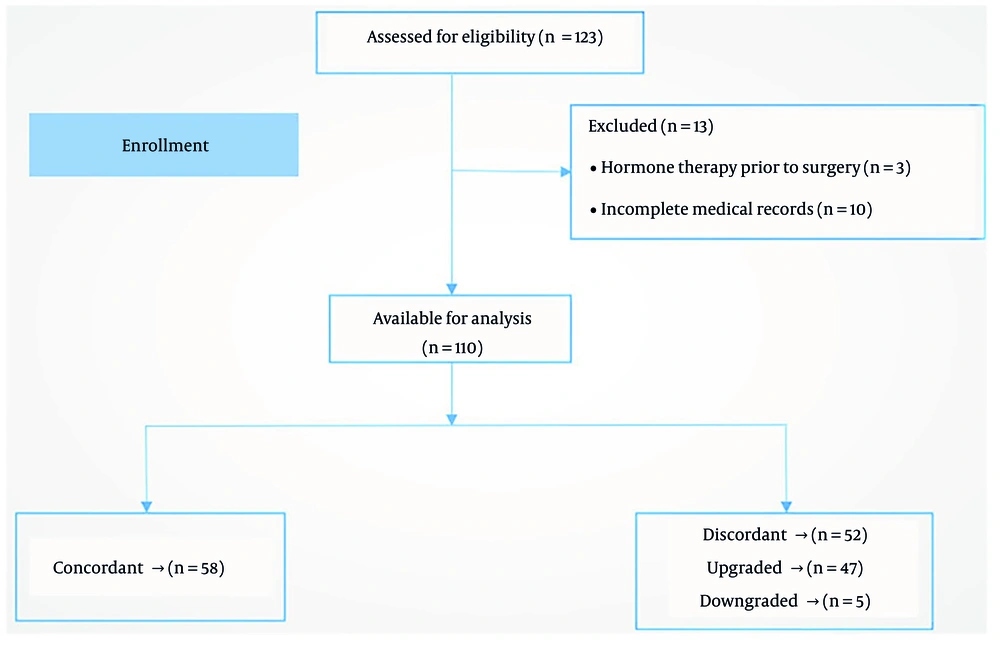
Figure 1.
STROBE-style flow diagram of patient enrollment, allocation, and analysis.
The primary outcome was pathological upgrading, defined as any increase in ISUP grade in the RP specimen compared with the needle biopsy. After comparing GG between biopsy and RP specimens, patients were classified into two groups: those whose GG was upgraded (upgrading group) and those without upgrading (non-upgrading group).
3.2. Data Collection
Potential factors associated with GG upgrading, including age, pre-biopsy PSA level, free/total (f/t) PSA ratio, prostate volume, PSAD, the time interval between needle biopsy and RP, MRI findings (Prostate Imaging-Reporting and Data System (PI-RADS), presence of cancerous lesions within the prostate gland tissue, extracapsular extension, and seminal vesicle invasion), and pathological parameters (number of cores taken, percentage of positive cores, and ISUP grade of PB), were recorded and compared between the two groups. Prostate volume was measured using transrectal ultrasound (TRUS) to calculate PSAD. MRI was performed before biopsy using a 3-Tesla scanner and interpreted according to PI-RADS v.2 protocols. All patients underwent systematic TRUS PB prior to RP.
3.3. Time Frame and Follow-Up
Baseline (time zero) was defined as the date of the diagnostic prostate biopsy. The follow-up period extended from biopsy to the date of radical prostatectomy. The time interval between biopsy and surgery was recorded for each patient.
3.4. Data Analysis
Data analysis was performed using IBM SPSS Statistics for Windows, version 27. The Kolmogorov-Smirnov test was used to assess the normality of continuous variables. Analyses of parameters affecting GS upgrading were performed using the independent t-test for continuous variables and the chi-square test or Fisher's exact test for categorical variables. Univariable analysis was conducted to evaluate the association between each predictor and ISUP upgrading. Variables with a P value < 0.25 in univariable analysis were entered into the multivariable logistic regression model to identify independent factors associated with upgrading. Given the limited number of events, the number of variables included in the multivariable model was restricted to minimize potential overfitting. A P value less than 0.05 was considered statistically significant.
3.5. Missing Data
Clinical, laboratory, and pathological variables were complete for the 110 included patients. However, pre-biopsy MRI data were missing for eight patients (7.3%). Therefore, MRI variables were analyzed using complete-case analysis, and no imputation of missing MRI data was performed. Because MRI findings were not included in the final multivariable model, the impact of missing MRI data on the main study findings is expected to be limited. Nevertheless, some degree of selection bias cannot be excluded.
4. Results
The mean age of the patients at the time of biopsy was 63.47 years (range 46 - 87), and the median PSA before biopsy was 8.25 ng/mL (IQR: 6.50 - 12.15). The mean interval between PB and RP was 95.25 (SD, 73.25) days (range 24 - 655). The mean prostate volume was 43.95 (SD, 18.72) cc (range 12 - 124). The laboratory and pathology findings of the patients are shown in Table 1.
Table 1.Comparisons of Characteristics Between Patients with and Without ISUP Score Upgrading a
| Variables | Non-upgrading (n = 63) | Upgrading (n = 47) | P-Value |
|---|---|---|---|
| Age (y) | 63.17 ± 6.18 | 62.7 ± 6.92 | 0.707 b |
| PSA (ng/mL) | 0.548 c | ||
| < 10 | 42 (60.0) | 28 (40.0) | |
| > 10 | 21 (52.5) | 19 (47.5) | |
| PSA density (ng/mL/cm3) | 1.00 c | ||
| < 0.15 | 17 (58.6) | 12 (41.4) | |
| > 0.15 | 46 (56.8) | 35 (43.2) | |
| Free/total PSA | 0.004 c | ||
| ≤ 0.1 | 14 (37.7) | 23 (62.2) | |
| > 0.1 | 49 (67.1) | 24 (32.9) | |
| Prostate volume (cc) | 0.564 c | ||
| < 40 | 28 (53.8) | 24 (46.2) | |
| > 40 | 35 (60.3) | 23 (39.7) | |
| Biopsy cores taken | 0.440 c | ||
| < 12 | 13 (65.0) | 7 (35.5) | |
| > 12 | 50 (55.0) | 40 (45.5) | |
| Positive biopsy cores | 1.00 c | ||
| < 50 | 40 (58.0) | 29 (42.0) | |
| > 50 | 23 (56.1) | 18 (43.9) | |
| ISUP grade of biopsy | 0.002 c | ||
| = 1 | 19 (39.6) | 29 (60.4) | |
| > 1 | 44 (71) | 18 (29.0) | |
| Prostate biopsy to radical prostatectomy interval (d) | 87.69 ± 51.28 | 105.38 ± 94.80 | 0.212 b |
a Values are expressed as mean ± SD or No. (%). Abbreviations: ISUP, International Society for Urological Pathology; PSA, prostate-specific antigen; RP, radical prostatectomy; SD, standard deviation.
b Independent t-test.
c Chi-square test.
Of the 110 patients, the ISUP grade results of 58 samples (52.7%) remained unchanged. Discordance between PB samples and RP specimens was 47.3%, of which 42.7% (47 samples) showed ISUP upgrading and 4.5% (5 samples) were downgraded. Samples with a downgraded ISUP grade were included in the non-upgrading group. ISUP grade 1 accounted for the highest number of biopsy samples (48 samples), whereas ISUP grades 4 and 5 each accounted for the lowest number of samples (4 samples). As shown in Table 1, among the variables examined for predicting upgrading, only f/tPSA and ISUP grade were statistically significant. Accordingly, upgrading occurred in 62.2% of biopsy samples from patients with f/tPSA ≤ 10% (P = 0.004). In addition, 60.4% of biopsy samples with ISUP grade 1 showed upgrading (P > 0.002).
4.1. MRI Findings
MRI findings were available for 102 patients and are shown in Table 2. None of the MRI variables evaluated were significantly associated with upgrading in univariable analysis and were therefore excluded from the multivariable model.
Table 2.Comparisons of Distribution of MRI Findings Between Patients with and Without ISUP Upgrading (N = 102) a
| Variables | Non-upgrading (n = 63) | Upgrading (n = 47) | P-Value |
|---|---|---|---|
| PI-RADS | 0.483 b | ||
| 1 | 0 (0.0) | 0 (0.0) | |
| 2 | 3 (50.0) | 3 (50.0) | |
| 3 | 5 (50.0) | 5 (50.0) | |
| 4 | 37 (66.1) | 19 (33.9) | |
| 5 | 17 (56.7) | 13 (43.3) | |
| Cancerous lesion within the prostate gland | 0.407 c | ||
| No | 8 (50.0) | 8 (50.0) | |
| Yes | 54 (62.8) | 32 (37.2) | |
| Extracapsular extension | 0.815 c | ||
| No | 46 (59.7) | 31 (40.3) | |
| Yes | 16 (64.0) | 9 (36.0) | |
| Seminal vesicle invasion | 0.708 c | ||
| No | 58 (61.7) | 36 (38.3) | |
| Yes | 4 (50.0) | 4 (50.0) |
a Values are expressed as No. (%). Abbreviations: ISUP, International Society for Urological Pathology; MRI, magnetic resonance imaging; PI-RADS, Prostate Imaging-Reporting and Data System.
b Fisher exact test.
c Chi-square test.
4.2. Multivariable Analysis
After including clinical variables with a possible influence on upgrading in RP pathology ISUP grade (P < 0.25), multivariable logistic analysis showed that only the f/tPSA ratio (OR = 0.27, 95% CI, 0.11 - 0.65, P = 0.004) and the ISUP grade of needle biopsy (OR = 0.25, 95% CI, 0.11 - 0.57, P = 0.001) were significant predictors of discordance between biopsy samples and RP specimens in both the unadjusted and adjusted models. These findings indicate that, for each unit increase in f/tPSA, the odds of upgrading were multiplied by 0.27 (a 73% reduction), and that, in biopsy samples with ISUP grades higher than 1, the probability of upgrading decreased by 75%. Model goodness of fit according to the Hosmer-Lemeshow test was χ2 = 2.11; df = 2; P = 0.348, indicating an acceptable fit for the regression model (Table 3).
Table 3.Logistic Regression Analysis for Predicting ISUP Score Upgrading a
| Models and Variables | B | SE | P-Value | Exp(B) | 95% CI for EXP(B) | |
|---|---|---|---|---|---|---|
| Lower | Upper | |||||
| Unadjusted model | ||||||
| Age | -0.016 | 0.034 | 0.640 | 0.984 | 0.921 | 1.052 |
| f/tPSA | -1.296 | 0.460 | 0.005 | 0.274 | 0.111 | 0.674 |
| ISUP grade of biopsy | -1.435 | 0.464 | 0.002 | 0.238 | 0.096 | 0.591 |
| Interval between biopsy and RP (day) | 0.002 | 0.003 | 0.580 | 1.002 | 0.995 | 1.009 |
| PSAD | 1.023 | 0.884 | 0.247 | 2.783 | 0.492 | 15.745 |
| Positive biopsy cores (%) | 0.513 | 0.995 | 0.606 | 1.670 | 0.238 | 11.734 |
| Constant | 4.380 | 2.595 | 0.091 | 79.847 | ||
| Adjusted model | ||||||
| f/tPSA | -1.304 | 0.450 | 0.004 | 0.271 | 0.112 | 0.655 |
| ISUP grade of biopsy | -1.398 | 0.430 | 0.001 | 0.247 | 0.106 | 0.574 |
| Constant | 4.018 | 1.089 | 0.000 | 55.599 | ||
a Abbreviations: ISUP, International Society for Urological Pathology; PSA, prostate-specific antigen; PSAD, PSA density; RP, radical prostatectomy.
5. Discussion
Discordance between biopsy and RP pathological grading can affect treatment and management decisions for PCa (3). Some studies indicate that techniques such as extended prostate needle biopsy and imaging modalities, including multiparametric magnetic resonance imaging (mpMRI) and MRI-targeted biopsy combined with systematic biopsy, may enhance concordance rates (10, 18). However, these imaging techniques are not available in many centers, and their implementation requires a high level of experience and skill.
The findings of this study suggest a substantial degree of ISUP upgrading in PB samples. Of 110 samples, 47 (42.7%) were upgraded in ISUP grade, consistent with most previous studies (2, 3, 19). An f/tPSA ratio ≤ 10% and ISUP grade 1 on the initial biopsy were considered predictors of upgrading. Few studies have examined the effect of the f/tPSA ratio on discordance between biopsy and RP specimens (20, 21).
In a predictive model for Gleason score upgrading proposed by Zhou et al. in 2024, age and a positive MRI target were identified as risk factors, and f/tPSA was identified as an independent predictor. This indicates that even when considering additional factors (such as age or MRI results), f/tPSA continues to contribute to the prediction of upgrading (20). Moreover, Ceylan et al. found a negative correlation between the f/tPSA ratio and the GS. This finding indicates that as the f/tPSA ratio decreases, the likelihood of detecting a higher GS increases (21).
In our study, patients with ISUP grade 1 on the initial biopsy were more likely to be upgraded in RP pathology results. Recent studies have reported that upgrading in ISUP grade ≤ 2 remains more common (17, 22, 23). In a study by Özgür et al. of patients with PB pathology of ISUP grade 1, ISUP grade upgrading was detected in 29.7%. They reported that serum PSA level, the percentage of tumor-positive cores, positive surgical margins, capsule invasion, and seminal vesicle invasion were significantly higher in the group with ISUP grade upgrading after RP (6). In addition, Li et al., in a study of patients with ISUP grade 1 and 2 PCa in a Chinese cohort, found that GG upgrading was more likely to occur in patients initially diagnosed with GG 1 than in those identified with GG 2. Their results showed that patients with upgraded GG had higher total PSA (tPSA) and PSAD (22). In another study by Takeshima et al., patients with ISUP grade 1 and 2 on biopsy were more likely to experience ISUP grade upgrading after robot-assisted RP (23).
Although a number of studies have concluded that rising PSA prior to the initial biopsy is a notable and independent predictor of pathological upgrading after RP, (5, 24, 25) our study found no association between PSA level and ISUP upgrading. Consistent with our findings, Huang et al. (9) reported that prebiopsy PSA is not associated with an increased risk of GS upgrading in Taiwanese men. In addition, an Australian population-based series found no association between preoperative PSA level and GS upgrading (26).
Because PSA levels can be elevated in both benign and malignant conditions, PSA cannot serve as a definitive predictor on its own. The inconsistency among studies highlights the need for a comprehensive evaluation of multiple factors.
Conversely, our data did not support the predictive value of MRI findings and pathological features for ISUP upgrading. In contrast to our findings, some studies have shown that patients with a PI-RADS score greater than 3 on biopsy are more likely to have ISUP grade upgrading on final pathology (22, 27). A recent study by Pockros et al. identified the PI-RADS score as an independent predictor of pathological upstaging, while lymph node metastasis was observed only in patients with PI-RADS 4 or 5 lesions (28). In addition, several studies identified the presence of positive lesions on MRI as a predictor of increased GS upgrading. (2, 29). Moreover, it has been shown that among patients who underwent RP and had ISUP grade upgrading, the rates of positive surgical margin, capsule invasion, and seminal vesicle invasion were considerably higher than in patients whose ISUP grade did not change (6). In accordance with our study results, Li et al. found no strong association between positive surgical margin, seminal vesicle invasion, lymphatic invasion, and GS upgrading (30).
The present study identifies a potential limitation in relying on MRI indices to predict ISUP upgrading. It suggests that MRI alone may not be a reliable predictor for assessing upgrading risk. This may be attributable to factors such as inter-radiologist variability in imaging interpretation and the multifaceted nature of PCa.
Despite efforts to improve biopsy accuracy, such as MRI-targeted biopsy, and to reduce discordance, (18) discordance is not entirely eliminated. Upgrading can have significant clinical implications for patient prognosis and treatment decisions. The high rate of ISUP upgrading underscores the limitations of biopsy alone for treatment planning and highlights the importance of considering final pathology results in treatment decisions.
In general, one reason for the discrepancy between PB samples and RP is that biopsy samples are obtained from specific areas of the prostate, typically using a needle that extracts only a limited volume of the overall prostate tissue.
Pathologists' interpretation is another factor that can lead to discrepancies in ISUP grading. Although the new ISUP grading system has attempted to minimize differences in the interpretation of pathology specimens and to increase report accuracy, the experience and expertise of urologists and pathologists may vary considerably.
Studies have demonstrated the role of operator experience in performing PB and, consequently, in cancer detection rates. (31) In a nationwide study in Norway, Kvale et al. showed greater concordance between the GS of needle biopsies and RP in centers that analyzed more than 40 RP pathology specimens per year than in lower-volume centers (12). Kulkarni et al. also highlighted the predictive role of the pathologist's level of expertise in GS upgrading (32).
Our study has several potential limitations. First, the primary limitation is the relatively small sample size, which may have limited statistical power and increased the risk of model overfitting. Second, the retrospective design and inclusion of only surgically treated patients may limit generalizability and introduce selection bias. Third, pathological grading was performed by different pathologists without centralized re-review, which may have introduced interobserver variability. Finally, MRI findings were unavailable for eight patients. Although the proportion of missing data was relatively small (7.3%), complete-case analysis may have introduced some degree of selection bias.
These limitations highlight the need for large population-based prospective cohorts to accurately identify definitive risk factors for ISUP grade upgrading in patients with an initial diagnosis of ISUP grade 1 on PB and to identify patients with clinically significant features of PCa.
5.1. Conclusions
Our results suggest that an f/tPSA ratio ≤ 10% and ISUP grade 1 on the initial biopsy are associated with an increased risk of ISUP upgrading. This finding enhances the practical value of monitoring the f/tPSA ratio in patients with biopsy ISUP grade 1 and considering it in the context of other risk factors when assessing the likelihood of ISUP upgrading. However, the adequacy and accuracy of these findings require further study.