1. Background
Major adverse cardiovascular events (MACEs), including myocardial infarction, heart failure, and stroke, are frequent and remain the predominant cause of death in patients undergoing maintenance hemodialysis (MHD) (1-3). The high incidence of MACEs in this population results from a complex interplay of factors, such as volume overload, hypertension, anemia, electrolyte imbalances, metabolic disturbances, the presence of arteriovenous fistulae, atherosclerosis, chronic inflammation, and malnutrition (3-6).
Nutrition and cellular health play crucial roles in chronic kidney disease (CKD) by preserving residual kidney function, reducing the physiological burden on the kidneys, slowing disease progression, and preventing systemic complications as renal function declines (7, 8). Total iron-binding capacity (TIBC) is an important nutritional and metabolic marker because it reflects the body’s ability to transport and bind iron through transferrin, thereby aiding in the assessment of iron metabolism and detection of iron deficiency anemia (9, 10). In patients undergoing MHD, reduced TIBC levels have been associated with malnutrition, muscle wasting, and increased mortality risk (11-13).
Likewise, phase angle (PhA), as assessed by bioelectrical impedance analysis (BIA), is widely regarded as an indicator of cellular health and membrane integrity (14, 15). Higher PhA values indicate intact cell membranes and better cellular function, whereas lower PhA values suggest malnutrition, sarcopenia, advanced age, and chronic diseases, including end-stage renal disease (15-19). Low PhA has been identified as a predictor of energy-protein malnutrition, higher cardiovascular event rates, and increased mortality in patients undergoing MHD (19-21).
Although TIBC and PhA have been individually studied as prognostic factors, their interrelationship and combined predictive value for MACEs and mortality in patients undergoing MHD remain unclear. Therefore, we hypothesized that decreased plasma TIBC concentration and reduced PhA are both associated with a higher risk of MACEs and mortality among Vietnamese patients undergoing MHD.
2. Methods
2.1. Study Design and Subjects
We performed a retrospective cohort study in 182 patients undergoing MHD at Military Hospital 103, Hanoi, Vietnam, from April 2021 to April 2024. Patients of both sexes aged 18 years or older who had received MHD for a minimum of 3 months and completed a continuous 3-year follow-up were included in the study. Patients were excluded if they had an acute infection at enrollment, had previously undergone kidney transplantation, were pregnant or lactating, or had distorted BIA results. Eligible patients were informed about the study and provided written consent to participate.
2.2. Clinical and Laboratory Measurements
At baseline, data on clinical characteristics and laboratory parameters were collected. Fasting venous blood samples were drawn in the morning, 30 minutes before the hemodialysis session, to determine complete blood count and plasma biochemical indices, including glucose, urea, creatinine, total protein, albumin, lipid profile, and electrolytes. Phosphorus, β2-microglobulin, PTH, and hs-CRP were also measured from the same blood sample. Total iron-binding capacity was determined using the ELISA method.
2.3. Body Composition and Phase Angle Measurement
Segmental BIA was conducted in all participants using the InBody S10 device to determine Body Mass Index (BMI), lean mass, body fat mass, extracellular water/total body water ratio (ECW/TBW), and whole-body PhA at 50 kHz. Phase angle is a direct variable derived from BIA and calculated based on the ratio of reactance (Xc) to resistance (R) as follows: PhA (°) = arctangent (Xc/R) × (180°/π) (22).
2.4. Assessment of Atherosclerosis
To assess the presence of atherosclerosis, all patients underwent carotid Doppler ultrasonography. A diagnosis of atherosclerosis was established when carotid intima-media thickness (IMT) was greater than 1.5 mm (23).
2.5. Follow-up and Outcome Assessment
All MACEs, including myocardial infarction, stroke, heart failure, aortic dissection, and peripheral arterial disease diagnosed by cardiologists, were recorded during the 3-year follow-up period. Cardiovascular and all-cause mortality, excluding trauma-related deaths, were also documented over the same period.
2.6. Statistical Analysis
Continuous data were summarized as mean ± standard deviation and analyzed using analysis of variance (ANOVA) or Student’s t-test, while categorical variables were expressed as frequencies and percentages and compared using the chi-square test. Multivariate logistic regression analysis was used to identify independent related factors. Receiver operating characteristic (ROC) curve analysis with AUC estimation was performed to predict MACEs and all-cause mortality. Statistical analyses were conducted using SPSS version 20.0 (Chicago, IL, USA), and statistical significance was defined as P < 0.05.
3. Results
Table 1 shows that the MACE group had significantly higher values for age, duration of hemodialysis, prevalence of diabetes mellitus, plasma creatinine, PTH, hs-CRP, incidence of atherosclerosis, and mortality, whereas plasma albumin, high-density lipoprotein cholesterol (HDL-C), TIBC, lean mass, and PhA were significantly lower than in the non-MACE group (P < 0.05 to P < 0.001).
Table 1.
Clinical and Paraclinical Comparison Between Groups with and Without Major Adverse Cardiovascular Events a
| Characteristics | All (N = 182) | MACE Group (N = 48) | Non-MACE Group (N = 134) | P-Value |
|---|---|---|---|---|
| Age (y) | 50.21 ± 15.45 | 59.06 ± 13.92 | 47.04 ± 14.76 | < 0.001 |
| Gender | 0.790 | |||
| Male | 94 (51.6) | 24 (50.0) | 70 (52.2) | |
| Female | 88 (48.4) | 24 (50.0) | 64 (47.8) | |
| Hemodialysis duration (mo) | 30 (5 - 72) | 96 (48 - 119.25) | 12 (4.0 - 43.5) | < 0.001 |
| < 12 | 65 (35.7) | 1 (2.1) | 64 (47.8) | |
| 12 - < 60 | 61 (33.5) | 14 (29.2) | 47 (35.1) | |
| ≥ 60 | 56 (30.8) | 33 (68.8) | 23 (17.2) | |
| 24-h urine volume (mL) | 50 (0 - 900) | 0 (0 - 0) | 600 (0 - 1000) | N/A |
| Hypertension | 175 (96.2) | 47 (97.9) | 128 (95.5) | 0.678 |
| Diabetes mellitus | 53 (29.1) | 36 (75.0) | 17 (12.7) | < 0.001 |
| Systolic blood pressure (mmHg) | 138.74 ± 13.11 | 136.88 ± 13.51 | 139.4 ± 12.94 | 0.253 |
| Diastolic blood pressure (mmHg) | 83.76 ± 7.28 | 83.75 ± 8.47 | 83.77 ± 6.84 | 0.988 |
| BMI (kg/m²) | 0.119 | |||
| < 18.5 | 21 (11.5) | 4 (8.3) | 17 (12.7) | |
| 18.5 - 22.9 | 138 (75.8) | 34 (70.8) | 104 (77.6) | |
| ≥ 23 | 23 (12.6) | 10 (20.8) | 13 (9.7) | |
| Mean BMI (kg/m²) | 20.63 ± 2.23 | 21.15 ± 2.54 | 20.44 ± 2.09 | 0.087 |
| Red blood cell (T/L) | 3.08 ± 0.65 | 3.08 ± 0.67 | 3.08 ± 0.65 | 0.966 |
| Hemoglobin (g/L) | 90.3 ± 19.25 | 89.81 ± 18.72 | 90.47 ± 19.51 | 0.840 |
| Hematocrit (L/L) | 0.27 ± 0.05 | 0.27 ± 0.05 | 0.27 ± 0.05 | 0.751 |
| Anemia | 175 (96.2) | 46 (95.8) | 129 (96.3) | 1.000 |
| Glucose (mmol/L) | 5.71 (4.83 - 7.22) | 5.84 (4.74 - 8.03) | 5.7 (4.86 - 7.08) | 0.615 |
| Urea (mmol/L) | 27.64 (22.11 - 33.02) | 29.29 (24.92 - 34.99) | 26.84 (21.25 - 32.51) | 0.097 |
| Creatinine (µmol/L) | 826.88 (714.05 - 1023.91) | 913.46 (751.45 - 1079.39) | 805.87 (672.25 - 982.93) | 0.022 |
| Protein (g/L) | 73.0 ± 6.26 | 72.61 ± 5.36 | 73.14 ± 6.56 | 0.611 |
| Albumin (g/L) | 38.27 ± 3.82 | 36.89 ± 3.72 | 38.77 ± 3.74 | 0.004 |
| Cholesterol (mmol/L) | 4.0 (3.34 - 4.75) | 3.82 (3.11 - 4.64) | 4.02 (3.46 - 4.79) | 0.092 |
| Triglyceride (mmol/L) | 1.48 (0.97 - 2.23) | 1.28 (1.0 - 1.71) | 1.62 (0.96 - 2.37) | 0.121 |
| LDL-C (mmol/L) | 2.75 ± 0.73 | 2.74 ± 0.74 | 2.75 ± 0.73 | 0.970 |
| HDL-C (mmol/L) | 1.01 ± 0.30 | 0.93 ± 0.24 | 1.03 ± 0.32 | 0.040 |
| Lipid disorder | 115 (63.2) | 35 (72.9) | 80 (59.7) | 0.103 |
| Total calcium (mmol/L) | 2.27 (2.11 - 2.44) | 2.3 (2.21 - 2.53) | 2.26 (2.09 - 2.42) | 0.144 |
| Phosphorus (mmol/L) | 2.09 ± 0.72 | 2.27 ± 0.72 | 2.03 ± 0.72 | 0.051 |
| β2-microglobulin (µg/L) | 29.75 ± 3.15 | 30.11 ± 3.17 | 29.62 ± 3.15 | 0.353 |
| PTH (pg/mL) | 474.15 (200.12 - 940.55) | 929.3 (264.75 - 1387.5) | 454.95 (182.87 - 709.62) | 0.003 |
| hs-CRP (mg/L) | 2.29 (0.9 - 4.78) | 4.67 (3.24 - 6.47) | 1.78 (0.65 - 3.18) | < 0.001 |
| TIBC (µmol/L) | 46.51 (22.57 - 67.19) | 22.67 (14.43 - 39.72) | 56.39 (28.53 - 76.72) | < 0.001 |
| Lean mass (kg) | 33.95 ± 2.91 | 31.65 ± 2.98 | 34.77 ± 2.41 | < 0.001 |
| Body fat mass (kg) | 8.8 (6.05 - 13.5) | 11.4 (4.42 - 14.72) | 8.4 (6.05 - 13.0) | 0.153 |
| ECW/TBW (%) | 41.05 ± 2.27 | 40.82 ± 2.55 | 41.14 ± 2.16 | 0.399 |
| PhA (°) | 5.2 ± 1.39 | 3.9 ± 0.6 | 5.67 ± 1.3 | < 0.001 |
| Atherosclerosis | 67 (36.8) | 38 (79.2) | 29 (21.6) | < 0.001 |
| MACEs | 48 (26.4) | N/A | N/A | N/A |
| Mortality | 23 (12.6) | 16 (33.3) | 7 (5.2) | < 0.001 |
Abbreviations: BMI, Body Mass Index; RBC, red blood cell; LDL-C, low-density lipoprotein cholesterol; HDL-C, high-density lipoprotein cholesterol; β2-M, β2-microglobulin; PTH, parathyroid hormone; hs-CRP, high-sensitivity C-reactive protein; TIBC, total iron-binding capacity; ECW, extracellular water; TBW, total body water; PhA, phase angle; MACEs, major adverse cardiovascular events; N/A, not applicable.
a Values are expressed as No. (%), mean ± SD or median (IQR).
As shown in Table 2, duration of hemodialysis, diabetes mellitus, plasma HDL-C, TIBC, and PhA were independently associated with MACEs in patients undergoing MHD (P < 0.05 to P < 0.01).
Table 2.
Multivariate Analysis of Factors Associated with Major Adverse Cardiovascular Events
| Variables | OR | 95% CI | P-Value |
|---|---|---|---|
| Age | 0.978 | 0.894 - 1.068 | 0.616 |
| Male sex | 0.106 | 0.009 - 1.209 | 0.071 |
| Duration of hemodialysis | 1.058 | 1.024 - 1.093 | 0.001 |
| Diabetes mellitus | 11.206 | 1.186 - 105.9 | 0.035 |
| Creatinine | 0.999 | 0.994 - 1.005 | 0.823 |
| Albumin | 0.970 | 0.730 - 1.290 | 0.836 |
| Triglyceride | 0.745 | 0.219 - 2.533 | 0.638 |
| HDL-C | 0.003 | 0.001 - 0.636 | 0.033 |
| β2-M | 0.901 | 0.592 - 1.372 | 0.629 |
| PTH | 1.000 | 0.998 - 1.001 | 0.713 |
| hs-CRP | 1.328 | 0.843 - 2.092 | 0.222 |
| TIBC | 0.936 | 0.884 - 0.992 | 0.025 |
| PhA | 0.090 | 0.015 - 0.523 | 0.007 |
Abbreviations: OR, odds ratio; CI, confidence interval; HDL-C, high-density lipoprotein cholesterol; β2-M, β2-microglobulin; PTH, parathyroid hormone; hs-CRP, high-sensitivity C-reactive protein; TIBC, total iron-binding capacity; PhA, phase angle.
As shown in Figure 1, age, plasma albumin, PTH, hs-CRP, TIBC, and PhA were associated with the prediction of MACEs. Among these variables, PhA and TIBC demonstrated the best predictive performance. The AUC for PhA was 0.895 (P < 0.001), with an optimal cut-off value of 4.6°, yielding a sensitivity of 87.5% and specificity of 79.9%. For TIBC, the AUC was 0.796 (P < 0.001), with an optimal cut-off value of 53.44 µmol/L, corresponding to a sensitivity of 85.4% and specificity of 66.7%. Other variables showed moderate predictive value, including hs-CRP (AUC = 0.783), age (AUC = 0.729), PTH (AUC = 0.645), and albumin (AUC = 0.630).
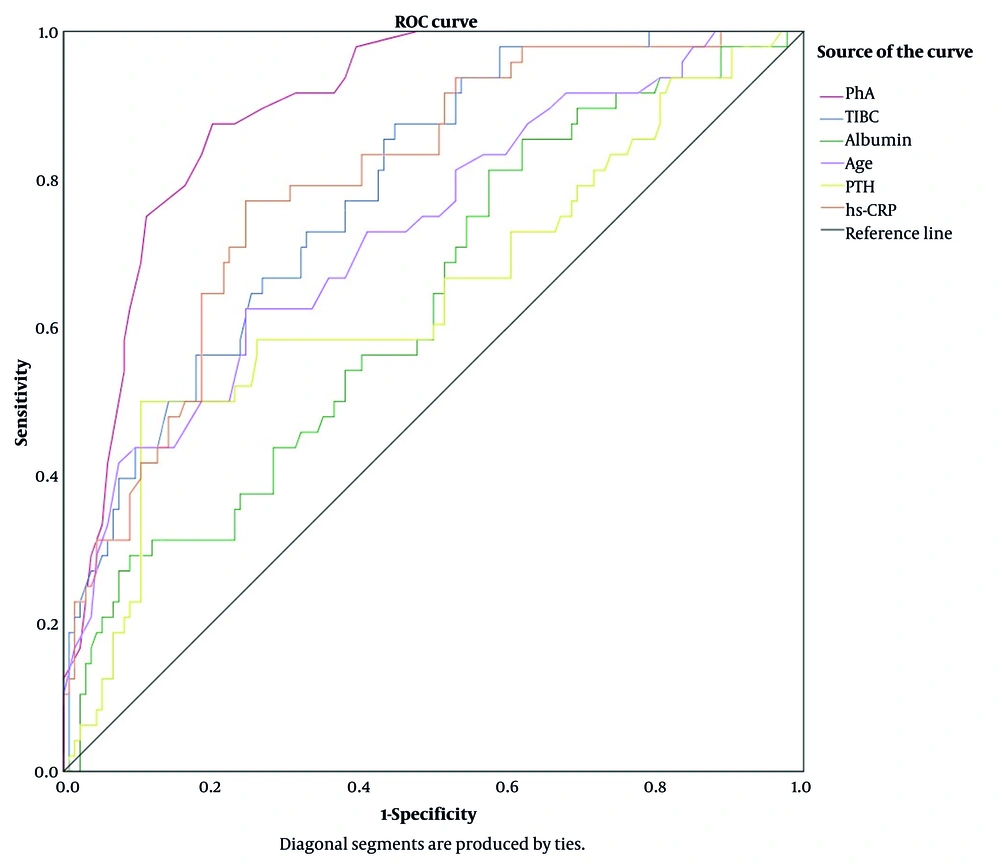
Figure 1.
Receiver operating characteristic (ROC) curves predicting major adverse cardiovascular events using selected factors: PhA: AUC = 0.895; P < 0.001; cut-off value = 4.6°; sensitivity = 87.5%; specificity = 79.9%. TIBC: AUC = 0.796; P < 0.001; cut-off value = 53.44 µmol/L; sensitivity = 85.4%; specificity = 66.7%. hs-CRP: AUC = 0.783; P < 0.001; cut-off value = 3.19 mg/L; sensitivity = 77.1%; specificity = 75.4%. PTH: AUC = 0.645; P = 0.003; cut-off value = 1056.65 pg/mL; sensitivity = 50%; specificity = 79.9%. Age: AUC = 0.729; P < 0.001; cut-off value = 59.5 years; sensitivity = 62.5%; specificity = 89.6%. Albumin: AUC = 0.630; P = 0.007; cut-off value = 39.44 g/L; sensitivity = 81.3%; specificity = 75.4%.
Table 3 shows that the mortality group had significantly higher age, duration of hemodialysis, prevalence of diabetes mellitus and lipid disorders, plasma PTH and hs-CRP levels, incidence of atherosclerosis, and MACE rate, while plasma albumin, HDL-C, TIBC, lean mass, and PhA were significantly lower than in the survivor group (P < 0.05 to P < 0.001).
Table 3.
Comparison of Clinical and Paraclinical Characteristics Between the Mortality and Survivor Groups a
| Characteristics | Mortality Group (N = 23) | Survivor Group (N = 159) | P-Value |
|---|---|---|---|
| Age (y) | 62.30 ± 11.39 | 48.47 ± 15.20 | < 0.001 |
| Gender | 0.402 | ||
| Male | 10 (43.5) | 84 (52.8) | |
| Female | 13 (56.5) | 75 (47.2) | |
| Hemodialysis duration (mo) | 0.058 | ||
| < 12 | 6 (26.1) | 59 (37.1) | |
| 12 - < 60 | 5 (21.7) | 56 (35.2) | |
| ≥ 60 | 12 (52.2) | 44 (27.7) | |
| Hemodialysis duration (mo) | 60 (5 - 108) | 24 (5 - 67) | 0.067 |
| 24-h urine volume (mL) | 0 (0 - 600) | 100 (0 - 900) | 0.251 |
| Hypertension | 23 (100) | 152 (95.6) | 0.598 |
| Diabetes mellitus | 16 (69.6) | 37 (23.3) | < 0.001 |
| Systolic blood pressure (mmHg) | 137.17 ± 14.21 | 138.96 ± 12.97 | 0.542 |
| Diastolic blood pressure (mmHg) | 83.26 ± 7.01 | 83.84 ± 7.33 | 0.724 |
| BMI (kg/m²) | 0.803 | ||
| < 18.5 | 2 (8.7) | 19 (11.9) | |
| 18.5 - 22.9 | 19 (82.6) | 119 (74.8) | |
| ≥ 23 | 2 (8.7) | 21 (13.2) | |
| BMI (kg/m²) | 20.78 ± 2.12 | 20.61 ± 2.26 | 0.733 |
| Red blood cell (T/L) | 3.23 ± 0.78 | 3.06 ± 0.63 | 0.241 |
| Hemoglobin (g/L) | 95.30 ± 23.14 | 89.57 ± 18.60 | 0.183 |
| Hematocrit (L/L) | 0.29 ± 0.07 | 0.27 ± 0.05 | 0.138 |
| Anemia | 20 (87.0) | 155 (97.5) | 0.054 |
| Glucose (mmol/L) | 5.02 (4.43 - 6.86) | 5.73 (4.93 - 7.25) | 0.148 |
| Urea (mmol/L) | 27.64 (22.35 - 30.61) | 27.66 (21.87 - 34.23) | 0.672 |
| Creatinine (µmol/L) | 902.97 (731.19 - 1044.31) | 825.26 (685.7 - 1000.88) | 0.435 |
| Protein (g/L) | 71.56 ± 6.35 | 73.21 ± 6.24 | 0.239 |
| Albumin (g/L) | 35.74 ± 4.51 | 38.64 ± 3.57 | 0.001 |
| Cholesterol (mmol/L) | 4.03 (3.24 - 4.64) | 3.99 (3.36 - 4.77) | 0.976 |
| Triglyceride (mmol/L) | 1.45 (1.04 - 2.59) | 1.51 (0.97 - 2.23) | 0.842 |
| LDL-C (mmol/L) | 2.93 ± 0.76 | 2.72 ± 0.73 | 0.212 |
| HDL-C (mmol/L) | 0.88 ± 0.22 | 1.03 ± 0.31 | 0.034 |
| Lipid disorder | 19 (82.6) | 96 (60.4) | 0.039 |
| Total calcium (mmol/L) | 2.3 (2.12 - 2.49) | 2.27 (2.11 - 2.44) | 0.684 |
| Phosphorus (mmol/L) | 2.02 ± 0.52 | 2.10 ± 0.75 | 0.621 |
| β2-microglobulin (µg/L) | 29.78 ± 3.99 | 29.75 ± 3.02 | 0.966 |
| PTH (pg/mL) | 1266.1 (345.7 - 2051) | 456.9 (193 - 756.4) | 0.004 |
| hs-CRP (mg/L) | 4.99 (4.32 - 6.4) | 2.01 (0.78 - 3.68) | < 0.001 |
| TIBC (µmol/L) | 23.65 (14.2 - 31.3) | 54.43 (26.28 - 70.48) | < 0.001 |
| Lean mass (kg) | 31.95 ± 3.19 | 34.24 ± 2.76 | < 0.001 |
| Body fat mass (kg) | 8.4 (2.5 - 13.5) | 8.8 (6.1 - 13.6) | 0.594 |
| ECW/TBW (%) | 41.37 ± 3.01 | 41.01 ± 2.15 | 0.475 |
| PhA (°) | 3.68 ± 0.5 | 5.42 ± 1.34 | < 0.001 |
| Atherosclerosis | 18 (78.3) | 49 (30.8) | < 0.001 |
| MACEs | 16 (69.6) | 32 (20.1) | < 0.001 |
Abbreviations: BMI, body mass index; RBC, red blood cell; LDL-C, low-density lipoprotein cholesterol; HDL-C, high-density lipoprotein cholesterol; β2-M, β2-microglobulin; PTH, parathyroid hormone; hs-CRP, high-sensitivity C-reactive protein; TIBC, total iron-binding capacity; ECW, extracellular water; TBW, total body water; PhA, phase angle; MACEs, major adverse cardiovascular events.
a Values are expressed as No. (%) or mean ± SD or median (IQR).
As presented in Table 4, male sex, plasma PTH, hs-CRP, TIBC, and PhA were independently associated with mortality in patients undergoing MHD (P < 0.05 to P < 0.01).
Table 4.
Multivariate Analysis of Factors Associated with Mortality
| Variables | OR | 95% CI | P-Value |
|---|---|---|---|
| Age | 1.016 | 0.931 - 1.109 | 0.718 |
| Male sex | 0.128 | 0.018 - 0.933 | 0.043 |
| Duration of hemodialysis | 0.990 | 0.969 - 1.011 | 0.353 |
| Diabetes mellitus | 0.523 | 0.091 - 3.005 | 0.468 |
| Creatinine | 1.003 | 0.999 - 1.007 | 0.113 |
| Albumin | 0.897 | 0.721 - 1.117 | 0.333 |
| Triglyceride | 2.767 | 0.825 - 9.287 | 0.099 |
| HDL-C | 0.192 | 0.003 - 12.606 | 0.439 |
| β2-M | 1.092 | 0.840 - 1.419 | 0.510 |
| PTH | 1.001 | 1.000 - 1.002 | 0.029 |
| hs-CRP | 1.210 | 1.016 - 1.442 | 0.033 |
| TIBC | 0.923 | 0.865 - 0.985 | 0.016 |
| PhA | 0.057 | 0.009 - 0.341 | 0.002 |
Abbreviations: OR, odds ratio; CI, confidence interval; HDL-C, high-density lipoprotein cholesterol; β2-M, β2-microglobulin; PTH, parathyroid hormone; hs-CRP, high-sensitivity C-reactive protein; TIBC, total iron-binding capacity; PhA, phase angle.
Figure 2 illustrates the ROC curves for predicting mortality. Phase angle and TIBC also showed strong predictive value. The AUC for PhA was 0.898 (P < 0.001), with an optimal cut-off value of 4.35°, providing a sensitivity of 95.7% and specificity of 76.1%. Total iron-binding capacity had an AUC of 0.843 (P < 0.001), with a cut-off value of 37.26 µmol/L, corresponding to a sensitivity of 95.7% and specificity of 71.1%. Other predictors included hs-CRP (AUC = 0.801), age (AUC = 0.777), albumin (AUC = 0.708), and PTH (AUC = 0.687), which demonstrated moderate predictive performance.
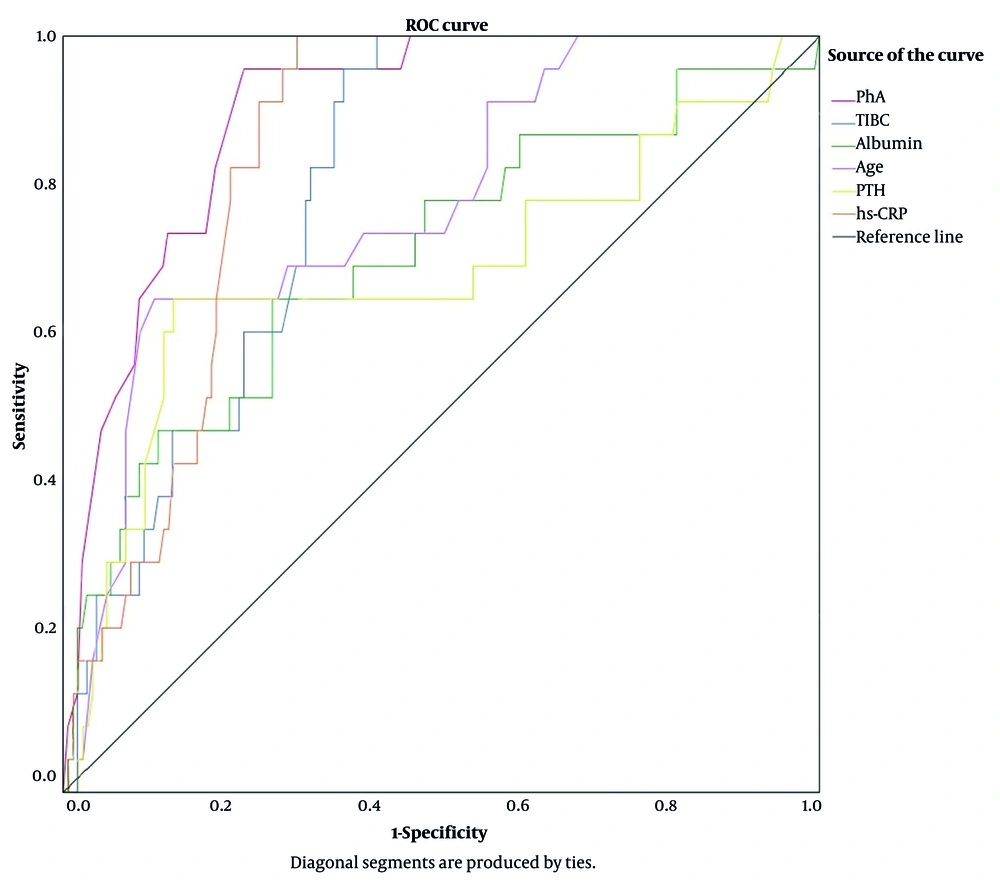
Figure 2.
Receiver operating characteristic (ROC) curves predicting mortality using selected factors: PhA: AUC = 0.898; P < 0.001; cut-off value = 4.35°; sensitivity = 95.7%; specificity = 76.1%. TIBC: AUC = 0.843; P < 0.001; cut-off value = 37.26 µmol/L; sensitivity = 95.7%; specificity = 71.1%. hs-CRP: AUC = 0.801; P < 0.001; cut-off value = 3.25 mg/L; sensitivity = 95.7%; specificity = 62.9%. PTH: AUC = 0.687; P = 0.004; cut-off value = 1056.65 pg/mL; sensitivity = 65.2%; specificity = 85.5%. Age: AUC = 0.777; P < 0.001; cut-off value = 66.5 years; sensitivity = 65.2%; specificity = 88.1%. Albumin: AUC = 0.708; P = 0.001; cut-off value = 36.74 g/L; sensitivity = 65.2%; specificity = 72.3%.
4. Discussion
4.1. Rates of Major Adverse Cardiovascular Events and Mortality in Patients Undergoing Maintenance Hemodialysis
Our study showed that 26.4% of patients experienced MACEs and 12.6% of participants experienced all-cause mortality during the 3-year follow-up period (Table 1). The prevalence of MACEs varies among studies conducted in different regions and countries. In a study from Taiwan involving 179 patients undergoing MHD, with a mean follow-up period of 33.3 ± 6.7 months, the MACE rate was 20.1% (24). Similarly, a pooled analysis by Stirnadel-Farrant et al. that followed 16560 hemodialysis patients over two 3-year phases, of whom 8660 were at high cardiovascular risk, found that the highest MACE rates were in North America (19.4%) and Europe (17.4%), while the lowest rate was in Japan (7.5%) (25). More recently, in 2025, Ma et al. investigated the relationship between MACEs and protein-energy wasting (PEW) in Chinese patients undergoing MHD. Their study reported MACEs in 61 patients (29.1%, 61/210), with a significantly higher incidence in those with PEW compared with non-PEW patients (P = 0.015) (26).
Mortality rates among patients undergoing MHD have also been widely reported. In the same analysis by Stirnadel-Farrant et al., all-cause mortality was highest in North America (14.0%) and Europe (13.2%), while the lowest rate was in Japan (5.4%) (25). Several factors, including variations in age, sex distribution, comorbidities, and clinical characteristics of the study populations, may explain the differences in MACEs and mortality rates across studies. In our cohort, patients had a median dialysis duration of 30 months, with a high prevalence of hypertension (96.2%) and atherosclerosis (36.8%) (Table 1), both of which are well-recognized risk factors for increased MACEs and mortality in patients undergoing MHD.
4.2. Factors Associated with Major Adverse Cardiovascular Events and Mortality in Patients Undergoing Maintenance Hemodialysis
In our study, prolonged hemodialysis duration, diabetes, lower HDL-C, reduced TIBC, and decreased PhA were identified as independent predictors of MACEs (Tables 1 and 2). Notably, both low TIBC and low PhA demonstrated good predictive power for MACEs within 3 years, with AUCs of 0.796 and 0.895, respectively (P < 0.001) (Figure 1). Although HDL-C is traditionally regarded as “good” cholesterol, clinical studies have consistently shown that low HDL-C levels are strongly associated with a higher risk of cardiovascular events, such as atherosclerosis, myocardial infarction, and stroke, in patients undergoing MHD (27-29). In parallel, elevated hs-CRP is directly implicated in atherogenesis, consequently increasing the risk of cardiovascular events such as myocardial infarction and stroke in patients undergoing MHD (29, 30).
Total iron-binding capacity reflects the TIBC of transferrin in the blood. Low TIBC levels often indicate nutritional deficiency, which is common among elderly and chronically ill patients, including those undergoing MHD (11-13). Bioelectrical impedance-derived PhA serves as an indicator of cellular integrity and nutritional status. Similar to TIBC, a low PhA value reflects poor nutrition and deteriorated cellular health, frequently observed in patients undergoing MHD (15, 17-20).
Our study demonstrated that low TIBC and PhA were significant factors associated with MACEs. Although these parameters do not directly cause cardiovascular events, low TIBC is typically associated with anemia and inflammation, while reduced PhA correlates with atherosclerosis and chronic inflammation, which are key pathways contributing to increased MACEs in patients undergoing MHD (11, 20, 31). We also observed that TIBC and PhA were independent predictors of all-cause mortality, with AUCs of 0.843 and 0.898, respectively (P < 0.001) (Tables 3 and 4 and Figure 2). Consistent with our findings, previous studies have reported that low TIBC predicts mortality during the first 3 years in patients starting MHD (13) and that reduced PhA is associated with higher mortality in patients undergoing peritoneal dialysis (21). Our results further confirm the prognostic significance of TIBC and PhA, highlighting their roles as indicators of malnutrition and impaired cellular health, which contribute to increased mortality in patients undergoing MHD. Our findings suggest that both TIBC and PhA are useful predictors of MACEs and all-cause mortality in patients undergoing MHD.
Although this study achieved its objectives, several limitations should be acknowledged. First, it was conducted at a single center with a relatively modest sample size. Second, the relationship between TIBC, PhA, and the effectiveness of hemodialysis was not fully explored. Third, no intervention aimed at reducing adverse outcomes in patients was evaluated. Finally, although ROC analysis showed relatively high AUC values for TIBC and PhA, these findings should be interpreted with caution because the limited sample size may increase the risk of model overfitting.
4.3. Conclusions
In patients undergoing MHD, the incidence of MACEs was 26.4%, and all-cause mortality was 12.6% during a 3-year follow-up period. Elevated plasma PTH and hs-CRP levels and reduced TIBC and PhA were independently associated with both MACEs and mortality. Total iron-binding capacity and PhA demonstrated strong predictive value for cardiovascular events and overall mortality, underscoring their potential utility as simple, noninvasive prognostic indicators in patients undergoing MHD.