


1. Background
One of the big challenges of collecting unbiased and valid data in social and medical research, especially during the recent COVID-19 pandemic, is having a safe yet private and effective access to the individual participants (1). In this regard, phone interviewing has become a common way of collecting data due to the safety, privacy, and ease of conversation. Phone interviewing is also a common way of collecting information regarding an individual’s private life, especially when it involves stigma and social discrimination (sensitive information).
Over recent years, the validity and feasibility of different methods of data collection have been under serious debates (2). The validity of data depends on many factors, including the method used to collect data, the confidentiality of the requested information, and the anonymity of the participants (3). For example, a previous study suggested that the level of privacy during an interview is positively associated with the amount of information provided by the responder (4). As a result, if the privacy and trust of the participants are not considered appropriately, the participation rate, validity, and completeness of responses of the participants may be affected, causing validity and reliability issues in the data and results (5). Factors that may influence the response rate and the quality of collected information include the method of collecting data (e.g., face-to-face interview, phone interview, or self-administered questionnaire), the location of the interview (e.g., in street, house, or hospital), the type of questions (e.g., sensitive/personal, or impersonal), and the accessibility of the participants (e.g., the flexibility in timing and duration of interview) (6). Therefore, choosing the best possible method for collecting data is very important for the validity and reliability of the study results (2).
Although face-to-face interview is still the most common way of data collection, due to the recent COVID-19 pandemic and the necessity of social distancing and movement restrictions in many countries, conducting interviews via a mobile/phone or internet are becoming widely used (7). Besides the safety, other benefits of phone interviews are the flexibility of the interview’s timing and conditions, as well as the better availability of the participants. Compared to face-to-face interviews, the extensive geographic access to mobile phones makes phone interviews much easier and cheaper for the researchers all around the world. Moreover, phone interviewing is a valuable way of interviewing subjects that are difficult to reach or reluctant to be in a face-to-face interview, especially when some sensitive questions are to be asked (8). In addition, with a phone or face-to-face interview, questions are directly asked to the responder, and the number of unanswered or misunderstood questions is reduced (9).
However, alongside the benefits of using a phone interview, there are some disadvantages as well. It is suggested that phone interviews are typically suitable for short interviews or in very specific occasions (10, 11). For example, in a phone interview, although the most effective method of communication (e.g., verbal) is still available, both the interviewer and interviewee do not see each other. As a result, some nonverbal elements (e.g., body language) might be missed during the interview. Another disadvantage of a phone interview is the lack of awareness of the interviewee’s situation at the time of the phone call (12), and especially when using a landline phone, the responder’s answering may be affected by the lack of privacy. Another problem that is associated with using a cell phone for an interview is the possibility of sampling and responder bias. For example, not answering unknown phone calls, limited cell phone coverage, lack of trust between interviewer and interviewee, and the lower response rate than face-to-face interviews may cause sampling and information biases (13). It is also important to note that the pattern of answering sensitive questions is strongly influenced by the cultural and social features of the study population. It should also be noted that, due to social stigma and discrimination, gathering information about an individual’s very personal life (e.g., substance use, sexual behaviors, sexually transmitted infections [STIs], and psychological problems) is always challenging. This challenge becomes even more serious when the study is being conducted in a religious community (14, 15).
Phone interviews are becoming common in recent years, especially in North America and Western Europe (16-19), and the use of this method for data collection seems to be inevitable for many health and marketing studies. In addition, during the recent COVID-19 pandemic, due to the risk of a close contact between interviewer and interviewee, a phone interview is more preferable compared to door-to-door or face-to-face interviewing methods.
2. Objectives
The purpose of this study was to investigate the feasibility and validity of phone interviewing using mobile phones to collect sensitive information related to the participants’ sexual behavior in Marvdasht, Iran.
3. Methods
This cross-sectional study was conducted on rural and urban communities (male and females), who were in the sexually active age range (18 - 50 years) in Marvdasht, the second largest county of Fars province in Iran. According to the latest national census in November 2016, the population of Marvdasht is 323,434, and it has 94,699 households. Also, a recent report suggested that the rate of active mobile users is very high in Iran (94.9%).
3.1. Data Collection
At first, housewives of the selected houses were interviewed at their house doors. During the interview, the interviewers asked for the name, sex, age, and occupation of the householders. For those aged, between 18 - 50 years, cell phone numbers were also reported by the responders. The interview was conducted by well-experienced and trained female nurses. Due to the low level of literacy among the responders, verbal consent was obtained at the start of the interview.
As the second phase of data collection, an invitation letter with a sentence introducing the study as a ‘social survey’ was given to the housewives to be delivered to the eligible individuals in the household (people aged 18 - 50 years). The letter announced that, within two days, a call from the study office at Shiraz University of Medical Sciences would be made to them. This was done to assure the family members about the origin of the call, the importance of participation, and the confidentiality of their information. Also, neither the housewife nor the eligible responder were aware of the content of the interview unless they answered a phone call. The phone interview was conducted by a same-sex trained interviewer and started with introducing the research team and explaining the aims. The responder was free stop the interview at any time. Also, a verbal consent was obtained from the participants over the phone. The participants answered several questions regarding the sexual aspects of their life, including the presence of defined STI syndromes. All eligible members of a family were interviewed at almost the same period of time to prevent sharing the experience of the interview with other family members. To those who did not respond to the first call, a second call was made two to three hours after the first call. In case of no response to the calls, the householder was called again three days later. In the case of no answer to the last call, the person was considered unable to reach. The existence of STI syndromes was asked from the responders. Details of the STI-related syndromes investigated in this study have been provided in a previous study (20).
3.2. Sampling
3.2.1. Study Population
The participants were selected from rural and urban residents of Marvdasht county using data from a census run by the county’s health center under the Iranian Ministry of Health and Medical Education. The sample size was decided to be equal for urban and rural populations. This is because Marvdasht is a county with about 170,000 urban population living in Marvdasht city and about 160,000 rural population living in 226 villages. In total, 6,000 houses were selected in urban (n = 3000 houses) and rural (n = 3000 houses) areas independently using a systematic random sampling method.
3.3. Statistical Methods
T-test, Fisher’s exact, and χ2 tests were used to measure any association between the study variables. SPSS software version 19 was used for data analysis (Figure 1).
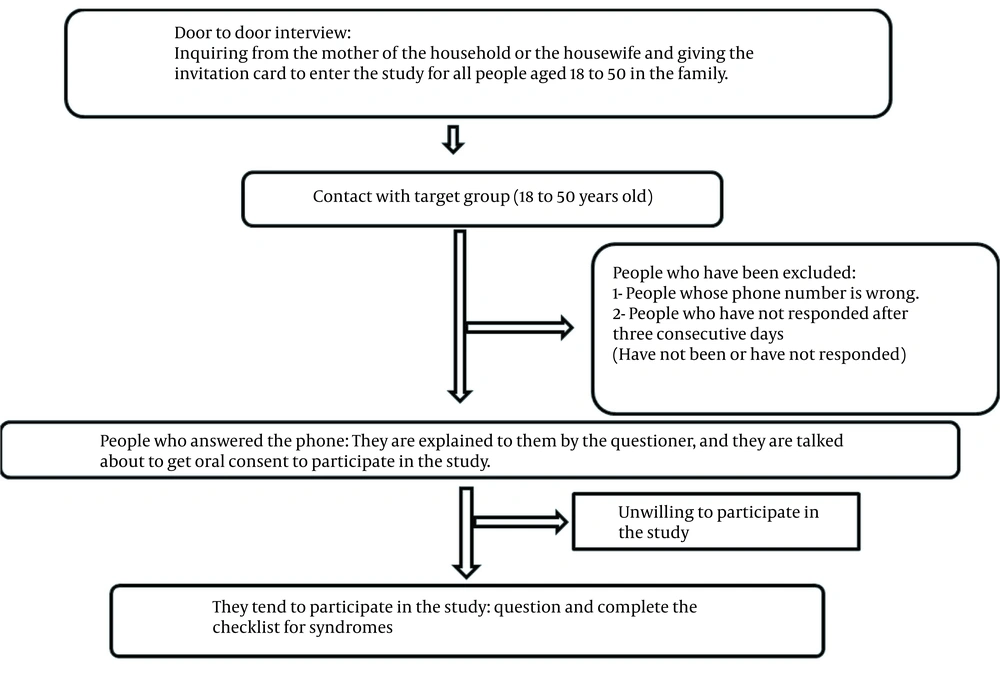
Figure 1.
Flowchart of the study procedures
4. Results
As presented in Table 1, a total of 5,894 individuals with an age range of 18 - 50 years (3,202 males vs. 2,692 females) participated in this study (2,991 from urban and 2,903 from rural areas). The mean age of participants was 33.85 ± 8.85 years. In general, 63.78% of the participants answered the calls. Also, 36.35% of participants did not pick up the phone (26.63% no response and 3.31% out of range). However, of those who answered the call, 92.18% accepted to participate, of whom 99.5% cooperated until the end of the interview.
Table 1.Response Rate
| Variables | No. (%) |
|---|---|
| Call result | |
| Successful | |
| First round | 3068 (52.05) |
| Second round | 398 (6.75) |
| Third round | 299 (5.07) |
| Total | 3765 (63.87) |
| Missed | |
| No response | 1570 (26.63) |
| Out of range | 258 (3.31) |
| Phone number is wrong | 199 (2.31) |
| No phone number | 89 (1.51) |
| Total | 2143 (36.35) |
| Participation in the study | |
| Yes | 3470 (92.18) |
| No | 295 (7.83) |
| Collaborating until the end of the interview and answering all questions | |
| Yes | 3440 (99.1) |
| No | 30 (0.86) |
The associations between answering the calls and willingness to participate in the study with the demographic characteristics of the participants are presented in Tables 2 and 3. Accordingly, answering the calls was associated with age, gender, place of residency, and education of the individuals (P < 0.05 for all). For example, those who had no phone or did not answer the calls were on average 6.02 years older and 1.70 years younger than those who answered the calls, respectively. In addition, having a mobile phone was more common among males (100%) than females (96.90%) (P < 0.001). Male participants answered the calls more frequently than females (85.51% in males vs. 59.40% in females). Regarding the place of residency, although answering the calls was not significantly different between residences of rural and urban areas, the reason for not answering the calls was different. For example, 0% and 2.96% of urban participants and 2.81% and 5.57% of rural residences had no phone or were out of range, respectively. Fewer participants with higher education owned no mobile phone (0.4%) than those who were illiterate (5%). On the other hand, willingness to participate in the study and cooperate until the end of the interview was associated with gender (P < 0.05), but not with the place of residency, job, and education (P > 0.05) (Table 4).
Table 2.The Difference Between Mean Age of Individuals in Different Segments
| Variables | Age | |||
|---|---|---|---|---|
| Mean ± SD | Missed Call | Mean ± SD | P-Value | |
| Successful call | 33.93 ± 10.63 | Unresponsiveness | 32.20 ± 9.10 | > 0.0001 |
| Phone number is wrong | 33.74 ± 9.73 | 0.816 | ||
| Inaccessibility | 31.20 ± 8.86 | > 0.0001 | ||
| No phone number | 38.22 ± 10.25 | 0.002 | ||
| Participation in the study | 34.02 ± 10.642 | No participation in the study | 31.78 ± 9.248 | 0.0011 |
| Collaborating until the end of the interview and answering all questions | 34.02 ± 10.658 | No collaboration until the end of the interview and answering all questions | 33.48 ± 7.197 | 0.854 |
Table 3.Response to Different Rounds of Calls Based on Demographic Status
| Variable | Successful Call | Missed Call | Total | |||||
|---|---|---|---|---|---|---|---|---|
| First Round | Second Round | Third Round | No Answer | Out of Range | No Phone Number | Phone Number Was Wrong | ||
| Gender | ||||||||
| Male | 1535 (54.93) | 312 (11.16) | 272 (9.73) | 405 (14.49) | 198 (7.08) | 0 | 72 (2.57) | 2794 (49.33) |
| Female | 1316 (45.86) | 86 (2.99) | 27 (0.94) | 1165 (40.60) | 60 (2.09) | 89 (3.10) | 126 (4.39) | 2869 (50.66) |
| P-value | > 0.0001 | > 0.0001 | > 0.0001 | > 0.0001 | > 0.0001 | > 0.0001 | 0.001 | - |
| Place of residency | ||||||||
| Urban | 1524 (55.86) | 217 (7.95) | 147 (5.38) | 678 (13.85) | 81 (2.96) | 0 | 81 (2.96) | 2728 (46.34) |
| Rural | 1544 (48.89) | 180 (5.69) | 151 (4.78) | 891 (25.93) | 176 (5.57) | 89 (2.81) | 117 (3.70) | 3158 (53.65) |
| P-value | 0.075 | 0.296 | 0.578 | > 0.0001 | > 0.0001 | > 0.0001 | 0.007 | - |
| Education | ||||||||
| Illiterate | 101 (23.1) | 10 (3) | 4 (1.2) | 83 (19.0) | 13 (3) | 21 (5) | 15 (3.4) | 247 |
| Elementary | 548 (43.7) | 43 (6.1) | 51 (7.7) | 327 (26.1) | 56 (4.5) | 24 (1.9) | 42 (3.3) | 1091 |
| Middle school | 624 (51.8) | 89 (15.3) | 61 (12.4) | 248 (20.6) | 52 (4.3) | 9 (0.8) | 36 (3) | 1119 |
| High school and diploma | 877 (49.9) | 107 (12.2) | 86 (11.1) | 431 (24.5) | 77 (4.4) | 7 (0.4) | 62 (3.5) | 1647 |
| Academic | 579 (50.6) | 93 (16.5) | 66 (14.1) | 265 (23.2) | 44 (3.8) | 7 (0.4) | 20 (1.7) | 1074 |
| P-value | > 0.0001 | > 0.0001 | > 0.0001 | 0.009 | 0.667 | > 0.0001 | 0.072 | - |
| Job (males) | ||||||||
| Unemployed and student | 134 (39.5) | 31 (15.1) | 25 (14.4) | 58 (17.1) | 39 (11.5) | - | 9 (2.7) | 296 |
| Self-employed | 807 (55.2) | 143 (21.9) | 148 (29) | 170 (11.6) | 96 (6.6) | - | 36 (2.5) | 1400 |
| Farmer and rancher | 186 (55.9) | 37 (25.2) | 33 (30) | 42 (12.6) | 18 (5.4) | - | 5 (1.5) | 321 |
| Employee | 231 (47) | 59 (22.8) | 39 (19.7) | 62 (12.6) | 29 (5.9) | 11 (2.2) | 431 | |
| P-value | > 0.0001 | 0.110 | > 0.0001 | 0.026 | 0.004 | 0.732 | - | |
| Job (females) | ||||||||
| Employed | 86 (51.8) | 13 (16.3) | 3 (4.5) | 52 (31.3) | 0 | 1 (0.6) | 2 (1.2) | 157 |
| Housewife | 1226 (42.9) | 55 (3.4) | 18 (1.1) | 917 (32.1) | 57 (2) | 66 (2.4) | 109 (3.8) | 2448 |
Table 4.Participation in the Study and Collaboration up to the End of the Interview and Answering All Questions Based on Demographic Status
| Variables | Participation in the Study | Collaboration up to the End of the Interview and Answering All Questions | ||||||
|---|---|---|---|---|---|---|---|---|
| Yes | No | Total | P-Value | Yes | No | Total | P-Value | |
| Place of residency | 0.308 | 0.328 | ||||||
| Rural | 1735 (92.97) | 131 (7.02) | 1866 (49.56) | 1720 (99.07) | 16 (0.92) | 1736 (50.02) | ||
| Urban | 1734 (91.40) | 163 (8.5) | 1897 (50.38) | 1723 (99.36) | 11 (0.63) | 1734 (49.97) | ||
| Gender | ≥ 0.0001 | 0.0001 | ||||||
| Female | 1558 (100) | 0 (0) | 1558 (41.38) | 1567 (100) | 0 | 1567 (45.15) | ||
| Male | 1911 (86.62) | 295 (13.37) | 2206 (58.59) | 1887 (98.53) | 28 (1.46) | 1915 (55.18) | ||
| Education | 0.602 | 0.439 | ||||||
| Illiterate | 120 (90.90) | 12 (9.09) | 132 (3.50) | 786 a (99.36) | 5 (0.63) | 791 (24) | ||
| Elementary | 670 (94.36) | 40 (5.63) | 710 (18.85) | |||||
| Middle school | 799 (91.73) | 72 (8.26) | 871 (23.13) | 790 (98.87) | 9 (1.12) | 799 (23.02) | ||
| High school and diploma | 1108 (92.71) | 87 (7.28) | 1195 (31.73) | 1864 a (99.30) | 13 (0.69) | 1877 (53.09) | ||
| University degree | 760 (90.69) | 78 (9.30) | 838 (22.25) | |||||
| Job | 0.552 | 0.05 | ||||||
| Unemployed or student | 188 (82.45) | 40 (17.54) | 228 (6.05) | 183 (96.31) | 7 (3.68) | 190 (5.52) | ||
| Self-employed | 1115 (87.04) | 166 (12.95) | 1281 (34.02) | 1101 (98.65) | 15 (1.34) | 1116 (32.16) | ||
| Farmer | 262 (89.41) | 31 (10.58) | 293 (7.78) | 257 (98.46) | 4 (1.53) | 261 (7.52) | ||
| Employee | 334 (86.30) | 53 (13.69) | 387 (10.28) | 333 (99.40) | 2 (0.59) | 335 (9.65) | ||
aThe groups were merged.
5. Discussion
The results of our study showed that response to the phone calls and participation rates were significantly different with regard to gender, age, place of residency, and occupation. For example, in all rounds of calls, the response rate was higher for males, urban residents, illiterate, self-employed, and older age subjects. However, the significant difference between males and females in continuing the interview and answering the sensitive questions (complete response) was in favor of female participants. The gender difference in complete response may be due to the fact that males were often at work in a non-private place at the time of interview, as the calls were made between 8 am to 1 pm. These results are not in line with the results of a study, in which the response rate to a mobile phone interview was significantly lower in males than in females (13). The results of our study also showed that having no cell phone was more common in females than males. Similarly, previous reports suggested that individuals have different levels of access to technology depending on their gender. For example, women have lower access to mobile phone and more often use landlines for communication, and those women generally use mobile phone for social communication rather than non-private or work-related subjects (21).
Considering the place of residency, there was no significant difference in successful calls between urban and rural participants. However, more rural subjects had no phone or were out of range. It is possible that due to technical issues, few villages did not have full coverage of mobile phones. As a result, a poor coverage makes the communication difficult, especially when the participant is working in remote areas (22). The results may also be observed due to the cultural differences between the two urban and rural groups (e.g., the rural people feel more discomfort of disclosing their private life). As a result, cultural characteristics should be considered when designing such phone interviews (5).
There was also no significant difference in the participation rate and complete response to the questions among female participants with regard to their occupation. However, there was a significant difference in the participation of male participants with regard to their job status, so unemployed people answered the calls less frequently.
Roy and Vanheuverzwyn pointed out that when using a cell phone for interviews, people may not respond because of working, having no privacy, or doing something that requires attention (e.g., driving, studying, or being in a class) (22).
There was a significant difference in age between those who answered the calls and those who answered the questions. Accordingly, older subjects answered to the calls and participated in the interview more frequently. On the other hand, older people had less access to mobile phones. Similarly, Vehovar et al. showed that responsiveness to surveys conducted with mobile phones was higher in younger and less educated individuals (13).
Our study showed a good participation rate (92.18%) among those who answered the calls (the subjects were not aware of the content of the interview before answering the calls), and the rate of complete response was excellent (99.1%). However, Haghdoost et al., in a study on the similar (sensitive) issue used participants who were selected on the street, as they believed that they would have better participation due to the anonymousness of their identity compared to phone call interviewing method (because of the availability of names and home address) (5). Also, other researchers pointed out that if the responders’ confidentiality is protected, they would answer sensitive questions in a much better way (23). Our study rejected the above hypothesis. It is possible that people who are not in a face-to-face situation feel more confident while answering sensitive questions.
5.1. Conclusions
Our study showed that although using phone interview for collecting sensitive information may cause different sorts of bias, based on the high level of participation in the study and response to sensitive questions, this method can be used as a reliable approach for gathering information on sensitive questions in a community with a religious background. To do so, issues such as cell phone coverage, culture, time of call, and proper arrangement before making the calls should be carefully considered.
5.2. Limitations
Although the results of our study are possibly highly related to the culture of the study population, we believe the patterns of the participation and complete response rates are more or less the same in different communities. We could not clearly understand the reason for not answering the phones by some participants. However, we believe that the issue is independent of the sensitivity of the subject of the study as the individuals were not aware of the content of the interview before answering the call.



