


1. Background
Desirable sexual intercourse leads to marital satisfaction and mental health (1). The world health organization defines sexual health as concordant function of mind, sentiments, and body contributing to promotion of social, spiritual, and personality dimension of individuals and bringing them to perfection (2). Intimacy in sexual relations is an important behavioral pattern based on satisfaction and love (3). Sexual intimacy prognosticates the overall health of women and it requires expressing thoughts, feelings, sexual fantasies, and propounding sexual needs with the spouse. This kind of intimacy arouses sexual desires in couples, and it has an important role in sexual and marital satisfaction (4). One of the important factors in marital and sexual satisfaction in females towards their husbands is sexual assertiveness (5). Assertiveness is a mental and social sense to the personal perceptions or interpretation concerning how to show emotions in sexual relations (6) and includes the ability of individuals in commencing the required sexual activity, refusing unwanted sexual activity, and protecting one from unwanted pregnancies and sexually transmitted diseases (7).
Not having certain sexual skills due to the dissatisfaction about sexual behavior, being exposed to sexually transmitted diseases, and having a forced sex, especially an inability to refuse unwanted sexual activity (intercourse) can impose many problems on women (8).
Sexual disputes and problems are the leading cause of divorce, and even in Iran, the divorce statics indicate the significant role of sexual disputes and problems on disintegration of families (9). The findings indicate that 50% to 60% of divorce cases are due to the sexual problems and dysfunctions (10). Nowadays, the felicitous and conscious understanding of sexual instinct is far more important than sexual intercourse; furthermore, most of the incorrect performances of the couples are due to the lack of sufficient sexual knowledge and sexual relation skills (11).
The connubial compatibility, life satisfaction, and eventually general health of couples can be promoted by developing sexual relation skills (12). Due to the correlation among sex quality, sexual dysfunction, and low quality of life, there is a need to study assertiveness, enrichment, and improvement of the quality of sex relations in married couples (13). Sexual dissatisfaction on the one hand and the demand of the couples for improvement of sexual relations on the other indicate the importance of this issue and the needs of couples for intervention and specialized training (14).
2. Objectives
Sexual enrichment counseling aims at influencing and improving sexual assertiveness in married females, which can lead to improvements in quality of marital life.
3. Methods
This was a randomized controlled trial, and the participants were all married females at the reproductive age of 18 to 45 years, who visited a health center in Karaj in 2016. Convenience sampling method was used based on the following inclusion criteria: being married and living with spouse, being married for at least 1 year, having literacy skills, and agreeing to participate in the sessions regularly and consciously. Those having psychological disorders, intensive connubial problems, sexual dysfunction, using any kind of medicine or drugs, and those suffering from known diseases affecting their sexual function were excluded from the study. Sample size was calculated based on the mean and standard deviation from a previous study (15). Considering the first type of error (alpha level) 5% and the power of 80% in finding the difference of 10 scores in the intervention and 10% attrition, 30 samples were selected for each group.

Simple random allocation was done using a computer software program that generated the random sequence. This study was blind only in the stage of data analysis as an assistant coded the groups, and the main researcher, who was responsible for data analysis, was not aware of the name of groups.
3.1. Data Collection
Data were collected by a self-administrated questionnaire that included the 2 following sections: (1) the demographic characteristics of the participants, and (2) Hulbert’s sexual assertiveness questionnaire. Personal information contained questions on age, education, income, duration of marriage, number of children, age of last child, and employment status of the participants. To examine the validity of the content, the demographic questionnaire was presented to 5 faculty members and after applying their comments, the questionnaire was prepared for the final version.
Hulbert Sexual Assertiveness Questionnaire: This 25-item test was first developed by Hulbert in 1992. Likert 5-scale measure was used for the test options. The options are graded from always = 0 to never = 4, and scores ranging from 0 to 100, with higher scores indicating higher sexual assertiveness and lower scores indicating lower sexual assertiveness. Implementing this indicator, David Farley Hulbert obtained the test retest reliability of 0.86. The content validity index (CVI) of the Hulbert Index was calculated to be 0.91 in a study in Iran (16). In the present study, to determine reliability, the questionnaire was completed by 20 participants, and scores were analyzed using SPSS statistical software, and the Cronbach’s alpha of the questionnaire was found to be 0.87. Hulbert Sexual Assertiveness Questionnaire was implemented on the 2 groups as a pretest, and then, the experimental group received sexual enrichment counseling training in six 90-minute sessions. The posttest was implemented 2 and 4 weeks after the final session. The content of the sessions are provided in Table 1.
Table 1.Content of the Intervention Sessions
| Session | Purpose | Content |
|---|---|---|
| 1 | Acquainting the participants with each other and with the counselor, implementing the pretest questionnaire and developing sexual awareness | 1, Acquainting the participants with each other and with the counselor as well as with the principles and provisions of sessions; 2, explaining the purpose of the research for the participants 3, sex education including the importance of sexual relations, brief training of sexual response, and male and female genital organs and their functions. |
| 2 | Training the sexual skills to the couples | 1, The ways of promoting intimacy and sexual satisfaction and sexual relations skills in couples; 2, increasing verbal communication, positive interactions, expression of emotions and realistic expectations; 3, the differences between males and females and the impediments of having an enjoyable sexual relations; 4, training the assertiveness skills and increasing self-confidence. |
| 3 | Training the enrichment sexual relations based on our five senses | 1, Asking about the previous session, checking assignment and feedback of transferring experience to the spouse; 2, training the effect of safe sexual relations on couples; 3, the ways of identifying the sensitive spots of your body and acquainting with variety of physical contact; 4, thoroughly explaining the emotional and sensory contact. |
| 4 | Keep training the enrichment sexual relations based on our five senses | 1, Reviewing the assignment of the previous session and feedback of transferring experience to the spouse; 2, explaining completely humorous touches and sexual games. |
| 5 | Keep training the enrichment sexual relations based on our five senses | 1, Reviewing the assignment of the previous session and transferring experience to the spouse; 2, explaining completely sexual touch. |
| 6 | Explaining the importance of practicing the learned skills and also giving thanks to the visitors | 1, Reviewing the assignment of the previous session and transferring experience to the spouse; 2, reviewing the previous learned skills based on a clear expression of sexual preferences to spouse, in addition, receptive listening to the sexual preferences of the spouse; 3, to practice the learned skills. |
3.2. Data Analysis
SPSS software Version 21 was used for data analysis. To assess the effectiveness of sexual enrichment counseling on sexual assertiveness score, paired t test and AVOVA with repeated measure were used.
3.3. Ethical Consideration
This study was approved by the ethics committee of Medical University of Karaj (Abzum.Rec.1395. 30.). It was also registered in Iranian registry of clinical trials (IRCT) under the number of 2016123031662N1.
4. Results
The average age of the participants was 20 to 40 years, and most of them were housewives holding a high school diploma degree. The demographics of the participants are demonstrated in Table 2. Before the study, there were no significant differences between the 2 groups in demographic variables and sexual assertiveness score.
Table 2.Demographic Characteristics of the Participants
| Variables | Control | Intervention | Result |
|---|---|---|---|
| Mean (± SD) | Mean (± SD) | Test, P Value | |
| Age | 31.47 (± 4.883) | 33.47 (± 4.932) | t-test, 0.120 |
| Duration of marriage | 8.60 (± 4.658) | 10.04 (± 5.512) | t-test, 0.177 |
| Age of last child | 2.92 (± 2.208) | 4.26 (± 4.373) | t-test, 0.166 |
| Number of children | 1.43 (± 0.817) | 1.60 (± 0.814) | Mann-whitney, 0.432 |
| Income | 2196600 (± 797618) | 1935000 (± 740823) | Mann-whitney, 0.193 |
| Number (Percent) | Number (Percent) | P Value | |
| Education | Mann-whitney, 0.177 | ||
| Guidance school | 6 (20) | 4 (13.3) | |
| High school | 17 (56.7) | 14 (46.7) | |
| High education | 7 (23.3) | 12 (40) | |
| Job status | Chi 2, 0.192 | ||
| Housewife | 20 (66.7) | 25 (83.3) | |
| Employee | 10 (33.3) | 5 (16.7) | |
| Economic status | Mann-whitney, 0.460 | ||
| Weak | 3 (10) | 2 (6.7) | |
| Average | 22 (73.3) | 21 (70) | |
| Good | 6 (20) | 4 (13.3) |
The mean score of sexual assertiveness before the study was 45.51 ± 8.85 in the intervention group and 46.21 ± 10.43 in the control group. After counseling, the results revealed an improvement in the mean score of sexual assertiveness 1 week and 1 month after the consultation in the intervention group. The mean score of sexual assertiveness was 68.44 ± 6.12 in the intervention group and 46.42 ± 10.07 in the control group 1 week after the intervention. In addition, the mean score of sexual assertiveness 1 month after the intervention was 71.14 ± 6.24 in the intervention group and 45.51 ± 9.38 in the control group. A within-group comparison revealed that the sexual assertiveness variable had significantly increased in the intervention group over time, but it did not change significantly in the control group. As well, a between-group comparison indicated no significant difference between the sexual assertiveness of the 2 groups (P = 0.000). Thus, the intervention affected the sexual assertiveness scale and improved it (Table 3).
Table 3.A comparison of the Sexual Assertiveness Between The Two Groupsa
aValues are expressed as mean ± SD.
bP value significant (P < 0.05).
Education had a significant relationship with sexual assertiveness (Table 4). Other variables had no significant relationship with sexual assertiveness. However, age and marriage duration were entered into the model to determine their effect on the relationship between enrichment counseling and the sexual assertiveness score. The results revealed that education had an independent and significant relationship with sexual assertiveness score (P = 0.000), but age and duration of marriage did not have any significant relationship. The total number of participants was 54 after attrition. The flow diagram of the study is provided in Figure 1.
Table 4.The Effect of Important Variables on Sexual Assertiveness Scorea
| Source | Mean Square | Sum of Square | F | DF | Sig |
|---|---|---|---|---|---|
| Intercept | 4264.21 | 4264.21 | 36.69 | 1 | 0.000 |
| Age | 57.62 | 57.62 | 0.49 | 1 | 0.485 |
| duration of marriage | 1.58 | 1.58 | 0.01 | 1 | 0.908 |
| Education | 1598.64 | 3197.29 | 13.75 | 2 | .000 |
| Error | 116.20 | 5345.62 | 46 |
aP value significant (P < 0.05).
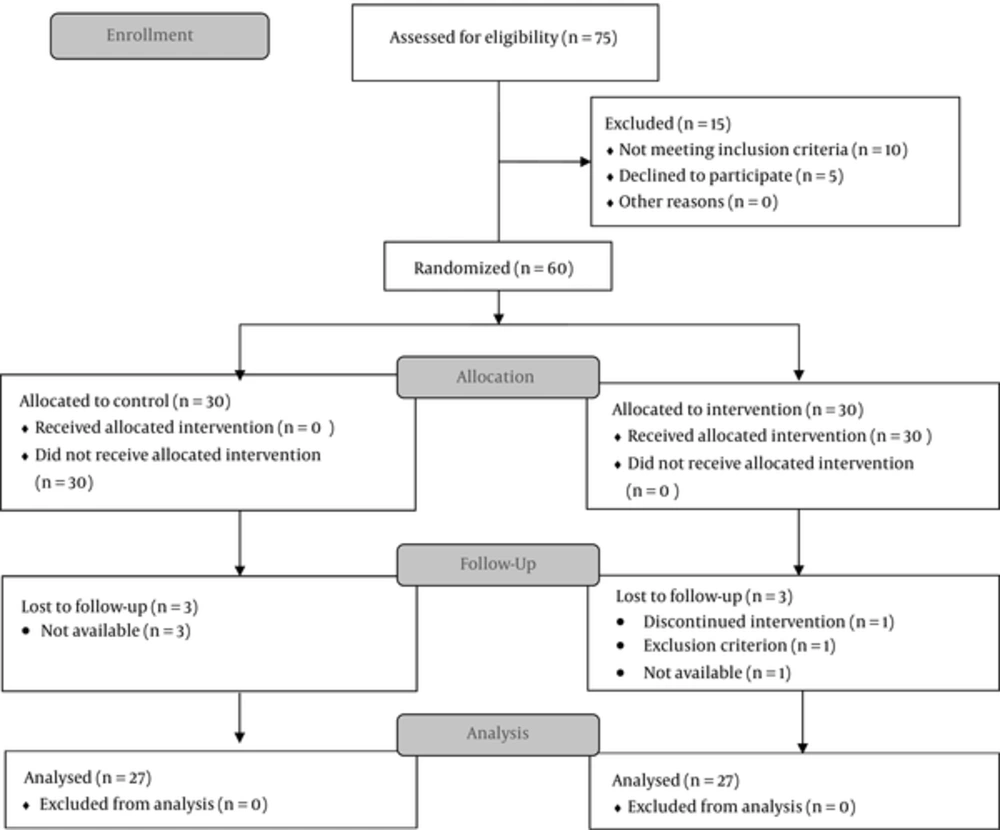
Figure 1.
CONSORT 2010 Flow Diagram 1
5. Discussion
The current study was conducted to assess the effectiveness of sexual enrichment counseling on sexual assertiveness in married women. The results demonstrated that the intervention had a positive effect on sexual assertiveness in women. Since assertiveness is associated with satisfaction and quality of sexual relations, better sexual performances, sexual skills, and compatibility (17, 18), those who have sexual assertiveness seemed to be less involved in risky sexual behaviors and were more able to protect themselves against sexual violence (19). The results of this study can play a significant role in promoting intimacy and sentimental relationship as well as decreasing sexual problems of the couples.
One of the most important factors influencing the individual and social life of humans is sexual desires, whose way and quality has a crucial role in the development of personality and individual health, and peace and comfort; thus, ignoring sexual desires may contribute not only to disruption in all aspects of sexual relations, but also to breakup of the family. Several studies have evaluated the effect of sexual training on sexual and marital satisfaction and found that females’ sexual satisfaction influenced the quality of marital life. Nichols (2005) stated that to achieve mutual agreement in marital relations, a satisfactory sexual relation is essential and dissatisfying this instinct may lead to mental and physical illnesses as well as aggression and depression (20).
The existence of sexual and gender stereotypical common myths in the society, accepting the pleasure of men, and inability of females in expressing their sexual desires have led to passive sexual behavior in women. This makes women, despite legitimizing their relationships in marriage, to be in conflict with their sexual assertiveness or lack of it. Researches on self-expression revealed that when people trust each other and express their thoughts and feelings, they may develop an intimate relationship and this improves the sexual intimacy of couples and help them enjoy their sexual relationship more (21).
Sexual enrichment counseling has significantly improved self-expression ability and sexual assertiveness in women. The current results are consistent with those of Mester and Jonson’s findings declaring that sexual problems are not the result of any deep psychological disorders, but the result of very simple causes such as training deprivation and fallacious information and beliefs about desires and sexual relations. Gellman’s studies (1983) also illustrated that providing sexual education and information, anatomy of body, and sexual techniques are effective in the medical treatment of sexual dysfunctions (22). Some other studies have also demonstrated that sexual education is effective in promotion of sexual self-assertiveness, marital satisfaction, intimacy, and happiness (23, 24).
Education level of most of the participants of the 2 groups was high school diploma; most of them were housewives and their duration of marriage was 2 to 20 years; their age ranged from 20 to 40 years; and most of them had a moderate economical level. Moreover, there was a significant difference between education and sexual assertiveness score (P < 0.001). Similarly, the interfering relationship between educations in groups was observed between those with primary and guidance school education level. After data reconciliation in the education variable, it was found that intervention significantly improved sexual assertiveness, and this was consistent with the findings of other studies (25).
5.1. Limitations
The sexual beliefs and attitudes of the participants from different subcultures might have been different, and this was a limitation of the study. Thus, conducting similar studies with larger samples and in other sociocultural groups are highly recommended.
5.2. Conclusions
Considering the effectiveness of sexual enrichment counseling on sexual assertiveness in married women and its positive effects on improving their quality of sexual life and quality of family life, it is expected (anticipated) that designing and implementing such training courses would have an incontrovertible role in decreasing sexual problems among married couples.


