1. Background
Vitamin D (Vit D) is a lipid-soluble vitamin that was first recognized in the 1920s (1). Sir Edward Mellanby observed Rickets disease development in his study conducted on dogs due to a vitamin deficiency (2). Earlier, it was thought that Vit D would only affect calcium and phospor metabolism, however, recently it has been demonstrated that Vit D has receptors on many tissues such as pancreas, breast, lung, gonads, stomach, heart, brain, skin, and lymphocytes (2). Nowadays, Vit D deficiency is pandemic and it is associated with many cancer types, cardiovascular diseases, otoimmune diseases, and infectious diseases (3). There are 2 main types of Vit D (4); ergocalsiferol (Vit D2 ; 25(OH)D2) which is mostly obtained from foods of plant origin and cholecalciferol (Vit D3; 25(OH)D3) which is derived from 7-dehydrocholesterol: a product of cholesterol oxidation in the skin with ultraviole-B radiation effect (4). Vit D3 is the main Vit D for humans (5). Although the metabolisms of Vit D2 and D3 are similar, Vit D3 is more potent than Vit D2 for increasing serum 25(OH)D levels (5).
There is a negative correlation between Vit D and Body Mass Index (BMI) (3). Vit D is a sterol, therefore, the storage rate of Vit D increases in fatty tissues (3, 6). Consequently, Vit D levels in the circulation decreases (3, 6). Also, it is speculated that lower Vit D levels in obese patients may be due to the fact that these people mostly live indoors and have a sedentary life (3, 6).
The aim of this study was to evaluate Vit D levels in Turkish women with BMI > 25 kg/m2.
2. Methods
2.1. Participants
A total number of 31 Turkish women with BMI > 25 kg/m2 were recruited in this study during winter and were divided into 2 groups according to their BMI. Group 1 consisted of subjects with BMI > 25 - 34 kg/m2 and group 2 consisted of subjects with BMI ≥ 35 kg/m2. Participants with thyroid/parathyroid disorders, heart failure, arrhythmias, renal/hepatic dysfunction, uncontrolled hypertension, neoplasm, chronic inflammatory diseases, active infection, connective tissue/ottoimmune diseases, and pregnancy, and patints who were taking medications affecting the endpoints including Vit D preparations and insulin sensitisers were excluded. Written informed consent was taken from all the participants and our local hospital’s Ethics Board approved this study.
2.2. Laboratory Measurements
Venous blood samples were collected from the participants during early morning hours. Blood samples were immediately centrifuged at 1000 rpm for 10 minutes and the upper serum was frozen at -80 degrees Celsius for future use.
Routine biochemical and hormonal parameters were measured using Cobas c501 and C6000 otoanalyzer (Roche Diagnostic, USA).
The Homeostatic Model Assessment (HOMA) was used to quantify the Insulin Resistance (IR). The approximating equation for IR used a fasting plasma sample and was derived by the use of the insulin-glucose product divided by a constant:
HOMA-IR = (Glucose (mg/dL) x Insulin) / 405.
2.3. Vitamin D Assay
High performance liquid chromatography-mass spectrometry (HPLC-MS) method was used to measure the serum level of 25(OH)D following the standards stipulated by NIH (Ultimate 3000 device, Thermo Fisher Scientific Vit D kits, Germany).
All of the blood samples were collected during winter (January-March).
2.4. Statistics
Number cruncher statistical system (NCSS) (Kaysville, Utah, USA 2007) program was used for statistical analysis. Study data were analyzed using descriptive statistical methods such as mean, standard deviation, median, frequency, ratio, minimum, and maximum. Normally distributed quantitative data were analyzed by Student t test and non-normally distributed data were analyzed by Mann Whitney U test. Spearman’s rank correlation was used to test the association of Vit D with other laboratory parameters. P values (two-tailed) lower than 0.05 with 95% confidence level were considered as statistically significant.
3. Results
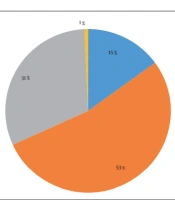
Group 1 consisted of 15 (46.9%) women with BMI = 25-34kg/m2 and group 2 consisted of 17 (53.1%) women with BMI ≥ 35kg/m2. Laboratory findings of the groups are given in Table 1. Accordingly, age was not statistically different between the groups (36.2 ± 13.46 vs 40.47 ± 15.4, P = 0.41). Although Vit D levels in both groups were below the reference limit which was 25 ng/mL, it was similar between the groups (24.82 ± 13.7 ng/mL vs 23.56 ± 12.31 ng/mL; P = 0.901). Glucose levels were significantly lower in group 1 than group 2 (90.85 ± 13.25 mg/dL vs 118.5 ± 50.55 mg/dL; P = 0.04). Although statistically insignificant, insulin levels were higher in group 2 than group 1 (19,68 ± 7,91 µU/mL vs 17.6 ± 12.02 µU/mL; P = 0.29). Other biochemical markers were similar between the groups. Correlation analysis between Vit D and other parameters is given in Table 2. Accordingly, insulin levels were negatively correlated with Vit D levels (r = -0.631; P = 0.002; P < 0.05). HOMA-IR levels were insignificantly higher in group 2 patients than group 1 (5.10 ± 2.89 vs 4.19 ± 3.35; P = 0.25). HOMA-IR was negatively correlated with Vit D (r = -0.456; P = 0.05).
Table 1.
Laboratory Findings of the Groups
| Variables | Group 1 (BMI < 35), (n = 15) | Group 2 (BMI ≥ 35), (n = 17) | P Value | ||
|---|---|---|---|---|---|
| Min - Max | Mean ± SD | Min - Max | Mean ± SD | ||
| Age | 15 - 52 | 36.2 ± 13.46 | 17 - 60 | 40.47 ± 15.4 | 0.413 |
| Glucose, mg/dL | 72 - 124 | 90.85 ± 13.25 | 80 - 233 | 118.5 ± 50.55 | 0.044a |
| TSH, µIU/mL | 0.6 – 4.6 | 2.41 ± 1.03 | 0.5 - 7.6 | 2.56 ± 1.93 | 0.321 |
| Insulin, µU/mL | 3- 44.2 | 17.6 ± 12.02 | 8.7 - 33.3 | 19.68 ± 7.91 | 0.292 |
| Cortisol, µg/dL | 10.9 - 23,4 | 15.6 ± 6.78 | 5.7 - 20.2 | 10.42 ± 5.84 | 0.180 |
| Vitamin D, ng/mL | 8 – 48.6 | 24.82 ± 13.7 | 8.9 – 49.8 | 23.56 ± 12.31 | 0.901 |
| TC, mg/dL | 173 - 230 | 197 ± 24.26 | 117 - 238 | 196.6 ± 49.08 | 0.462 |
| HOMA-IR | 0.6 - 11.8 | 4.19 ± 3.35 | 1.8 – 11.2 | 5.10 ± 2.89 | 0.256 |
| Triglyceride, mg/dL | 61 - 132 | 93.5 ± 35.86 | 109 - 141 | 127.25 ± 15.84 | 0.149 |
| HDL, mg/dL | 35-73 | 48±17,68 | 34 - 64 | 51.25 ± 12.53 | 0.773 |
| LDL, mg/dL | 113,8-144,8 | 130,3±13,53 | 24 – 157.2 | 113.24 ± 53.82 | 0.806 |
Abbreviations: HDL, High Density Lipoprotein; HOMA-IR, Homeostatic Model Assessment-Insulin Resistance; LDL, Low Densitylipoprotein; TC, Total Cholesterol; TSH, Thyroid Stimulant Hormone.
aMann Whitney U Test, P < 0.05.
Table 2.
Correlation Analysis Between Vitamin D and Other Parameters
| Variables | Vitamin D | |
|---|---|---|
| r | P Value | |
| Age | 0.116 | 0.271 |
| Glucose | -0.137 | 0.513 |
| TSH | -0.258 | 0.258 |
| Insulin | -0.631 | 0.002a |
| Cortisol | 0.503 | 0.204 |
| BMI | -0.048 | 0.911 |
| TC | -0.143 | 0.760 |
| Triglyceride | -0.214 | 0.645 |
| HDL | -0.157 | 0.368 |
| LDL | 0.048 | 0.911 |
| Homa-IR | -0.456 | 0.050b |
Abbreviations: BMI, Body Mass Index; HDL, High Density Lipoprotein; HOMA-IR, Homeostatic Model Assessment-Insulin Resistance; LDL, Low Density Lipoprotein; TC, Total Cholesterol, TSH, Thyroid Stimulant Hormone.
aSpearman korelasyon analizi, P < 0.01.
bSpearman korelasyon analizi, P < 0.05.
4. Discussion
The results in this study demonstrated decreased Vit D levels in obese Turkish women and a negative correlation among Vit D and insulin and IR in this group of patients. These findings are compatible with previous studies that exhibited negative correlation among Vit D, obesity, and IR (3, 6).
Our country is prone to Vit D deficiency because it is located on 36 to 42 degrees North latitude (7). And efficient sunshine for Vit D production is observed only in 4 months in the year (7). Besides, it is known that people living in areas more than 35 degrees latitude are prone to inadequate Vit D synthesis (1, 7).
Vit D active metabolites affect target cells through Vit D Receptors (VDR) (8). VDRs are located on more than 30 different tissue cells such as parathyroid, renal, endothelial, myocardial, vascular smooth muscle, skin, lung, pancreas, etc. (8). Vit D is essential for optimal functioning of many organs and tissues (9). Vit D deficiency is correlated with coronary artery disease, heart failure, stroke, diabetes, hypertension, and endothelial dysfunction (10). NHANES III trial demonstrated negative association between serum 25(OH)D3 levels and hypertriglyseridemia, diabetes, hypertension, and obesity (11). Framingham Offspring’s study has, also, revealed higher cardiovascular events in subjects with lower 25(OH)D3 levels after a 5.4 year follow-up (12).
Vit D deficiency is observed during the course of many chronic diseases (13). For example, 1-alpha hydroxilase enzyme activity is diminished during renal failure (13). Therefore, Vit D cannot be converted to its active form and, consequently, parathormone levels are increased (13). Increase in parathormone is associated with a sudden increase of blood pressure and cardiac contractility power which may cause cardiac hypertrophy, myocardial fibrosis, and, eventually, heart failure (13). Human studies have demonstrated that 1,25(OH)D3 inhibits renin synthesis and lowers blood pressure (1). Many observational studies have, also, revealed Vit D deficiency in patients with heart failure (14). Vit D deficiency is, also, associated with increased inflammatory marker levels such as C-reactive protein and interleukin-6 (8). Increased total cholesterol and triglyceride levels and decreased high density lipoprotein and apolipoprotein A-1 levels are found in patients with low vit D levels (14). Minambres et al. showed statistically decresed Vit D levels in patients with familial hyperlipidemia compared to controls and an increase in Vit D levels after replacement treatment (15). A meta-analysis conducted on 65994 patients revealed reverse relation with Vit D levels and cardiovascular and cerebrovascular events (12). Carelli et al. demonstrated the negative correlation between Vit D levels and carotis intima-media thickness (16). Demir et al. evaluated Vit D levels in 87 patients with thoracic aorta dilation and showed significantly lower Vit D levels and higher parathormone levels in the patient group than the controls (17).
There was a significant negative correlation among vit D and serum insulin levels and IR in our study. Animal studies have shown that 1α,25-dihydroxyvitamin D3 stimulates the pancreatic β-cell to secrete insulin, therefore, Vit D deficiency increases IR and the incidence of metabolic syndrome and diabetes (1, 18). Young et al. demonstrated that Vit D deficiency is determinative in coronary calcification development in patients with type 1 diabetes (19). Scott et al. showed IR in Vit D deficient women with polycyctic ovary syndrome (20). Sun et al. revealed that 1 year Vit D supplementation reduced IR in healthy Japanese adults (21).
Many studies have, also, investigated the effect of Vit D supplementation on various clinical situations, however, the results are conflicting (22-25). Eftekhari et al. evaluated the effect of consuming Vit D on glucose metabolism in patients with type 2 diabetes and demonstrated increased insulin secretion without improvement in HbA1c levels and IR (22). Akbarzadeh et al. studied the anti-inflammatory effect of Vit D supplementation in patients with diabetes (23). Vaziri et al. showed that Vit D supplementation during the last trimester of pregnancy is helpful in decreasing perinatal depression rates (24). Vaziri et al, also, published another similar study in which they evaluated the role of Vit D ingestion during pregnancy on the bone mass of both the mother and the child; and the child’s anthropometric measurements, however, could not demonstrate an improvement with Vit D (25).
4.1. Study Limitations
One important limitation of the current study was the relatively small number of participants who were included, therefore, further studies with larger sample sizes are warranted to confirm our findings. We only selected subjects with BMI > 25 kg/m2. Another group of subjects with normal BMI could have been included. However, our aim in this study was to evaluate and compare Vit D levels in obese patients. By this way, our study can be evaluated as being original. On the other hand, we only measured Vit D levels during winter. Another measurement during the summer season is needed.
4.2. Conclusion
In conclusion, obese Turkish women have Vit D deficiency and are prone to IR. Further research is required to determine the potential benefits of vitamin D supplementation for reducing IR in this group of patients.