1. Background
Breast cancer is the most common cause of cancer-related death in women worldwide and accounts for more than 23% of new cases of cancer each year. Numerous strategies are currently used for the treatment of cancer, including chemotherapy and radiotherapy (1). However, as these methods target both normal and cancer cells, they cause various side effects.
In recent decades, targeted therapy has attracted the attention of scientists. Specific monoclonal antibodies have been developed against different targets in breast cancer cells (2). One of the best targets is the human epidermal growth factor receptor 2, ErbB2/HER2. ErbB2 is a member of the epidermal growth factor family of receptor tyrosine kinases, involved in a variety of malignancies (3), such as gastric, colorectal, ovarian, endometrial, pancreatic, and breast cancers (4, 5). Moreover, it plays an important role in the differentiation, proliferation, and migration of cancer cells (1).
Several studies have shown the relationship between amplification and overexpression of ErbB2 and progression of breast cancer (6-8). Trastuzumab and pertuzumab, 2 Food and Drug Administration (FDA)-approved monoclonal antibodies against ErbB2, have shown some benefits in the treatment of breast cancer (9, 10). However, they have a limited clinical use, which is mainly due to their immunogenicity (11, 12).
Some limitations of whole antibodies can be overcome by reducing antibodies to their minimal binding domains. Advances in antibody engineering have provided small single-chain variable-fragment (scFv) antibodies, which are produced by the association between heavy-chain variable (VH) and light-chain variable (VL) domains through a synthetic peptide, (GGGGS)3 (13-15).
ScFvs with a molecular mass of 26-27 kDa have several advantages, including human origin, small size, strong penetrating power, high affinity, simple specificity, and also ease of mass production. These antibodies also show great potential for the diagnosis and treatment of a number of diseases, including prostate, pancreas, melanoma, and breast cancers (16-18).
2. Objectives
In this study, we aimed to select specific human recombinant single-chain antibodies against 2 ErbB epitopes and to evaluate the reactivity of the selected scFvs through phage enzyme-linked immunosorbent assay (ELISA).
3. Methods
3.1. Phage Rescue
A recombinant scFv library was used for producing the phage display library of scFvs (19). Escheria coli bacteria, containing a phagemid with an insert segment (obtained from the human recombinant antibody laboratory at the Department of Immunology), were grown overnight. All grown cells were scraped in 50 mL of 2TY broth and incubated at 37°C for 1 hour. After reaching an optical density (OD) of 0.6 - 1, M13KO7 helper phage (New England Biolabs Inc., USA) was added to the medium, mixed, and incubated for 1 hour.
The E. coli suspension was transferred to a 50 mL tube and centrifuged. The bacterial pellet was transferred to 50 mL of 2TY broth, containing both ampicillin and kanamycin (100 and 50 μg/mL, respectively), and was cultured overnight with shaking at 30°C. The culture was centrifuged, and the supernatant containing the phage was filtered in order to remove bacterial particles; finally, it was stored at a temperature of 4°C.
3.2. Selection of Specific scFvs against HER2 Epitopes
Immunotubes (Nunc, Roskilde, Denmark) were coated with 10 μg/mL of epitopes in phosphate buffered saline (PBS) and incubated overnight at 4°C. Blocking solution (10% fetal calf serum and 2% skimmed milk in PBS) was added to the tubes and incubated at 37°C for 2 hours. The tube was washed 4 times with PBS plus Tween 20 (PBST) and 4 times with PBS. Then, 1011 pfu/mL of the rescued phages, diluted in blocking solution, was added an d incubated at room temperature for 1 hour.
The log-phase E. coli TG1 was added to the immune tube and incubated for 1 hour at 37°C to allow cell infection by phage. The infected E. coli TG1 was centrifuged, the supernatant was removed, and the cell pellet was cultured on a 2TY agar plate. Helper phage M13KO7 was used to rescue the phage-transformed E. coli. Then, 4 rounds of panning were carried out to select specific scFvs against 2 ErbB2 epitopes.
3.3. PCR and DNA Fingerprinting of the Selected Clones
Polymerase chain reaction (PCR) and DNA fingerprinting of randomly selected clones were carried out after the fourth round of panning. Each PCR product was digested with MvaI restriction endonuclease (Roche Diagnostics GmbH, Mannheim, Germany) for 2 hours at 37°C. The digested product was run on 2% Agarose gel.
3.4. Phage ELISA
Antigen-specific phage clones were identified by phage ELISA. ErbB2 peptide, as an antigen, was coated in an ELISA plate well in triplicate. Then, the selected phage antibody was added. After washing with PBS, anti-Fd antibody (Sigma, Germany) was poured and incubated at 25°C for 1 hour. Following washing, anti-rabbit horseradish peroxidase (HRP) conjugated antibodies (Sigma, Germany) were added to each well and incubated at room temperature for 1.5 hours.
TMB peroxidase substrate (Thermo Scientific, USA) was added after washing the wells. ODs were determined after 10 minutes, using an ELISA reader (BP800; Biohit, USA). On the other hand, the unrelated peptide, epitope of prostate stem cell antigen (TARIRAVGLLTVISK), unrelated scFv (anti-HSV-gB scFv), M13KO7, and non-peptide wells were considered as the controls.
3.5. Statistical Analysis
Data were analyzed using one-way analysis of variance (ANOVA) test to compare the mean absorbance values between the related and unrelated peptides for the 2 selected scFvs. The data are presented as mean ± standard deviation. P-value less than 0.05 was considered statistically significant.
4. Results
4.1. PCR and DNA Fingerprinting
Figures 1 and 2 show PCR and DNA fingerprinting of clones after the panning process against peptide I (A) and peptide II (B), respectively. The 950-bp band (VH-linker-VL) was obtained for all the clones (Figure 1). One dominant fingerprinting pattern was obtained against each peptide: pattern A for scFvI (lanes 5, 7, 10, 13, 14, 17, 19, and 20) with a frequency of 40% (Figure 2A) and pattern B for scFvII (lanes 1, 8, 13, 15, 16, 17, 18, 19, and 20) with a frequency of 45%. One colon from each pattern was selected for further evaluation.
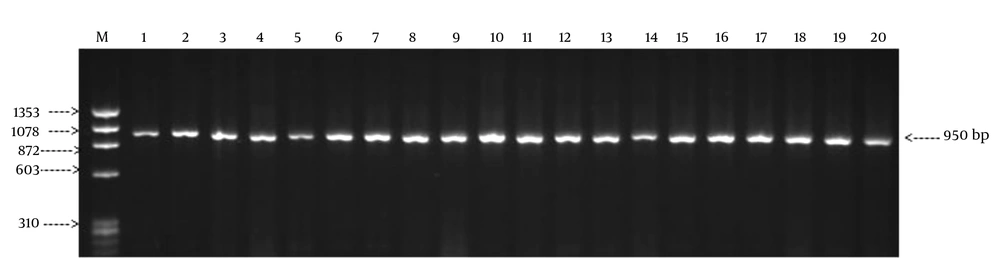
Figure 1.
PCR of the Selected Clones after Panning (A 950-bp Band for 20 Examined Clones)
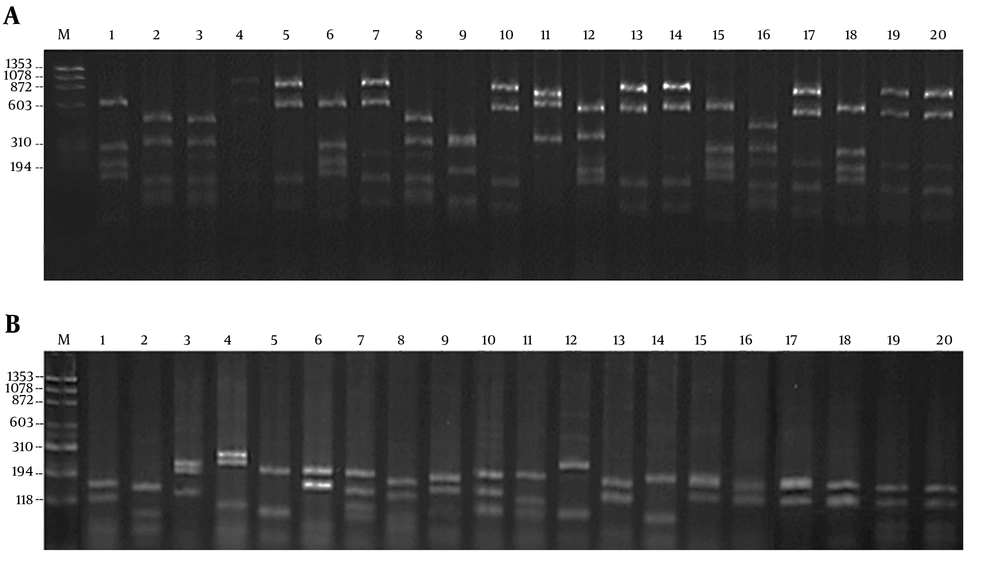
Figure 2.
Each scFv showed 1 dominant pattern. The common pattern of A, scFvI (lanes 5, 7, 10, 13, 14, 17, 19, and 20) and B, the common pattern of scFvII (lanes 1, 8, 13, 15, 16, 17, 18, 19, and 20) are presented.
4.2. Phage ELISA
Phage ELISA was used to demonstrate the specific binding of the selected scFv antibodies to the corresponding peptide. ANOVA test showed a significant difference in the average absorbance between the well coated with the corresponding peptide and the well containing no peptides for the selected scFvs, ie, scFvI and scFvII (Figures 3 and 4). ODs of 0.65 ± 0.042 and 0.71 ± 0.058 were obtained for scFvI and scFvII reactions with the corresponding peptide, whereas the ODs of non-peptide wells were 0.1 ± 0.042 and 0.13 ± 0.058, respectively (Table 1).
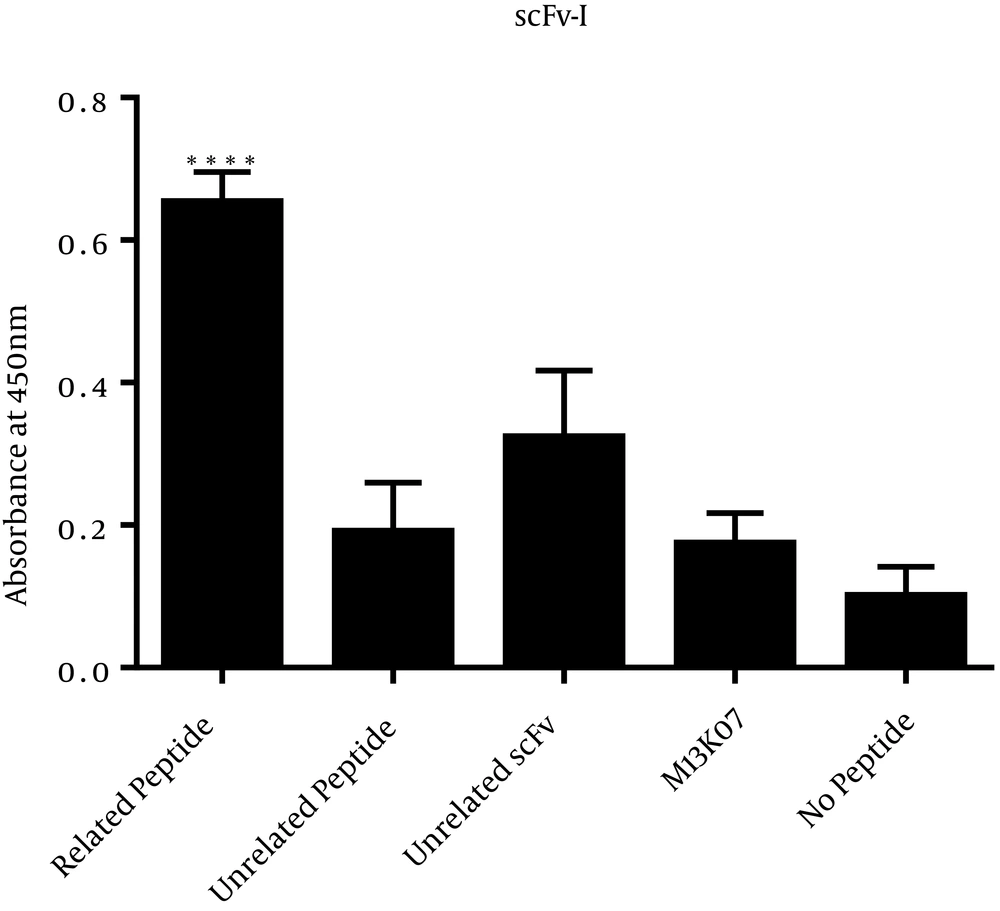
Figure 3.
The ELISA Results of scFvI
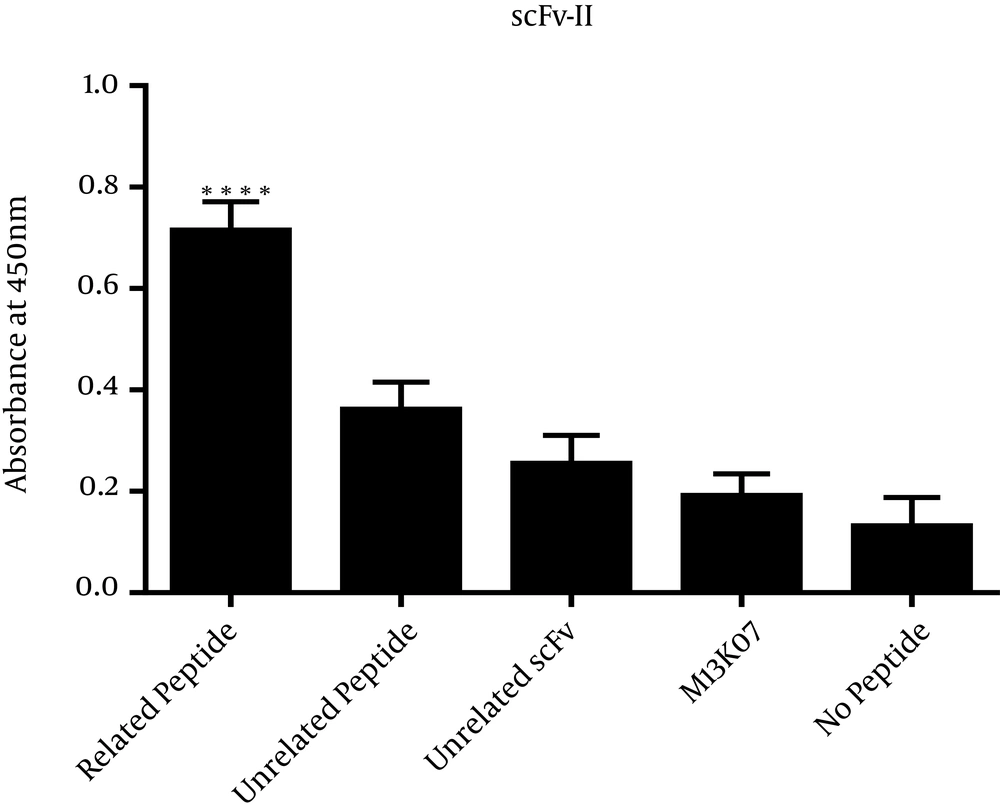
Figure 4.
The ELISA Results of scFvII
Table 1. The Average ODs of scFvI and scFvII in Reaction with the Related Peptide, Unrelated Peptide, Unrelated scFv, M13KO7, and Non-Peptide Well in Phage ELISA
| OD ± SD of scFvI | OD ± SD of scFvII | |
|---|---|---|
| Related peptide | 0.65 ± 0.042 | 0.71 ± 0.058 |
| Unrelated peptide | 0.19 ± 0.069 | 0.36 ± 0.055 |
| Unrelated scFv | 0.32 ± 0.093 | 0.25 ± 0.057 |
| M13KO7 | 0.17 ± 0.044 | 0.19 ± 0.045 |
| No peptide | 0.1 ± 0.042 | 0.13 ± 0.058 |
5. Discussion
Targeted cancer therapy, which acts on receptors overexpressed on the surface of cancer cells, is a new field of immunotherapy studies. Identification of proper targets to suppress cell growth and survival is an important step in this strategy (20). Targeted cancer therapies, approved by FDA, are used to treat cancer. Some of these approaches are presented in clinical trials and some are in the preclinical stage. As this type of therapy acts on a specific target, especially cancer cells, fewer or even no normal cells are affected (21, 22).
Breast cancer is a heterogeneous disease with several types. One of the most common types of breast cancer is ErBb2/HER2-positive breast cancer, which accounts for 25% - 30% of all cases of breast cancer (23). ErbB2 protein is expressed at high levels on the surface of ErBb2-positive breast cancer cells. ErbB2 homo- and heterodimerization with other ErbB family members promote cancer transformation through activation of the PI3K pathway (24).
Numerous targeted therapies have been introduced against ErbB2 (6, 25, 26). Although humanized monoclonal antibodies against ErbB2 (ie, trastuzumab and pertuzumab) are currently used for the treatment of breast cancer and interfere with ErbB2 dimerization, their disadvantages, including low tissue penetration, induction of human anti-mouse antibody (HAMA) reaction, and high production costs, encourage scientists to develop new methods for overcoming these drawbacks (27-29).
The recombinant scFvs opened new windows in cancer therapy due to their small size, human origin, and ability to penetrate solid cancers (16, 28, 29). A number of antitumor scFvs, alone or in conjugation with toxins, have been introduced in clinical trials. Bispecific, diabody, tribody, and tetrabody scFvs are other forms of scFvs, which have great potential for efficient tumor targeting (30, 31).
In the present study, we selected 2 specific anti-ErBb2 scFv antibodies against ErbB2 peptides (amino acids 557 - 567; ARHCLPCHPEC), which include the loop 1 of ErbB2 targeted by trastuzumab; this region is introduced as a proper site for anticancer immunotherapy (32, 33). The second peptide, used for the selection of scFvs, contained amino acids 377 - 392 (LPESFDGDPASNTAPL), as the first target of pertuzumab in the epitope; also, it is considered as a novel recombinant monoclonal antibody against ERbB2. Binding of antibodies to these epitopes blocks ErbB2 dimerization and inhibits transphosphorylation of tyrosine residues in the intracellular region of ErbB2, which leads to the inhibition of proliferation in ErbB2-expressing cells (34).
It has been shown that the target peptide, used in the selection of scFvs, plays the most important role in successful immunotargeting by scFvs (19, 35). A number of tumor markers and ErbB2 epitopes have been introduced for cancer immunotherapy (34). The epitope accessibility is one of the criteria affecting the binding and efficiency of antibodies. The 2 epitopes selected in this study were located in ErbB2 regions, which are accessible for antibody binding.
The results of the panning process demonstrated the selection of 2 specific scFvs, scFvI and scFvII, with frequencies of 40% and 45%, respectively. Specific scFvs with frequencies of 35% and 20%, respectively were selected against CTLA4 antigen, as a potential marker for targeted cancer therapy via panning a library against the CTLA4 epitope (36). In this regard, Mohammadi et al. (37) reported the selection of specific scFvs against a breast cancer tumor marker, MUC18, using the panning process, which led to the isolation of specific scFvs with a frequency of 40%. Overall, the panning process, which enriches the phage antibody, is an effective process for selecting high-affinity and high-specificity antibodies in targeted therapy.
The results of the panning process were confirmed by phage ELISA, which represents the reactivity and specificity of the selected scFvs. Phage ELISA results showed a significant difference in the average ODs obtained from the reaction of scFvs with the related peptides and non-peptide wells. Also, among other antigen and antibody controls, unrelated peptides, such as antigen control unrelated scFv and M13KO7 as the antibody control, showed significantly lower ODs, compared to the related peptides.
In this regard, Xia et al. showed the specificity of anti-CD133 scFv, using phage ELISA and confirmed the panning results regarding the selection of library clones (38). Also, after the selection of a high-affinity scFv against VEGFR1, which is a receptor tyrosine kinase implicated in cancer pathogenesis, the reactivity and specificity of the phage antibody were evaluated in the phage ELISA test (39). The phage ELISA results represented the specificity of the anti-ErbB2 scFvs.
The human origin of these novel antibodies, which prevent HAMA reaction, is the unique property of these fully human antibodies and makes them desirable for breast cancer targeted therapy. The possibility of genetic manipulation is another feature, which facilitates the formation of fusion peptides with additional function to overcome tumor growth and proliferation more efficiently. Moreover, the small size and deep tissue penetration of specific anti-ErbB2 scFvs provide better immunotargeting results. However, further research is required to reveal the effects of the selected scFvs against breast cancer cells.