1. Background
Hospital readmission is an important subject in health and medicine. Hospital readmissions are attracting increasing attention as a measure of health care quality and a cost-effective target (1). The hospitalization index is receiving increased scrutiny as a marker of poor-quality patient care (2). Recent policy changes, including substantial financial penalties, make readmission an important, if not the most important, pay-for-performance program for health care in the United States (3). Due to its importance, it became a dominant discourse in the health research in the last decade. The importance of subject is related to the costs imposed to the health system because of readmission problems (4, 5). Also, readmission is related to some human problems such as wasting time, money, and absence from work.
The index called LACE can predict hospital readmissions (6). It means that LACE index is employed to predict the risk of unplanned readmission within 30 days after hospital discharge both in medical and surgical patients. In this index, “L” refers to the length of stay including the day of admission and discharge, and if the patient was admitted to the emergency department; “A” stands for the acuity of the admission, specifically, if the patient is admitted through the emergency department vs. an elective admission; “C” stands for co-morbidities, incorporating the Charlson comorbidity index (7), and finally “E” stands for the number of emergency department visits within the last 6 months (8-10). To evaluate the risk of readmission, it is defined as low (scores 0 to 4); moderate (scores 5 to 9) and high (the score ≥ 10). Without considering the scores, LACE index is good to predict the readmission risk of 4 items.
The current study investigations on hospital readmission in Iran did not have any results as there were no studies about the subject. Due to this point and the importance of the issue, the current study aimed at evaluating the causes of 30-day readmissions in an educational hospital in Shiraz, South of Iran.
2. Methods
It was a retrospective case-control study on patients' readmission in Shahid Faghihi educational Hospital in Shiraz, Iran. The context of the study was the general hospital in Shiraz, the 2nd largest educational hospital in this city. Except for some cases, specifically traumatic patients, this hospital provides many medical services.
The study population included all patients admitted to the hospital, and the study was conducted based on the following steps: At first, all patients admitted from January 2013 to January 2014 (for 13 months) were identified by referring to the health information system (HIS) of the hospital. After that, all readmitted patients were recognized. In the next step, as the readmitted patients included 2 groups, planned and unplanned patients; the readmitted patients were identified. Planned patients included patients of post-angiography for angioplasty, or patients referred to the urology department planned to remove double J stent. Patients undergoing dialysis and the ones visiting the outpatient department (OPD) were excluded. In addition, 25 readmitted patients were excluded because of duplication and lack of profile (Figure 1).
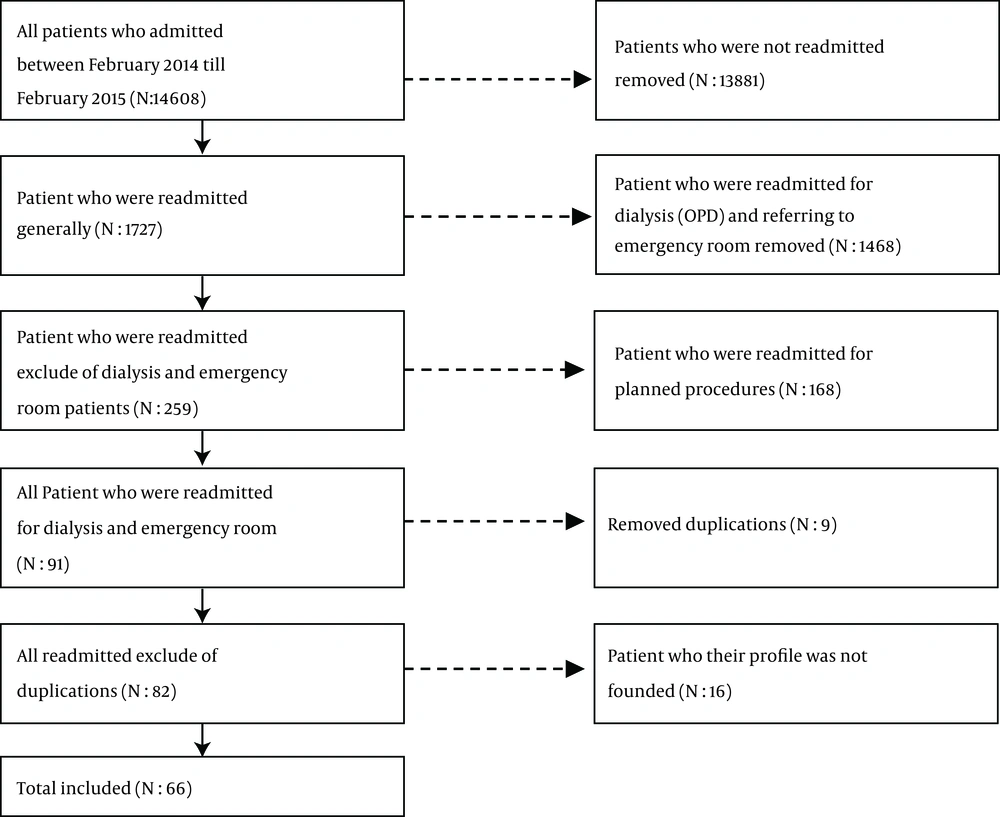
Figure 1.
Flow Diagram of the Search
For each readmitted patient, 2 non-readmitted patients were assigned to the control group; totally, 132 patients were enrolled into the control group. To evaluate the readmission reasons, a questionnaire was made including a check list of demographic traits, and the questions that examined the LACE variables. Based on LACE index 4 subject were categorized to evaluate the causes of readmission, which were the length of stay, acuity of the admission, comorbidity (with or without the history of chronic non-communicable diseases such as hypertension (HTN), diabetes mellitus (DM), chronic kidney disease (CKD) (internal), surgical, urologic, neurological, nephrological, and heart problems), and the number of visiting emergency department within 30 days after discharge. It should be mentioned that there were no scores according LACE. The 4 variables of LACE index were just used. In addition, the current study evaluated the season of admission, paraclinical requests, living area of the patients, and their relationship with readmission. About paraclinical requests, there was a hypothesis that more requests was related to more complication of illness. In addition, as social factors are related to readmission (11), the living area was considered as a readmission predicting factor.
Data were transferred into the Stata software version 11.0 and analyzed using conditional regression analysis. The current study evaluations were based on the effect of mentioned causes on readmission of patients. The crude odds ratio in this relationship was evaluated with 95% confidence interval (CI).
3. Results
Results showed that during the time of study, 14,608 patients were admitted to the hospitals, which a part of them were readmission cases. After excluding the planed readmissions, it was found that 66 patients were readmitted during the time. The group included 38 males (57.6%) and 28 females (42.4%). For every case, 2 control cases were selected and thus, 132 patients were recruited as the control group. By referring to the HIS system, the control cases were selected from the patients not readmitted in that time. Then, the patients with similar problems were selected. After that, it was tried to select the patients with similar conditions based on gender, age, and similar diagnosis. For each of the patient cases, 2 control cases were recruited. In this group there were 76 males (57.6%) and 56 females (42.4%). Results of the causes affecting the readmissions are shown in Table 1.
Table 1. Conditional Regression of Hospital Readmission
| Variable | Cases, N (%) | Control, N (%) | Unadjusted OR (95%CI) | P Value |
|---|---|---|---|---|
| Length of admission | 7.06 ± 4.43 | 6.07 ± 5.53 | 1.03 (0.97 - 1.09) | 0.20 |
| Acuity of the admission | 22 (33.33) | 55 (41.67) | Referent | 0.09 |
| Not acuity | 44 (66.67) | 77 (58.33) | 2.24 (0.86 - 5.82) | |
| Comorbidities: | ||||
| History of internal disease | ||||
| No | 35 (53.03) | 88 (66.67) | Referent | 0.04a |
| Yes | 31 (46.97) | 44 (33.33) | 2.02 (1.01 - 4.02) | |
| History of surgical procedure | ||||
| No | 52 (78.79) | 119 (90.15) | Referent | 0.03a |
| Yes | 14 (21.21) | 13 (9.85) | 2.55 (1.08 - 6.01) | |
| History of neurological problem | ||||
| No | 59 (89.39) | 121 (91.67) | Referent | 0.58 |
| Yes | 7 (10.61) | 11 (8.33) | 0.67 (0.30 - 1.53) | |
| History of heart diseases | ||||
| No | 40 (60.61) | 73 (55.30) | Referent | 0.35 |
| Yes | 26 (39.39) | 59 (44.70) | 1.34 (0.46 - 3.83) | |
| History of urologic diseases | ||||
| No | 56 (84.85) | 118 (89.39) | Referent | 0.33 |
| Yes | 10 (15.15) | 14 (10.61) | 1.58 (0.62 - 4.05) | |
| History of cancer | ||||
| No | 61 (92.42) | 119 (90.15) | Referent | 0.57 |
| Yes | 5 (7.58) | 13 (9.85) | 2.54 (0.79 - 8.14) | |
| History of nephrological diseases | ||||
| No | 59 (89.39) | 126 (95.45) | Referent | 0.11 |
| Yes | 7 (10.61) | 6 (4.55) | 0.71 (0.22 - 2.26) | |
| Emergency department visit | 1.68 ± 2.26 | 1.18 ± 2.02 | 1.12 (0.96 - 1.30) | 0.13 |
| Season of admission | ||||
| Spring | 15 (22.73) | 26 (19.70) | Referent | 0.31 |
| Summer | 18 (27.27) | 32 (24.24) | 0.94(0.38 - 2.31) | |
| Fall | 20 (30.30) | 38 (28.79) | 0.92 (0.38 - 2.20) | |
| Winter | 13 (19.70) | 36 (27.27) | 0.63 (0.25 - 1.57) | |
| Living area | ||||
| Wealthy districts of Shiraz | 4 (6.06) | 14 (10.61) | Referent | 0.61 |
| Moderate districts of Shiraz | 6 (9.09) | 9 (6.82) | 2.33 (0.51 - 10.67) | |
| Poor district of Shiraz | 20 (30.30) | 36 (27.27) | 1.93 (0.56 - 6.60) | |
| Metropolis resident | 23 (34.85) | 50 (37.88) | 1.63 (0.46 - 5.69) | |
| Rural area and small town resident | 13 (19.70) | 23 (17.42) | 2.00 (0.52 - 7.65) | |
| Paraclinical requests | 1.48 ± 3.12 | 0.76 ± 1.20 | 1.28 (1.01 - 1.63) | 0.04a |
aP-value less than 0.05 considered as significant.
Based on Table 1, the history of internal problems (P = 0.03), previous surgical procedures (P = 0.03), and more paraclinical requests (P = 0.04) were significantly associated with readmission.
4. Discussion
The current study aimed at exploring the rate and causes of readmission in an educational hospital in Shiraz, Iran. The obtained results showed that in about 1 year, 132 patients were readmitted in this hospital. Results of the current study showed that 4 factors as of the history of internal problems, surgical procedures, and more paraclinical requests predicted the readmission of patients in the hospitals.
The comparison of results with LACE index showed that comorbidity, specifically about internal and surgical problems, was related to readmission. Other items of LACE, such as length of admission, acuity vs. not acuity, and emergency department visits, were not confirmed by the current study findings; although it was proposed to conduct further studies. Despite other studies, season of admission had no relationship with readmission.
About the living area, the study showed that people of poor areas, such as small towns and poor districts of Shiraz, had more readmission than others; although the difference was insignificant. However, a broad range of social factors affect the risk of post-discharge readmission and mortality in community-acquired pneumonia (CAP) and heart failure (HF) (11). Further studies are suggested.
About the internal problems, other studies showed that internal problem was a predictor of readmission in pneumonia (12, 13). Thus, they proposed that pneumonia guidelines and pathways should include objective criteria to judge the stability on discharge to ensure that efforts to shorten the length of stay do not jeopardize the patient’s safety (12).
Although the current study did not consider the type of surgical procedure, it is important point out that every surgical procedure can predicted hospital readmission. Other studies showed the relationship between some procedures and readmission (14, 15). Also, it was shown that nearly 1 in 7 patients hospitalized for a major surgical procedure was readmitted to the hospital within 30 days after discharge (16). The current evidence suggests that postoperative complications play a key role in surgical readmissions (3, 17). Generally, it is believed that hospital readmission is a sign of poor quality patient care in surgical patients (14). Thus, it is proposed to promote care and consideration in surgical patients. For example, in colorectal cancer, it was proposed that the identification of high-risk patient subgroups may assist in effectively targeting adhesion-prevention strategies, and giving preoperative advice on adhesion risk (18).
The main point of the current study was that the number of paraclinal requests such as sonography, magnetic resonance imaging (MRI), computed tomography (CT) scan, and other ones was a predicting index for readmission. Although there were not any studies on this finding, it includes an important point. The number of paraclinical requests was related to the amount of complications of the illness. For example, if a patient with complication needed some paraclinical assessments, consulting with other departments is increased. In this scenario increase in some paraclinical requests means that the condition of the patient is complicated. Thus, it is proposed to consider this variable more.
According to the current study findings, it is proposed that policies should consider these 3 variables as well as other causes. No single intervention was regularly associated with reduced risk for 30-day rehospitalization (19), based on the comprehensive and multidisciplinary approach (20).
4.1. Limitations
It was the 1st study conducted on hospital readmission in Iran. Therefore, it had some limitations. Initially, its duration was very limited. Many studies on readmission are conducted during some years and sometimes 1 decade or more, the current study examined the subject in 1 year. Also, the study included a variety of diseases. Future studies on readmission should be conducted with focus on 1 illness. And, finally, there was a limitation about the patients discharged from the hospital that may have referred to other hospitals in Shiraz. The study could not follow the readmission of discharged patients in other hospitals or the ones that maybe dead.
4.2. Conclusion
According to the results of the current study, it can be said that readmission is a problem for health care systems. It imposes several burdens to these systems as well as mortality. Results of the current study showed that history of internal problems, surgical procedures, and more paraclinical requests predicted the rate of under 30-day readmission. Thus, policy makers should consider these 3 items along with the evaluation of other aspects of readmission based on the fundamental researches.