1. Introduction
Maternal-infant attachment (MIA) is one of the most important patterns of relationship that is crucial to the survival and development of the infant. Reva Rubin introduced MIA in 1967 and it was popularized in 1976 by Klaus and Kennell (1). Attachment is recognized as a two-way interaction between a child and their mother or caregiver, and develops during the first year of life (2). The attachment theory holds that a consistent primary caregiver is necessary for an infant’s optimal development as closeness to the attachment figure provides protection and a psychological sense of security (3). The process of attachment begins during pregnancy and it continues to specify after the birth of the child (4). The attachment between an infant and the mother is necessary for social and emotional development, positive parenting behaviors, and improved cognitive ability of a child (5).
Attachment is created from some component responses that have the function of attachment of the mother to the her baby and the infant to the mother (6). These component responses, such as sticking, sucking, following, crying, and smiling occur independently during infancy (2, 4).
Mothers, who have an elevated attachment to their infants are often aware of their needs, and this feeling affects many aspects of the infant’s personality, such as their sense of curiosity, and ability to socialize and trust (7). In this relationship, the infant would learn the manner of relating to and communicating with others, and therefore, it is considered as the foundation for the formation of the child’s future behaviors (8). The strengths and characteristics of those initial attachments critically influence other bonds that become established from birth throughout adulthood (9). Also, destruction of this relationship pattern during the first year of life can have critical long-term effects on the baby’s development of satisfying interpersonal relationships as well as social interaction (10).
Maternal outcomes of poor attachment include hostility, irritability, lack of maternal feelings, and rejection of the child (11).
Several researches, both on humans and animals, have illustrated that maternal responses affect the child’s long-term development and health (2, 4, 12).
Given the impact of attachment across the lifespan, knowledge about factors related to MIA can be of particular value (13). It is important for health providers to recognize signs of insignificant MIA that can most easily be removed by observing the maternal attachment with her baby and to learn to patterns of desirable behaviors that increase attachment (10). Also, health providers can use factors related to MIA to gain understanding of infants’ attachment issues and how mothers relate to infants in their life. The aim of the present review was to identify factors associated with MIA.
2. Methods
2.1. Search Strategy and Data Sources
The procedure for this review was performed according to “preferred reporting items for systematic reviews and meta-analyses” (PRISMA-P). The researchers primarily conducted a targeted search of gray literature and peer-reviewed articles, published in English and Persian, between August 1990 to May 2018. This systematic review article brings explicit attention to many aspects of the MIA. In this review, advanced search was performed using Persian electronic databases, including Iran Medex, Iran Doc, Magiran, SID, and Google Scholar. Also, English electronic databases, included Social Science Research Network (SSRN), Web of Science, Global Health and International Bibliography of Social Sciences, MEDLINE, CINAHL, HMIC, Child Data, NCJRS, HSRProj, and IBSS. Electronic databases included New York Academy of Medicine Gray Literature Report, ProQuest Dissertations and Theses, Scopus, WHO Global Health Library, Popline, and PAIS, which were searched for gray literature using combinations of the keywords below. The search in each database was done using the combination of MeSH terms and keywords, including “maternal infant attachment” OR “mother-to-infant attachment” OR “mother child relations” OR “mother child interaction” OR “mother infant interaction” OR “mother-infant attachment”.
The peer-reviewed search results were imported in EndNote, organized by MIA topic. By contrast, due to limitations in the search capacity of the gray databases, gray literature search results were imported to EndNote in relation to MIA. The results of the related literatures to MIA were inducted into EndNote. A primary review of the summary was conducted, and review of the full-text in the records was performed by assessing the inclusion criteria. If included literatures were related to the MIA and mother infant interaction, published in Persian or English language, and localized on human populations, they were considered in the review. Upon review of the full-text, any study that did not meet the inclusion criteria were deleted.
2.2. Inclusion and Exclusion Criteria
Documents were eligible for inclusion in this study if: They focused on mother-infant relations in humans, were published in a scientific and high-quality scholarly journal, had been published between August 1990 to May 2018, and had suitable information about effective factors on MIA. Documents with no direct mention of MIA, studies on selected populations (i.e. maternal attachment with fetus or child’ attachment with their parents), and documents published before 1990 were excluded.
All included documents were assessed independently by the authors using STROBE (strengthening the reporting of observational studies in epidemiology) and CASP (critical appraisal skills program) checklist. STROBE is an assessment instrument that assesses the quality of cohort, case-control, and cross-sectional studies (14). Also, CASP (15) is an assessment instrument that assesses the quality of systematic review and clinical trials.
The main information was extracted from studies by the reviewers, name of authors, published years, sample size, data collection strategy, study population, setting, reliability and validity of the tool, study objectives and findings, STROBE, and CASP score.
All duplicate records were identified and removed. Two reviewers independently screened titles and abstracts for eligibility. Then, reasons for removal of studies was recorded. According to the inclusion criteria, 137 documents were selected, 38 documents were excluded due to duplicate articles; in the second step, 95 articles were excluded due to eligibility, and finally, 27 documents remained (Figure 1).
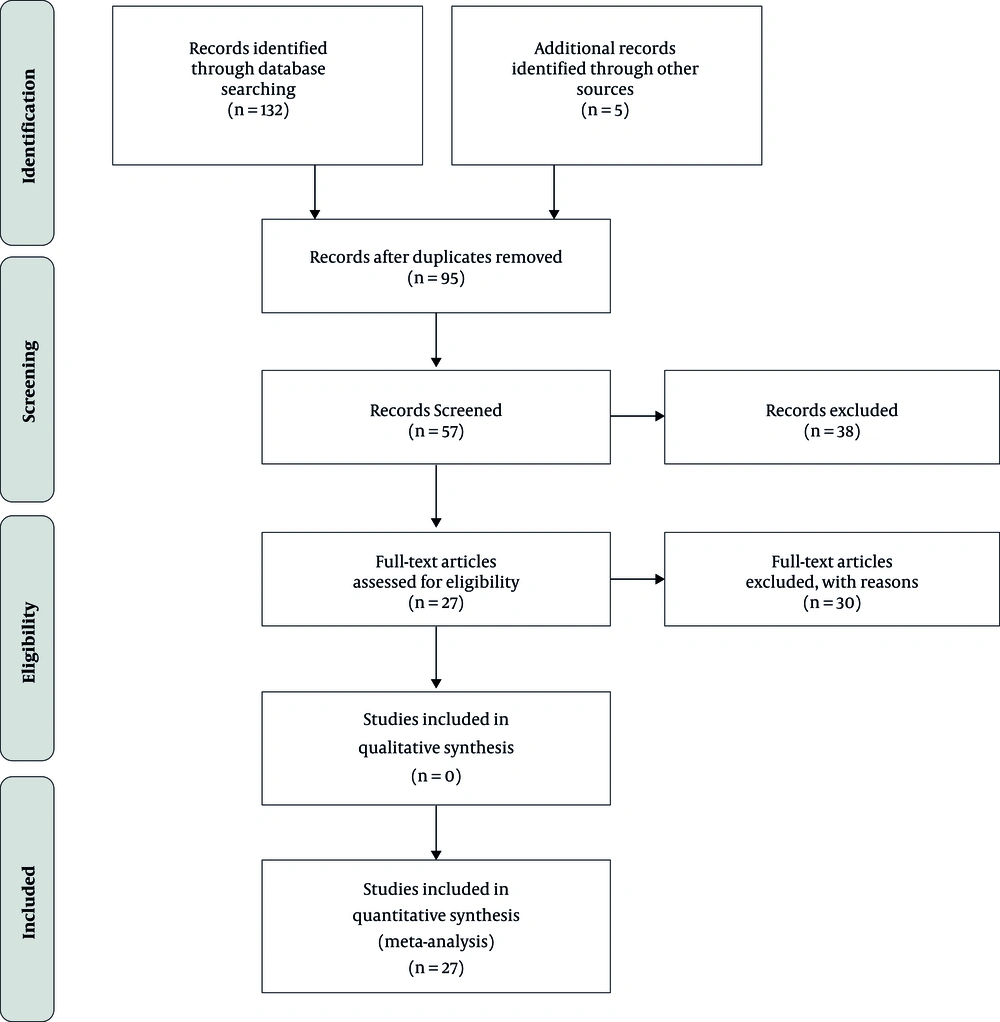
Figure 1.
PRISMA flow diagram
3. Results
The 27 documents included in this review were from a preliminary investigation of 137 documents (Table 1). The last analysis was performed on 27 documents with the suitability criteria. The obtained results of related records can be divided to two broad categories, including maternal factors and infancy factors.
The most important maternal factors affecting MIA were age, educational level, job, income, place of residence, psychosocial support, marital satisfaction, psychological disorders, single parenting, number of children, number of pregnancies, unplanned pregnancy, high risk pregnancy, level of attachment to the fetus during pregnancy, type of delivery, educational attainment, rooming‐in, skin-to-skin contact, effective communication, mother’s perceptions of her infant, involvement in caring for the newborn, early initiation of breastfeeding, and oxytocin concentration.
The infancy factors affecting MIA included health problems, prematurity, infant gender, and infancy moods.
Table 1.Characteristics and Main Findings of Included Studies in Systematic Review of Factors Related to Maternal-Infant Attachment
| Author (Year Published) | Design | Population | Data Gathering Methods | Results |
|---|---|---|---|---|
| Mangelsdorf et al. (1990) (16) | Prospective study | 66 mothers | Interview | Interaction between talent to the distress of infant and maternal personality predicts MIA. |
| Lyons-Ruth et al. (1990) (17) | Descriptive study | 31 infants | Bayley mental scale | Children with high social risk because of the combined factors of poverty, inadequacy care-taking and maternal depression, were seriously encountered with insufficient MIA. |
| Jacobson and Frye (1991) (18) | Case - control study | 46 mothers | Pre- post test and Intervention | Maternal social support on MIA |
| van den Boom (1994) (19) | Case - control study | 100 mothers | Neonatal behavioral assessment scale (pre- post test and intervention) | Mothers in the intervention group were significantly more stimulating, responsive, controlling of their baby’s behavior, and visually mindful than the control group. Also, infants in the intervention group cried less and had higher scores in self-soothing, quality of exploration, and sociability. |
| Isabella (1994) (20) | Longitudinal study | 32 mothers | Interview (pre- post test and intervention) | Social support, good family functioning during pregnancy, and mothers’ satisfaction with their marriage effects on MIA. |
| Manassis et al. (1994) (21) | Cross-sectional study | 80 mothers | Adult attachment interview | There is a high level of insecurity among offspring of fearful mothers. |
| Teti et al. (1995) (22) | Longitudinal investigation | 149 mothers | Telephone interview | The attachment strategy type effects MIA. |
| Owen and Cox (1997) (23) | Prospective study | 38 mothers | Beavers-Timberlawn family evaluation scale | Chronic marital conflict effects insecurity in MIA. |
| Pederson et al. (1998) (24) | Prospective study | 60 mothers | Adult attachment interview | Autonomous mothers are more sensitive at home and sensitive mothers had robustness relationship with her baby. |
| Gloger-Tippelt and Huerkamp (1998) (25) | Prospective study | 28 mothers | Partnership questionnaire | The parent partnership significantly impacted MIA. |
| Feldman et al. (2002) (26) | Case - Control Study | 73 infants | Bayley-II and mother-infant interaction questionnaire | KC had a considerable positive impact on MIA. |
| Diener et al. (2003) (27) | Cross-sectional study | 74 mothers | Attachment Q-set, stress index | Maternal, child, and contextual variables affect MIA. |
| Huth-Bocks et al. (2004) (28) | Prospective study | 206 mothers | Interview | Contextual and individual factors were substantial in illustrating infant attachment. |
| Letourneau et al. (2004) (29) | Review article | Resources available | Search in online database | Adolescent mothers because of high stress, limited educational opportunities, lacking adequate financial resource, and family instability had poor MIA |
| Denham and Moser (2006) (30) | Cross-sectional study | 38 mothers | Attachment, stress, and infant temperament questionnaires | Babies with negative-emotional temperament, such as fussy babies, have lower levels of MIA. |
| Glasser (2007) (31) | Cross-sectional study | 346 mothers | Maternal attachment inventory | MIA scores in the natural childbirth group were significantly higher than the caesarean section group, while there was no such a difference between them at the age of six weeks. |
| Gharaibeh and Hamlan (2011) (32) | Cross-sectional study | 220 mothers | The parental self-efficacy scale and maternal attachment inventory | Marital satisfaction, maternal self-efficacy, and prenatal period difficulties are important factors that affect maternal attachment . |
| Toosi et al. (2011) (33) | Clinical trial | 84 mothers | Anxiety inventory and the maternal infant attachment tab view | Maternal interaction behavior training increases MIA and decrease anxiety. |
| Meijssen et al. (2011) (34) | Randomized controlled trial | 78 mothers | Working model of the child interview | Early support for mothers increase a healthy MIA. |
| Galbally et al. (2011) (35) | Systematic review | 80 studies | Search of three electronic databases | Oxytocin is one of the important factors in the quality of the MIA. |
| Moghaddam et al. (2011) (36) | Descriptive-correlational study | 102 mothers | Mother to infant attachment inventory | Maternal attachment style appears to be important in MIA. |
| Borimnejad et al. (2013) (37) | Quasi-experimental study | 140 mothers | Parental stressor scale | Training programs decline maternal stress and lead to higher MIA. |
| Sohrabi et al. (2014) (38) | Clinical trial | 42 mothers | Mother-to-infant attachment scale | The mean score of maternal attachment after massage were significantly increased. |
| Dadipoor et al. (2014) (39) | Descriptive-analytical | 600 mothers | Simon’s mother-child attachment questionnaire | Age, educational level, place of residence of the mother and family income effect MIA. |
| Dezvaree (2016) (13) | Descriptive-analytic research | 463 mothers | Maternal attachment questionnaire | Neonate gender, desired pregnancy and desired neonate gender were as the effective predicting factors on the MIA. |
| Sayahi et al. (2017) (40) | Descriptive-analytical | 320 mothers | Muller’s mother-infant attachment questionnaire | Unwanted pregnancy, marital satisfaction, spouse-to-child attachment, and children numbers effect on MIA. |
| Nieto et al. (2017) (41) | Prospective study | 156 mothers | Interview | Low social support and pre- and postpartum depression and low level of adjustment with the partner increases the risk of low MIA. |
4. Discussion
The current research introduces a variety of resources and strong evidence of effective factors on MIA. The potential benefits of this result are explained as evidence-based study about factors influencing MIA. The results of various studies showed that maternal demographic characteristics, such as age, educational level, Job, and income influences MIA (27, 28, 39). The variable of maternal age is consistently related to MIA across studies. A very young maternal age is a risk factor for MIA. Children of adolescent mothers are less likely to develop a secure attachment (39).
Attachment research has demonstrated that poverty and its accompanying stress may increase the risk of an insecure attachment style (27). Low-income mothers usually have poor attachment quality with their infant (39).
Recent evidence suggests that with marital satisfaction, MIA would increase (40).
Also, among reviewed researches, some studies have reported that there was a significant difference in attachment scores of mothers with wanted and unwanted pregnancy. When mothers reported wanted pregnancy, they were more likely to obtain a higher score of attachment (40).
The evidence is conclusive about the importance of the type of labor (NVD/CS) for MIA. Women with cesarean delivery had higher fatigue scores compared to women with vaginal delivery. Higher level of fatigue after delivery causes more difficulty in taking care of the child, which in turn results in weaker MIA (31).
The current results showed that early contact and breastfeeding enhances MIA. Wieland et al. (1993) showed that breastfeeding facilitates MIA because it develops a close contact between the mother and her infant and the physical contact increases the level of infant and maternal beta-endorphin (4). Feldman et al. revealed the significant and positive impact of KMC on MIA (26).
Galbally et al. demonstrated a correlation between oxytocin concentration and level of MIA (35). Oxytocin levels increase during labor, birth, and breastfeeding, and contribute to the MIA.
Regarding effective factors, this review showed that maternal stress and infant temperament influence MIA (5, 16, 19). Also, Fussy babies had lower attachment to their mothers (30).
4.1. Conclusions
In conclusion, the results of the present study suggest a range of affective causes, such as mother and infancy factors. The researchers recommend a number of suggestions for future research for better progress of MIA. More randomized controlled trials are needed to assess the impact of comprehensive interventions on MIA, as randomized controlled trials could improve our understanding of what intervention is most efficacious in MIA. Also, further researches are needed to explore different patterns of attachment behaviors and their deviating forms.
One of the major strengths in this research was the extensive review and more than one researcher evaluated each document. The study limitations included the likelihood of removing a number of eligible studies. On the other hand, most included studies in this review were quantitative, and the results of quantitative research cannot always represent the actual situation.