




1. Background
The emergency department (ED) plays a major role in healthcare settings. Hospital wards that suffer from various issues, such as great pressure caused by the high demand for emergency care services and deficiencies, can lead to crowding and prolonged waiting times. In other words, there exists a high level of mismatch between supply and demand in EDs (1). ED crowding is a major obstacle to a timely provision of emergency care, which has become a universal concern for all healthcare systems (2).
Crowding conditions in ED influence ambulance patient offload time, the clinician review time, the patient waiting time, patient complaints, and even mortality (3-5). Moreover, ED overcrowding entails a prolonged stay in EDs, coupled with an increase in the time of analgesia and antibiotics (6-8). In addition, it reduces the quality of care (9), patient satisfaction (5, 10), and physician productivity (11), in which many patients prefer to leave the ED at their own discretion and without being visited (12).
The literature revealed that some interventions and models have been posited to reduce ED overcrowding, the length of stay, and ameliorating the quality of emergency care. For most strategies to be successful there is a need for interventions at multiple levels, which is categorized into input, throughput, and output ED measures. Almost all input and output measures require multi-level involvement, leadership, and coordinated approach entailing various hospital and out-of-hospital interventions (9, 13). Certain studies have evaluated ED models of care, such as early physician-based triage and early treatment (9, 14-16). Senior early assessment is one of the model of care, which is known as “primary intervention triage” or “senior intervention triage”. This model, which is a multidisciplinary team response, facilitates rapid patients’ assessment and work ups, early diagnosis, critical interventions, clinical management, as well as rapid disposition (17). A randomized control trial evaluated the impact of senior early assessment model of care on performance measures. The main goal was to achieve a target of 90% of emergency patients to leave ED within four hours of arrival (18).
Since around 30 million critical patients are annually admitted to Iranian EDs, overcrowding continues to negatively impact ED function (19).
2. Objectives
Studies on the interventions and models of care in Iranian EDs are few and far between; hence, the aim of the present study was to evaluate the impact of senior early assessment model of care based on national ED performance measures in an ED of the main referral medical center in southern Iran.
3. Methods
3.1. Study Design
In the current study, ED performance was compared during a six month period before (Sep. 2013 - Feb, 2014) and after (Sep. 2014 - Feb. 2015) the development of the senior early assessment model of care in adults’ ED of Shiraz Namazi Hospital, the largest teaching and referral hospital in southern Iran, with an admission of approximately 24,000 in 29 wards, annually. This program was implemented by the ED’s management. In this study, the national ED performance indices were compared before and after this intervention by using the retrospective recorded data. All admission records were extracted from ED Hospital Information System (HIS) of the hospital.
3.2. Sample Size
The sample size was fixed by all patients who referred to the ED during the study periods.
3.3. Participants
The participants included all patients aged 18 or over who were admitted to the ED during the study periods. The exclusion criteria included patients who left without being visited, records that were omitted due to mistakes in registration, and patients with incomplete documents.
3.4. Intervention and Outcomes
In traditional ED care, following triage, patients are primarily visited and assessed by medical interns and junior residents of emergency medicine. Medical interns are medical students who are in their last 18-month period of their medical education process. Junior residents are residents who are in their first year of their residency education process.
In the senior early assessment model of care, however, following triage, patients are assessed and managed by the attending physicians who supervise the senior residents of emergency medicine. The senior residents are residents who are in the last year of their residency education process. ED attending physicians are emergency medicine specialist who are Iranian board-certified and are faculty members. The difference of ED performance was compared before and after the new model implementation by national indices. To calculate the indices, whole conditions have been considered together before and after conducting this model, which we did not specify in detail.
3.5. The Researched Indices
Four Iranian national ED performance measures were selected to assess the ED performance prior to and following the intervention, which is defined by the Iranian Ministry of Health as follows (20):
3.5.1. Percentage of Patient Disposition Within Six Hours
Proportion of patients temporarily admitted to the ED and disposed within six hours to all patients admitted to the ED on a temporary basis over a certain period of time.
3.5.2. Percentage of Discharge with Personal Responsibility
Proportion of patients discharged with personal responsibility, despite medical advice, to all patients admitted on a temporary basis.
3.5.3. Mean Duration of Each Triage Level
Mean duration between the initial triage by the nurse and the primary medical visit based on the triage level. According to the emergency severity index (ESI), ED’s patients are stratified into five groups, from level 1 (most urgent) to level 5 (least urgent) (21).
3.5.4. Percentage of Unsuccessful Cardiopulmonary Resuscitation (CPR) Attempts
Proportion of unsuccessful CPR in ED to all CPR cases performed over a given period of time.
Successful CPR means a CPR after which the patient finds spontaneous circulation and does not need to be restored for at least 20 minutes.
3.6. Statistical Analysis
Using the statistical package for social sciences (SPSS Inc., Chicago, Illinois, USA), version 22.0, and Medcalc, data were analyzed. Descriptive and analytical tests, such as χ2-test were employed for the categorical variables, and Mann-Whitney U test was utilized for the continuous ones. Results are presented as mean ± standard deviation (SD) for continues variables, and summarized in number (percentage) for categorical ones. Two-sided P value < 0.05 and confidence interval (CI) of 95% were considered as statistically significant. Moreover, Microsoft Office Excel, version 2013 for Windows, was used to create the diagrams.
3.7. Ethical Consideration
The vice chancellor of research and technology as well as the local Ethics Committee of Shiraz University of Medical Sciences approved the study (IR.sums.med.rec.1396.s11). Since we extracted the admission records from ED HIS, and the patients’ names were confidential, we did not use the informed consent in this study.
4. Results
A total of 48,194 patients, with a mean of about 8,000 patients per month, were analyzed over a six month period before the senior early assessment model of care. In addition, 49,133 patients, with a mean of about 8,200 patients per month, were analyzed during a period of six months following the advent of new model. There was no significant difference between the number of patients’ admitted over the two periods (P = 0.785) (Table 1).
Table 1.Comparing ED Indices Before and After the Senior Early Assessment Model of Care in One of the General Teaching Hospitals in Southern Irana
| Indices | Before | After | P Value |
|---|---|---|---|
| Number of patients admitted (total) | 48,194 | 49,133 | |
| Number of patients admitted, per months | 0.785 | ||
| Mean ± SD | 8,032.33 ± 895.95 | 8,188.83 ± 1033.47 | |
| Minimum | 7,180 | 6,512 | |
| Maximum | 9,619 | 9,010 | |
| Patients’ disposition within 6 hours, % | 79.48 ± 3.76 | 88.05 ± 5.94 | 0.025 |
| Discharge with personal responsibility, % | 7.98 ± 1.44 | 7.47 ± 3.27 | 0.374 |
| Unsuccessful CPR attempts, % | 20.5 ± 3.27 | 25.38 ± 5.9 | 0.127 |
| Duration of triage time, min | |||
| Triage level 1 | 0 | 0 | - |
| Triage level 2 | 6.7 ± 0.86 | 5.43 ± 1.3 | 0.054 |
| Triage level 3 | 8.62 ± 1.52 | 7.42 ± 0.49 | 0.119 |
| Triage level 4 | 10.10 ± 1.63 | 8.42 ± 0.58 | 0.076 |
| Triage level 5 | 11.75 ± 1.94 | 10.58 ± 1.02 | 0.310 |
| Total | 37.17 ± 5.10 | 31.85 ± 2.13 | 0.132 |
Abbreviations: ED, emergency department; SD, standard deviation.
aValues are expressed as mean ± SD.
As shown in Table 1, 79.48% of patients were disposed within six hours in the old model, a rate which was 88.05% after the intervention of the new strategy (P = 0.025) (Figure 1). Although the percentage of discharge with personal responsibility decreased from 7.98% to 7.47%, no statistically significant change exists between the two periods (P = 0.347) (Figure 2). Moreover, the percentage of unsuccessful CPR attempts increased from 20.5% to 25.38%, a change which was not significant (P = 0.127) (Figure 3).
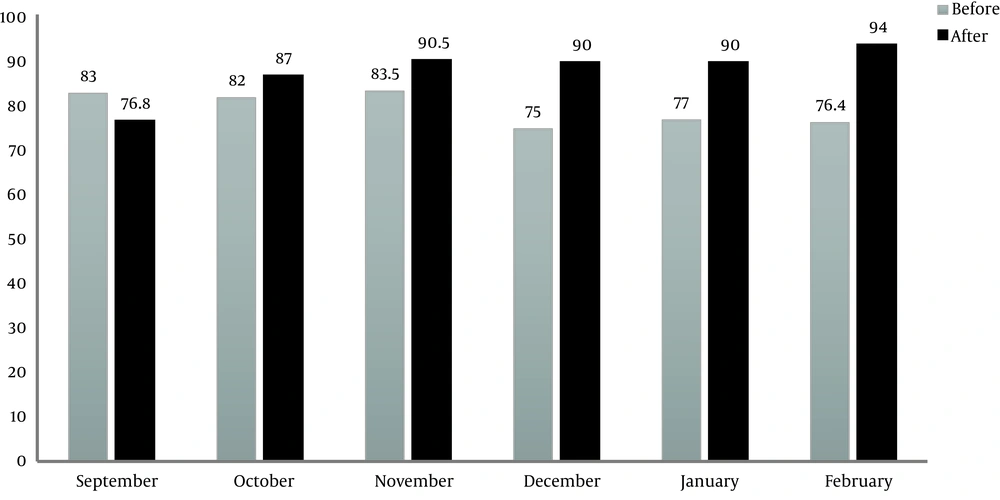
Figure 1.
Comparing the patients’ disposition within six hours before and after the senior early assessment model of care in one of the general teaching hospitals in southern Iran
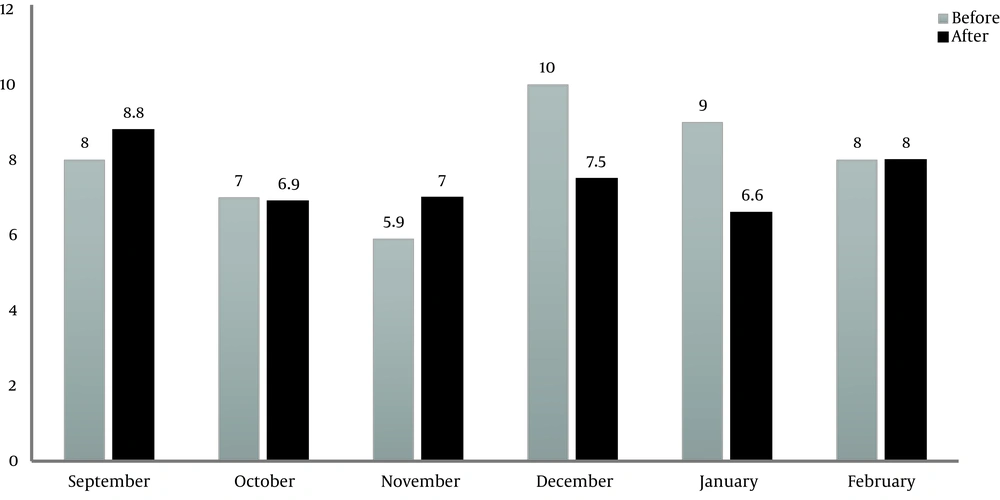
Figure 2.
Comparing the discharge with personal responsibility before and after the senior early assessment model of care in one of the general teaching hospitals in southern Iran
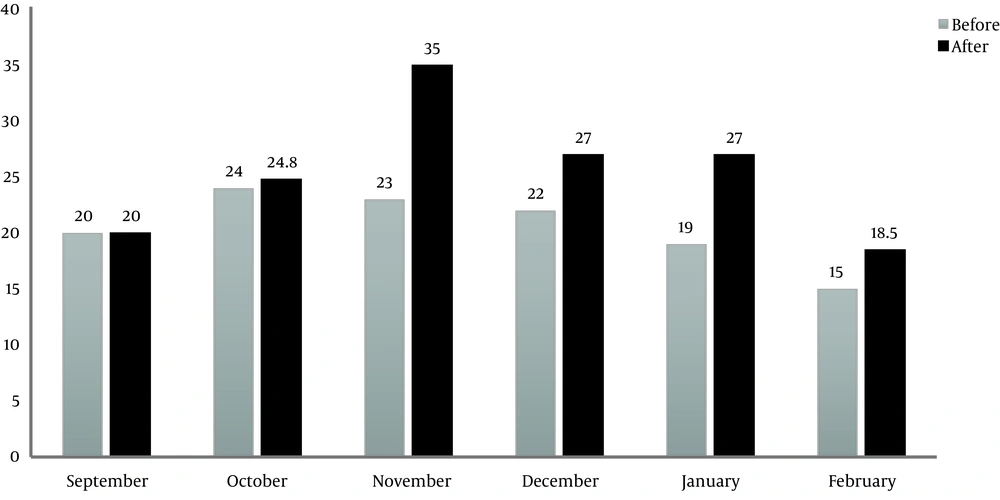
Figure 3.
Comparing the unsuccessful CPR attempts before and after the senior early assessment model of care in one of the general teaching hospitals in southern Iran
With the new model of care, the mean ± SD of duration for triage time was reduced from 37.17 ± 5.10 to 31.85 ± 2.13 minutes, a reduction that was not statistically significant (P = 0.132) (Figure 4). It is to be noted that such duration was zero at level 1 of ED in both groups. The mean ± SD of duration for triage times in other levels is shown in Table 1. Although the patients’ early assessment model of care led to reduction in the mean ± SD for triage times in all ED levels, these reductions were not statistically significant.
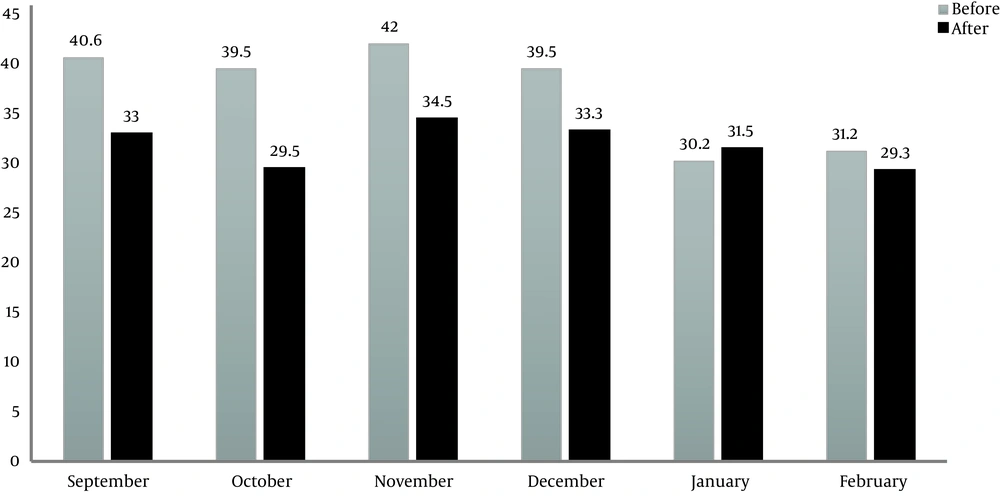
Figure 4.
Comparing the duration of triage time before and after the senior early assessment model of care in one of the general teaching hospitals in southern Iran
5. Discussion
The current study was conducted to evaluate the senior early assessment model of care in a southern Iranian ED. The results showed that the length of stay, identified as patients’ disposition within six hours, was significantly reduced in this model. In a prospective cohort study, Asha and Ajami investigated the impact of senior assessment and streaming model of care, observing a 19% relative improvement in Australian national emergency access target (NEAT). Although their study was adjusted for factors such as differences in admission, staffing, and access to inpatient units, the intervention itself only ran on Fridays to Mondays, and the findings were compared with patients admitted during the rest of the week (22). Shetty et al. conducted a before and after interventional study, making use of a new model of care [senior streaming assessment further evaluation after triage (SAFE-T) zone concept] in ED. They revealed a significant reduction in the length of stay in triage levels 3 and 4 (14.3% and 11.8%) (16). Moreover, Yousefzadeh Chabok et al. stated that there was a significant association between patients’ disposition within six hours and the presence of ED specialist (23). On the other hand, a recent systematic review of early assessment models of care in ED indicated no significant reduction in the overall 20 minute ED length of stay (24). Davis et al. also didn’t observe an association between senior early assessment model of care and ED length of stay in their randomized control trial study. However, their main goal was to have 90% of emergency patients leaving ED within four hours of arrival. Evidence has further indicated that improvements have been made in the subgroup of discharged patients (18). Hashemi et al. did not see any significant changes in the percentage of cases disposed within six hours, with the presence of ED residents (25). ED is not an ideal location for rest and recovery; hence, ED physicians have to make an appropriate diagnosis and admit or release the patients as quickly as possible.
Although the patients’ early assessment model of care reduced the mean ± SD of triage times from 37.17 ± 5.10 to 31.85 ± 2.13 minutes, the reduction was not statistically significant in any of the levels. In each level, the same results were obtained. Hashemi et al. reported a significant reduction in the triage times after the presence of ED residents (19). Spaite et al. reported that the waiting time was highly linked to patient satisfaction (25). Similar to Hashemi et al. (19) the present study observed a reduction in the percentage of discharge with personal responsibility from 7.98% to 7.47%, which was not statistical significant before and after the senior early assessment model of care.
In addition, the results showed that an increased, but not statistically significant, augment was further seen in the percentage of unsuccessful CPR attempts (from 20.5% to 25.38%). This was also in line with Hashemi et al. which did not find any significant change with regards to unsuccessful CPR attempts either. They reported this rate as 88% after the presence of ED residents, stating that the difference might have been due to the correction of methods in recording the unsuccessful CPRs (19). The rate of unsuccessful CPR attempts was reported to be higher than 80% in other studies (26, 27). This rate was 88.6% and 63.36% in studies conducted in Iran (28, 29), which indicated a satisfactory condition in the ED. Factors such as CPR duration and time of arrival of the CPR team can predict the CPR outcome (28).
In spite of the insufficient trained ED physicians, it has been predicted that the rate of referral to EDs will be 2-fold by 2025 (30). Senior emergency physicians have myriad advantages over general physicians or junior emergency physicians, such as the fact that they are familiar with the medical care process, teamwork, and organizational culture of the ED. Needless to say, senior emergency physicians possess more experience with regards to handling emergency cases, which allows for the development of better diagnostic and treatment skills (31).
The current study was not without limitation, which impacts the results. The study population in a single ED is the most important one. Thus, our results might not be simulated in other EDs. In addition, the admitted patients were not necessarily the same before and after intervention. Therefore, the study was not blinded, thus it is guessed that ED physicians might have worked harder in the new model, and the nurses might have fulfilled the patients’ timetable more accurately due to better education. We were also not able to measure and adjust for other factors, such as the medical staff’s skill mix. Models of care at individual hospitals should be designed and implant according to space, geography, patient acuity, as well as skill and number of staff. Multicenter blinded RCT studies, prospective cohort research with trend analysis, and qualitative studies are required to find the exact long-term outcomes, benefits, and costs.
5.1. Conclusions
Applying new strategies of care, such as senior early assessment, can solve overcrowding in the ED. In this study, we were able to reduce the patients’ disposition within six hours, which resulted in the reduction of the length of stay. Although no significant differences were observed concerning unsuccessful CPR, duration of triage time, and discharge with personal responsibility, future research can assess this model, particularly through the trend analysis over years, to find the exact long-term outcomes.

