1. Background
The aging process affects all body systems. The thyroid gland is not excluded from this process. Changes to this gland may include anatomical changes (mostly as fibroses), as well as functional changes (due to a reduction in the accumulation of triiodothyronine), but many older adults, with increasing age, may have normal thyroid function (1, 2). The association between thyroid function and depressive disorders has long been recognized. Patients with thyroid dysfunction are more prone to developing depressive symptoms; in addition, depression may be accompanied by various thyroid abnormalities (3).
The World Health Organization estimated that the number of people aged 60 years or older will rise from 900 million to two billion between 2015 and 2050 (moving from 12% to 22% of the total global population). Population aging will happen more quickly than before and the number of older people who need support for daily living activities is forecast to quadruple by 2050 in developing countries. This transition triggers all countries, especially developing countries, to address the needs of older people and implement an integrated system of long-term care to achieve healthy aging (4).
Depression is a common psychiatric disorder in older adults, affecting their health-related quality of life, disability, and mortality. The point prevalence of depressive disorders in older adults varies between 10% and 20% (5), and its prevalence rises with increasing age. In addition, 10% - 15% of older adults may have clinically significant depressive symptoms, even in the absence of major depressive disorder (6). A population-based study in the USA revealed that 13.7% of US older adults had lifetime major depressive disorders; furthermore, an additional 13.8% had lifetime subsyndromal depression, which could be associated with the elevated rates of comorbid anxiety, mood, and personality disorders (7).
Thyroid hormones have well-known impacts on metabolic activities in the adult brain and thyroid dysfunction has been associated with different neuropsychiatric problems such as depressive disorders. The American Psychiatric Association guidelines suggest a thyroid function examination when evaluating depressive patients (8). Previous studies demonstrated various associations between depressive symptoms and thyroid function; some showed this association with hypothyroidism; some others with hyperthyroidism; and a few studies reported the association between depression and euthyroidism (8-12).
2. Objectives
Considering the various correlations, the present study aimed to assess the association of thyroid function with depressive symptoms in older adults in the north of Iran via a longitudinal study; of course, by identifying the current situation, appropriate interventions can be proposed to improve mood disorders in older adults.
3. Methods
This prospective study is part of the second phase of the Amirkola Health and Ageing cohort Project (AHAP), which has been initiated since the year 2011 (13). We invited 1,616 older adults (aged 60 or over) in the Amirkola region, North of Iran, who had been recruited in the first phase of the AHAP study, to participate in the study. All of them would be followed for five years (from 2011 to 2016) if they met the inclusion criteria and did not have the exclusion criteria.
The inclusion criteria included individuals who did not have depressive symptoms according to the geriatric depression scale (GDS) scoring measure at the baseline examination (in the first phase of the AHAP study). The exclusion criteria included persons whose information was incomplete in the first phase of the AHAP study, those who did not complete the research examinations or blood tests at the first phase, and those with a previous history of hypothyroidism or hyperthyroidism.
The collected data included demographic characteristics (age, gender, education, and marital status). Depressive symptoms were evaluated by the 15-item GDS questionnaire. A score of 0 - 4 was categorized as normal, 5 - 8 as mild depression, 9 - 11 as moderate depression, and 12 - 15 as major depression (14).
To evaluate the thyroid function, we assessed the T3, T4, and Thyroid Stimulating Hormone (TSH) levels using the radioimmunoassay method. All of the laboratory tests were performed in a particular laboratory under regular external quality control. The TSH levels of more than 5.5 mU/L and less than 0.5 mU/L were considered as hypothyroid and hyperthyroid function, respectively. The T4 level in the range of 4.6 - 12.6 µg/dL and the T3 level in the range of 80 - 200 ng/dL were considered as normal.
Data analysis was performed by SPSS V. 21. The t-test, ANOVA, logistic regression model, and Pearson’s correlation coefficient were used for data analysis at a significance level of P < 0.05. Those variables whose crude odds ratios showed a P value of less than 0.25 were used as covariates in the logistic regression model, in addition to thyroid function. The Kolmogorov-Smirnov test was used to evaluate the normal distribution of quantitative data.
4. Results
Totally, 1,463 older adults (657 females and 806 males) were enrolled in the study. However, 153 (9.5%) individuals were excluded because of incomplete information or failure to complete the first phase of the study. Moreover, 1,248 (85.3%) were married and 215 (14.7%) were single, widowed, or divorced. In addition, 937 (64.0%) individuals had primary education, 427 (29.2%) secondary education, and 99 (6.8%) post-secondary education.
The participants were divided into two groups based on the presence of depression; 623 persons (391 females and 232 males; 45.3% of the participants) with a mean age of 69.6 ± 7.3 years had mild to severe depression and 840 (54.7%) individuals had no depressive symptoms. Totally, 59.5% of women and 28.8% of men had depressive symptoms. In this study, 1077 (73.6%) persons reported comorbid disorders. The baseline thyroid function of the participants divided into two groups (with and without depressive symptoms) is presented in Table 1. It shows that the mean levels of T3 (P = 0.330), T4 (P = 0.312), and TSH (P = 0.064) had no significant difference between these two groups. In our study, 216 (14.8%) persons [104 (16.7%) of depressed patients and 112 (13.3%) of non-depressed individuals] were hypothyroid and no significant difference was found between men and women in the prevalence of hypothyroidism in depressed (P = 0.108) and non-depressed (P = 0.203) groups at the baseline examination.
Table 1.Baseline Thyroid Function of Older Adults Based on Depressive Symptomsa
| Variable | With Depressive Symptoms (N = 623) | Without Depressive Symptoms (N = 840) | P Value |
|---|---|---|---|
| Thyroid function | 0.05 | ||
| Hyperthyroid | 13 (2.1) | 9 (1.1) | |
| Hypothyroid | 104 (16.7) | 112 (13.3) | |
| Euthyroid | 506 (82.2) | 719 (85.6) | |
| T3 level, ng/dL | 120.91 ± 25.98 | 123.82 ± 25.07 | 0.330 |
| T4 level, µg/dL | 7.71 ± 1.53 | 7.67 ± 1.57 | 0.312 |
| TSH level, mU/L | 3.48 ± 3.43 | 3.21 ± 2.97 | 0.064 |
aValues are expressed as mean ± SD or No. (%).
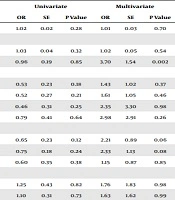
The logistic regression model was used to assess the effect size of different demographic and medical variables and thyroid function on the incidence of depressive symptoms. The results showed that the female gender (adjusted OR = 2.075; P < 0.0001), marital status “no marriage” (adjusted OR = 1.789; P = 0.001), and the number of comorbid somatic disorders (adjusted OR = 1.382; P < 0.0001) had significant effects on the depression incidence (Table 2); but hypo (P = 0.933) or hyper (P = 0.208) thyroid function, age (P = 0.540), and primary education level (P = 0.538) did not have significant effects.
Table 2.Adjusted Odds Ratios (OR) of Demographic and Medical Characteristics on Depressive Symptoms in Older Adults
| Variable | Adjusted OR (95% CI) | P Value |
|---|---|---|
| Thyroid function | ||
| Normal (reference) | - | |
| Hyperthyroidism | 1.823 (0.716 - 4.639) | 0.208 |
| Hypothyroidism | 1.014 (0.731 - 1.408) | 0.933 |
| Age (for each year increase) | 0.995 (0.978 - 1.012) | 0.540 |
| Gender (female/male) | 2.075 (1.607 - 2.680) | < 0.0001 |
| Literacy | ||
| Illiteracy (reference) | - | |
| Primary school education level | 0.918 (0.699 - 1.205) | 0.538 |
| Secondary school education or higher | 0.574 (0.331 - 0.995) | 0.048 |
| No marriage | 1.789 (1.275 - 2.510) | 0.001 |
| The number of comorbid diseases | 1.382 (1.294 - 1.477) | < 0.0001 |
After the baseline assessment, 571 (68%) out of 840 individuals who did not have depressive symptoms were followed for five years. Other people were excluded because they died between 2011 and 2016 or could not complete the second round of examination. The thyroid function and depressive symptoms of this population after a five-year follow-up are presented in Table 3. It shows that 69 (12.1%) persons were hypothyroid and six (1.1%) were hyperthyroid. Overt or subclinical hypo or hyperthyroid function had no significant difference between older adults who were depressed (P = 0.103) or non-depressed (0.128) during these five years.
Table 3.Thyroid Function and Depressive Symptoms in Older Adults After Five-Year Follow-Upa
| Thyroid function/depressive symptoms | Depressed | Non-Depressed | P Value |
|---|---|---|---|
| Overt or subclinical hypothyroid | 0.103 | ||
| Yes | 10 (14.5) | 59 (85.5) | |
| No | 102 (20.6) | 394 (79.4) | |
| Overt or subclinical hyperthyroid | 0.128 | ||
| Yes | 2 (33.3) | 4 (66.7) | |
| No | 102 (20.6) | 394 (79.4) |
aValues are expressed as No. (%).
Pearson’s correlation coefficient showed a positive correlation between the GDS score and the T4 level (r = 0.322, P = 0.001), but the correlation was not significant between the GDS score and TSH level (P = 0.281).
5. Discussion
In this study, 45.3% of the older adults had depressive symptoms. The female gender, individuals who were single, widowed or divorced (in comparison with married subjects), and persons with comorbid chronic diseases had higher prevalence rates of depression. The World Health Organization reported that more than 20% of adults aged 60 or over suffer from a mental or neurological disorder. The WHO represented depression as one of the two most common mental disorders in this age group (15). The variety in the prevalence of depression in older adults can be attributed to study design, demographic and socioeconomic characteristics of the study population, and assessment tools used for a depression diagnosis. The high prevalence of depressive symptoms in our research should trigger health policymakers to implement proper approaches to prevent and control depression in older adults.
In this study, among older adults with depression, 8.9% had hypothyroidism and 1.9% had hyperthyroidism. Fugger reported the point prevalence rate of comorbid hypothyroidism and hyperthyroidism in MDD patients as 13.2% and 1.6%, respectively; their findings represented that concurrent thyroid disease was higher in women, older adults, and subjects with comorbid self-reported chronic diseases (10). Navarro et al. reported the overall prevalence of hypothyroidism as 11.1% in hospitalized patients with depressive disorders (16). The study design, inpatient or outpatient assessment of study population, and the mean age of participants in different studies can justify these differences in results.
In this research, 14.8% of the elderly population at the first examination and 12.1% at the second examination had an overt or subclinical hypothyroid function; furthermore, 1.5% at the first and 1.1% at the second assessment had a hyperthyroid function. Ajish and Jayakumar reported in a study that 7% - 14% of older adults might have serum TSH levels above the upper limit of the reference range. They represented the peak incidence of hyperthyroidism in the second or third decades of life and 10% - 15% of hyperthyroid patients in the age group of over 60 years (17). Bensenor et al. reported a 4.4% prevalence of hypothyroidism in older adults (18). Al Eiden et al.’s study of examining 394 adults (aged 18 - 89 years) referring to primary health care settings in Riyadh revealed that 10.3% and 2.1% of this population had subclinical hypo or hyperthyroid function, respectively, and hypothyroidism was significantly more common in older adults (≥ 60 years) (19). Kim reported that hypothyroidism might be more frequent in elderly persons due to the increasing incidence and prevalence of autoimmune thyroiditis, which could occur with aging (11). Patients who have comorbid depressive disorders and thyroid dysfunction need to receive more drugs; in addition, thyroid dysfunction, especially hypothyroidism, can be linked to depression severity (10). Thyroid disorders are more frequent in elderly people, and it is necessary to diagnose these disorders in this population, because thyroid-associated symptoms, especially overt and subclinical hypothyroidism, are very similar to the symptoms of the normal aging process (18). If thyroid disorders are not diagnosed soon in elderly people, their impacts on health, morbidity, and mortality of these people can be wide (2).
A five-year follow-up of older adults revealed no significant association between hypo or hyperthyroid function and depressive symptoms. Berent et al. represented that free thyroid hormone concentrations were associated with depression severity (9). Blum et al.’s study revealed that after a three-year follow-up, depressive symptoms were not associated with hypothyroidism in the elderly population; however, GDS scores were significantly higher in hyperthyroid patients (8). Kamble et al. reported a significant decrease in the T3 level and an increase in the T4 level in depressed middle-aged adults (mean age 40.2 ± 10.3 years) (20). Siegmann et al. reported the prevalence of autoimmune thyroiditis as 4% - 13% in the United States and found that these patients could experience more psychiatric disorders, such as depression and anxiety, besides somatic complications (21). Grigorova and Sherwin found no significant correlations between thyroid hormone levels and scores on mood, verbal memory, or working memory measures in euthyroid women (mean age 51 years) (22). The difference in these results can be attributed to the study design, participants’ age, gender, and underlying assessed medical characteristics. One of the factors that can justify our result about no correlation between thyroid function and depression is that our study population has been followed in the AHAP cohort study since the year 2011; therefore, the early detection of depressive symptoms in these people and the early onset of hypothyroidism treatment might have occurred.
The most important strong points of this study are a large number of participants and a five-year follow-up of this population. One of the limitations of this study is that no structured interview was conducted with patients.
5.1. Conclusions
A five-year follow-up of elderly people revealed no significant correlation between depressive symptoms and thyroid function in this population.