


1. Background
Brain tumors are among the most critical and complex pathologies of the central nervous system. Accurate and early diagnosis plays a decisive role in determining the treatment pathway, reducing neurological complications, and extending patient survival (1). Owing to the intricate structure of the brain and the high heterogeneity of tumors in terms of size, shape, and location, any error in detection or tumor-boundary delineation can lead to irreversible consequences (2).
Among medical imaging modalities, magnetic resonance imaging (MRI) is the primary tool for diagnosing and monitoring brain tumors because of its superior soft-tissue contrast, non-ionizing nature, and multimodal imaging capabilities (3). However, MRI scans are frequently affected by artifacts such as noise, intensity inhomogeneity, overlapping grayscale values of different tissues, and indistinct boundaries between healthy and pathological regions. These factors complicate manual analysis and make it highly dependent on the observer’s expertise (4).
To overcome these limitations, image processing and automated segmentation techniques have received substantial attention in recent studies. Early methods, such as thresholding, region growing, and edge-based techniques, are computationally simple but often fail to perform robustly on real-world brain MRI data because of severe intensity variation and noise (5). Consequently, researchers have shifted their focus to more advanced clustering methods.
The K-means algorithm is a widely used clustering method because of its simplicity and speed. However, its hard-clustering nature, in which each pixel belongs exclusively to one cluster, is often unrealistic for medical images, particularly at tumor boundaries where partial volume effects occur (6). To better model the inherent uncertainty in MRI data, fuzzy logic-based methods were introduced, allowing each pixel to belong to multiple clusters simultaneously with varying degrees of membership (7).
The Fuzzy C-Means (FCM) clustering algorithm is one of the most widely used fuzzy methods in medical image segmentation and has shown high efficacy in modeling ambiguous boundaries and overlapping tissues (8, 9). Several studies have indicated that FCM is more accurate than hard-clustering methods in separating brain tumor regions (10). Nevertheless, the FCM objective function is non-convex, and the algorithm’s performance is highly sensitive to the initialization of cluster centers, the number of clusters, and the fuzzifier parameter. In many cases, this sensitivity causes the algorithm to converge to local minima rather than the global optimum (11).
To improve FCM performance, researchers have used metaheuristic optimization algorithms to identify optimal initial centers or tune algorithm parameters. In this context, hybridizing FCM with algorithms such as genetic algorithms, particle swarm optimization, and ant colony optimization has been reported to improve segmentation accuracy and result stability (12-14). However, some of these methods still face challenges, including premature convergence, parameter sensitivity, and increased computational complexity (15).
The Imperialist Competitive Algorithm (ICA) is a population-based optimization algorithm inspired by sociopolitical processes of imperialistic competition. Because of its strong global search capability and effectiveness in avoiding local minima, ICA has shown robust performance in solving nonlinear and multidimensional problems (16, 17). Recent studies have also demonstrated promising results when ICA is applied to image processing and clustering optimization tasks (18).
A review of the literature shows that, despite the development of numerous methods for brain tumor segmentation, challenges such as sensitivity to initialization, reduced accuracy in noisy images, and result instability persist in some approaches (19). Therefore, developing a hybrid framework that combines the advantages of fuzzy clustering for modeling uncertainty with the global search capability of optimization algorithms remains essential.
2. Objectives
Based on these challenges, this study proposes a hybrid method for brain tumor segmentation in MRI images that combines FCM clustering and ICA. In the proposed method, ICA serves as an optimization layer to determine the optimal initial cluster centers, after which the fuzzy clustering process is performed using this optimized initialization. The primary objectives of this framework are as follows:
To increase segmentation accuracy by effectively delineating tumor regions from healthy brain tissue.
To reduce the dependence of the clustering process on random initialization, thereby mitigating the risk of convergence to local minima.
To improve the stability and reproducibility of segmentation results, particularly in images characterized by noise and indistinct boundaries (20).
3. Methods
3.1. Overview of the Proposed Framework
This study proposes a hybrid framework that integrates the FCM clustering algorithm with ICA for segmenting brain tumor MRI images. The primary objective is to improve the accuracy and stability of the clustering process by combining the soft-clustering capability of fuzzy logic with the global optimization potential of evolutionary algorithms. Because brain tumor images are characterized by uncertainty, noise, and intensity overlap between healthy and pathological tissues, hard-clustering methods often fail to yield reliable results.
The proposed framework comprises three main stages:
Preprocessing: MRI images are preprocessed and mapped to an appropriate feature space to enhance features relevant to the tumor region.
FCM clustering: The FCM algorithm is used to partition pixels into clusters by assigning fuzzy membership degrees.
Optimization via ICA: ICA acts as an evolutionary optimization layer to determine the optimal initial cluster centers, thereby improving the convergence behavior of FCM.
This hybridization mitigates the risk of entrapment in local minima and improves final segmentation accuracy.
3.2. Data Acquisition and Preprocessing
The study used MRI sequences from the BraTS 2024 benchmark dataset (21). Because MRI scans are affected by systemic noise, intensity inhomogeneity, and inter-subject variability, preprocessing is essential to ensure data quality and clustering performance.
Initially, input images were converted to grayscale, when necessary, and pixel intensities were normalized to mitigate amplitude variation. Intensity normalization scales pixel values within a specific range, ensuring stability during the fuzzy clustering process. After normalization, each image was mapped to a set of pixels, with each pixel represented as a feature vector. In the simplest configuration, the feature vector for a pixel consists of its gray-level intensity. Thus, each pixel was treated as a sample in a one-dimensional feature space. This vector representation enables direct application of the fuzzy clustering algorithm. Although spatial or local statistical features can be appended to the vector to enhance differentiation, this study primarily focused on intensity features to demonstrate the efficacy of the proposed initialization method. The extracted feature vectors served as input for the subsequent FCM algorithm.
3.3. Fuzzy C-Means Clustering Algorithm
Fuzzy C-Means is a widely established method in medical image analysis that models inherent data uncertainty through membership degrees. In brain tumor MRI, boundaries between healthy tissue and tumor are often indistinct because of the partial volume effect; therefore, fuzzy clustering provides more flexible and accurate results than hard clustering.
Let X={x1, x2, …, xN} be a set of N pixels, where the goal is to partition these pixels into C clusters. Unlike hard clustering, FCM allows each pixel to belong to multiple clusters simultaneously. The objective function of FCM is defined as follows:
Where:
xi is the feature vector of the i-th pixel.
vj is the center of the j-th cluster.
uij represents the degree of membership of pixel i in cluster j.
m>1 is the fuzzification parameter (weighting exponent) that controls the softness of clustering.
To minimize the objective function, the membership matrix and cluster centers are iteratively updated using the following equations:
This process is repeated until a stopping criterion, such as the maximum number of iterations or a minimal change in cluster centers, is met. Despite its utility, FCM is highly sensitive to the random initialization of cluster centers because of the non-convex nature of its objective function. This sensitivity often leads to convergence at local minima, thereby reducing segmentation accuracy in complex MRI images.
3.4. Optimization via the Imperialist Competitive Algorithm
The Imperialist Competitive Algorithm is a population-based optimization method inspired by sociopolitical processes such as imperialistic competition, assimilation, and the collapse of empires. ICA uses evolutionary mechanisms to search the solution space effectively and has demonstrated robustness in solving nonlinear, complex, and multidimensional problems.
In ICA, each candidate solution is modeled as a country. The population is divided into two groups: imperialists, which are the countries with the lowest cost or best fitness, and colonies. Empires are formed by assigning colonies to imperialists according to the power of the imperialists. The main evolutionary steps include the following:
Assimilation: Colonies move toward their corresponding imperialist, improving their position in the search space.
Competition: Imperialistic competition occurs as weaker empires gradually lose their colonies to stronger empires.
Elimination: Empires that lose all colonies eventually collapse.
This continuous competition drives the population toward promising regions of the search space, substantially increasing the probability of finding the global optimum. In this study, ICA was used to overcome the initialization sensitivity of FCM. By intelligently searching for the optimal initial cluster centers that minimize the fuzzy objective function, ICA ensures robust convergence and stability.
3.5. Proposed Hybrid FCM-ICA Framework
To address the limitations of conventional FCM, particularly its dependence on initial values, this study introduces a hybrid FCM-ICA framework. The core concept is to use the global search capability of ICA to determine the optimal initial cluster centers (vj) before executing the standard FCM iterations.
Encoding strategy:
In the proposed framework, each country in the ICA population represents a candidate solution for the cluster centers. Mathematically, a country is defined as a vector containing all cluster centers:
Country =[v1,v2, …, vC]
where each element represents a cluster center in the feature space, and the number of elements depends on the number of clusters.
Fitness function:
The quality of each country is evaluated using the FCM objective function (Jm). The goal of the ICA is to minimize this value. Countries that yield a lower Jm are considered more powerful and are more likely to be selected as imperialists.
Execution flow:
After the population is initialized, the ICA process, including assimilation, competition, and elimination, iterates until a stopping criterion is met. The best country found by ICA, or the global best, is then extracted as the set of optimal initial cluster centers. Finally, the standard FCM algorithm is initialized with these optimized centers and run to fine-tune membership degrees and produce the final segmentation. This hybrid approach ensures that FCM starts from a near-optimal point, avoids local minima, and improves segmentation stability, particularly in noisy MRI data.
The procedural steps of the proposed method are detailed in Algorithm 1, and the overall process flow is illustrated in Figure 1.
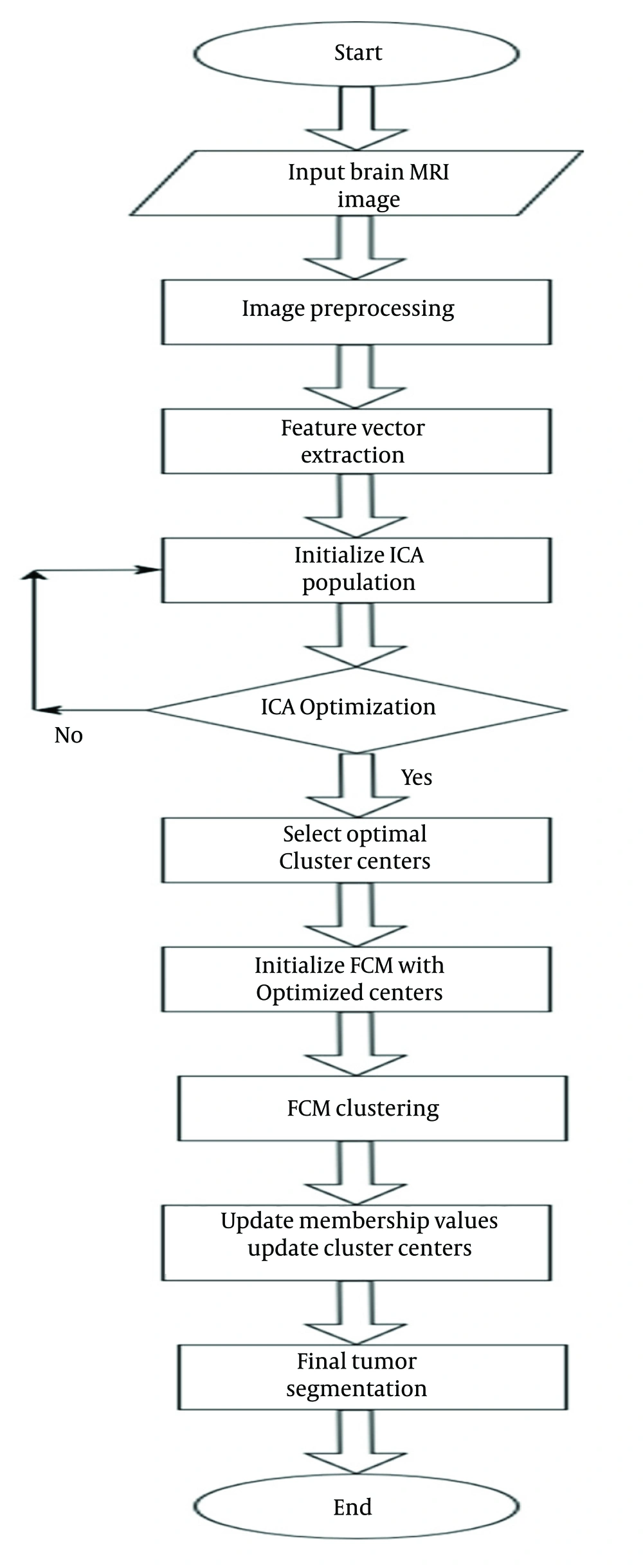
Figure 1.
Overall process flow of the hybrid FCM-ICA clustering method for brain tumor segmentation.
3.1. Algorithm 1. Hybrid FCM-ICA Clustering for Brain Tumor Segmentation
Input:
MRI image dataset
Number of clusters C
Fuzzification parameter m
Maximum number of ICA iterations T_ICA
Maximum number of FCM iterations T_FCM
Output:
Final segmented image
1. Preprocess the MRI image and extract feature vectors Xi.
2. Initialize a population of countries in ICA.
3. Represent each country as a set of cluster centers.
4. Country =[v1,v2, …, vC]
5. For each country, compute the fitness value using the FCM objective function Jm.
6. Form initial empires based on country fitness values.
7. While the ICA stopping criterion is not satisfied:
7.1. Assimilate colonies toward their imperialist.
7.2. Perform imperialistic competition.
7.3. Eliminate weak empires.
7.4. Update the fitness values of all countries.
8. end while
9. Select the best country as the optimal initial cluster centers.
8. Initialize FCM using the optimized cluster centers.
9.11. for t=1t = 1t=1 to TFCMT_{FCM}TFCM do
9.1. Update membership values Uij.
9.2. Update cluster centers Vj.
10. Generate the final segmented MRI image.
3.6. Implementation and Computational Environment
The proposed algorithms were implemented in Python 3.9 using the NumPy and Scikit-learn libraries. All experiments were conducted on a workstation equipped with an Intel Core i7 processor and 16 GB of RAM. Statistical analyses and performance evaluations were performed in the same computational environment to ensure consistency and reproducibility.
4. Results
4.1. Experimental Setup and Dataset
To evaluate the performance of the proposed hybrid framework, experiments were conducted using the BraTS 2024 benchmark dataset (21), a reference standard for brain tumor analysis. This dataset comprises MRI scans annotated by expert radiologists, which served as the ground truth for validating segmentation algorithms. The study specifically focused on images containing active tumor regions, as accurate delineation of these areas is critical for clinical diagnosis and treatment planning. The selected images exhibited substantial heterogeneity in intensity and tissue structure and contained noise and ambiguous boundaries, which are common challenges in medical image segmentation. Before clustering, preprocessing was applied to improve algorithmic stability. This included intensity normalization to scale pixel values to the required range and the application of smoothing filters to suppress noise while preserving structural details. Representative images from the BraTS 2024 dataset illustrating these challenges are presented in Figure 2.
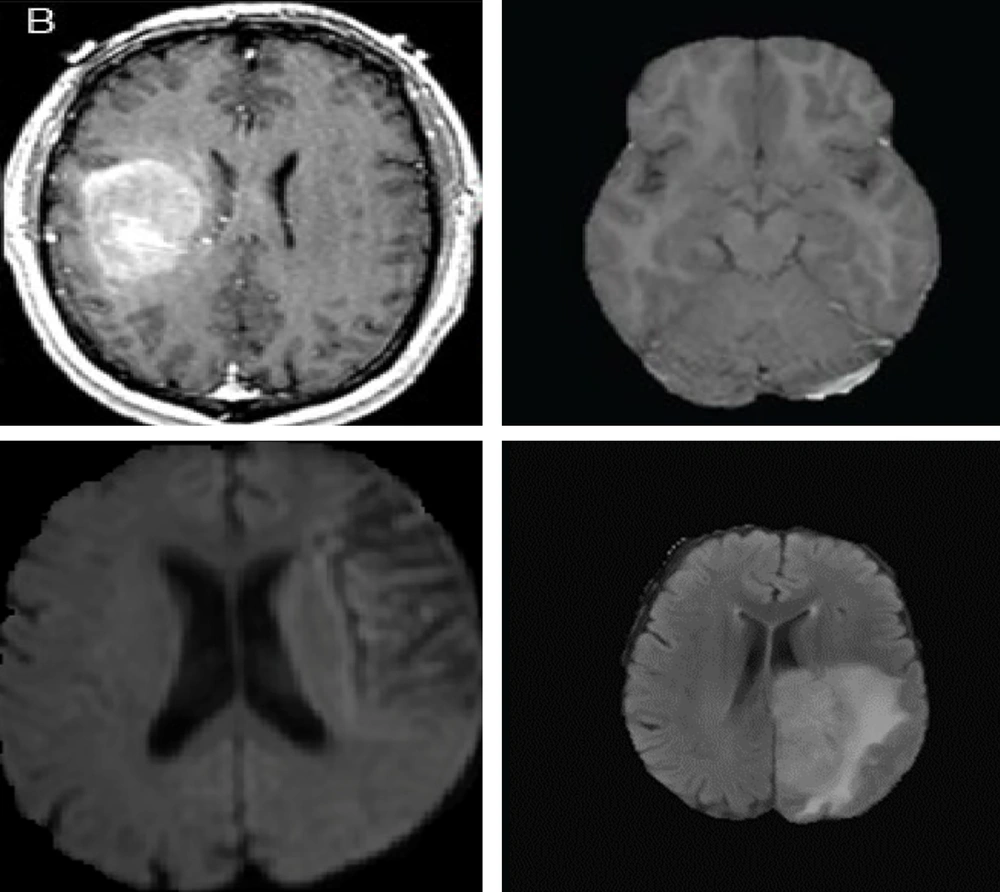
Figure 2.
Sample images from the BraTS 2024 dataset.
4.2. Performance Metrics
For quantitative evaluation, the segmentation results were compared pixel by pixel with the ground truth. Performance was assessed using five standard metrics: Accuracy, Sensitivity (Recall), Specificity, Precision, and the Dice Similarity Coefficient (DSC). These metrics are defined as follows:
Accuracy: Measures the overall correctness of the segmentation.
Sensitivity (Recall): Measures the proportion of actual tumor pixels correctly identified.
Specificity: Measures the proportion of non-tumor pixels correctly identified.
Precision: Measures the proportion of identified tumor pixels that are actually tumor.
Dice Coefficient (DSC): Measures the overlap between the predicted segmentation and the ground truth.
Where true positive, true negative, false positive, and false negative represent the pixel-level classification counts.
4.3. Parameter Sensitivity Analysis
The performance of the proposed FCM-ICA framework is influenced by two key parameters: the number of clusters in the FCM component and the number of countries (N country) in the ICA optimization layer. Extensive experiments were conducted to determine the optimal configuration.
Effect of cluster number:
As shown in Table 1, setting the number of clusters to two yielded suboptimal results, with accuracy values of approximately 25% to 32%. This poor performance is attributed to substantial overlap in gray-level intensities between tumor and healthy tissues. A binary clustering approach fails to distinguish tumor regions from other high-intensity brain structures. Increasing the number of clusters to three resulted in a substantial improvement in accuracy, up to 88.1%, because it enabled better separation of the tumor, healthy tissue, and background.
Table 1.Analysis of Segmentation Accuracy Based on the Number of Clusters and ICA Countries
| Row | No. of Clusters | No. of Countries | Accuracy (%) |
|---|---|---|---|
| 1 | 2 | 30 | 25.0 |
| 2 | 2 | 50 | 32.5 |
| 3 | 2 | 70 | 25.0 |
| 4 | 3 | 30 | 86.0 |
| 5 | 3 | 50 | 88.1 |
| 6 | 3 | 70 | 84.5 |
| 7 | 4 | 30 | 71.8 |
| 8 | 4 | 50 | 74.0 |
| 9 | 4 | 70 | 64.4 |
Effect of country count (N country):
The number of countries in ICA affects convergence behavior.
4.4. Comparative Analysis
To validate the efficacy of the proposed method, its performance was compared with three established algorithms: K-means, standard FCM, and Kernel-based Intuitive Fuzzy C-Means (KIFCM). For fairness, all comparative clustering methods, including K-means, FCM, and KIFCM, were executed using the same number of clusters (C = 3). The comparison was based on Precision, Recall, and Accuracy, as summarized in Table 2 and visualized in Figure 3.
Table 2.Performance Comparison of K-Means, FCM, KIFCM, and the Proposed FCM-ICA Method
| Method | Precision (%) | Recall (Sensitivity) (%) | Accuracy (%) |
|---|---|---|---|
| K-means | 68.0 | 58.0 | 66.3 |
| FCM | 82.7 | 77.4 | 82.0 |
| KIFCM | 89.1 | 83.7 | 86.9 |
| FCM-ICA (Proposed) | 87.8 | 85.5 | 88.1 |
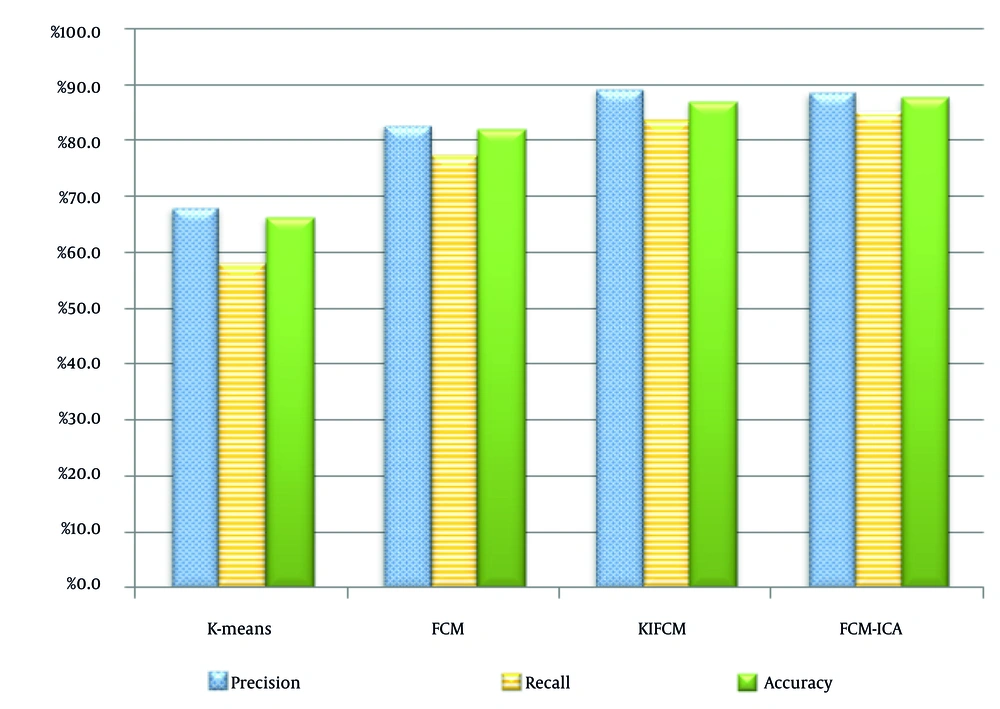
Figure 3.
Bar chart comparing the performance metrics of K-means, FCM, KIFCM, and FCM-ICA.
5. Discussion
In this study, a hybrid framework integrating FCM clustering and ICA was proposed for brain tumor segmentation in MRI images. Quantitative and qualitative results demonstrate that the proposed method significantly outperforms the reference methods in accurately delineating tumor regions. The observed improvement is primarily attributed to the use of ICA to determine optimal initial cluster centers, a critical factor in preventing the clustering process from converging to local minima.
A fundamental challenge in standard FCM clustering is its high sensitivity to the initialization of cluster centers. The analysis confirmed that random initialization often leads to suboptimal segmentation accuracy and instability in the final results because the algorithm may become trapped in local optima inherent to the non-convex objective function. By using ICA as a global search agent, this limitation was effectively mitigated. ICA ensures that clustering begins in a near-optimal region of the solution space, thereby improving convergence behavior and enhancing final segmentation precision.
Analysis of the experimental results highlights the critical impact of parameter selection on framework performance, particularly the number of clusters. As shown in the Results section, a binary clustering approach resulted in misclassification of healthy tissues as tumor regions because of substantial overlap in gray-level intensities in MRI scans. Conversely, increasing the number of clusters to three enabled better separation of different image regions. This finding aligns with the physical nature of MRI data, in which tissue boundaries are often gradual rather than sharp because of the partial volume effect, necessitating a multi-cluster approach to capture nuances among tumor, edema, and healthy tissue.
Investigation of ICA parameters also showed that the number of countries (N country) directly affects algorithmic convergence. A low population size restricted the exploration capability of the algorithm, leading to premature convergence. In contrast, an excessive number of countries caused divergence and substantially increased computational cost without a proportional gain in accuracy. In this study, N country = 50 was identified as the optimal value, establishing a favorable balance among segmentation accuracy, stability, and computational time.
Compared with reference methods based on hard clustering and standard optimization techniques, the proposed FCM-ICA framework showed superior stability to noise and intensity inhomogeneity. This characteristic is particularly important for clinical applications because real-world MRI data invariably contain noise and artifacts. The findings suggest that coupling fuzzy clustering with metaheuristic optimization algorithms is an effective strategy for enhancing medical image segmentation.
Despite these promising results, the proposed method has certain limitations. Computational time is increased compared with classical FCM because of the evolutionary optimization layer. In addition, algorithm performance remains dependent on careful tuning of control parameters. However, this increase in computational cost is considered acceptable given the substantial improvements in accuracy and stability. Future studies could focus on strategies to reduce computational complexity and incorporate more advanced texture and shape features to further refine segmentation performance.
Brain tumors, characterized by uncontrolled growth of abnormal cells, represent a critical, life-threatening condition that disrupts vital neurological functions. Because of their aggressive nature, early detection and accurate assessment of tumor progression are essential for selecting appropriate treatment strategies and improving survival. Although clinical diagnosis relies heavily on medical history and standard imaging modalities such as computed tomography and MRI, visual interpretation of these scans can be subjective and time-consuming. Consequently, digital image processing, particularly automated segmentation, has become an essential tool for precisely extracting tumor boundaries to support clinical decision-making.
Various techniques, ranging from basic image filtering, such as Gaussian and Sobel methods, to advanced machine learning and soft computing approaches, have been used for medical image segmentation. Among these methods, FCM clustering has proven particularly effective because it can assign pixels to multiple clusters with varying degrees of membership, providing robustness to noise and soft tissue boundaries. However, a major limitation of standard FCM is its sensitivity to the initial selection of cluster centers, which often leads to convergence to local optima rather than the global solution.
In this study, a hybrid framework integrating ICA with FCM was proposed to overcome this limitation and enhance segmentation performance. By leveraging the global search capability of ICA, the proposed method optimizes the initialization of cluster centers and prevents premature convergence. The segmentation process used pixel intensity as the primary feature, leveraging the fact that tumor regions in MRI scans typically exhibit higher intensity, or hyperintensity, than healthy brain tissue.
Experimental validation on the BraTS 2024 benchmark dataset demonstrated that the proposed FCM-ICA algorithm significantly outperforms traditional segmentation methods. The results indicate that this hybrid approach provides higher accuracy and stability in differentiating tumor tissues, effectively mitigating the initialization sensitivity of classical FCM. These findings suggest that the FCM-ICA framework has significant potential as a reliable automated tool for brain tumor detection and offers a precise and robust alternative for medical imaging analysis.


