1. Introduction
Tuberculosis (TB) is one of the top 10 causes of death in children worldwide [1]. Children under 3 years of age are at greatest risk for developing tuberculosis [2]; however, they are given low priority in most health programs [1] and often go undiagnosed [2]. Although there are many progressions on tuberculosis in adult patients, childhood tuberculosis remains a hidden epidemic in most countries [3]. According to WHO and the stop TB partnership, most affected children can be saved with better diagnosis of the condition, greater access to health services and improved coordination of healthcare programs [4]. But TB can be hard to diagnose in children. Non-specific symptoms and signs, difficulties to obtain sufficient sample and pauci-bacillary nature of the disease are the three most important causes.
While high-income countries use sophisticated childhood molecular tests to detect tuberculosis, most developing countries still use a method developed 130 years ago. WHO has proposed 4 criteria for diagnosis of tuberculosis in children, of which one should met 3 scores: 1-relevant symptoms (+1), 2-close contact (+2), 3-tuberculin skin test (+1), 4-radiological findings compatible with tuberculosis diagnosis (+1) along with isolation of microorganism from a sample. Since it is difficult to make a diagnosis based on bacteriology, diagnosis of tuberculosis in children strongly relies on radiological findings and tuberculin skin test results [5]. Relevant radiological features detectable by chest X-ray are: enlarged mediastinal/hilar lymphadenopathy, primary complex of Ranke, pneumonic infiltration, abscess, cavity, calcification, plural effusion and empyema [6]. Mediastinal lymphadenopathy which is considered as a radiological hallmark of primary TB, could be hard to detect by chest X-ray alone. Moreover, chest X-ray is often disappointing in finding of minimally active disease which is present in most patients with normal chest X-ray. Poor inter-observer agreement in X-ray interpretation is another challenging problem in the routine use of chest X-ray in identification of tuberculosis [7].
CT scan has a high contributing role in TB diagnosis which often leads to an important change in treatment decision making and is regarded as a gold standard for mediastinal lymph node enlargement. Most studies have been focused on the low sensitivity and specificity of conventional X-ray and not a digital X-ray. This study is performed to compare digital X-ray and spiral CT findings in children under 15 years old who are admitted for evaluating tuberculosis.
2. Materials and Methods
This cross-sectional comparative study was carried out on 38 children under 15 years old who were admitted to pediatric department of National research institute of tuberculosis and lung disease (NRITLD), Massih Daneshvari hospital for evaluation of tuberculosis during 2010 to 2012. According to the records, all the children had been visited by a pediatrician and if the history and physical exam, especially a history of close contact raised the suspicion for TB infection, tuberculin skin test, gastric lavage/sputum smear collection and radiological evaluations, including both digital chest X-ray and CT scan were requested on the admission day before starting any anti-TB medication.
Tuberculin skin test was performed with intradermal injection of 0.1 mL solution containing 5 unit tuberculin in the anterior part of forearm and after 48 - 72 hours, the induration size was recorded. Sample collection was performed by gastric washing for all the children who had not been able to produce sputum. The protocol for gastric lavage was as below: after introducing a small, smooth rubber tube into the stomach either by swallowing or by gently inserting it in one nostril, a syringe was attached to the free end of the tube and the contents withdrawn and put in a bottle as soon as sufficient length of tube is inserted to reach the contents of the stomach. Then a cup or more of warm saline was syringed back into the stomach to wash it and is again aspirated out. This washing might had been repeated several times until a sufficient sample had been obtained. Then the tube was withdrawn and then gastric lavage was completed. These procedures were repeated for at least 3 consecutive days. All samples were sent for direct smear, staining by Ziehl-Neelsen and also for specific culture.
Digital chest X-ray (PA) and spiral thoracic CT (TCT) either with or without IV contrast was performed for all the suspected children. TCT was acquired with spiral scanner (Siemens Somatom Emotion Plus device). First scanogram was acquired, and then the spiral CT scan was taken, starting from the apices of the lungs and ending caudally at the level of adrenal glands (110 kV, 37 mAs, adjustable for body habitus).
All the relevant records were reviewed and 110 children all under 15 years old who were admitted for tuberculosis infection/tuberculosis disease evaluation were included. Children with any previous pulmonary disease, recent use of anti-TB medication, HIV positivity, history of any intervention on the lung fields (surgery, radiotherapy, etc.), history of taking any drug with considerable pulmonary side effects, having less than 3 samples for direct smear, not having a thoracic CT or digital chest X-ray or performing chest X-ray and TCT with more than 48 hours interval were excluded from the study. Finally we found 38 children met our criteria.
Thoracic CT scans were reviewed in the standard mediastinal and lung parenchymal windows (mean window width 1700, center -600). To prevent any bias, chest X-ray was evaluated first and then TCT was reviewed.
Diagnosis was made based on isolation of microorganism from the samples as well as the WHO criteria: 1-history of close contact with smear positive adult (+2), 2-relevant symptoms (+1), 3-recent conversion of tuberculin skin test (> 15 mm or > 10 mm, according to the history of BCG vaccination) (+1) and 4-radiological abnormalities compatible with TB diagnosis (+1). At least 3 out of 5 scores were needed for meeting the diagnostic criteria. Abnormalities depicted by thoracic CT and digital chest X-ray were compared and the overall sensitivity and the sensitivity for any individual finding were determined (McNemar Test, P < 0.05 considered as a significant difference for sensitivity). SPSS-16 was used for statistical analyses. Institutional review board approval was not required for this retrospective study.
3. Results
Of 110 records reviewed, 38 children were included in this study. Median age was 8.1 years (9 months-15 years old), 42% were boys and 57.9% were girls. Forty eight percent were Iranian and 52% were Afghan with a history of BCG vaccination in 68%. All of them had a history of close contact with a smear positive family member with active pulmonary tuberculosis. Clinical symptoms were present in 78% of children, the most prevalent of which were lack of appetite (62%), fatigue (51%), weight loss /failure to thrive and productive cough (40%). All the patients had a positive culture but direct smear for acid-fast bacillus was positive only in 38%. Positive tuberculin skin test, defined in BCG vaccinated and non-vaccinated children as indurations of 15 mm and 10 mm, respectively, were seen in 51% of the cases. All the children met WHO criteria and were discharged on anti TB medication.
Chest X-ray was normal in 36.8% of children, while CT scan was negative only in 21.1%. Five patients had normal chest X-ray and thoracic CT scan. Of these 5 children, 1 had positive PPD and 2 had positive smear, 1 had both positive smear and PPD and 1 had relevant clinical features. Overall sensitivity of thoracic CT scan and chest X-ray were 78.9% and 63.2%, respectively which showed no significant difference.
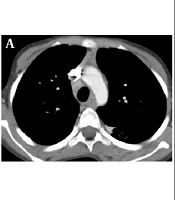
The most prevalent findings on chest X-ray were consolidation/ground glass opacity, lymphadenopathy and bronchiectasis, while consolidation/ground glass opacity, lymphadenopathy and nodule/nodular infiltration were the most common abnormalities on CT scan. CT scan detected lymphadenopathy (P = 0.006), nodule/nodular infiltration (P = 0.002), collapse (P = 0.004) and pleural effusion/thickening (P = 0.05) significantly better than chest X-ray (Table 1); however, they did not show significant difference in detection rate of consolidation/ground glass opacity, cavity/abscess and cicatricial volume loss (Table 1). Although thoracic CT scan detected more cases of bronchiectasis than digital chest X-ray, the difference was not statically significant. Table 1 shows abnormal findings detected in chest X-ray and CT scan of affected children.
Table 1.
Radiologic Findings of 38 Pediatric Patients With Tuberculosis in Chest X-Ray and CT Scan
| Findings | Chest X-Ray | CT Scan |
|---|---|---|
| 14 | 8 | |
| 7 | 22 | |
| 5 | 5 | |
| 2 | 8 | |
| 0 | 9 | |
| 6 | 15 | |
| 0 | 1 | |
| 1 | 6 | |
| 4 | 19 | |
| 20 | 19 | |
| 5 | 6 | |
| 6 | 11 | |
| 1 | 12 | |
| 4 | 7 | |
| 4 | 9 |
4. Discussion
We have revealed that investigation of children doubtful of tuberculosis by digital chest X-ray is still of great value. We have also shown thoracic CT scan in children suspected of tuberculosis infection can be restricted in patients with complication.
Imaging is one of the most important criteria in TB diagnosis in children. The most common radiological features of childhood tuberculosis are lymphadenopathy (90% - 95%) [8, 9], consolidation (70%) [9, 10] and pleural effusion [10] in primary tuberculosis and consolidation, nodular infiltration (25%) and cavity (20% - 45%) in reactivation tuberculosis [11, 12]. Many studies have demonstrated the superiority of thoracic CT scan over the conventional chest X-ray in early evaluation and long term management of children suspected to be infected by tuberculosis but there are only few studies focused on the role of digital chest X-ray in approach and management of childhood tuberculosis. The aim of this study was to make a comparison between digital chest X-ray and thoracic CT scan in detecting abnormal findings in children with definite tuberculosis infection based on having a positive culture and meeting WHO criteria. In the next step, the sensitivity for the most common radiological findings in childhood tuberculosis in each modality were determined to reveal the blind spot of digital chest X-ray.
In previous studies, it has been shown that CT scan is especially useful in detection of mediastinal lymphadenopathy [13-16], nodules, small cavities [10] and areas of scar [13]; however, the results of current study are not exactly the same. In this study while it is demonstrated that mediastinal lymphadenopathy, especially on the right side, is detected significantly better by thoracic CT scan than chest X-ray, the same results are not found for cavity, nodule and scar changes. The result of this study showed that while the overall sensitivity of thoracic CT scan is higher than digital chest X-ray, but it is not of important significance.
In one study the overall sensitivity of conventional chest X-ray and thoracic CT scan was stated 35% and 75%, respectively [17]. In current study the sensitivity of thoracic CT scan and digital chest X-ray were 78.9% and 63.2%, respectively, which at least in part can be due to the digital and not conventional technique of chest X-ray. In some studies, one of the most common abnormal patterns of chest X-ray in the affected children was consolidation and right hilar lymphadenopathy which is in accordance with previous studies [18-20]. On the other hand, the most common abnormal findings compatible with pediatric TB diagnosis on CT were consolidation, mediastinal lymphadenopathy and nodular infiltration, the two latter of which are not detected optimally by chest X-ray both in the current and previous studies [10]. Chest X-ray found lymphadenopathies predominantly in hilar region. Indeed, there was no significant difference for hilar lymphadenopathy detection between CT and chest X-ray, while thoracic CT scan recognized lymph node enlargement in mediastinal region much more effectively, this is due to mediastinal lymph node superimposition over the sternum and bony spine on chest X-ray; however, none of these regions are considered more specific for tuberculosis infection [21]. As expected, collapse, especially subsegmental type and band atelectasis and pleural effusion/thickening were the other findings depicted significantly better by thoracic CT in comparison with chest X-ray. It should be noted that pleural effusion/thickening is an important radiologic criterion in diagnosis of primary tuberculosis infection [18]. For other abnormalities such as consolidation/ground glass opacity, cavity/abscess and cicatricial volume loss, the detection rate was not markedly different between these two modalities. In this study CT scan better demonstrated the extent and distribution of consolidation/ground glass opacity, but there was no important difference in detection rate of consolidation/ground glass opacity by digital chest X-ray and CT scan. Regarding the cavity/abscess, again the sensitivity of digital chest X-ray and CT scan was not considerably different; this may be due to larger size of cavities in this study. In the past studies also, CT scan was better only for detection of small cavities and not larger ones [10]. Although mild scar changes can be more precisely shown by CT scan, regarding extensive scar changes usually associated with cicatricial volume loss, the sensitivity of digital chest X-ray and CT scan was not much different in this study and this seems reasonable. Bronchiectasis was the last abnormality for which the sensitivity of CT and chest X-ray did not very much. It should be noted that we used spiral CT and not HRCT (which is the most accurate method of CT for assessment of bronchiectasis) in this study. Despite this, we recommend larger scale studies for comparing CT scan and digital chest X-ray for diagnosing tuberculosis induced bronchiectasis in children.
This study demonstrated that digital chest X-ray is not as accurate as thoracic CT scan in detecting mediastinal lymphadenopathy and nodule/nodular infiltration, so in a clinically relevant setting with a chest X-ray negative for lymphadenopathy or nodular infiltration thoracic CT scan should be considered, but if mediastinal lymph node enlargement and nodule/nodular infiltration are depicted well in digital chest X-ray, thoracic CT scan may not add further clinically significant information over the digital chest X-ray. This study proposed that early investigation of children suspicious of tuberculosis by digital chest X-ray is still of great value and can obviate the need for CT scan and hence protect children from excessive radiation in many cases. Overall, it seems that thoracic CT scan in tuberculosis infected children can be limited to investigation of complications in selected patients, however, the results of this study should be confirmed by larger investigations.