
1. Background
Cognitive impairment is considered to be among the most prominent dysfunctions in patients suffering from schizophrenia, especially in areas of attention, executive function, and memory (1). Cognitive deficits are linked to poor occupational and social functions, as well as poor independent living (2-6). Therefore, the treatment of cognitive impairments is considered an essential goal, and several cognitive remediation and cognitive enhancing medications are developing for the treatment of schizophrenia patients.
Having insufficient insight into their illness is considered a hallmark of patients with schizophrenia. Generally, insight includes three aspects: Recognizing the mental illness that the person has, the ability of labeling abnormal mental events as pathological and adhering to treatment (7). Lately, researchers have suggested that schizophrenia patients are not only unaware of their psychotic symptoms, but they are also unaware of their cognitive problems, such as attention, memory, and problem solving (8-13). A large body of evidence has shown that insight into psychotic symptoms and awareness about the necessity for treatment are correlated to drug compliance in schizophrenia. It is reasonable to assume that a lack of insight into cognitive dysfunction could affect its treatment in schizophrenia.
Moreover, studies have found that poor cognitive insight is linked with delusions and poor insight into psychotic symptoms in schizophrenia patients (14, 15).
There are two methods to assess insight into cognitive impairments in patients, including clinician-rated and self-report measures. The latter method has some benefits that make its use very common. The main advantage of self-report measures is that they are based on the participant's own experience rather than inferring through observation, thus tend to be more accurate. Moreover, there is no concern about inter-rater reliability and clinician bias in the self-report questionnaire. Finally, they can be administered easily, quickly, and inexpensively.
A number of self-report scales have been developed for assessing insight into cognitive impairment in schizophrenia, such as the Birchwood Self-report Insight Scale (16), assessment of insight in psychosis (17), Berrios Insight Scale (18), and the Beck Cognitive Insight Scale (19). Moreover, Medalia and colleagues have developed two measures of insight into cognitive deficits named measure of insight into cognition, clinician rated (MIC-CR), and self-report (MIC-SR), which focus on executive functioning, memory, and attention (13, 20). Measure of insight into cognition, self-report is a short questionnaire, which is easily completed by the patient himself in a short time, and assesses the most common areas of cognitive impairment in patients suffering from schizophrenia related to their functional outcome. Saprestein et al. replicated the initial findings of psychometric properties of the MIC-SR and suggested it as a valid and reliable complementary instrument for assessing neurocognitive insight in patients suffering from schizophrenia spectrum disorders. The findings of this study showed acceptable Cronbach's alpha for MIC-CR (0.83), significant test-retest reliability (P < 0.001), concurrent validity (r = -0.70), as well as a significant correlation between MIC-CR and MIC-SR (21).
The main goal of the current study was to evaluate the validity and reliability of the Persian version of MIC-SR. Before this study, none of the measures of insight into cognitive deficit that are utilized in studies on schizophrenia were translated into the Persian language and thus were not validated. Persian is one of the most important languages in Central Asia and the Middle East and is the official language of Afghanistan, Iran, and Tajikistan. Over 100 million people speak Persian around the world, and it is one of the world's top 20 most widely spoken languages (22, 23). A reliable and valid self-assessment scale of cognition can help clinicians create more targeted treatment goals and monitor the effects of treatment.
2. Objectives
In this study, the reliability and criterion validity of MIC-SR were assessed using an interview-based assessment of cognition in schizophrenia [Schizophrenia Cognition Rating Scale (SCoRS)] and a standardized performance-based cognitive battery [the brief assessment of cognition in schizophrenia (BACS)].
3. Methods
3.1. Participants
A group comprised of 33 schizophrenia patients (23 men) participated in this study. All the participants met the DSM 5 criteria for schizophrenia diagnosis, received antipsychotic medications at the time of testing, and were stable clinically. The mean chlorpromazine equivalent dose was 395.7 (SD = 179.9) mg (24). The control group consisted of 33 healthy individuals (24 men) who had no personal or family history of any neurological or psychological disorders. Exclusion criteria for all participants were a history of traumatic head injury, history of neurological disease, use of ECT in the past 6 months, and current substance abuse. Written informed consent was obtained from all participants, and this study was approved by the ethics committees of Kerman University of Medical Sciences with EC/KNRC/93-44 ID.
3.2. Persian Adaptation Procedures
The standard forward-backward method was used for the translation of the MIC-SR from English to Persian. In the first step, the MIC-SR was translated into Persian by two Persian speaking psychiatrists. After completion, those Persian translations were re-translated to English with the help of two independent bilingual experts that were privy to the primary English versions, and any differences found between the two versions were reconciled. There were no significant translation problems, and all questions were reserved in the Persian adaptation.
3.3. Assessment Procedures
All of the participants were assessed by the Persian MIC-SR, the Persian versions of the BACS (25), and the SCoRS (26). The Positive and Negative Symptom Scale (PANSS) was utilized to evaluate the severity of symptoms in the patients (27). In order to discern the correlations between the Persian version of MIC-SR and quality of life and global functioning, the global assessment of functioning (GAF) (28) and WHO QOL Brief scale (29) were used, respectively.
3.3.1. MIC-SR
The MI-CSR is a 12-item self-report measurement which evaluates the perceived frequency of difficulty experienced with cognitive skills. The items are rated on a scale ranging from 0 (never) to 1 (once a week or less), 2 (twice a week), or 3 (almost daily). The overall score obtained by this method ranges from 0 to 36, and by dividing the obtained total score by 12, the average score for experiencing cognitive problems is obtained. Greater scores are indicative of more perceived problems regarding cognition in everyday life.
3.3.2. SCoRS
Schizophrenia Cognition Rating Scale is an interview-based battery with 20 items for cognitive impairment and evaluation of their impact on daily performance. Interviewers are required to read the questions on a proportionate scale. Every scale can have a score of 1 to 4, and greater scores indicate a higher level of impairment. Three distinct sources are used for obtaining information, namely the patients themselves, an informant (friend, family member, etc.), and the interviewer that performs the scoring on the patient and the informant. After going through all the 20 questions, a global rating score needs to be completed by the interviewer, which is on a scale of 1 - 10. This score depends on the interviewer's overall understanding of the difficulty level the subject is facing due to their cognitive deficits.
3.3.3. BACS
The BACS is a performance-based cognitive evaluation battery which is devised for measuring cognitive function in schizophrenia (30). The battery evaluates cognitive domains that are commonly impaired, which include: Verbal fluency, verbal memory, motor speed, executive function, working memory, and attention. For this purpose, one score is obtained from each subtest, and the composite score is calculated by the sum of subscales. A lower score indicates greater cognitive impairment.
3.4. Data Analysis
By using a combination of independent t-tests and χ2-test, the demographic data of the two groups was compared with each other. Pearson correlation was utilized to investigate any relationship between rating scales. To evaluate the predictive value of BACS and SCoRS for predictive functional outcomes, regression analyses with GAF and WHO QOL Brief was performed as outcome variables.
4. Results
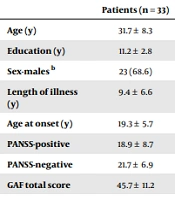
Table 1 demonstrates the clinical and demographic characteristics of the study participants. The groups in this work were well matched in terms of sex, age, and years of education.
Table 1.
Demographic and Clinical Characteristics of the Study Participants a
| Patients (n = 33) | Controls (n = 33) | P-Value | |
|---|---|---|---|
| Age (y) | 31.7 ± 8.3 | 30.9 ± 8.4 | NS |
| Education (y) | 11.2 ± 2.8 | 12.5 ± 2.6 | NS |
| Sex-males b | 23 (68.6) | 24 (68.6) | NS |
| Length of illness (y) | 9.4 ± 6.6 | ||
| Age at onset (y) | 19.3 ± 5.7 | ||
| PANSS-positive | 18.9 ± 8.7 | ||
| PANSS-negative | 21.7 ± 6.9 | ||
| GAF total score | 45.7 ± 11.2 | ||
| Mean chlorpromazine equivalent (mg) | 395.7 ± 179.9 |
Abbreviations: GAF, global assessment of function; PANSS, Positive and Negative Symptom Scale; NS, not significant.
a Values are expressed as mean ± SD or No. (%).
b χ2-test.
Table 2 shows means and standard deviations for BACS and SCoRS subscales. The two groups differed significantly regarding all the measures, and this shows that the patients received significantly higher rating scores in SCoRS assessment and lower rating scores in all BACS subscales, suggesting greater cognitive impairment, either interview-based or objective-based in schizophrenia.
Table 2.
Means and Standard Deviations of the Schizophrenia Cognition Rating Scale and Brief Assessment of Cognition in Schizophrenia Subscales of the Study Participants
| Patients (n = 33) | Controls (n = 33) | P-Value | |
|---|---|---|---|
| SCoRS rating score | |||
| Global | 6.7 ± 1.9 | 2.4 ± 1.9 | < 0.001 |
| Interviewer | 43.8 ± 9.5 | 27.5 ± 6.3 | < 0.001 |
| Patient | 37.2 ± 6.9 | 27.1 ± 6.7 | < 0.001 |
| Informant | 39.5 ± 8.9 | 28.4 ± 6.1 | < 0.001 |
| BACS | |||
| Global | 26.6 ± 6.1 | 38.9 ± 5.2 | < 0.001 |
| Verbal memory | 35.7 ± 10.4 | 54.2 ± 8.6 | < 0.001 |
| Digit sequencing | 13.8 ± 5.1 | 23.4 ± 3.6 | < 0.001 |
| Token motor | 45.8 ± 12.6 | 71.6 ± 9.5 | < 0.001 |
| Semantic fluency | 15.9 ± 4.7 | 20.5 ± 4.5 | < 0.001 |
| Letter fluency (sum of ‘F’ and ‘S’) | 18.3 ± 6.1 | 26.1 ± 7.8 | < 0.001 |
| Symbol coding | 29.1 ± 11.1 | 43.3 ± 9.9 | < 0.001 |
| Tower of London | 11.6 ± 4.4 | 17.4 ± 2.5 | < 0.001 |
Abbreviations: SCoRS, Schizophrenia Cognition Rating Scale; BACS, brief assessment of cognition in schizophrenia.
4.1. Reliability: Internal Consistency
Coronbach’s alpha coefficient was used for the calculation of internal consistency for the MIC-SR, which was 0.83. The inter-correlations between the MIC-SR subscales were also calculated. There were significant correlations between the three MIC-SR subscales (moderate to strong) in patients suffering from schizophrenia (Table 3).
Table 3.
Intercorrelations Between the Measure of Insight Into Cognition Self-report Subscales in Schizophrenia Patients
| MIC-SR Subscales | Attention | Executive Function | Memory | MIC-SR Global Score |
|---|---|---|---|---|
| Attention | 1 | 0.61 | 0.51 | 0.80 |
| Executive function | 1 | 0.61 | 0.83 | |
| Memory | 1 | 0.90 |
Abbreviation: MIC-SR, measure of insight into cognition self-report.
4.2. Criterion Validity
For the purpose of examining criterion validity, Pearson correlations were calculated between the MIC-SR subscales and measures of cognition based on interview assessment (SCoRS, patient’s rating) and objective assessment (BACS). It should be noted that only related cognitive measures (memory, attention, executive function) of the SCoRS and the BACS were chosen. Considerable correlations were observed between the MIC-SR measures and the SCoRS patient's rating, while none of the correlations among the BACS subscales and MIC-SR were significant (Table 4).
Table 4.
Correlations Between the Measure of Insight Into Cognition Self-report Subscales and Patient Schizophrenia Cognition Rating Scale and WHO-Quality of Life in Schizophrenia Patients
| MIC-Attention | MIC-Problem Solving | MIC-Memory | |
|---|---|---|---|
| Patient SCoRS | |||
| Attention (3 items) | 0.58 | ||
| Problem solving (3 items) | 0.44 | ||
| Memory (4 items) | 0.61 | ||
| WHO-quality of life | -0.41 | -0.50 | -0.25 |
Abbreviations: SCoRS, Schizophrenia Cognition Rating Scale; MIC, measure of insight into cognition.
Finally, the relationship between the MIC-SR subscales and WHO-quality of life, GAF, and PANSS scores were also calculated. The results showed only significant correlations between the WHO-quality of life and MIC-SR subscales of attention and problem solving (Table 4), while other correlations were not significant (all P > 0.05).
5. Discussion
Insight into illness is one of the most important factors involved in drug compliance and prognosis in patients with schizophrenia. Treating cognitive deficits in schizophrenia has become a key component of their management; thus, it is important to know whether the patient is aware of having cognitive problems or not. Self-report measures, such as MIC-SR, provide a reliable and easy way to make assessments if patients realize their cognitive problems. The current work aimed to appraise the reliability as well as the validity of the Persian adaptation of the self-reported awareness of cognitive problems in schizophrenia, named MIC-SR. In order to reach this aim, we compared the Persian version of MIC-SR with an interview-based assessment of cognition (ScORS) and actual neurocognitive performance (BACS).
The results revealed that the Persian MIC-SR has a great rate of internal consistency, which is in agreement with previous studies (13, 21). Moreover, the correlations between the Persian MIC-SR subscales and their corresponding measures in the ScORS were all statistically significant in schizophrenia. It is noteworthy that similar to MIC-SR, the ScORS targets a detailed assessment of the performance of daily tasks in the real world and indexes the perspective of patients regarding their functional and cognitive abilities (25). Therefore, good concurrent validity of the Persian MIC-SR with ScORS indicates that the Persian MIC-SR is a suitable measure for assessing awareness of cognitive dysfunction in Persian speaking schizophrenia patients.
Among the essential validators of insight into the cognitive functioning scale, one can point out its connection to real-world functioning. In this study, the Persian MIC-SR subscales of attention and problem solving had a significant inverse correlation with WHO-quality of life. Consistent with our study, Kurtz and Tolman found the quality of life inversely related to attention and problem solving (31), while Boyer et al. found no significant correlation between the quality of life and neuropsychological measures of attention, memory, or executive functioning (32). A possible justification for these results can be unreliable insight regarding cognitive capacities among patients with schizophrenia.
It should be noted that we also examined whether awareness of cognitive deficits in schizophrenia was related to demonstrable cognitive performance. Consistent with Medalia et al., the current results revealed that there were no considerable correlations between the MIC-SR measures and the corresponding BACS subscale (33). Importantly, while 85% of our patients performed 1.5 - 2 SDs below the healthy controls on the BACS composite score, they showed partial insight into their cognitive deficits. In agreement with our results, Moritz et al. found that self-reported cognitive functioning was poorly related to neurocognitive performance in schizophrenia. Taken together, this finding suggested that patients suffering from schizophrenia have limited insight into their actual cognitive deficits (9). Consistent with Medalia and Thysen, our data did not support an association between the severity of psychotic symptoms and insight into cognitive dysfunction in schizophrenia (13).
Overall, the Persian MIS-SR demonstrated satisfactory rates of validity and reliability, indicating that it can be considered a convenient tool for the evaluation of insight into cognitive dysfunction in Persian-speaking schizophrenia patients.
5.1. Limitations
There are limitations to this study. First, cognitive performance was assessed by only one neuropsychological test; therefore, a definite statement about an overall association between poor insight and cognitive performance is difficult. Second, test-retest reliability was not examined in this study. Further research is recommended for evaluating the rate of reliability of the Persian MIC-SR over a longer period.
5.2. Conclusions
The results show that the Persian version of the MIC-SR has acceptable psychometric properties that can assess awareness of cognitive impairments in patients suffering from schizophrenia.