
1. Background
Discharge against medical advice (DAMA) occurs when a patient chooses to leave a hospital before completing the prescribed course of treatment without the permission of the attending physician. This decision often reflects patient dissatisfaction and poses a significant challenge for healthcare system managers (1, 2). Discharge against medical advice can also negatively impact patients' clinical outcomes.
The issue is particularly critical in pediatric and neonatal care, as decisions for early discharge are typically made by parents who may not fully grasp the potential consequences (3, 4), leading to ethical and legal dilemmas (5, 6). Neonates are especially vulnerable, and early discharge can have severe consequences, including unreported instances of mortality (7, 8). Certain conditions, such as being born to diabetic mothers, further increase the risk (9, 10).
Neonates discharged early are more prone to adverse medical events, readmissions (occurring in 9 to 13% of DAMA cases), longer hospital stays, increased costs, and higher mortality rates (6, 11, 12). Studies have shown alarming mortality rates among preterm infants discharged against medical advice, particularly in middle- or low-income countries, where DAMA significantly contributes to mortality and morbidity (13).
To mitigate this public health issue, it is crucial to raise awareness about the potential consequences of DAMA and to implement strict oversight by government agencies (5, 14). The reasons for DAMA vary across different regions and are influenced by cultural, social, and economic factors (15). Additionally, the approach of physicians, the adequacy of facilities and medical staff, and hospital type (private, educational, general, or specialized) all play significant roles in the DAMA process (16, 17). Therefore, findings from similar studies may not be universally applicable to other areas.
2. Objectives
To the best of our knowledge, the topic has not been investigated in Guilan province. Given the importance of the issue and the fact that each region has its own unique pattern, this study was planned as a fundamental step to determine the status of DAMA in an academic and referral center. The findings of this survey could serve as a practical guide to improving the current situation.
3. Methods
After receiving approval from the Ethics Committee of Guilan University of Medical Sciences (GUMS), this retrospective cross-sectional study was conducted at Alzahra Hospital, a public academic and referral center, during the period of 2020 - 2021. Medical records of neonates discharged from the neonatal intensive care unit (NICU) without the responsible physician's permission were sorted out and reviewed using a census method.
3.1. Exclusion Criteria
Files with incomplete data (more than 15% missing in the main variables of the study) were excluded. Information including gender, gestational age (weeks), infant weight, type of delivery, level of maternal education, residential area, insurance status, reason for hospitalization, number of hospitalization days, and reasons for discharge with personal consent were gathered. The data were recorded by the NICU nursing system in the neonates' files. These data were carefully entered into questionnaires by a trained medical student under the supervision of the thesis supervisor. Finally, after completing the questionnaires, they were handed over to the statistical consultant for further analysis.
3.2. Statistical Analysis
The collected data were analyzed using SPSS 21 software (IBM Corp. Released 2012. IBM SPSS Statistics for Windows, v. 21 Armonk, NY: IBM Corp). The Kolmogorov–Smirnov test was used to define normality distribution, and frequency and frequency percentages were analyzed and tested using the chi-square test. A P-value less than 0.05 was considered significant.
4. Results
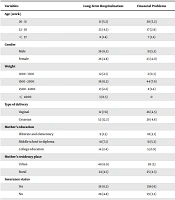
In this study, data from 581 files out of 2327 that were discharged against medical advice were analyzed. The highest frequency was among infants born between 40 and 37 weeks (48%), with weights ranging from 4 000 to 2 500 g (56.1%). Of these infants, 52.2% were male and 47.8% were female. Cesarean delivery accounted for a higher frequency (72.8%) compared to vaginal delivery (27.2%). Additionally, 83.3% of mothers had a high school diploma level of education, and 60.6% resided in urban areas. Most of these infants were covered by insurance (54.7%). The most common reason for hospitalization was jaundice (71.8%) (Table 1). The primary reason for early discharge was attributed to family problems (64.4%), followed by dissatisfaction with the treatment process (15.3%), long-term hospitalization (11%), and financial problems (9.3%) (Table 2). The study results also indicated a significant relationship between neonatal age (P < 0.001), weight (P < 0.001), type of delivery (P < 0.001), maternal education (P < 0.001), insurance status (P < 0.001), and reason for hospitalization (P < 0.001) with DAMA, as analyzed using the Chi-square test (Table 3). Some categories of variables were merged due to low frequency.
Table 1.
Demographic Data of Neonates Discharged Against Medical Advice from Alzahra Hospital (n = 581)
| Variables | Values a |
|---|---|
| Age (week) | |
| 26 - 27 | 8 (1.4) |
| 28 - 31 | 113 (19.4) |
| 32 - 36 | 176 (30.3) |
| 37 - 40 | 279 (48) |
| < 40 | 5 (0.9) |
| Gender | |
| Male | 303 (52.2) |
| Female | 278 (47.8) |
| Weight | |
| 1000 - 1500 | 18 (3.1) |
| 1500 - 2500 | 221 (38) |
| 2500 - 4000 | 326 (56.1) |
| < 4000 | 16 (2.8) |
| Type of delivery | |
| Vaginal | 423 (72.8) |
| Cesarean | 158 (27.2) |
| Mother's education | |
| Illiterate and elementary | 50 (8.6) |
| Middle school to diploma | 484 (83.3) |
| College education | 47 (8.1) |
| Mother's residency place | |
| Urban | 352 (60.6) |
| Rural | 229 (39.4) |
| Insurance status | |
| Yes | 318 (54.7) |
| No | 263 (45.3) |
| Cause of hospitalization | |
| Respiratory distress syndrome | 127 (21.9) |
| Transient respiratory tachypnea | 34 (5.9) |
| Abnormality at birth | 3 (0.5) |
| Jaundice | 417 (71.8) |
a Values are expressed as No. (%).
Table 2.
Causes of Neonate Discharge Against Medical Advice Hospitalized in Alzahra Hospital
| Causes of Discharge | Values a |
|---|---|
| Long-term hospitalization | 64 (11) |
| Financial Problems | 54 (9.3) |
| Dissatisfaction with the hospital and treatment process | 89 (15.3) |
| Family issues | 374 (64.4) |
a Values are expressed as No. (%).
Table 3.
Comparison of Reasons for Discharge Against Medical Advice According to Demographic Variables a
| Variables | Long-Term Hospitalization | Financial Problems | Dissatisfaction with the Hospital and Treatment Process | Family Issues | P-Value b |
|---|---|---|---|---|---|
| Age (week) | < 0.001 | ||||
| 26 - 31 | 31 (5.3) | 30 (5.2) | 2 (0.3) | 58 (10) | |
| 32 - 36 | 25 (4.3) | 17 (2.9) | 16 (2.8) | 118 (20.36) | |
| < 37 | 8 (1.4) | 7 (1.2) | 71 (12.2) | 198 (34.1) | |
| Gender | 0.064 | ||||
| Male | 36 (6.2) | 31 (5.3) | 35 (6) | 201 (34.6) | |
| Female | 28 (4.8) | 23 (4.0) | 54 (9.3) | 173 (29.8) | |
| Weight | < 0.001 | ||||
| 1000 - 1500 | 12 (2.1) | 2 (0.3) | 0 | 4 (0.7) | |
| 1500 - 2500 | 36 (6.2) | 44 (7.6) | 12 (2.1) | 129 (22.2) | |
| 2500 - 4000 | 13 (2.2) | 8 (1.4) | 73 (12.6) | 232 (39.9) | |
| < 4000 | 3 (0.5) | 0 | 4 (0.7) | 9 (1.5) | |
| Type of delivery | <0.001 | ||||
| Vaginal | 12 (7.6) | 26 (4.5) | 30 (5.2) | 90 (15.5) | |
| Cesarean | 52 (12.3) | 28 (4.8) | 59 (10.2) | 284 (48.9) | |
| Mother's education | < 0.001 | ||||
| Illiterate and elementary | 9 (1.5) | 18 (3.1) | 0 | 23 (4) | |
| Middle school to diploma | 41 (7.1) | 31 (5.3) | 81 (13.9) | 331 (57) | |
| College education | 14 (2.4) | 5 (0.9) | 8 (1.4) | 20 (3.4) | |
| Mother's residency place | 0.307 | ||||
| Urban | 40 (6.9) | 29 (5) | 48 (8.3) | 235 (40.4) | |
| Rural | 24 (4.1) | 25 (4.3) | 41 (7.1) | 139 (23.9) | |
| Insurance status | < 0.001 | ||||
| Yes | 36 (6.2) | 356 (6) | 84 (14.5) | 163 (28.1) | |
| No | 28 (4.8) | 19 (3.3) | 5 (0.9) | 211 (36.3) | |
| Cause of hospitalization | < 0.001 | ||||
| Respiratory distress syndrome | 40 (6.9) | 19 (3.3) | 6 (1) | 62 (10.7) | |
| Transient respiratory tachypnea | 8 (1.4) | 4 (0.7) | 0 | 22 (3.8) | |
| Abnormality at birth | 2 (0.3) | 0 | 0 | 1 (0.2) | |
| Jaundice | 14 (2.4) | 31 (5.3) | 83 (14.3) | 289 (49.7) |
a Values are expressed as No. (%).
b P < 0.05 was considered statistically significant.
5. Discussion
Discharging patients with personal consent signifies satisfaction with healthcare services. However, it can also pose a threat to patients' health, particularly concerning neonates, who are a sensitive and vulnerable population. In this study conducted during 2020 - 2021, the prevalence of neonatal discharge with personal consent was 24.96%, which was higher compared to similar studies in Nigeria (9.1%) (4), Haiti (10%) (18), and Saudi Arabia (1.6%) (3). The most common reason for neonatal hospitalization in our study was jaundice, consistent with findings from a study by Roodpeyma and Hoseyni (19). Other studies have indicated that sepsis was the most frequent diagnosis among neonates discharged with personal consent (3, 4, 14, 20). The increased prevalence of neonatal discharge with personal consent in our study could be attributed to differences in study timing, and our data collection period coincided with the COVID-19 outbreak, leading to fears of infection that may have prompted early DAMA.
Additionally, the variation in reasons for hospitalization, with our study focusing on less severe conditions like jaundice compared to life-threatening conditions like sepsis in other studies, could contribute to this disparity. According to our findings, the primary reason for neonatal discharge with personal consent was related to family problems, followed by dissatisfaction with hospital performance, prolonged hospitalization, and financial constraints. This contrasts with most similar studies where economic issues significantly influenced parental decision-making, highlighting a notable difference in our results (4, 14, 21). Staff misbehavior, frustration due to poor prognosis, lack of improvement in neonatal conditions, and inadequate facilities for parents were reported as reasons for discharge. However, in many studies, a high percentage of parents did not provide any reason (11, 15, 20). The gender of the neonates studied did not significantly affect the reasons for discharge. Similarly, residency had no impact on the rate of early neonatal discharge in this study. In Pokhrel and Bhurtel study, neonates were term and of normal weight (14), which was similar to our findings, suggesting these factors may influence parents' decision to DAMA. Additionally, according to the study by Onankpa, families who had natural childbirths were more inclined to discharge the baby with personal consent (12), consistent with our findings.
Based on the results of this study, family problems, such as being a single parent, inability to have accompaniment at the hospital, having other young children at home, poor physical or medical conditions of the mother, and lack of family cooperation, were the most common cause of early discharge. When a family requests early discharge for neonates, it is necessary to investigate these factors and, if necessary, seek the assistance of a family counselor. To reduce the prevalence of DAMA, it is essential to increase awareness and knowledge in the community and improve communication between medical staff and parents.
Studies have indicated that DAMA status is affected when medical services are provided by the government or covered by health insurance. In this study, most discharged neonates were covered by insurance, suggesting that most medical services in this center are provided by the government. Therefore, it is crucial to communicate the results of this study to hospital authorities and the deputy director of treatment to minimize such cases through effective planning.
5.1. Suggestions
It is recommended that prospective studies be conducted to investigate the consequences of early discharge. Additionally, conducting similar studies with a multi-center approach involving the participation of private sectors would provide valuable insights.
5.2. Limitations
Despite the valuable information obtained from this research, we acknowledge some limitations inherent in retrospective studies. Medical files with incomplete information were excluded, and our data were limited to what was documented in the files. The inability to conduct long-term follow-ups of infants after discharge is another limitation of this study. Furthermore, it should be noted that the study period coincided with the COVID-19 pandemic, and this situation undoubtedly influenced its results.
5.3. Conclusions
According to this research's results, the DAMA rate was higher than in other studies. This can be attributed to the timing of the research, which coincided with the COVID-19 outbreak, and the differences in causes of hospitalization. In this study, neonatal jaundice was the primary reason for hospitalization, which posed a lower risk compared to causes such as sepsis in other studies. The most common reason for DAMA was related to family problems, such as the presence of other children needing care at home, while financial problems were the least common. Therefore, efforts should be made to identify these cases and provide practical and preventive solutions to families to prevent endangering the safety of neonates. The fact that only a limited percentage consented to DAMA due to financial problems is indicative of acceptable insurance coverage within the system. However, given the importance of the issue, efforts should be made to minimize financial obstacles from influencing such decisions as much as possible. This research also underscores the need for the hospital supervisory system to emphasize the importance of recording more accurate information in medical files. Access to more data could lead to more valuable results and enable follow-up of neonates after DAMA.