
1. Background
Oral and dental health seeking increases the number of patients requiring advanced dental healthcare (1). Since some patients referred to receive dental treatments may have systemic diseases, the dentist should have sufficient information to manage these patients (2).
Systemic conditions and diseases affect the whole body. In addition to their possible oral manifestations, these diseases can impair dental treatments (3, 4). Further, systemic diseases reduce patients' tolerance for dental interventions or their ability for adequate dental or oral protection (4). Cardiovascular diseases, respiratory diseases, diabetes, and adverse pregnancy complications are associated with oral diseases, including periodontitis (5, 6).
In addition, systemic diseases, either alone or through drugs taken, can cause the incidence of oral manifestations such as dry mouth, mucous lesions such as lichenoid reactions, and mouth ulcers (7). Thus, to present rational dental treatment for all patients, taking the medical history before oral treatment seems essential (8).
Studies have indicated that around half of patients referring to the dentistry faculties have at least one medical condition (9, 10). Furthermore, considerable differences have been observed in the prevalence of systemic diseases based on gender, age, race, geographical location, and ecological conditions (11). In Iran, there is no consensus on the curriculum for educating about various medical conditions. It is important to note that common systemic diseases should be included and thoroughly studied in educational curricula (12). The goal is to prevent risky events in dentistry activities as much as possible.
2. Objectives
Given the relatively high prevalence of systemic diseases and their impact on patient management, treatment planning, and outcomes, as well as the potential consequences of inadequate awareness in this area, along with the inconsistencies in research findings and the changing frequencies of these diseases due to lifestyle changes in society, the purpose of this study was to examine the frequency of systemic diseases among patients seeking treatment at the surgery department of Zahedan Faculty of Dentistry.
3. Methods
This descriptive-analytical cross-sectional study was approved by the research ethics committee of Zahedan University of Medical Sciences with the code of IR.ZAUMS.REC.1400.426. It utilized the information on the medical files of patients referring to the surgery department of Zahedan Faculty of Dentistry in 2021 - 2022.
Initially, the study was performed as a pilot with a sample size of 50 patients. Next, the final sample size was estimated at 450 based on the obtained data and using Stata 11 software at a confidence interval of 95%. Considering the equality of the conditions of the pilot study and the main study, 50 samples present in the pilot study were also considered in the final sample size. These samples were chosen through simple and available sampling among those who met the inclusion criteria.
Referral to the surgery department of Zahedan Faculty of Dentistry in 2021 - 2022, availability of the medical file and at least 18 years of age were the inclusion criteria, while incomplete information on the medical files, including absent age, gender, and marital status, was regarded as the exclusion criteria.
After selecting the patient's medical files, the required information, including the type of systemic disease, was extracted based on the patient's medical history, along with age, gender, and marital status, and then recorded in a designed checklist. The patient would be excluded from the study if the information was incomplete. The completed files of patients participating in this research were confirmed by one of the professors in the surgery department of Zahedan University of Medical Sciences. Also, completing the files was done under the supervision of an oral and maxillofacial surgeon.
The systemic diseases examined in the patient file included hypertension, hyperthyroidism, digestive system disorders, coronary artery disease, hematological and hemorrhagic diseases, kidney failure, asthma, infectious diseases, epilepsy, congenital cardiovascular disease, hepatitis, rheumatoid fever/rheumatic heart disease, bacterial endocarditis, and allergy (11), which were gathered in the checklist.
Descriptive statistics, such as frequency, percentage, mean, and standard deviation, were used to describe the data. To compare the frequency of systemic diseases in patients across different age groups, genders, marital status, and types of systemic disease, chi-square or Fisher's exact tests were employed at a 5% significance level. The analysis was conducted using Stata 11 software.
4. Results
A total of 463 patients referring to the surgery department of the Zahedan Faculty of Dentistry were investigated with a mean age of 39.29 ± 11.72 years. Specifically, 63.5% (n = 294) of the studied patients were female and 36.5% (n = 169) were male. The frequency of systemic diseases in the studied subjects was 27.4% (n = 127), while 72.6% (n = 336) had no special systemic disease. The frequency of systemic disease per type of disease is presented in Table 1. Hypertension, diabetes, and anemia had the highest frequencies, in sequence, among the patients referring to the surgery department of the Zahedan Faculty of Dentistry. Nevertheless, some of the individuals had more than one systemic disease. Thus, the sum of systemic diseases in this table and other results is larger than that of patients suffering from systemic diseases.
Table 1.
Frequency of Systemic Disease per Type of Disease
| Systemic Disease | No. (%) |
|---|---|
| Fatty liver | 6 (3.7) |
| Diabetes | 33 (20.5) |
| Hypertension | 43 (26.8) |
| Anemia | 20 (12.5) |
| Thyroid | 14 (8.7) |
| Cardiovascular | 12 7.5 () |
| Convulsions | 6 (3.7) |
| Kidney | 5 (3.1) |
| Epilepsy | 2 (1.2) |
| Asthma | 5 (3.1) |
| Celiac | 1 (0.6) |
| Allergy | 4 (2.5) |
| Digestive | 8 (4.9) |
| Rheumatic fever | 2 (1.2) |
The frequency of systemic diseases in patients referring to the surgery department of the Zahedan Faculty of Dentistry in terms of age, gender, and marital status is reported in Table 2, which showed no significant difference regarding gender and marital status (P = 0.567 and P = 0.193). However, the frequency of systemic diseases was significantly higher in those above 45 years of age compared to individuals younger than 45 (P < 0.001).
Table 2.
Frequency of Systemic Diseases in Patients Referring to the Surgery Department of Zahedan Faculty of Dentistry in Terms of Age, Gender, and Marital Status
| Variables | Systemic Disease, No. (%) | P-Value a | |
|---|---|---|---|
| No | Yes | ||
| Gender | |||
| Female | 78 (61.4) | 216 (64.3) | 0.567 |
| Male | 49 (38.6) | 120 (35.7) | |
| Age | |||
| < 45 (y) | 65 (51.2) | 273 (81.3) | < 0.001 |
| > 45 (y) | 62 (48.8) | 63 (18.8) | |
| Maritalstatus | |||
| Single | 13 (10.2) | 50 (14.9) | 0.193 |
| Married | 114 (89.8) | 286 (85.1) | |
a P-value was calculated using the chi-2 statistic test at 95% CI.
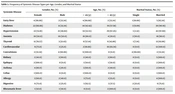
In addition, the frequency of systemic disease types per age, gender, and marital status is outlined in Table 3. Hypertension, diabetes, and thyroid disease had the highest frequency in women (hypertension and diabetes being equal), while hypertension, diabetes, and anemia had the highest frequency in men, in sequence. Furthermore, anemia, hypertension, and diabetes had the highest frequency in those below 45 years (hypertension and diabetes being equal), while hypertension, diabetes, and cardiovascular diseases showed the highest frequency in individuals older than 45. Finally, epilepsy and diabetes had the highest frequency in single individuals, while hypertension and diabetes indicated the highest frequency in married subjects.
Table 3.
Frequency of Systemic Disease Types per Age, Gender, and Marital Status
| Systemic Disease | Gender, No. (%) | Age, No. (%) | Marital Status, No. (%) | |||
|---|---|---|---|---|---|---|
| Female | Male | < 45 (y) | > 45 (y) | Single | Married | |
| Fatty liver | 4 (66.66) | 2 (33.34) | 4 (66.66) | 2 (33.34) | 1 (16.66) | 5 (83.34) |
| Diabetes | 22 (66.66) | 11 (33.34) | 14 (42.42) | 19 (57.58) | 3 (9.09) | 30 (90.91) |
| Hypertension | 22 (51.16) | 21 (48.84) | 14 (32.55) | 29 (67.45) | 1 (2.32) | 42 (97.68) |
| Anemia | 10 (50.0) | 10 (50.0) | 16 (80.0) | 4 (20.0) | 2 (10.0) | 18 (90.0) |
| Thyroid | 11 (78.57) | 3 (21.43) | 8 (57.14) | 6 (42.86) | 1 (7.14) | 13 (92.86) |
| Cardiovascular | 9 (75.0) | 3 (25.0) | 2 (16.66) | 10 (83.34) | 0 (0.0) | 12 (100.0) |
| Convulsions | 2 (33.34) | 4 (66.66) | 6 (100.0) | 0 (0.0) | 4 (66.66) | 2 (33.34) |
| Kidney | 2 (40.0) | 3 (60.0) | 2 (40.0) | 3 (60.0) | 0 (0.0) | 5 (100.0) |
| Epilepsy | 2 (100.0) | 0 (0.0) | 1 (50.0) | 1 (50.0) | 0 (0.0) | 2 (100.0) |
| Asthma | 4 (80.0) | 1 (20.0) | 3 (60.0) | 2 (40.0) | 0 (0.0) | 2 (100.0) |
| Celiac | 1 (100.0) | 0 (0.0) | 1 (100.0) | 0 (0.0) | 0 (0.0) | 1 (100.0) |
| Allergy | 3 (60.0) | 2 (40.0) | 3 (75.0) | 1 (25.0) | 0 (0.0) | 4 (100.0) |
| Digestive | 6 (75.0) | 2 (25.0) | 5 (62.5) | 3 (37.5) | 2 (25.0) | 6 (75.0) |
| Rheumatic fever | 1 (50.0) | 1 (50.0) | 0 (0.0) | 2 (100.0) | 0 (0.0) | 2 (100.0) |
5. Discussion
Systemic diseases can affect organs and tissues of the body (13). Considering the advances in medical science and patient care, many systemic diseases are controllable, and the life expectancy of patients has increased accordingly. Since the number of people suffering from systemic diseases or requiring dental treatment is also growing, attention to systemic diseases and their associated factors is crucial (7, 14).
To find any systemic disease, taking a complete history of patients is necessary. Diagnosis of systemic disease and consumption of drugs, as well as their associated factors in patients referring to dentistry centers, is crucial for dentists, especially at faculties and dental offices. Dentists must evaluate the patient's medical history and current health status before planning dental treatments to prevent complications during and after dental treatment (7). Thus, the present study determined the frequency of systemic diseases in patients referring to the surgery department of Zahedan Faculty of Dentistry in 2021 - 2022.
The present study showed that out of 463 patients referring to the surgery department of the Zahedan Faculty of Dentistry, 127 (27.4%) had systemic diseases, while 336 (72.6%) had no systemic disease.
Rezaei Estabraghi et al. (7) and Taghibakhsh et al. (11) showed that the prevalence of systemic diseases was 42.2% and 41.4% in patients referring to the Faculty of Dentistry of Azad University, Tehran branch, respectively. In addition, Ayazi and Esfehani (4) reported that the frequency of systemic diseases among clients referring to the Qazvin Faculty of Dentistry was 32%. Also, Al-Bayaty et al. (9) in India, Mesgarzadeh et al. (15) in Tehran, and Parirokh et al. (12) in Tehran, Mashhad, and Kerman reported 42%, 41%, and 33.8%, respectively, as the prevalence of systemic diseases in the clients referring to dentistry faculties and private dental offices. In studies by Khader et al. (16) in northern Jordan, Amirchaghmaghi et al. (17) in Mashhad, and Kumar and Rajan (18) in southern India, the frequencies of systemic diseases were reported at 58.6%, 73.3%, and 52.8%, respectively, which are larger than the values reported in the present research. This difference can be due to the different geographical locations and sample sizes across various studies.
In addition, in another study performed by Fernandez-Feijoo et al. (19) in New York, the frequency of systemic diseases across different age groups was 55%, which is higher than the results obtained in the present research. Differences in the geographical coverage and expensiveness of healthcare services in America and lack of suitable insurance coverage may have caused the high frequency of systemic diseases among clients referring to the faculties of dentistry in this country.
In addition, in the present research, the most common underlying conditions among patients reporting systemic disease were hypertension (8.6%), diabetes (6.6%), and anemia (4%), while the lowest frequency with a prevalence smaller than 1% belonged to celiac, epilepsy, and allergy diseases.
In studies by Rezaei Estabraghi et al. (7), Al-Bayaty et al. (9), Mesgarzadeh et al. (15), Kumar and Rajan (18), and Bayat et al. (20), similar to the present study, hypertension and diabetes were reported as the most prevalent conditions. In addition, Taghibakhsh et al. (11) reported hypertension and thyroid disease, Parirokh et al. (12) reported cardiovascular diseases and hypertension, Ayazi and Esfehani (4) reported cardiovascular diseases and digestive disorders, and Khader et al. (16) reported digestive disorders as the most frequent systemic diseases. Based on the present study and the mentioned ones, it can be found that the prevalence of all systemic diseases, especially hypertension and diabetes, has been growing in recent years.
Also, the present study results indicated that the frequency distribution of systemic diseases in patients referring to the surgery department of the faculty of dentistry did not differ significantly in terms of gender and marital status; however, the absence of systemic diseases was significantly higher in those younger than 45 years of age (81.3%) compared to those above 45 (18.8%).
Rezaei Estabraghi et al. (7) showed no significant relationship between gender and systemic diseases, which aligns with the present research. However, in the study by Taghibakhsh et al. (11), a significant relationship was reported between gender and systemic diseases, as well as between marital status and systemic diseases. In addition, Altan et al. (21) reported a significant relationship between systemic diseases and gender, which is not in line with the present study findings. This discrepancy can be attributed to the different sample sizes.
In addition, Taghibakhsh et al. (11), Al-Bayaty et al. (9), and Kumar and Rajan (18) indicated that the prevalence of systemic diseases has grown significantly with age, which aligns with the present study.
In the present research, anemia, hypertension, and diabetes were most frequent at ages under 45, while hypertension, diabetes, and cardiovascular diseases claimed the highest frequency at ages above 45. In the research by Taghibakhsh et al. (11), allergies, digestive disorders, thyroid diseases, hematological diseases, psychological disorders, congenital cardiovascular disease, kidney failure, epilepsy, infectious diseases, and hepatitis among the age range of 25 to 45 years, and hypertension, cardiovascular disease, and diabetes in the age range of 45 - 65 years were the most prevalent diseases. In the research by Khader et al. (16), bleeding and digestive disorders at ages younger than 40 years, while hypertension and diabetes at ages above 40 years had the highest prevalence. In the study by Ayazi and Esfehani (4), allergy and digestive disorders at ages younger than 40, while cardiovascular disease at ages above 40, claimed the highest prevalence. In addition, Nery et al. (22) and Radfar and Suresh (10) indicated that with increased age, the prevalence of psychiatric disorders significantly grows in patients seeking dental and periodontal treatments.
In recent years, medical and dental procedures have been constantly changing and will also be developing in the future. Since the number of patients with systemic diseases who require dental treatments is increasing, dentists should have the necessary preparation to deal with these patients. Taking a complete history and physical examination for each patient is essential to identify the patients who are medically susceptible to disease but are unaware of that. Based on the conditions of each person, some modifications may be needed in the treatment plan of the patient according to their conditions. For example, dental treatments should be dedicated only to emergency conditions within the first six months following acute myocardial infarction. In addition, the prescription of drugs for this group of patients should be done more cautiously to prevent interactions with drugs these patients are taking. Since the dentistry setting is considered a stressful environment for special people, reducing stress in this context during treatment, especially for hypertensive individuals, would be useful (23).
5.1. Conclusions
Based on the present study, the prevalence of systemic diseases in patients referring to the surgery department of Zahedan Faculty of Dentistry was relatively low compared to other studies. Hypertension, diabetes, and anemia had the highest frequency among systemic diseases. Nevertheless, dentists should note that some patients with special medical conditions may have contraindications for using some medical procedures or drugs or may need special care during treatment. Thus, taking a complete history and precise clinical examinations is essential before initiating dental treatment.