
1. Background
Coronary heart disease is a significant global health concern and a leading cause of death worldwide (1). Cardiovascular diseases, including coronary heart disease, account for 17 million deaths annually and are the primary cause of mortality globally. In Iran, cardiovascular diseases are responsible for 39.3% of all deaths, with heart attacks comprising 19.5%, strokes 9.3%, high blood pressure 3.1%, and other cardiovascular diseases accounting for the remainder (2). This disease affects an individual’s physical health and has implications for their social relationships, lifestyle, family environment, employment, and income levels. Coronary heart disease has multifaceted effects on physical, mental, social, and spiritual well-being. Although factors such as high blood pressure, high cholesterol levels, diabetes, and obesity have traditionally been associated with the disease (3), research has shown that they are not causative factors. Recent evidence indicates that psychological factors, such as depression, anxiety, and hostility, play an independent risk factor in the development and occurrence of coronary heart disease. These psychological factors have physiological effects on individuals with the disease (4).
Emotions are crucial in adapting to stress and changes, influencing daily life (5). Emotions are biological reactions that arise in response to significant life challenges and situations, helping individuals coordinate their responses. Despite having a biological foundation, emotion regulation involves controlling one’s emotions and modes of expression (6). Inadequate emotion regulation can lead to the chronic activation of the endocrine and autonomic nervous systems, resulting in physical and mental health issues. Additionally, emotions modulate certain spinal reflexes, where positive emotions can inhibit receptors and reduce pain intensity. Conversely, negative emotions and physical pain symptoms can increase receptor activity and intensity (7).
Expressed or suppressed emotions are significant psychological factors that can influence the occurrence or exacerbation of cardiovascular disease. In particular, the long-term effects of suppressing negative emotions can increase sympathetic activity within the cardiovascular system (8). The impact of cardiovascular disease on a person’s emotional well-being and distress levels is considerable (9). Distress tolerance, which focuses on an individual’s perceived or actual ability to endure unpleasant or hazardous events, is influenced by both automatic (unconscious) and voluntary (conscious) processes. Experiential avoidance, a broader category of adaptive responses aimed at modifying upsetting internal experiences and their triggering circumstances, might encompass distress tolerance as a subtype (10).
Although the general concept of emotional inhibition involves suppressing ongoing emotional experiences, empirical research investigating this hypothesis currently needs to be improved. It is important to note that suppressing an aroused emotional state might or might not be an inherent component of distress tolerance (11). Various psychological interventions have been employed to enhance positive variables and reduce negative variables in patients with coronary heart disease. Researchers in recent decades have emphasized the importance of considering a broader role for psychological therapies in improving the well-being of individuals with coronary heart disease (12). Positive psychology therapy is one therapeutic option explored for this patient population (13).
Happiness is a central concept in positive psychology, as outlined by Rashid and Seligman, and it encompasses three components: Positive emotion (enjoyable life), engagement (attractive life), and meaning (meaningful life). Positive interventions aim to facilitate the cultivation of a pleasant, engaging, and meaningful life according to this perspective (14). Positive psychology represents a relatively recent branch of psychology that shifts the focus from studying abnormal behaviors to exploring human strengths and capabilities. Rather than concentrating on weaknesses and limitations, positive psychology emphasizes happiness, enjoyment, problem-solving, and optimism (15). It is a scientific field investigating factors that enhance individuals’ quality of life. Positive psychology promotes well-being by fostering positive experiences, character strengths, and supportive environments. Negative appraisals, situational fears, and avoidance are typical of psychological difficulties. Therefore, positive interventions can potentially disrupt this cycle and facilitate healing (16).
To summarize, coronary heart disease is a global health concern and a leading cause of death. Psychological factors, such as depression and anxiety, contribute to its development. Emotion regulation and distress tolerance are essential for managing the emotional impact of the disease. Positive psychology interventions aim to enhance well-being by promoting happiness and optimism. These interventions can potentially disrupt negative cycles and improve individuals’ quality of life.
2. Objectives
This study sought to ascertain the effectiveness of positive therapy in emotional regulation and distress tolerance in patients with coronary heart disease because psychological issues contribute to performance issues in patients with coronary heart disease.
3. Methods
The present study used quasi-experimental designs of pre-test and post-test followed up with a control group. The statistical population of this study included all individuals with coronary heart disease who were referred to Shahid Beheshti Hospital in Nowshahr, Mazandardan, in 2023. The samples of this study consisted of 45 patients with coronary heart disease who were chosen using available sampling methods. The inclusion criteria were being at least 30 years old, having a minimum educational level of high school diploma or equivalent, not receiving any psychotherapeutic treatments since the diagnosis of coronary heart disease, and not having severe medical conditions, such as epilepsy, musculoskeletal disorders, or respiratory impairments that could hinder their ability to tolerate long therapy sessions. Furthermore, participants who were absent for more than two therapy sessions were considered ineligible and excluded from the program.
3.1. Emotion Regulation Questionnaire
In 2001, Garnefski et al. (17) developed this survey. Separate versions of this multidimensional questionnaire and self-report instrument for adults and children have a total of 36 items. The reliability and validity of this questionnaire have been reported to be high by Garnefski et al. Each of the nine factors-self-blame, acceptance, rumination, positive refocusing, refocusing on planning, evaluating positive reappraisal, perspective taking, catastrophizing, and blaming others—are evaluated on a five-point scale (always or never) in 4 questions. The Persian translation of this scale has been confirmed to be accurate by Samani and Sadeghi (18). Using Cronbach’s alpha, it was observed that the negative emotion regulation methods subscale had a reliability coefficient of 0.78, the positive emotion regulation strategies subscale had a reliability coefficient of 0.83, and the total scale had a reliability coefficient of 0.81. According to the literature, the reliability of the scale is 0.75. In addition, the validity and reliability of the scale of cognitive techniques of emotion regulation are adequate and meet the requirements for application in Iranian society. Cronbach’s alpha, used in this study, indicated that this questionnaire was reliable (α = 0.83).
3.2. Distress Tolerance Questionnaire
This scale was created by Simons and Gaher as a self-assessment of emotional distress tolerance (19). This distress tolerance scale assesses an individual’s ability to tolerate emotional distress, mental assessment of distress, attention to negative emotions when they occur, and regulatory measures to alleviate distress. This scale consists of 15 items and four subscales: Emotional distress tolerance items (1, 3, 5), being absorbed by negative emotions items (2, 4, 15), mental estimation of distress items (6, 7, 9-11), and regulating efforts to relieve distress items (8, 13, 14). A 5-point Likert scale is used to score each item on this scale (1: Completely agree; 2: Slightly agree; 3: Neither agree nor disagree; 4: Slightly disagree; 5: Completely disagree). The validity coefficient of the scale is reported as 0.85. Furthermore, suitable for usage in Iranian culture, the scale of cognitive techniques for emotion regulation has the right validity and reliability. The reliability of this questionnaire was determined in the current study using Cronbach’s alpha, which was 0.79. High scores on this scale signify a high tolerance for distress. After 6 months, the intraclass correlation coefficient was 0.61%, and Cronbach’s alpha coefficients for these subscales were 0.72, 0.82, 0.78, 0.70, and 0.82 for the entire scale. Cronbach’s alpha coefficient was reported as 0.86 and 0.67, respectively, in the study conducted by Alavi et al. in 2011 (20) (Table 1).
Table 1.
Positive Therapy Sessions Based on the Model of Rashid and Seligman (2013)
| Sessions | The Title of the Session | The Content of the Session | Homework | Session Time (min) |
|---|---|---|---|---|
| First | Introduction and acquaintance | Establishing and fostering initial communication, introducing group members to one another and the consultant, outlining research objectives and working methods, grouping and scheduling meeting times, outlining meeting rules and principles, stressing the value of adhering to them while participating actively in discussions and completing assignments, providing explanations during training sessions, learning about the idea of positive thinking and having a positive outlook, and pre-test implementation | - | 60 |
| Second | Recognizing one’s assets and becoming conscious of the advantages of positivity | Finding one’s talents, deciding on life objectives and the course of desires, looking at strategies to go toward one’s desires and goals, looking at the key elements of a healthy life, understanding the advantages of positivity, and developing positive beliefs are all important life skills. | Take note of his/her attributes and what others have said about him/her. | 60 |
| Third | Optimism skill training | Examining the assignment of the second session, teaching the skill of optimism, and evaluating spontaneous thoughts | Take note of the positive traits that individuals have mentioned about you. Make a list of your unplanned thoughts. | 60 |
| Fourth | Learning to have a positive view of others | Examining the assignment of the previous session (a form of strengths from the point of view of others and transferring them from the second and third columns to the first column) | Take note of the abilities of 10 family members, relatives, friends, and coworkers. | 60 |
| Fifth | Telling at least 10 to 15 good experiences and memories | Note at least 10 to 15 good experiences and memories and recount them to the group members, listen to the good experiences of the group members, and extract the positive characteristics. | Completing 10 to 15 good experiences and memories with family members at home. | 60 |
| Sixth | Examining the strengths of memories | Examining the strengths of memories, how to react when receiving feedback from others, teaching to change words positively, and increasing positive self-talk | Make a list of your own replacement words. | 60 |
| Seventh | Providing valid evidence and criteria | Prioritizing one’s strengths and capabilities and presenting valid evidence and criteria | Summarizing all the positive features that they have found in themselves and using their reliable strengths in solving problems and issues | 60 |
| Eighth | Conclusion | Making a final summary, getting feedback from members, and saying positive sentences by them, implementing post-test, conducting the survey | - | 60 |
3.3. Procedure
This study adhered to ethical principles by ensuring the voluntary participation of the individuals involved. Before the commencement of the project, the participants were fully informed about the study’s purpose, procedures, and guidelines. Their attitudes and opinions were respected throughout the research process. The participants had the freedom to withdraw from the study at any point without consequence. Additionally, the participants in the control group were allowed to receive the same intervention provided to the experimental group in similar treatment sessions after the completion of the project, should they express interest. Access to all confidential documents, questionnaires, and records was limited to authorized personnel only. Written informed consent was obtained from all volunteers, indicating their willingness to participate. Descriptive data analysis was conducted to calculate the statistical indices for each research variable. Inferential statistics, specifically analysis of variance with repeated measurements, were performed using SPSS software (version 22) for statistical analysis.
4. Results
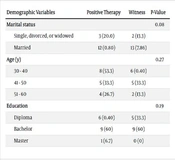
For each of the variables examined in this study, the frequency and percentage are shown in the Tables 2 and 3, along with statistical markers, such as mean, standard deviation, and the number of sample subjects.
Table 2.
Distribution by Frequency and Comparison of the Demographics of Research Units
| Demographic Variables | Positive Therapy | Witness | P-Value |
|---|---|---|---|
| Marital status | 0.08 | ||
| Single, divorced, or widowed | 3 (20.0) | 2 (13.3) | |
| Married | 12 (0.80) | 13 (7.86) | |
| Age (y) | 0.27 | ||
| 30 - 40 | 8 (53.3) | 6 (0.40) | |
| 41 - 50 | 5 (33.3) | 5 (33.3) | |
| 51 - 60 | 4 (26.7) | 2 (13.3) | |
| Education | 0.19 | ||
| Diploma | 6 (0.40) | 5 (33.3) | |
| Bachelor | 9 (60) | 9 (60) | |
| Master | 1 (6.7) | 0 (0) |
Table 3.
Mean and Standard Deviation of Research Variables in Two Experimental and Control Groups a
| Variables | Pre-test | Post-test | Follow-up |
|---|---|---|---|
| Tolerating emotional distress | |||
| Experimental | 5.66 ± 0.76 | 11.44 ± 0.70 | 11.72 ± 1.01 |
| Control | 5.33 ± 0.84 | 5.50 ± 0.78 | 5.66 ± 0.76 |
| Being attracted by negative emotions | |||
| Experimental | 5.94 ± 0.72 | 11.44 ± 0.70 | 11.83 ± 1.20 |
| Control | 4.88 ± 0.83 | 5.11 ± 0.67 | 5.50 ± 0.51 |
| Subjective assessment of distress | |||
| Experimental | 7.00 ± 0.84 | 13.05 ± 0.80 | 12.38 ± 0.77 |
| Control | 6.61 ± 0.77 | 6.38 ± 0.77 | 6.05 ± 0.53 |
| Adjust distress relief efforts | |||
| Experimental | 5.33 ± 0.68 | 11.50 ± 1.15 | 11.72 ± 1.01 |
| Control | 5.33 ± 0.59 | 5.44 ± 0.51 | 5.72 ± 0.46 |
| Blood pressure | |||
| Experimental | 16.44 ± 1.75 | 12.66 ± 1.97 | 12.38 ± 1.78 |
| Control | 15.88 ± 2.11 | 15.38 ± 1.97 | 15.44 ± 1.97 |
| Excitement regulation | |||
| Experimental | 30.27 ± 8.10 | 46.88 ± 11.60 | 45.72 ± 11.70 |
| Control | 35.44 ± 8.20 | 35.61 ± 8.11 | 36.20 ± 12.78 |
a Values are expressed as mean ± SD.
The Kolmogorov-Smirnov results for the research variables demonstrated that the amount of research variables was not significant at the level of 0.05, according to the obtained z. As a result, the distribution of data relevant to the study hypotheses was normal, and the assumption of data normality was met. Before analyzing variance with repeated measurements, the results of the M-Box, Mauchly’s sphericity, and Levene’s tests were examined to ensure that the assumptions were met. To ensure that the assumptions were met, the results of the M-Box, Mauchly’s sphericity, and Levene’s tests were evaluated before completing the repeated measure analysis of variance. The criteria of homogeneity of the variance-covariance matrices were met because the M-box test was not significant for any of the research variables. Additionally, the non-significance of any of the variables in Levene’s test showed that the condition of equality of variances between groups was met, and the amount of error variance of the dependent variable was equal in all groups. Finally, the examination of the results of Mauchly’s sphericity test showed that this test was also significant for the emotion regulation variable. Therefore, the assumption of the equality of variances within subjects (assumption of sphericity) was not met (Mauchly’s W = 0.63; df = 2; P > 0.0001).
Therefore, the Greenhouse-Geisser test was used to check the results of the univariate test for intragroup effects and interaction effects. The significance levels of all the tests were set at the 0.0001 level, indicating that there was a significant difference in the mean of the tests in terms of the effectiveness of positive therapy in improving emotion regulation in the two experimental and control groups. It should be mentioned that the Wilks’ lambda test with a value equal to 0.09 and the F = 132.67 test showed a significant difference between the scores of positive therapy effectiveness in improving emotion regulation and distress tolerance in the two experimental and control groups at a significance level of 0.0001.
Table 4 shows that the analysis of variance for the within-group factor (time) differs between groups. These findings indicated that the influence of time and group was considerable. The interaction of group and time was also significant (F = 111.36, df = 1.46), and its effect was 0.79. As a result, the fourth hypothesis was confirmed. Bonferroni’s post hoc test was also used for pairwise comparison of groups.
Table 4.
Using Variance Analysis with Repeated Measurements to Examine Emotion Regulation and Distress Tolerance at Pre-test, Post-test, and Follow-up
| Scale and the Source of Change | SS | MS | df | F | P-Value | Eta |
|---|---|---|---|---|---|---|
| Excitement regulation | ||||||
| Time | 67.28 | 46.46 | 1.46 | 160.63 | 0.001 | 0.85 |
| Time*group | 47.02 | 32.21 | 1.46 | 111.36 | 0.001 | 0.79 |
| Group | 94.46 | 94.46 | 1 | 99.15 | 0.001 | 0.19 |
| Tolerating emotional distress | ||||||
| Time | 185.08 | 133.96 | 1.38 | 124.71 | 0.001 | 0.81 |
| Time*group | 106.02 | 76.73 | 1.38 | 71.43 | 0.001 | 0.71 |
| Group | 51.26 | 51.26 | 1 | 87.50 | 0.022 | 0.17 |
| Being attracted by negative emotions | ||||||
| Time | 446.06 | 75.32 | 1.35 | 155.08 | 0.001 | 0.84 |
| Time*group | 356.06 | 22.26 | 1.35 | 123.79 | 0.001 | 0.81 |
| Group | 60.29 | 60.29 | 1 | 38.30 | 0.070 | 0.10 |
| Subjective assessment of distress | ||||||
| Time | 67.28 | 46.46 | 1.46 | 160.63 | 0.001 | 0.85 |
| Time*group | 47.02 | 32.21 | 1.46 | 111.36 | 0.001 | 0.79 |
| Group | 94.46 | 94.46 | 1 | 99.90 | 0.004 | 0.26 |
| Adjust efforts to relieve distress | ||||||
| Time | 230.46 | 160.14 | 1.43 | 79.16 | 0.001 | 0.73 |
| Time*group | 150.02 | 104.24 | 1.43 | 51.53 | 0.001 | 0.64 |
| Group | 17.41 | 17.41 | 1 | 86.18 | 0.001 | 0.29 |
The results shown in Table 5 reveal that the experimental group, which received positive therapy, demonstrated higher scores in psychological distress tolerance during the post-test phase than the control group. This finding indicates that positive therapy had a significant impact on increasing the participants’ ability to tolerate psychological distress. However, it should be noted that there was no significant increase in psychological distress tolerance during the follow-up phase in the positive therapy group when compared to the control group. Moreover, the variable score for emotion regulation in the experimental group during the post-test phase was higher than that of the control group, suggesting that positive therapy had a positive effect on improving emotion regulation. However, similar to psychological distress tolerance, there was no significant increase in emotion regulation during the follow-up phase in the positive therapy group, compared to the control group.
Table 5.
Bonferroni’s Post Hoc Test Results to Compare Emotion Adjustment and Distress
| Variables | Group | Levels | Post-test | Follow-up |
|---|---|---|---|---|
| Excitement regulation | Positive therapy | Pre-test | -5.74 a | -6.07 a |
| Post-test | - | -0.33 | ||
| Control group | Pre-test | 0.09 | 0.11 | |
| Post-test | - | 0.07 | ||
| Tolerating emotional distress | Positive therapy | Pre-test | -7.66 a | -6.40 a |
| Post-test | - | 1.22 | ||
| Control group | Pre-test | -0.67 | -0.09 | |
| Post-test | - | -0.76 | ||
| Being attracted by negative emotions | Positive therapy | Pre-test | -6.35 a | -6.10 a |
| Post-test | - | 0.25 | ||
| Control group | Pre-test | 0.43 | 0.50 | |
| Post-test | - | -0.14 | ||
| Subjective assessment of distress | Positive therapy | Pre-test | -6.92 a | 4.65 a |
| Post-test | - | 2.27 | ||
| Control group | Pre-test | -0.16 | -0.30 | |
| Post-test | - | -0.14 | ||
| Adjust distress relief efforts | Positive therapy | Pre-test | -6.22 a | -5.16 a |
| Post-test | - | 1.06 | ||
| Control group | Pre-test | -0.24 | -0.41 | |
| Post-test | - | -0.17 |
a P < 0.05.
The data presented in the table represent the results of the follow-up post-tests conducted for both the positive therapy group and the control group. In summary, the findings suggest that positive therapy had immediate benefits for enhancing psychological distress tolerance and emotion regulation. However, further research and longer follow-up periods are necessary to fully comprehend the sustained effects of positive therapy on these variables.
5. Discussion
This study aimed to evaluate the impact of positive therapy on coronary heart disease patients’ ability to manage their emotions and tolerate distress. The results showed that positive therapy has a meaningful impact on individuals with coronary heart disease’s ability to control their emotions and tolerate stress. The findings of this study are in line with the findings of studies by Anuri and Sardari (21), and Sapiña-Beltrán et al. (22) among others.
The use of positive-oriented psychotherapy consequently increased the average of positive strategies. It decreased the average emotional regulation in individuals with coronary heart disease in the experimental group, compared to the control group. These changes persisted in the follow-up phase, thereby bringing psychological benefits. Individuals with coronary heart disease and anxiety symptoms benefit from positive therapy to better their ability to regulate their emotions. In this sense, positivist psychology aims to increase human performance to its maximum, and by testing emotions, it achieves this goal (23). In the positive psychotherapy program, one of the most important goals is to help improve and increase individuals’ satisfaction with life, happiness, and well-being. Based on this approach, increasing capabilities, positive emotions, commitment, and meaning makes life happier and more prosperous and reduces emotional problems (24).
Positive thinking is a form of thinking that habitually seeks to get the best result from the worst situation. How individuals think about the event determines how they deal with it. Positive thinking is a way of thinking that enables a person to properly understand his/her and others’ behaviors, attitudes, feelings, interests, and talents and, by maintaining calmness and coolness, to make the best and wisest decision (25). To explain this finding, we can refer to the effect and function of positive emotions (26). Generating positive emotions in individuals, a key practice and premise of positive psychology, aims to counteract the impact of negative emotions, foster and enhance personal resources, boost psychological resilience, and promote physical well-being. It leads to psychological well-being and establishes the essential foundation for human development. Based on this approach, increasing capabilities, positive emotions, commitment, and meaning makes life happier and more prosperous and reduces emotional problems (27).
In addition, using negative strategies of cognitive emotion regulation might lead to an increase in anxiety symptoms in students by reducing positive emotions and even increasing negative emotions through ineffective strategies, such as self-blame. As has been emphasized in previous studies, the high use of negative strategies, such as mental rumination, catastrophic thinking, and blaming one and others, are associated with a high level of adverse emotional reactions, such as depression, anxiety, and stress. These strategies cause the intensification and continuation of adverse emotional reactions and cause the sufferers to face the problem with confusion and anxiety instead of an appropriate response, which harms their health (28). Therefore, positive psychology, which focuses on strengths and positive emotions, not only gives individuals the tools to reach the desired level of well-being, regardless of their circumstances, but it also enables patients to understand how to overcome problems in the best way by using hope, optimism, flexibility, interest, wisdom, and altruism, which leads to the reduction of negative strategies of cognitive emotion regulation (29, 30).
Furthermore, it was observed that positive psychological intervention had a more significant impact on individuals’ commitment and responsibility than self-compassion intervention (31). Positive psychology enhances individuals’ strengths, reinforcing commitment and responsibility. On the other hand, compassion intervention emphasizes developing affection, love, and understanding of one’s pain and suffering, recognizing them as inherent aspects of the human condition. The findings obtained from the participants with coronary heart disease indicated that the positive intervention positively influenced their sense of responsibility and commitment (32, 33).
Among the limitations of the current study, the following can be mentioned:
This study was conducted only on the population of patients with coronary heart disease at Shahid Beheshti hospital in Nowshahr, and caution should be exercised in generalizing the results to other regions and cities. The level of honesty of the respondents to the questions of the questionnaires is one of the uncontrollable limitations. The test conditions might have affected the subjects due to multiple answers to a questionnaire (pre-test and post-test). As a result, their accuracy in answering has decreased. Further research should be conducted in a wider geographical area to become more confident about the generalization of the results. Considering that this study was conducted on a community of individuals suffering from coronary heart disease, it is also suggested to be conducted in other communities. In future research, other treatment approaches should be used in comparison to this method to make it possible to compare the effectiveness of positive treatment to other approaches. In future research, the samples’ class and social base should be considered an intervening variable in the effectiveness of positive treatment. According to the present research findings, it is possible to recommend mental health professionals and individuals active in the field of health design and apply appropriate methods inspired by the positive treatment of the mental health of coronary patients. Considering the effect of positive treatment on emotion regulation, blood pressure reduction, and stress tolerance in individuals with coronary heart disease, it is suggested that psychologists use positive treatment widely in groups.
Overall, this study highlights the impact of positive therapy on emotion regulation and distress tolerance in individuals with coronary heart disease. These results indicated that positive therapy significantly improved emotion regulation, distress tolerance, and blood pressure in patients with coronary heart disease. The positive therapy group consistently exhibited better scores in these variables than the control group, suggesting the effectiveness of positive therapy in improving psychological and physiological well-being. The findings align with previous research, emphasizing the benefits of positive-oriented interventions for enhancing well-being and reducing emotional difficulties. Positive psychology interventions promoted positive emotions, resilience, and personal growth while reducing the use of negative cognitive emotion regulation strategies.